
Facades, Fixtures, Furniture: Matching Powder Coating to Construction Projects
Facades, Fixtures, Furniture: Matching Powder Coating to Construction Projects
Short answer: in construction and decoration, the finish should be chosen from the exposure of the element, not from the resin name on the bag. Aluminum-profile polyester systems serve doors, windows, glass curtain walls, sunrooms and architectural partitions; pure epoxy anti-corrosion systems serve heavy-duty industrial exposure, pipelines and electrical insulation; wrinkle, matt and other textured polyester systems serve fixtures, hardware, machinery housings and electrical cabinets; hybrid and TGIC-free systems serve furniture, appliance and interior component work. What follows is how to check that mapping against documented test data rather than against a finish name.
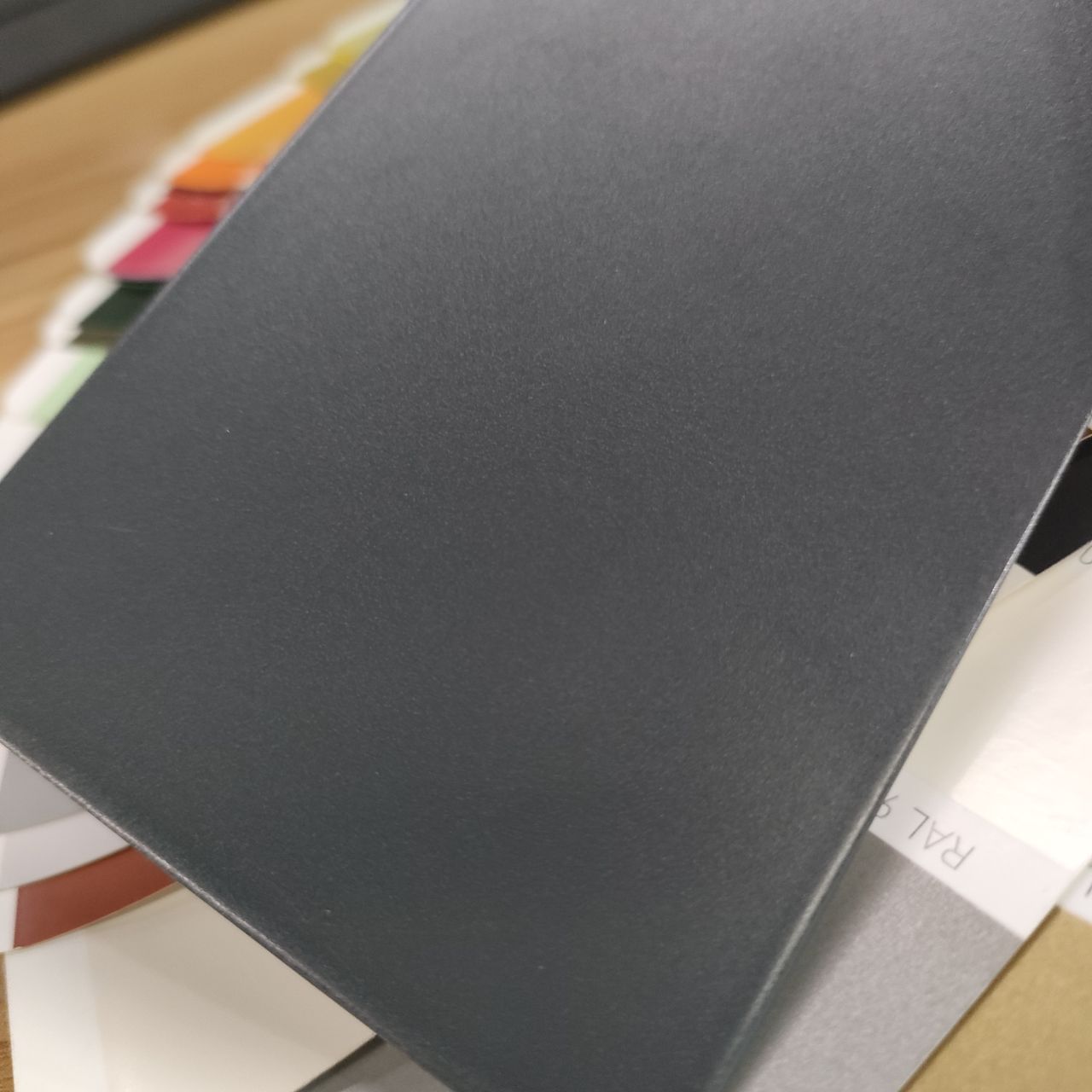
Aluminum-profile powder coating is the default family for facade, window and partition work. Image: Hsinda.
Why exposure, substrate and curing window decide the finish
Three variables do most of the sorting. The first is exposure: a curtain wall sees ultraviolet light, rain and temperature cycling, a valve body sees chemical contact, and a filing cabinet sees abrasion, cleaning agents and close visual inspection. The second is substrate and pre-treatment. Aluminum profiles, steel fabrications, castings and galvanized parts reach the line in different conditions, and the same powder on two substrates is not the same specification. The third is the curing window.
Every Hsinda product datasheet in this set specifies 180–200 °C for 10–15 minutes, with a nominal film thickness of 70 μm and coverage of 8–10 m² per kg at 30–90 μm. Those shared numbers define what a coating line can accept, not only what a buyer can order. A heavy welded assembly and a thin decorative panel do not heat at the same rate, so the oven and the part geometry become part of finish selection. Where a part or an assembled unit cannot take a full cure, the practical route is a documented low-temperature-curing variant rather than an under-cured standard product; Hsinda lists low-temperature curing among its customization performance options and against the type description of its hybrid system, and any such window should be confirmed in writing for the exact product.
Application method belongs to the same decision. The datasheets specify a tribo or electrostatic spray gun and an average particle size of 32–42 μm across the range, which is the input a coater needs when setting gun parameters, reclaim and film build.
What the shared test block does and does not prove
The Hsinda datasheets repeat one test block across the range, which makes them comparable at the level of method even where the values differ. That block is worth reading line by line before any finish is scheduled.
| Test (method) | Documented value | How a buyer should read it |
|---|---|---|
| Adhesion (ISO 2409:2020) | Grade 0 | Top classification on this cross-cut scale for the tested film; confirm it applies to your substrate and pre-treatment. |
| Impact (ISO 6272-1:2017) | 50 kg/cm on most datasheets; 2.5 Nm on the aluminum-profile datasheet | Resistance to deformation damage in handling and installation; the two entries are not directly convertible. |
| Bending (ISO 1519:2002) | ≤2 mm; ≤5 mm on the aluminum-profile datasheet | Formability where coated sheet or profile is bent after coating. |
| Cupping (ISO 1520:2006) | ≥6 mm; ≥5 mm on the aluminum-profile datasheet | Tolerance to deep deformation before film failure. |
| Hardness (ISO 15184:2020) | ≥H | Pencil hardness; a baseline for abrasion-prone fixtures. |
| Salt spray (ISO 7253:1996) | 500 h, film unchanged, unilateral cross-section corrosion ≤2 mm; 1,000 h on the aluminum-profile datasheet | Corrosion ranking under a defined laboratory method, not a service life. |
| Damp heat (GB/T1740-2007) | 1,000 h, slight gloss loss, ≤ level 1 | Humidity tolerance for enclosed or humid service. |
| Weathering (ISO 11341:2004) | 500 h under a 340 lamp, no powdering, gloss retention >50%; 1,000 h on the aluminum-profile datasheet | Appearance retention under accelerated UV, not a warranty period. |
Two cautions keep this block honest. Salt-spray hours are a laboratory ranking: 500 hours under ISO 7253:1996 does not convert into a fixed number of years on a building. And the aluminum-profile datasheet reports impact as 2.5 Nm against ISO 6272-1:2017 while most other sheets in the range report 50 kg/cm against the same method, so the two should not be converted into one another without the underlying test conditions. Buyers comparing those sheets should ask for the report rather than quote the headline.
Facades and building envelopes: aluminum-profile polyester systems
The building envelope is where appearance retention is tested hardest, and it is the clearest case for a dedicated aluminum-profile system. Hsinda's aluminum powder coating is a polyester formulation built on a super weather-resistant polyester resin with a TGIC curing agent, supplied in custom RAL and Pantone colours, and positioned in its datasheet for aluminum profiles, doors and windows, glass curtain walls, sunrooms and architectural partitions, with secondary use for transport and municipal elements such as guardrails, bus shelters and signage.
Its documented performance is the strongest weather package in the range: 1,000 hours of salt spray under ISO 7253:1996 with the film unchanged and unilateral corrosion at the cross-section limited to 2 mm; 1,000 hours under a 340 lamp in ISO 11341:2004 with no powdering and gloss retention above 50%; and one year of natural exposure in Florida with gloss retention above 50%. Adhesion is grade 0 under ISO 2409:2020, hardness is H or above under ISO 15184:2020, bending is 5 mm or less under ISO 1519:2002 and cupping is 5 mm or more under ISO 1520:2006 — the last two being what a fabricator needs when coated material is formed after coating.
Gloss is a specification variable rather than a fixed property: the range runs from 5% to 95% on ISO 2813:2014, and Hsinda's customization classification treats above 80% as high gloss, 40–79% as semi-gloss and 5–39% as matt. Metallic and pearlescent effects are available through a bonding system where a decorative profile needs one, which adds application control but not corrosion performance.
A product name is not an approval. Qualicoat and AAMA appear in the aluminum product's type line as the framework it is positioned against, so a project should receive the current certificate or test report for the specific colour and gloss being ordered. Approval is normally attached to a system, a plant and a film build, and a buyer who asks for that document in the RFQ stage avoids the more expensive conversation later.
Heavy-duty exposure: when pure epoxy carries the specification
Where the threat is chemical rather than decorative, the chemistry changes. Hsinda's anti-corrosion powder coating is a pure epoxy system, and its datasheet targets oil and gas pipelines, water supply systems, valves and steel reinforcement bars, alongside insulation duties such as busbars, switchgear, transformers, electric-vehicle battery components and motor hairpin stators, and heavy mechanical parts such as pump bodies and gearboxes. Documented values include 500 hours of salt spray under ISO 7253:1996, grade 0 adhesion, impact of 50 kg/cm, bending of 2 mm or less, cupping of 6 mm or more, hardness of H or above, and 1,000 hours of damp heat under GB/T1740-2007 with only slight gloss loss. The chemical-resistance line states good resistance to general acids and oils with average alkali resistance.
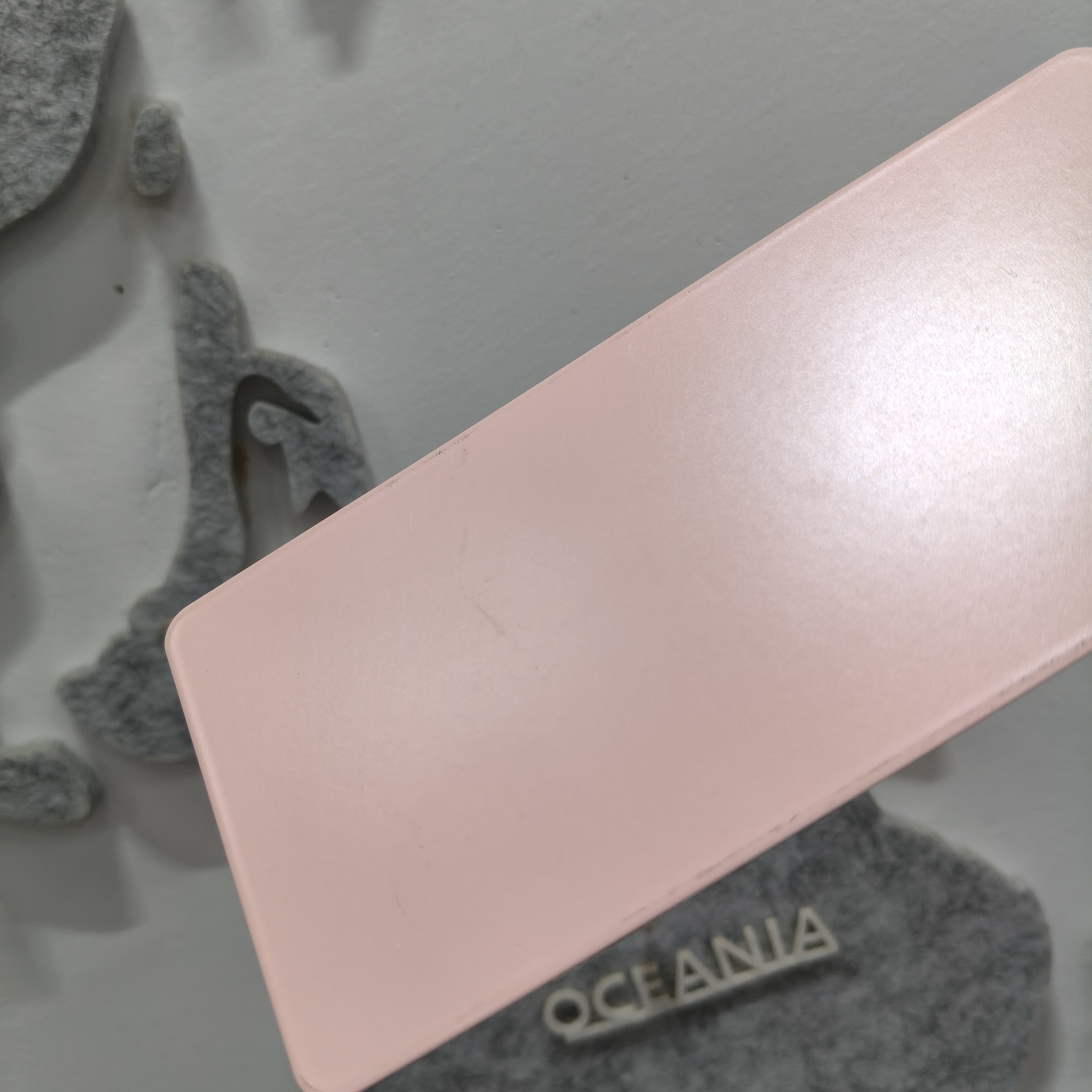
Pure epoxy anti-corrosion systems cover pipelines, valves, rebar and electrical insulation duties. Image: Hsinda.
The trade-off is established coating practice rather than a quirk of one supplier: epoxy chemistries are chosen for chemical resistance, adhesion and insulation, while polyester chemistries are chosen for exterior colour and gloss retention. That makes epoxy a weak first choice for a visible exterior face that must hold colour, and polyester facade systems a weak first choice for continuous chemical immersion. Where a project has both — a coated steel frame with an exposed architectural face — the honest answer is usually two specifications rather than one compromised one.
Fixtures, hardware and electrical assemblies
Fixtures are where texture earns its place. Hsinda's wrinkle powder coating is a polyester system whose datasheet lists machine tools, motor housings, instruments, sewing machines, distribution boxes, electrical cabinets, appliance housings, aluminum profiles, zinc-steel railings and hand tools. Two properties connect: the wrinkled surface covers casting and substrate defects, and the texture gives a grip surface on tools. The same test block applies — 500 hours of salt spray, grade 0 adhesion, 50 kg/cm impact, hardness H or above, and gloss adjustable within the 5%–95% range.
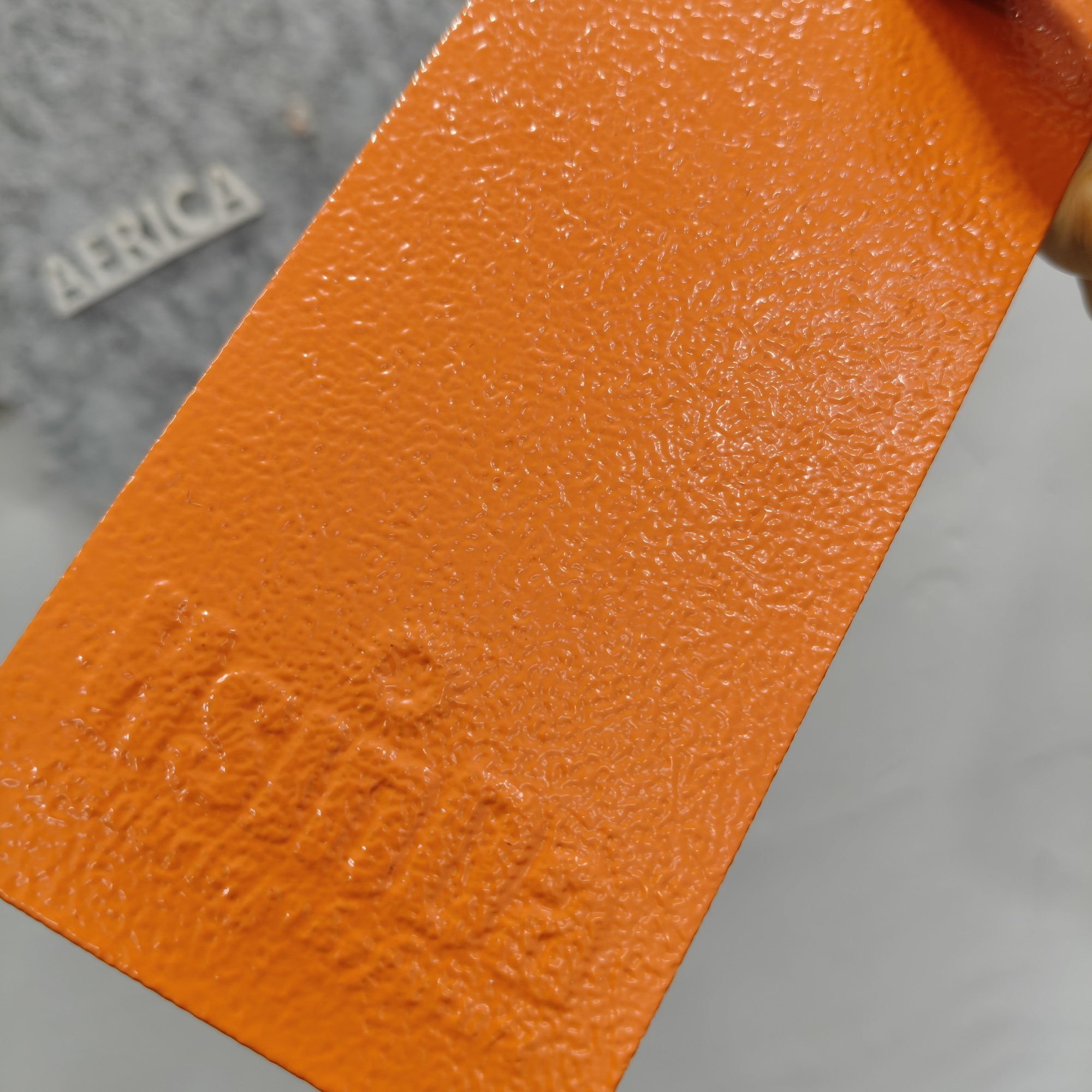
Wrinkle texture covers substrate defects and suits cabinets, machine housings and tools. Image: Hsinda.
Matt systems solve a different fixture problem. The matt datasheet is aimed at appliance housings, radiators and electric heating equipment, computer casings and stands, indoor and outdoor lighting where glare should be reduced, and automotive interior parts; its stated benefit is that a low-gloss surface shows scratches and fingerprints less than a high-gloss one. That is an appearance argument and should be weighed as one, because a low-gloss film still has to meet the same adhesion and corrosion results as any other finish.
Electrical assemblies add insulation to appearance. The epoxy datasheet covers busbars, switchgear, transformers and motor components, and the electrical-enclosure case in Hsinda's records — 40 tons supplied over a 10-year relationship across Mexico, Paraguay, Sri Lanka, Russia and China — lists corrosion resistance, insulating or static-conductive performance and appearance as the combined result. Where an enclosure is both visible and functional, the specification has to carry both clauses: a decorative powder chosen for colour alone will not answer the insulation question, and an insulation-grade epoxy chosen alone will not answer the colour-match question.
Hammer tone belongs to the same texture family. Hsinda's customization menu lists hammered finishes alongside wrinkled, sandblasted, stone-like and metallic effects. Because texture depth and gloss vary by product, the texture name is a starting point rather than a specification; the approved sample and the gloss value do the real work.
Furniture and interior components: hybrid, TGIC-free and low-gloss options
Furniture and interior components rarely face sustained ultraviolet light, but they face abrasion, cleaning chemicals and close inspection. The hybrid epoxy-polyester system is the indoor workhorse in this set: its datasheet lists office and residential furniture, shelving, lockers, filing cabinets, appliance housings, automotive interior parts and instrument and electronic housings, with 500 hours of salt spray, grade 0 adhesion and 50 kg/cm impact. Its type line also carries the descriptors VOC-free, MDF and low-temperature curing, which is the direction to explore when a substrate or an assembled part cannot take a full 180–200 °C cycle; that process window should be confirmed for the exact product rather than inferred from the descriptor.
TGIC-free chemistry is a specification decision with a compliance driver. Hsinda's TGIC-free powder is an HAA-cured polyester, listed for appliance housings and internal components, office and residential furniture, automotive interior and engine-bay parts, and instrument and electronic housings including heat sinks, computer cases and printers, with the same 500-hour salt spray, grade 0 adhesion and H-or-above hardness. Where a finish schedule is written around REACH obligations, the curing-agent chemistry belongs on the specification line rather than in a footnote.
Two recorded programmes show how the indoor logic behaves at volume. A shelving manufacturer in Colombia has taken 100 tons over 10 years under an epoxy-polyester electrostatic process, reporting zero VOC emissions, RAL-matched colours across gloss levels, and impact resistance more than three times that of traditional liquid paint. A hardware tool programme in Mexico and the United States has taken 1,000 tons over five years for shovels, wheelbarrows, post-hole diggers and wrenches, with the reported result being rust and abrasion resistance in outdoor working conditions. Both are supplier-recorded customer programmes rather than independent measurements; their value is that they show which questions to ask — colour range, gloss band, impact method and chemical exposure — not that they prove an outcome for a different project.
Matching project element to system: a working table
| Project element | System family | Verified anchors to quote |
|---|---|---|
| Curtain walls, windows, doors, sunrooms, partitions | Aluminum-profile polyester (TGIC) | 1,000 h salt spray; 1,000 h weathering with >50% gloss retention; 1 year Florida exposure >50%; grade 0 adhesion |
| Pipelines, valves, rebar, chemical exposure | Pure epoxy anti-corrosion | 500 h salt spray; good acid and oil resistance, average alkali; grade 0 adhesion; 50 kg/cm impact |
| Switchgear, busbars, transformer and EV components | Pure epoxy (insulation) | 500 h salt spray; 1,000 h damp heat; grade 0 adhesion |
| Cabinets, distribution boxes, machine housings, tools | Wrinkle polyester | 500 h salt spray; defect-covering texture; gloss 5–95% |
| Appliance housings, lighting, computer casings | Matt and low-gloss systems | Reduced visible glare and fingerprints; 500 h salt spray; grade 0 adhesion |
| Office furniture, lockers, shelving, indoor enclosures | Hybrid epoxy-polyester; TGIC-free HAA | 500 h salt spray; grade 0 adhesion; 50 kg/cm impact |
| Decorative profiles with metallic effect | Metallic bonding polyester | 500 h salt spray; 50 kg/cm impact; custom RAL and Pantone colour |
Powder versus liquid coatings: where the comparison is valid
A fair comparison with liquid paint has to stay inside what is documented. The shelving programme above reports zero VOC emissions for the powder process, which is a property of the technology as used in that programme rather than a unique claim for one supplier. The same programme reports impact resistance more than three times that of traditional liquid paint, a single programme result that should be read as a reason to request a comparative test, not as a transferred guarantee. What is structural rather than anecdotal is the process difference: powder forms a dry film at 180–200 °C for 10–15 minutes at a nominal 70 μm, which requires an oven, a racking plan and a part that can take the heat, while liquid systems avoid that constraint but carry solvent handling instead.
Coverage is where the two meet on cost. The datasheets state 8–10 m² per kg at 30–90 μm, so a buyer can convert an area take-off into powder kilograms before negotiating and can test whether a quoted price is consistent with the film thickness specified.
Procurement checks that follow the finish decision
Once the system family is fixed, the remaining risk sits in supply terms and evidence. Hsinda (Chengdu Hsinda Polymer Materials Co., Ltd), founded in 2015, operates a 10,000 m² plant with 45 employees, an 11-person research and development team and annual output of about 5,000 tons from eight production lines and three sample lines. It exports about 70% of output to more than 70 countries, including the United States, Canada, Mexico, South America, the Middle East and Central Asia, and its published profile lists Changhong, Xiaomi Appliances, TCL and Hitachi Elevator among domestic customers, with distributor relationships in Russia, Bangladesh, Poland, Portugal, the United States, Canada, Sri Lanka, Bolivia and Argentina and exclusive distributors in Kazakhstan, Uzbekistan and Chile.
Commercial terms differ by route. The ODM route lists a 300 kg minimum order, a 15–20 day lead time and 400 tons of monthly capacity. The OEM route lists carton, sample-card and logo customization with a 6-ton minimum order and a 20-day lead time. Both routes state 100% testing and 24-hour online service with technical support.
Beyond those terms, the audit list should carry the test report behind each quoted number, the gloss and colour standard agreed for the batch, the pre-treatment line used for the specific substrate, a retained approved sample, and the reorder window measured against the installation programme. Hsinda's factory holds ISO 9001 and ISO 14001 certification and its coatings have been tested under RoHS, REACH, SGS and AAMA regimes according to the company's published profile; those statements are company-reported and should be checked against current certificates for the project rather than accepted from a product page.
Market direction and a conditional outlook
Directional market data supports the construction and decoration focus without proving demand for any single finish. Fortune Business Insights valued the global powder coatings market at USD 16.12 billion in 2025, with Asia Pacific holding 63.10% of revenue that year. Grand View Research attributed 48.2% of 2025 market share to polyester resin, citing weatherability and UV resistance. Methodology and scope differ between research houses, so single figures should be read as directional rather than precise. On the demand side, the Associated General Contractors of America recorded more than 919,000 construction establishments in the United States in the first quarter of 2023 — a large base of potential specifiers, not a measure of coating consumption.
Two readings follow without overreach. The polyester share is consistent with the envelope-heavy specification logic described above, and Asia-Pacific supply concentration is a logistics and lead-time variable rather than a quality variable. Neither reading justifies a claim that one finish will outgrow another; that would require segment-level data this evidence set does not contain.
For the next specification cycle, the practical expectation is a continuation of scenario-based selection: facade schedules that name a weathering standard, corrosion schedules that name a salt-spray method, and interior schedules that name a gloss band and a curing-agent chemistry. Buyers who write those four lines into the schedule receive comparable quotes. Buyers who write only a colour name and a texture name receive comparable samples and incomparable performance.
FAQ
Which powder coating is used for aluminum facades, windows and curtain walls?
Aluminum-profile polyester powder coating is the usual choice. Hsinda's version is a super weather-resistant polyester with a TGIC curing agent, listed for aluminum profiles, doors and windows, glass curtain walls, sunrooms and architectural partitions. Its datasheet records 1,000 hours of salt spray under ISO 7253:1996, 1,000 hours of weathering under ISO 11341:2004 with gloss retention above 50%, one year of Florida natural exposure with gloss retention above 50%, and adhesion grade 0 under ISO 2409:2020.
When should an anti-corrosion epoxy powder replace a polyester finish?
When the main threat is chemical exposure or insulation duty rather than sunlight. Hsinda's anti-corrosion product is a pure epoxy system listed for oil and gas pipelines, water systems, valves, rebar, switchgear, busbars, transformer parts and heavy machinery components, with 500 hours of salt spray, grade 0 adhesion, 50 kg/cm impact and 1,000 hours of damp heat. Epoxy chemistry is generally chosen for chemical and insulation performance rather than long-term exterior colour retention, so visible facades normally stay on polyester.
Which finishes suit metal furniture, lockers and office fixtures?
Indoor furniture work usually sits with hybrid epoxy-polyester, TGIC-free HAA polyester or textured polyester systems. Hsinda lists office and residential furniture, shelving, lockers, filing cabinets and appliance housings for both the hybrid and the TGIC-free systems, with 500-hour salt spray, grade 0 adhesion and 50 kg/cm impact. Wrinkle polyester adds a defect-covering texture for machine housings, cabinets and tools. Gloss is a separate decision: matt surfaces reduce visible glare and fingerprints, while textured surfaces hide marks and substrate defects.
What do the 500-hour salt spray and grade 0 adhesion results actually demonstrate?
They demonstrate performance under a defined laboratory method, not a service life. The 500-hour result refers to ISO 7253:1996, where the film remains unchanged and unilateral corrosion at the cross-section stays at or below 2 mm; the aluminum-profile datasheet extends that to 1,000 hours. Grade 0 under ISO 2409:2020 is the top classification on that cross-cut scale for the tested film. Both results should be quoted with the product, pre-treatment and film thickness they were obtained on, because a different substrate or film build is a different test.
Does curing temperature limit which finishes a project can use?
It can. Every Hsinda datasheet in this set specifies 180–200 °C for 10–15 minutes at a nominal 70 μm film, so the oven and the part's heat tolerance are part of finish selection. Hsinda lists low-temperature curing among its customization performance options and against its hybrid system's type description, alongside MDF and VOC-free descriptors. Where an assembly cannot take a standard cure, that window should be confirmed in writing for the specific product rather than assumed from the finish name.
Full product and capability details are available in the public brochure: Hsinda powder coating brochure (PDF).
Have Questions or Need More Details?
Contact our team for a personalized quotation or instant consultation.
Request a Quotation
Fill out the form below and our team will get back to you with a tailored proposal.
WhatsApp Direct Chat
Prefer to chat in real-time? Message us on WhatsApp for instant assistance & quick answers.
- Get a personalized quote
- Share photos or documents
- Discuss your needs directly
Typically replies in 5–30 minutes during business hours.