
Factory Evidence Behind the 180 LEDs/m Acoustic LED Strip
Factory Evidence Behind the 180 LEDs/m Acoustic LED Strip
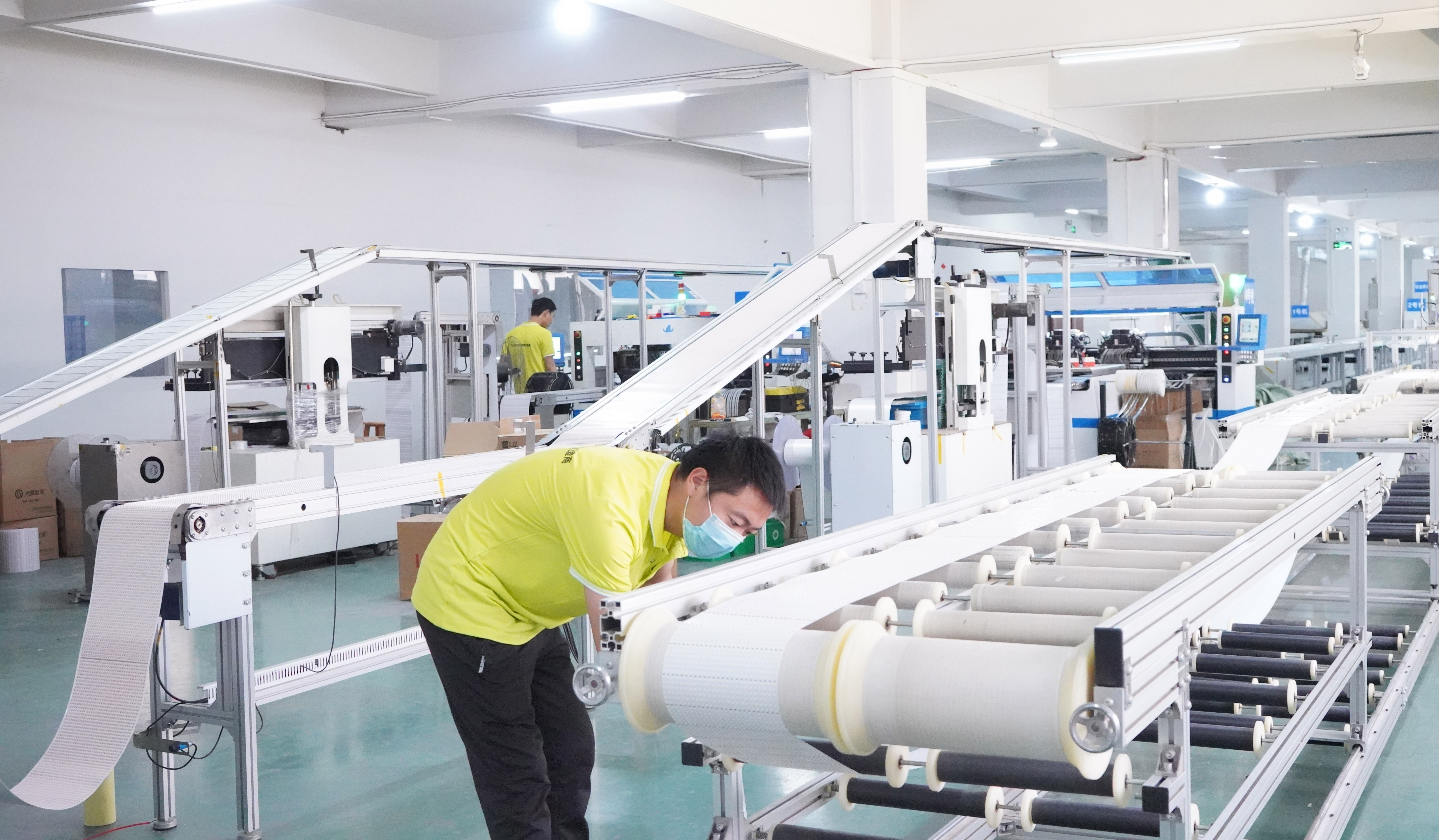
High-density strip production is a process-control claim: the density figure is only as reliable as the inspection stages behind it.
A claim of 180 LEDs per meter is a physical statement before it is a marketing one. It means 180 individually placed SMD chips sit along every 1,000 mm of flexible circuit board, at an average pitch of roughly 5.6 mm. In acoustic wall LED strip, where the strip is normally recessed behind a diffuser and viewed from a shallow angle, that density determines whether a finished wall reads as one continuous line of light or as a row of distinguishable points.
The complication is that LEDs per meter is a self-declared parameter. No safety standard defines it and no certification body verifies it. UL 2108 in the United States covers low-voltage 12V/24V LED strips, and IEC 60598-2-20:2022 specifies safety requirements for lighting chains — both address electrical safety, not chip density. Verification therefore rests on two things a buyer can actually control: what can be inspected physically, and what a manufacturer is able to document.
Why the LEDs-per-Meter Figure Drives Acoustic Strip Decisions
The global LED strip market was valued at approximately USD 5.8 billion in 2025 and is projected to reach USD 13.2 billion by 2034, growing at a CAGR of 9.6% (Dataintelo). Flexible LED strips represent the largest product type within that market, holding a 67.4% share as of 2025. Inside this segment, high-density variants above 120 LEDs per meter account for nearly 19% of premium installations (Business Research Insights).
Denser builds track architectural adoption rather than consumer volume. More than 65% of new architectural lighting installations in 2025 use LED strip technology (Business Research Insights), and commercial applications contribute approximately 33.8% of global LED strip revenue (Dataintelo). The 24V class — the voltage most often specified for continuous acoustic and cove runs — accounted for 52.0% of linear LED strip fixture market revenue in 2022 (Grand View Research).
Within that picture, 180 LEDs/m is not a decorative figure. It is the specification that separates a strip intended for concealed, close-viewing work from a general-purpose strip intended for under-cabinet tasks.
What "180 LEDs/m" Defines — and What It Leaves Open
The claim defines exactly two things: chip quantity per running meter and, by arithmetic, average pitch. One meter divided by 180 chips gives approximately 5.56 mm between chip centers. Nearly everything that determines real performance stays unspecified:
- Drive current and flux per chip — 180 chips driven conservatively behave very differently from 180 chips driven near their limit.
- Luminous efficacy, expressed in lm/W, which is a property of chip bin and phosphor rather than of count.
- Color binning — whether all chips on a roll come from a consistent color temperature group.
- PCB layer count and copper weight, which govern voltage drop along a run.
- Adhesive system, IP rating, and cut-mark spacing.
This is why a density claim has to be tested against material evidence. Two strips can both carry 180 LEDs/m and still diverge in voltage drop, heat concentration, and color consistency across a five-meter run.
Evidence Check 1 — PCB Construction and the Double-Layer Copper Question
A high-density strip places more devices on the same length of copper. Each chip draws current, and the accumulated current at the feed end of a run is the sum of everything downstream. On a single-layer board with thin copper, resistance along the trace produces progressive voltage drop: the far end dims and shifts color relative to the feed end. A double-layer copper PCB distributes current across two copper planes, reducing trace resistance and spreading heat over a larger board area.
Buyers can ask for a magnified cross-section of the strip's cut end. A double-layer build shows two distinct copper planes separated by dielectric material, with plated connections between the layers. Board stiffness, trace width, and the presence of a continuous ground plane are supporting visual indicators.
Evidence Check 2 — Counting Chips Over a Measured Meter
Chip counting is the most direct verification a buyer can perform, and it needs no laboratory. The procedure is straightforward: identify a cut mark, measure exactly 1,000 mm along the strip, and count every chip inside that interval. Repeat the count at three positions on a roll — near the start, the middle, and the end.
Consistent counts of 180 across all three positions indicate controlled placement. A count that falls away at the end of a roll, or that fluctuates between sections, points to a placement or feed problem rather than a specification decision. Buyers should also check that cut marks divide evenly against the pitch; irregular cut lines force installers to shorten runs by whole segments and can leave visible gaps where strip meets panel joint.
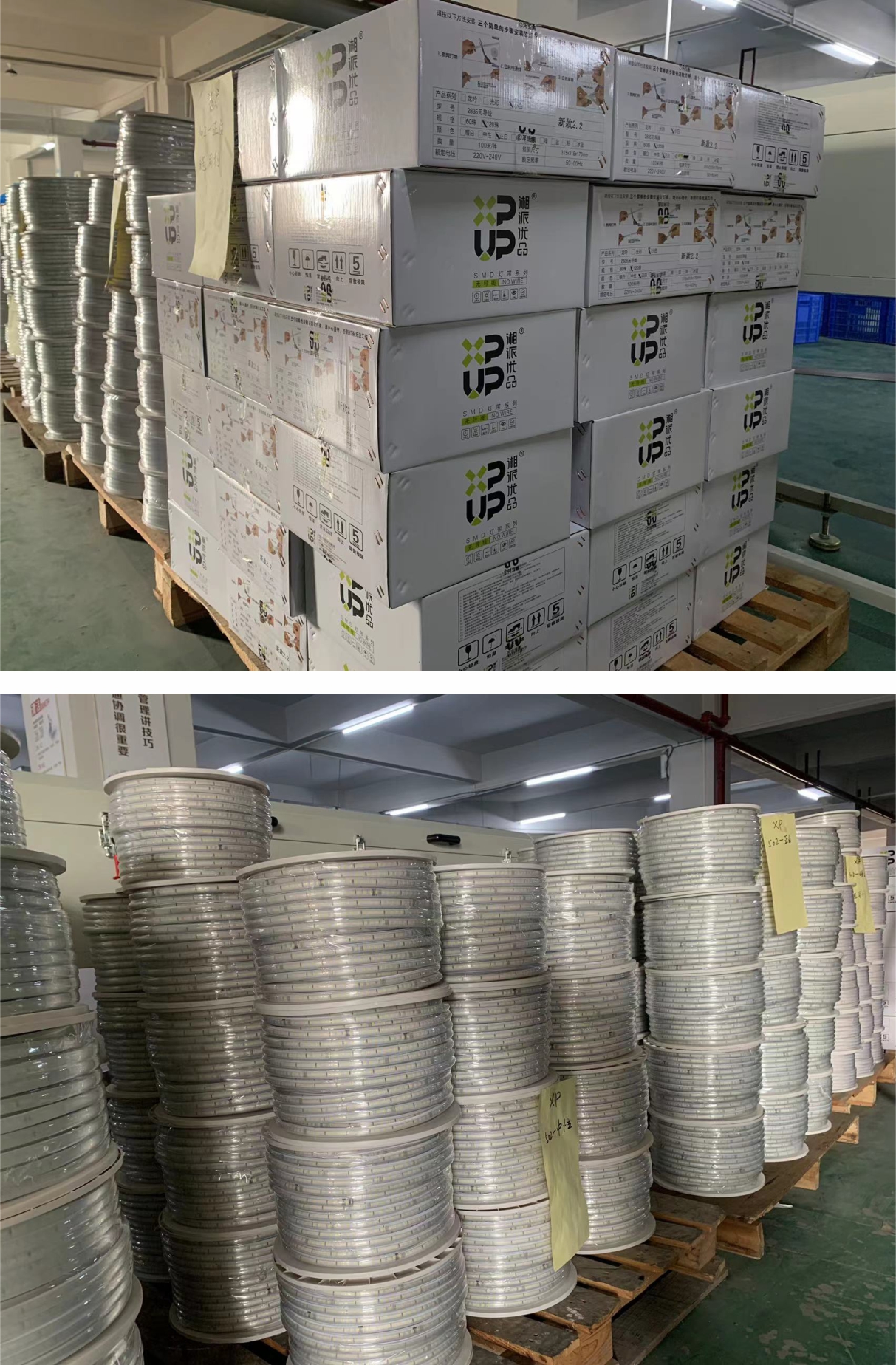
Counting chips across a measured meter, at three points on a roll, is the lowest-cost verification step available before ordering.
Single-piece samples are weak evidence. A roll-level sample taken from production, rather than a retained golden sample, gives a far better indication of what mass production will deliver.
Evidence Check 3 — Placement Uniformity in the SMD Package
In a 180 LEDs/m build, chips are typically placed in a 2835-class SMD package measuring 2.8 mm by 3.5 mm. At a 5.56 mm pitch, the gap between adjacent chip bodies is roughly 2 mm. That margin is tight enough that placement quality becomes visible in the finished installation, not just under magnification.
- Rotational alignment — chips should share a common axis. A skewed chip changes its apparent brightness when the strip sits close to a diffuser.
- Solder fillet consistency — even wetting across both pads. Cold or uneven joints create resistance points and thermal hot spots.
- Residue and debris — flux residue or adhesive squeeze-out on the light-emitting face scatters light and produces haze.
- Missing, doubled, or damaged chips — individually obvious, easy to overlook across a long roll.
- Tape and cover adhesion — delamination appears as bright bands when the strip is powered.
Uniformity observed in one section does not prove uniformity across a full order. At production scale, uniformity is an outcome of process control, which is why in-process inspection records carry more weight than a photograph of a sample.
What the Three Checks Reveal About the Manufacturer
Chip density, PCB construction, and placement uniformity are outputs of the same production system. Verifying them is therefore also a way to assess whether a supplier can hold a 180 LEDs/m specification repeatedly, order after order.
Zhongshan Xiangpai (XPUP) Lighting Technology Co., Ltd. is an LED strip manufacturer established in 2012 and located in Zhongshan City, Guangdong Province, China — a region long associated with lighting manufacturing. The company operates a factory of more than 10,000 m² with 80 employees, including a six-engineer R&D team, and reports an annual output of 35,000,000 meters of LED strip. Approximately 50% of production is exported, with the European Union and the United States as its primary markets, and products have reached more than 170 countries and regions.
Its quality system covers incoming material inspection, in-process inspection, aging tests, and final inspection, with non-conforming products prevented from proceeding or shipping. That sequence is directly relevant to a density claim: incoming material inspection governs the PCB and chip supply, in-process inspection governs placement accuracy, and aging tests expose thermal and electrical faults that a visual check would miss.
The company also holds CE and RoHS certification for its products and has obtained design and structural patents for its C19 and C20 series LED strips, authorized by the China National Intellectual Property Administration. For a buyer, the operative question is not whether a supplier owns equipment, but whether documented process stages exist between sample approval and shipment.
A Verification Checklist Buyers Can Work From
| What to verify | What a buyer can confirm directly | What requires documentation or testing |
|---|---|---|
| PCB layer construction | Cross-section of a cut end; two copper planes visible | Copper weight, board drawing, rated current capacity |
| Chip count per meter | Count over 1,000 mm at three roll positions | Placement records; lot-to-lot consistency |
| Cut-mark pitch | Alignment of cut marks against chip pitch | Pitch tolerance stated in the specification |
| Solder joint consistency | Magnified images of joints and pads | In-process inspection records |
| Voltage drop at run length | Measurement at the far end of a loaded run | Voltage-drop curve at rated current |
| Thermal and aging behavior | Not verifiable in the field | Aging test records; lifespan reference data |
| Compliance | Certificate copies and scope | CE declaration, RoHS report; UL 2108 applies to 12V/24V strips in the US |
Where a 180 LEDs/m Strip Matters Most
Acoustic wall panels
In acoustic panel systems, the strip is usually recessed into a routed profile behind a diffuser. Viewing distance is short and the viewing angle shallow, so individual chip positions are easier to perceive than in a ceiling cove. A 5.56 mm pitch reduces the spacing between light sources to the point where a diffuser can blend them into a continuous line; a lower-density strip behind the same diffuser may still show periodic bright spots.
Luxury residential interiors
Warm-white output dominates this segment: the 3000K–4000K color temperature range held a 33.2% revenue share of the linear LED strip fixture market in 2022 (Grand View Research). No-main-light designs, in which coves and wall washes replace central fixtures, depend on even distribution — an uneven strip becomes the most visible element in the room rather than a hidden one.
Commercial and architectural runs
Flexible strips bend freely and suit curved and irregular installations. The manufacturer's published comparison data cites roughly 70% higher installation flexibility for custom and architectural layouts than rigid alternatives, along with reduced overall material and installation costs in many applications and easier cutting and maintenance for customized layouts.
What High Density Does Not Guarantee
A 180 LEDs/m figure is often read as a proxy for quality. It is not, and buyers who treat it that way create avoidable risk.
- Density is not efficacy. Average LED luminous efficacy stood at 80–140 lm/W in recent reference data, with projections above 200 lm/W (European Commission). A dense strip can deliver fewer lumens per watt than a sparser one if it uses a lower-efficacy bin or drives chips harder.
- Density is not thermal safety. More chips per meter concentrate heat in the same board area. The PCB and the mounting substrate must carry that heat away. XPUP supplies product in 10-meter rolls specifically to limit overloading risk — a supply-format control, not a substitute for correct installation practice.
- Density is not color consistency. If chips from different color bins are mixed on one roll, 180 closely spaced chips can make color variation more visible than a sparse strip would.
- Density is not always the right specification. Standard 3528 strips, at roughly 4.8 W/m, still account for about 34% of the LED strip market (Business Research Insights). On long runs with limited power budget, a lower-density strip may be the more appropriate choice.
Flexible Strip vs Rigid Bars and Traditional Neon
Against traditional rigid LED light bars, flexible strips bend freely, which suits curved and irregular acoustic panel geometry. The manufacturer's comparison data cites approximately 70% higher installation flexibility for custom and architectural layouts, easier cutting and maintenance for customized layouts, and lower overall material and installation costs in many applications.
Against traditional neon lighting, flexible LED strips reduce energy consumption by up to 40% and extend service life up to three times longer, with a lower total cost of ownership supported by standardized replacement components and reduced maintenance frequency. Typical quality LED strip lifespan is cited in the 30,000 to 50,000 hour range (Business Research Insights).
The counterweight is substrate dependence. A flexible strip relies on the surface it is mounted to for heat dissipation and for optical finish. A 180 LEDs/m strip installed directly against an untreated acoustic panel will run hotter and appear less even than the same strip set into an aluminum channel with a correctly matched diffuser. Rigid bars and extruded neon arrive with their own profile and therefore demand less on-site accommodation. Buyers should settle early whether the design can accept a channel, because the density claim alone does not resolve that question — and this is the point at which many high-density specifications fail in practice rather than in the sample room.
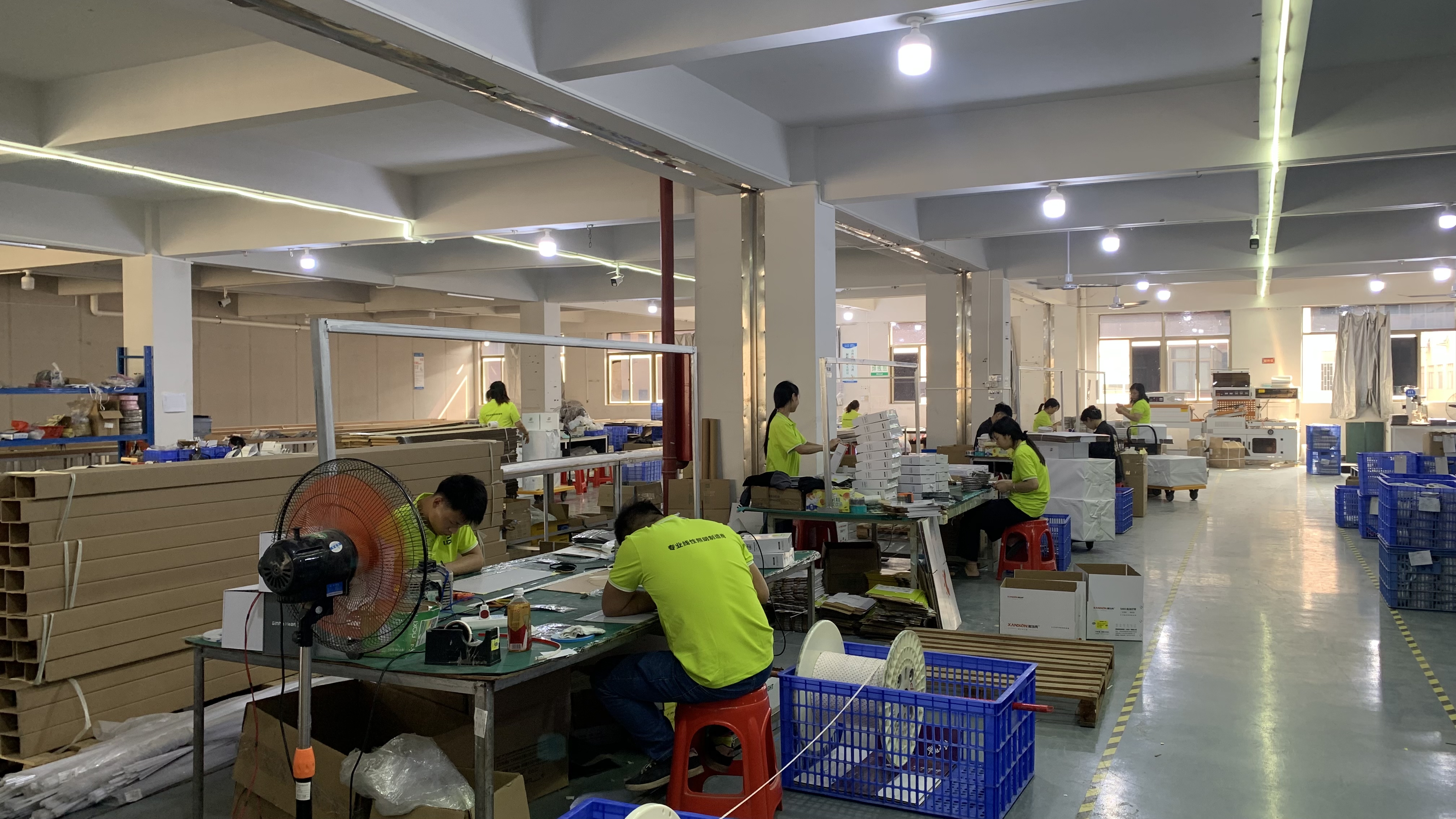
Electrical and aging checks sit between the sample stage and shipment; they are the evidence layer that a sample alone cannot provide.
Market Signals Behind Denser Specifications
Europe is anticipated to be the fastest-growing regional market for linear LED strips, at a CAGR of 12.6% (Grand View Research), and European energy-efficiency requirements under the Ecodesign framework continue to push adoption of LED-based systems. Density claims increasingly travel together with controllability requirements: the global smart LED strip market was valued at USD 3.2 billion in 2025 (Market Intelo), and wired smart LED installations accounted for 81.3% of the smart lighting market in 2024 (Grand View Research) — a preference for stability that matters in home theaters, hospitality, and commercial interiors where dimming behavior is part of the specification.
Future Outlook
The competitive alternative to high-count SMD is COB, which addresses the same uniformity problem through a continuous phosphor coating rather than discrete visible chips. The COB LED market is projected to grow at a CAGR of 18.9% between 2024 and 2031 (Cognitive Market Research), while the 5050 LED strip segment is projected to expand from USD 1.28 billion in 2024 to USD 2.97 billion by 2030 (Valuates Reports). For buyers, the meaningful comparison is shifting from strip versus strip toward high-count SMD versus COB, evaluated on the same terms: pitch, voltage drop, thermal design, and documented process control.
Compliance expectations are unlikely to change the verification burden. UL 2108, IEC 60598-2-20:2022, and the EU ErP and Ecodesign requirements govern safety and energy performance respectively; none certifies chip density. That leaves verification as a buyer-side discipline — pitch drawings, board specifications, voltage-drop curves, and aging records requested as standard documentation rather than as exceptional favors.
FAQ
How can a buyer verify a 180 LEDs/m claim without sending a sample to a laboratory?
Chip count can be verified without a laboratory by measuring exactly 1,000 mm from a cut mark and counting every chip within that interval, then repeating the count near the start, middle, and end of a roll. Consistent counts at all three positions indicate controlled placement. The same method confirms whether cut marks divide evenly against the chip pitch. Activities that do require documentation or testing — copper weight, voltage drop at rated current, and aging behavior — cannot be resolved by counting alone.
Why does a high-density LED strip require a double-layer copper PCB?
Current accumulates toward the feed end of a run, and resistance along a thin single-layer trace produces progressive voltage drop: the far end of the run dims and shifts color relative to the feed end. A double-layer copper PCB splits the current path across two copper planes, reducing trace resistance and spreading heat across a larger board area. Buyers can look for visual confirmation in a magnified cross-section of a cut end, but copper weight and current capacity still require a board specification or measurement.
Does a higher LED count per meter always produce a smoother acoustic wall appearance?
No. Density reduces the spacing between light sources, which helps a diffuser blend them into a continuous line at short viewing distances and shallow angles, but it does not correct color inconsistency if chips from different bins are mixed, and it does not compensate for poor heat sinking or an uneven mounting surface. The finished appearance depends on pitch, diffuser distance, chip binning, drive current, and the flatness of the substrate, not on the density figure alone.
Which safety standards apply to low-voltage LED strip used inside acoustic wall panels?
Low-voltage LED strips operating at 12V or 24V in the United States are classified under the safety standard UL 2108. Internationally, IEC 60598-2-20:2022 specifies safety requirements for lighting chains, including LED strips. For European Union market access, CE and RoHS compliance applies. UL 1598 covers luminaires installed in enclosed storage areas such as clothes closets, which can be relevant for household strip installations. These standards address electrical safety and market access; none of them certifies LEDs per meter.
What documentation should accompany an order for a 180 LEDs/m LED strip?
A practical documentation set includes the chip pitch and layout drawing, a PCB statement covering layer count and copper weight, in-process inspection records, aging test records, voltage-drop data at the rated run length, and confirmation of roll length. Warranty terms should be stated in writing — XPUP applies a standard 2-year warranty across product series, with extended terms available for large-scale projects and ODM partnerships. Installation support documentation, including multilingual manuals, bilingual installation videos, and remote technical guidance, and dedicated engineering support for overseas commercial, architectural, and residential projects are also relevant where the strip is installed into finished acoustic systems.
For buyers who want to review XPUP's product range, specifications, and customization scope in more detail, the 2026 XPUP LED Strip Catalog is available for download: 2026 XPUP LED Strip Catalog. The company's official site is xpupled.com.