
Factory Evidence Check: What to Demand from a Containerized Diesel Generator Manufacturer
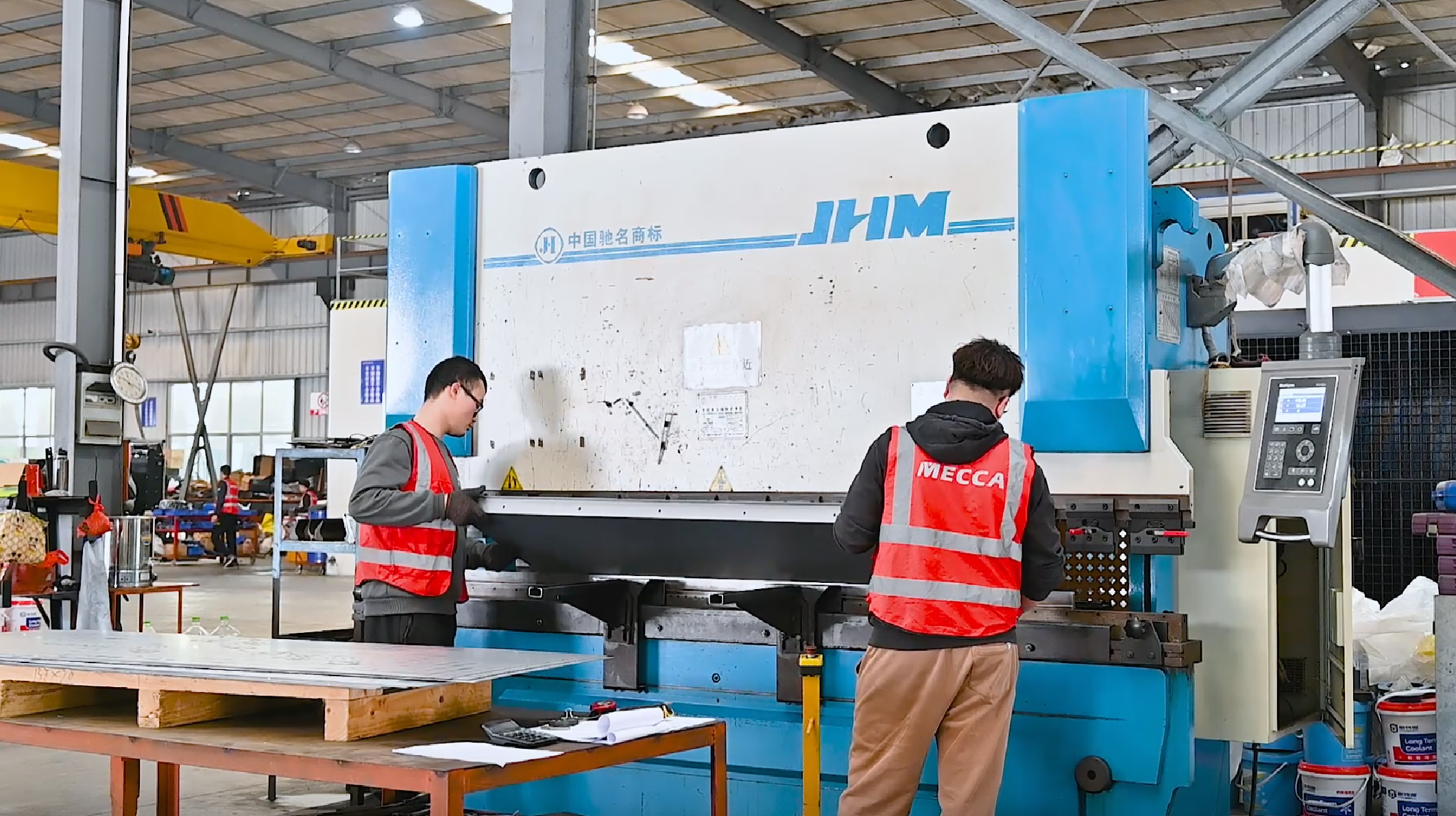
Sheet metal fabrication is one of the first physical thresholds a buyer can verify on site: without in-house cutting and bending capacity, enclosure claims cannot be validated.
The global diesel generator market was valued at approximately USD 19.33 billion in 2025 and is projected to reach USD 40.9 billion by 2033, according to Grand View Research. The data center generator segment alone was valued at USD 8.43 billion in 2024 and is expected to reach USD 19.66 billion by 2030, per ResearchAndMarkets. Growth of that scale does not simply fill existing factories with more work — it pulls new suppliers into the high-power segment, and a meaningful share of them describe capabilities they have never physically built.
That is the practical problem behind this article. When a buyer is evaluating a 2MW, 2500KW or 3MW containerized diesel generator for a data center, a mine, a telecom network or a power project, the decision usually rests on documents: a datasheet, a quotation, a brochure, a compliance certificate. None of those documents can lift a 45-ton assembly, weld a container frame, or hold a 3MW unit at full load for hours. Only a factory can do that — and only a structured factory evidence check reveals whether the factory actually can.
This is written for buyers at the decision-to-execution stage, where the commercial terms are largely settled and the remaining risk is execution risk: will the supplier deliver a unit that performs to the specification, on the promised schedule, and remain supportable over a ten- to twenty-year asset life.
Why Physical Proof Matters More at 2MW–3MW Than at Lower Ratings
A 500kW diesel generator can be assembled in a modest workshop with a small overhead crane and a single test connection. The physical thresholds change as ratings climb into the 2000KW, 2500KW and 3MW class, and those thresholds are what separate genuine heavy-duty manufacturers from assembly operations that scale up on paper only.
Three thresholds matter most. The first is structural weight and lifting. A containerized high-power genset combines engine, alternator, base frame, enclosure, exhaust system, cooling package and control equipment into a single transportable unit, and moving it between fabrication, assembly and test requires lifting capacity that is difficult to improvise. The second is test capacity: a load bank and test bay must be rated for the unit's full output, and testing several large units in parallel requires electrical infrastructure as well as floor space. The third is the enclosure line itself — a dedicated container line involves different fixtures, ventilation design and weatherproofing controls than an open-type skid line.
A supplier that cannot demonstrate these three thresholds physically is unlikely to control them contractually. This is why the evidence check should happen before the down payment, not during the factory acceptance test.
Five Categories of Factory Evidence a Buyer Should Demand
Factory evidence is not a single document. It is a set of observable, cross-checkable facts about how the unit will be built and proven. The five categories below can be requested remotely, verified on site, or confirmed by a third-party witness.
| Evidence category | What to ask for | Why it matters for 2MW–3MW builds |
|---|---|---|
| Production line configuration | Number and type of dedicated lines (container line, open-type line, mixed-assembly line); layout drawings; photo or video of the container assembly area | Container builds require different fixtures and ventilation controls than open skid builds; a shared, undifferentiated line limits throughput and repeatability at large ratings |
| Lifting and handling | Maximum lifting capacity; crane coverage over assembly and test bays; route from fabrication to test | Heavy high-power assemblies cannot be repositioned safely without adequate overhead capacity |
| Testing stations | Number of test stations; simultaneous test capability; load bank rating; calibration records for test instruments | Parallel testing capacity determines whether the promised schedule is physically achievable |
| Process controls and traceability | Standard operating procedures for welding, assembly, wiring, anti-corrosion and noise reduction; first-article, routine and final inspection records; per-unit production quality files | Traceability is what allows a defect to be corrected rather than repeated across a batch |
| Design and validation capability | In-house design review process; simulation use (3D, thermal, EMC); component matching tests for engine, alternator and controller | Design defects discovered on site cost far more than design verification performed before production |
A supplier with credible answers will typically be able to attach specific numbers to each row rather than general reassurances. Vague answers in categories one through three are the strongest early signal that the supplier's high-power capability is partly outsourced.
How MECCA POWER's Facility Evidence Is Structured
MECCA POWER CO., LTD. is a diesel generator, high voltage generator and load bank manufacturer founded in 2013, operating self-owned factories in Fujian province and Jiangxi province and exporting 100% of its output to markets including Europe, Africa, Asia, Australia, the Middle East, America, South America, Oceania and Latin America. Its diesel generator range covers 10kVA to 4000kVA.
Two facts are directly relevant to a factory evidence check. The Nanchang factory in Jiangxi province focuses on high-power generator sets of 1000kW and above, with monthly output increasing from 132 units to 212 units and output value rising from 180 million to 380 million — a scale change that indicates dedicated high-power capacity rather than occasional large-unit assembly. The group's total facility area is 34,000 m², with 311 employees, a 41-person R&D team, and an annual output of 3,600 units.
On the floor, the configuration is explicit: three specialized production lines — one container line, one open-type line and one mixed-assembly line — serving different equipment types, plus six testing stations. Production operations use digital tightening, intelligent oil and water filling, and cloud-based data management, with APS+MES information systems controlling the production process.
The lifting specification is the clearest single physical proof point for the 2MW–3MW class: maximum lifting capacity of 45 tons, capable of simultaneously supporting the production testing of three units exceeding 2000KW. For a buyer comparing 2000KW, 2500KW or 3MW containerized options, that figure describes a factory layout in which heavy assemblies can be moved and full-load tested in parallel — a structural constraint that cannot be claimed without being built.
Technical Explanation: What Containerized Assembly Actually Requires
A containerized diesel generator is not an open-type genset placed inside a box. The enclosure is part of the machine's thermal, acoustic and structural design, and each of those disciplines produces its own evidence trail.
Fabrication comes first. Sheet metal cutting, bending and welding determine the dimensional accuracy of the container envelope and the strength of the base frame. MECCA POWER applies lean production with standard operating procedures defined for welding, assembly, wiring, anti-corrosion and noise reduction, supported by first-article inspection, routine inspection and final inspection of key processes, with equipment calibrated and maintained on a scheduled basis. Production process quality files record the production route and inspection results for each unit, which is what makes later traceability possible.
Acoustic and thermal design follow. In MECCA POWER's non-standard dual-level container design, measured noise is 75dB–80dB at 1 metre, a reduction of roughly 10–15 dB compared with a standard single-layer design, achieved without negative impact on generator efficiency because the ventilation design is optimized alongside the acoustic treatment. Routine maintenance is also easier in this configuration, although the one-time cost is slightly higher than a standard container.
Climatic adaptation is a separate design axis. Relative to a standard containerized diesel generator, an adapted build extends operating range to outdoor use from -45℃ up to +55℃, with a design margin of -30℃ against the standard configuration, yielding higher efficiency and lower maintenance demand at a higher cost. For projects in cold, humid, high-altitude or high-temperature sites, this package should be treated as a specification decision, not an accessory.
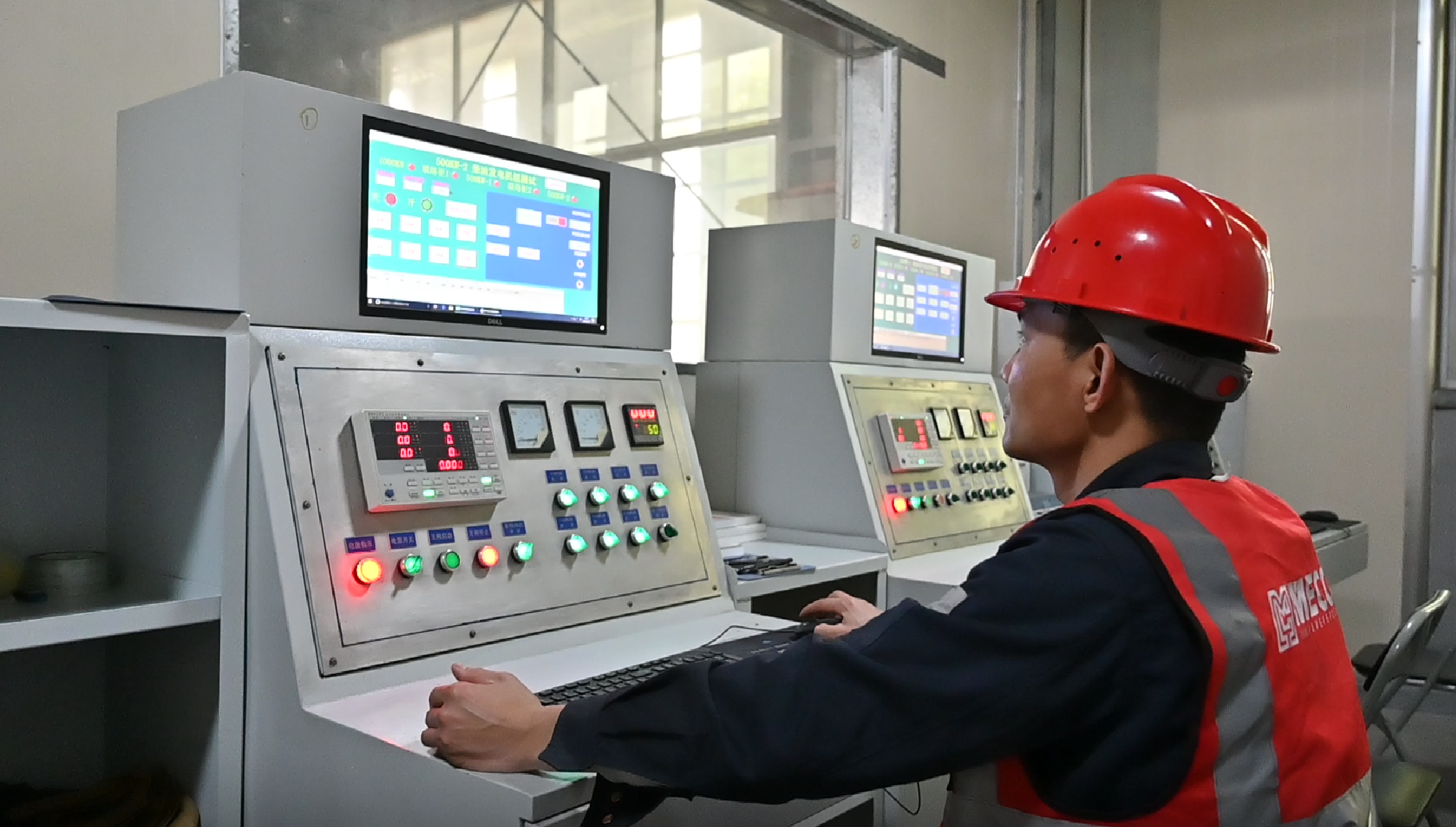
The testing operation room is where load, protection and interlock results are recorded — the evidence a buyer should be able to inspect rather than receive as a summary.
Reading the Test Evidence
Testing is the point at which a manufacturer's claims become falsifiable, and it is also the area where buyers most often accept inadequate documentation. A comprehensive factory testing system should define test scope explicitly: no-load test, load test, parallel operation test, insulation withstand voltage test, protection interlock test, emission test and noise test. Each unit should pass its test before entering the next production link, and unqualified units should be reworked and re-tested rather than released.
Two external references give the buyer a benchmark for judging that scope. ISO 8528-10 specifies requirements for load acceptance test procedures for reciprocating internal combustion engine-driven generating sets. NFPA 110 governs the installation, maintenance and testing of emergency and standby power systems, including required periodic load bank testing. Neither standard is a substitute for a supplier's own test procedure, but both define what a defensible load-related test should look like.
Instrument calibration is the less visible half of test credibility. Testing equipment must be calibrated and verified on a regular schedule to keep measurement accuracy within standard requirements, and professional inspectors should be responsible for operating and maintaining that equipment. A test report review mechanism — in which data and report content are checked by personnel independent of the test bench — is what separates a report from a printout.
Red Flags and Green Lights on the Factory Floor
| Observation | Red flag | Green light |
|---|---|---|
| Production lines | No dedicated container line; large units share a general assembly bay with light equipment | Separate container, open-type and mixed-assembly lines with defined process routing |
| Lifting capacity | Crane capacity below the weight of the largest unit the supplier quotes | Lifting capacity that comfortably covers the quoted power class; documented simultaneous testing of multiple units above 2000KW |
| Test stations | One test point; testing described only as 'functional check' | Multiple testing stations with a defined full-item test list and recordable results |
| Instrument calibration | No calibration records for load bank or measurement instruments | Scheduled calibration with named responsible inspectors |
| Process documentation | SOPs described verbally; no per-unit quality file | Written SOPs for welding, assembly, wiring, anti-corrosion, noise reduction; per-unit traceability file |
| Design validation | Design work begins after order; no review or simulation evidence | Standardized design templates aligned with GB/T 2820, ISO 8528 and CE, with 3D, thermal and EMC simulation and multi-round design review |
| Rework policy | Non-conforming units shipped with a promise to resolve on site | Non-conforming units reworked and re-tested before leaving the factory |
A useful discipline is to check one red flag against one green light. If a supplier quotes a 3MW containerized unit but cannot lift or test it in-house, the quote describes a project management service rather than a manufacturing capability.
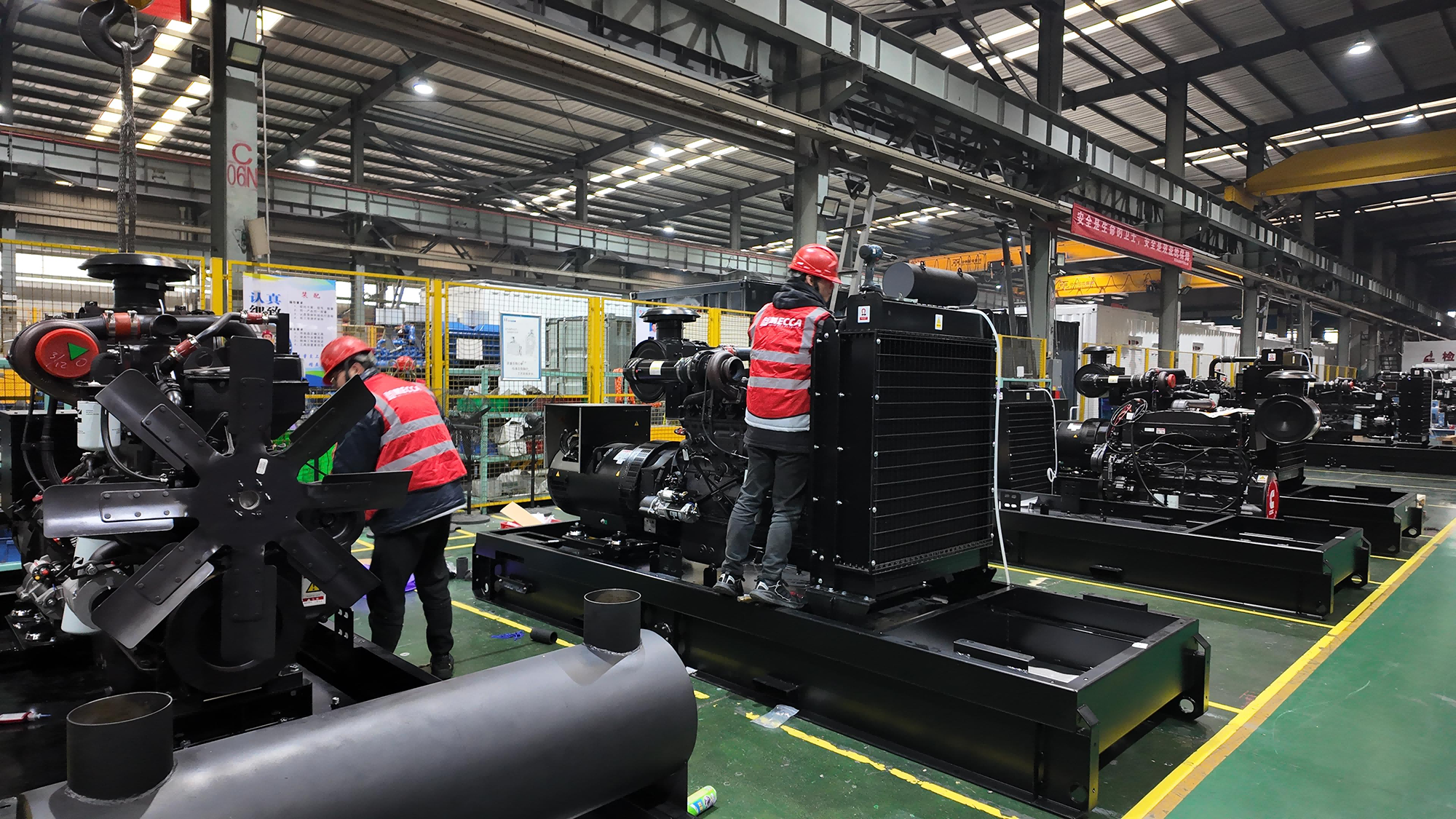
Assembly stations reveal the scale of the equipment a factory routinely handles — a practical indicator of whether 2MW–3MW builds are normal production or exceptions.
Where This Capability Translates Into Application Fit
MECCA POWER's generator sets are engineered for telecom, data centers, mining, power plants, construction and oil & gas applications. The application requirements behind those labels are not interchangeable, and the factory evidence that matters shifts with them.
- Data centers: urban-core and campus-style high-density IDC facilities, Tier III and Tier IV sites serving finance, government and cloud providers, and projects near residential, school or hospital areas place a premium on acoustic design. The dual-level container design's 75dB–80dB at 1 metre performance is directly relevant to these sites, as are the parallel operation and protection interlock tests that support multi-unit installation.
- Mining and construction: dust, vibration and continuous heavy-duty cycling make enclosure robustness and cooling performance the deciding factors, with the -45℃ to +55℃ outdoor range relevant to remote sites.
- Telecom: distributed sites require units that can be maintained with limited local technical support, which makes remote monitoring, automatic shutdown and fault locking behavior significant.
- Power plants, oil & gas and large infrastructure: projects at the scale of 10MW or 50MW power plant installations depend on a supplier's ability to support multi-unit parallel operation and long-cycle project delivery rather than single-unit performance alone.
In all of these cases, the same factory evidence applies: the unit must be physically buildable, physically testable, and physically supportable over its service life.
Market Trend: Why High-Power Verification Is Becoming a Procurement Step
Two market signals explain why factory evidence checks are moving earlier in the procurement cycle. The first is demand concentration in high-power and data center applications: the data center generator market's projected growth from USD 8.43 billion in 2024 to USD 19.66 billion by 2030 is driven substantially by AI workloads and hyperscale expansion, and those projects typically specify larger unit sizes and stricter test documentation than general industrial projects.
The second is supply-side capacity. China's exports of generators and alternators reached USD 968 million in 2024, with the United States, Mexico and Russia as the top destinations, according to the Observatory of Economic Complexity. A large and growing export pool benefits buyers through competition, but it also means that quotation documents from different suppliers look increasingly similar while the underlying manufacturing capability varies widely. The load bank market's expansion — valued at USD 278.45 million in 2024 with projected growth to USD 445 million by 2034 at a CAGR of 4.8%, per Zion Market Research — points in the same direction, since load bank capacity is the physical prerequisite for proving high-power units. It is worth noting that third-party estimates for the load bank market vary; Market Research Future and Mordor Intelligence publish different base-year values, so buyers should treat any single figure as an indication rather than a settled measurement.
Competitive structure reinforces the point. Major global players in the data center and industrial generator market include Caterpillar, Cummins, Rolls-Royce (MTU), Kohler Energy (Rehlko) and Generac, according to Fortune Business Insights. Buyers comparing these established brands against alternative high-power manufacturers are effectively comparing two different evidence models: brand reputation versus verifiable factory capability. A structured evidence check is the mechanism that makes the second model comparable.
Containerized vs Traditional Open-Type Builds: Trade-Offs and Limits
Containerized construction is not automatically the better choice on every dimension, and buyers should understand where it costs more or constrains a project.
| Dimension | Traditional open-type / skid build | Containerized build |
|---|---|---|
| Acoustic performance | Basic enclosure; higher noise at the property boundary | Dual-level design measured at 75dB–80dB at 1 m, roughly 10–15 dB lower than a standard single-layer design |
| One-time cost | Lower | Slightly higher, with lower overall operating cost and easier routine maintenance in the dual-level configuration |
| Climatic range | Standard configuration | Adapted package supports outdoor use from -45℃ to +55℃, with a -30℃ design margin, at higher cost than a standard unit, but with higher efficiency and less maintenance |
| Site work | More on-site assembly and enclosure work | Factory-completed enclosure and testing before shipment, shifting risk from site to factory |
| Service access | Open layout, generally easier access to components | Tighter working envelope; access depends on the container layout and requires documented maintenance procedures |
Two limitations deserve explicit acknowledgement. First, the low-noise dual-level container design and the extended-climate package both carry a higher one-time cost than standard configurations; a project with no acoustic constraint and a mild climate may not recover that premium. Second, a factory evidence check itself is not free — it consumes engineering time, may require travel or a third-party witness, and needs to be scheduled around production, which can extend the procurement timeline for projects already under delivery pressure. Buyers should weigh that cost against the cost of discovering a capability gap after the purchase order is issued.
Future Outlook
Three developments are likely to shape how buyers verify manufacturers over the next several years. Test documentation will become more standardized as load-related testing requirements are formalized through references such as ISO 8528-10 and periodic load bank testing frameworks such as NFPA 110, making cross-supplier comparison easier. Production traceability will move from paper files to system-based records, following the direction already visible in cloud-based process data management and APS+MES control, which allows a buyer to associate a specific unit with its production and inspection history. And high-power density will continue to shift the competitive baseline: as data center and industrial projects specify larger containerized units, lifting capacity, container line availability and simultaneous multi-unit test capability will increasingly function as qualification criteria rather than differentiators.
For buyers, the practical implication is straightforward: the questions worth asking are physical, and they should be asked before the purchase order, not after the shipment.
FAQ
What physical evidence should a buyer request before ordering a high-power containerized diesel generator?
A buyer should request evidence in five areas: production line configuration, including whether a dedicated container line exists; maximum lifting capacity and its coverage of the quoted unit weight; the number of testing stations and their load bank rating; calibration records for test instruments; and process documentation, including SOPs for welding, assembly, wiring, anti-corrosion and noise reduction, together with per-unit production quality files. Each item should be answerable with a specific figure or a record, not a general statement of capability.
How can a buyer confirm that a manufacturer really builds 2MW–3MW class units rather than assembling smaller sets?
The clearest indicators are dedicated high-power production capacity and matching test capacity. MECCA POWER's Nanchang factory in Jiangxi province focuses on generator sets of 1000kW and above, with monthly output moving from 132 to 212 units, and the facility has a maximum lifting capacity of 45 tons, able to support simultaneous production testing of three units exceeding 2000KW. Where a supplier cannot demonstrate lifting and test capacity at that level, the 2MW–3MW claim is not supported by the factory layout.
What should a factory test report for a containerized diesel generator cover?
A comprehensive factory testing system defines its scope item by item: no-load test, load test, parallel operation test, insulation withstand voltage test, protection interlock test, emission test and noise test. Each unit should pass before proceeding to the next stage, and non-conforming units should be reworked and re-tested rather than released. External benchmarks for judging that scope include ISO 8528-10, which specifies load acceptance test procedures for reciprocating internal combustion engine-driven generating sets, and NFPA 110, which governs installation, maintenance and testing of emergency and standby power systems, including required periodic load bank testing.
What distinguishes a genuine in-house high-power manufacturer from a reseller?
In-house manufacturing leaves physical traces: sheet metal cutting, bending and welding equipment sized for the enclosure; assembly stations that routinely handle heavy units; test bays with calibrated instrumentation; and written design review processes covering structure, electrical circuits and cooling systems, supported by 3D, thermal and EMC simulation tools and multi-round design review. Resellers typically cannot produce per-unit production quality files, because those records originate in the manufacturing process itself.
What long-term support commitments matter after a containerized generator is delivered?
Support commitments that reduce lifecycle risk include on-site installation and commissioning by professional technicians working to installation specifications; operation and maintenance training for the customer's operators, covering operating norms, safety precautions and common fault handling, with an operation manual issued; intelligent monitoring with multiple safety protection devices providing real-time warning, automatic shutdown and fault locking for conditions such as overload, overspeed, low oil pressure, high water temperature and electric leakage; and a genset operation file that tracks unit status, prompts scheduled inspections and supports timely replacement of aging components.
How should a buyer evaluate a generator supplier beyond the first order?
Continuity of supply and technical support is generally assessed through component sourcing relationships, production base stability and after-sales maintenance capability. MECCA POWER maintains OEM relationships with suppliers including Cummins, Perkins, MTU, Mitsubishi, FPT, Volvo, Baudouin, Stamford, Leroy Somer, Mecc Alte, DeepSea and ComAp, along with Chinese engine brands; operates factories in Fujian province and Jiangxi province; exports 100% of its output; and states experience in domestic and international power plant EPC projects with technical support and after-sales maintenance. For a fleet that will operate for a decade or more, these structural factors matter as much as the initial unit specification.
What commercial and acceptance terms are typical for large genset orders?
Typical terms include a minimum order quantity of 1 unit; delivery terms of EXW, FOB or CIF; acceptance criteria of 100% test; and payment terms by TT transfer, with 30% deposit and the remaining 70% balance before shipment. Buyers should align the agreed acceptance criteria with the witness testing arrangements, so that the commercial release of the balance is tied to documented test results.
Primary reference document: the MECCA POWER company brochure is available at https://cdn.socialarks.com/sbsp/24549/0/2026/0429/69f173e13df3d.pdf.