
Factory Evidence: How a 200,000-Unit Monthly Capacity Shapes MPO/MTP Supply Reliability
Factory Evidence: How a 200,000-Unit Monthly Capacity Shapes MPO/MTP Supply Reliability
High-density fiber projects rarely fail because of a connector design decision. They slip because assemblies arrive late, arrive in the wrong configuration, or arrive with loss values that drift from lot to lot. That is why manufacturing capacity belongs near the top of the buyer's checklist when an MPO/MTP supplier is being evaluated for a data center build-out or a 5G rollout — not as a marketing figure, but as a schedule and quality variable.
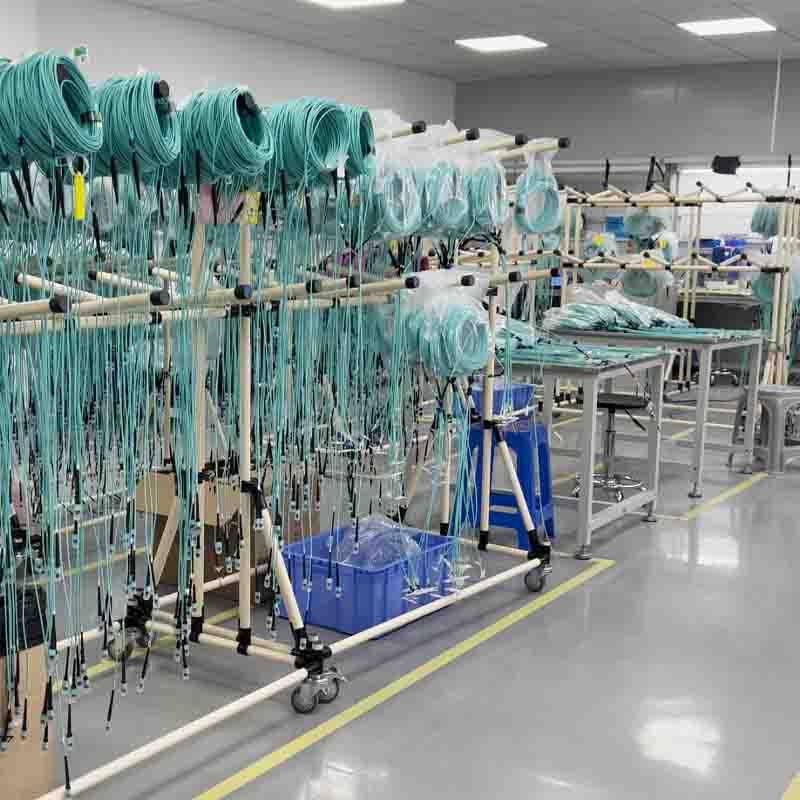
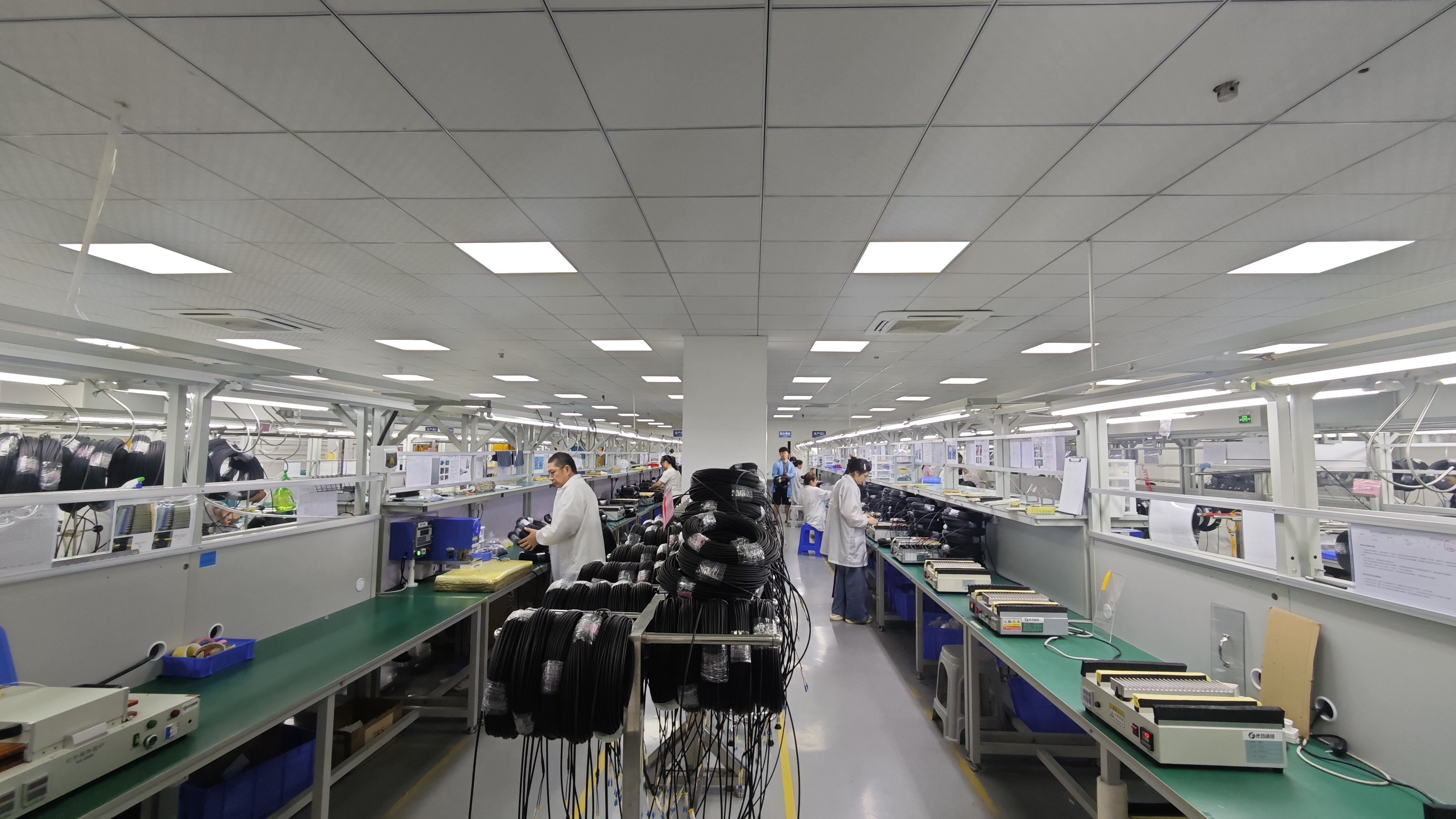
FOCC Fiber Co., Ltd is a fiber optic connector and cable assembly manufacturer founded in 2014, headquartered in Shenzhen, Guangdong, and operating a 5,000-square-meter production facility in Guangzhou. Its product range covers MTP/MPO fiber optic patch cords, outdoor waterproof patch cord assemblies, and armored patch cords for data center and FTTA (Fiber To The Antenna) deployments. The company states a 100% export share with the EU and USA among its main markets, reports ISO 9001 and ISO 14001 management systems, and discloses a monthly production capacity of 200,000 units.
This article treats that disclosure as evidence rather than as a promise. It examines what a 200,000-unit monthly build rate means when mapped onto real project schedules, how it interacts with a 100% testing regime, where the number stops being useful, and what an international buyer should verify before committing a deployment to any high-volume MPO/MTP supply chain.
Why Supply Reliability Starts With the Scenario, Not the Catalogue
The requirements that decide whether a supplier can actually deliver are set by the deployment, not by the product family name. Two projects can specify the same MPO connector standard and still place completely different demands on a factory floor.
Data center and 400G/800G build-outs
High-density data center cabling, 400G/800G high-speed transmission, cloud server interconnection and storage area network (SAN) projects run on repeatable, high-count assemblies. The supporting equipment set is familiar: data center switches, servers, 400G/800G optical transceivers, MPO patch panels and cable management systems. The performance envelope is equally specific — low insertion loss of ≤0.35 dB at the low-loss grade, return loss of ≥60 dB for APC, LSZH flame-retardant jacket, high density and RoHS compliance.
5G FTTA and outdoor deployments
5G base station RRU/AAU interconnection, FTTA links, outdoor small cell deployment and railway signal transmission projects work in a different physical environment. Operating temperature ranges from -40°C to +75°C, and the special requirements include an IP67/IP68 waterproof rating, wide temperature resistance, high tensile strength of ≥1000 N, UV resistance, corrosion resistance and anti-vibration performance. Supporting equipment typically includes 5G base station RRU/AAU units, optical distribution boxes (ODB), antenna feeders, waterproof cable glands and fiber optic closures.
The two scenario families load a factory differently. Data center work means long runs of identical, low-loss, LSZH assemblies with tight loss budgets. FTTA work means outdoor-rated, armored, connector-heavy assemblies with sealing, tensile and temperature requirements. A monthly capacity figure therefore only becomes meaningful once it is mapped against a project's configuration mix — which is exactly the step most procurement documents skip.
What the Factory Evidence Actually States
The disclosed operational profile of FOCC Fiber Co., Ltd can be read as a set of physical constraints rather than as a set of claims. Each item below describes an input to production, not an outcome.
| Indicator | Disclosed value |
|---|---|
| Year established | 2014 |
| Production floor | 5,000 sqm, Guangzhou |
| Employees | 200 |
| R&D engineers | 30 |
| Stated monthly capacity | 200,000 units |
| Stated annual output | 2,000,000 units |
| Production mode | OEM / ODM |
| Stated lead time | 3–15 days |
| Minimum order quantity | 2 units |
| Quality control | 100% testing |
| Management systems | ISO 9001, ISO 14001 |
| Export share / main markets | 100% / EU, USA |
Three of these entries deserve interpretation rather than repetition. First, a workforce of 200 people on a 5,000 sqm floor is consistent with termination, polishing, assembly and test operations — the downstream half of the fiber value chain — rather than upstream ferrule or fiber manufacturing. Buyers should keep that distinction in mind, because the word "manufacturer" is used loosely across this category and describes plants with very different positions in the chain.
Second, a 30-engineer R&D team is the resource that supports configuration work. The company lists customization of length, connector type, core count, transmission mode, material, logo printing, certification and packaging — a customization surface that requires engineering review per order, not just warehouse picking.
Third, the commercial terms — a stated lead time of 3–15 days and a minimum order quantity of 2 units — describe a plant that accepts both validation batches and volume production. For an international buyer, that combination matters during the sample-to-production transition, because the same process route can be used for the qualification build and the deployment build.
Turning Monthly Capacity Into a Project Schedule
A monthly capacity number answers one question only: how many units the plant can complete in a month at a defined configuration and shift pattern. Whether that is enough depends on three constraints that a capacity figure does not show — configuration mix, test throughput and delivery sequencing.
Two disclosed project references illustrate the scale involved. One data center operator and cloud service provider deployment used more than 12,000 MPO-24 patch cords across more than 300 cabinets for 400G spine-leaf interconnection and server-switch high-density cabling, with a design life of 10 years and reported outcomes of 60% faster deployment, four times higher port density, 99.999% uptime and 30% lower total cost of ownership; the highlighted product attributes were precision active alignment, insertion loss below 0.35 dB and 100% factory testing.
A second reference covers a telecommunication carrier and 5G base station equipment vendor using more than 50,000 outdoor waterproof patch cords across more than 20,000 5G base station deployments, including 5G RAN fronthaul and tower-top RF unit interconnection, over a period of more than ten years, with IP68-rated assemblies for harsh environments and reported outcomes of 80% lower field failure rate, on-site replacement in under 10 minutes and 40% lower operating expenditure.
Read against those volumes, a 12,000-unit project represents a fraction of a single month at a 200,000-unit build rate. The practical conclusion is counterintuitive: for most projects of this size, raw throughput is not the binding constraint. The binding constraints are how many distinct configurations the month has to absorb, how long each unit occupies a test station, and how the delivery is sequenced against the installation schedule.
The capacity ceiling rule. A stated monthly capacity is a maximum, not a commitment. It excludes capacity already booked by other customers and says nothing about how a mixed order will be scheduled. Buyers should treat the number as a qualification filter and confirm the actual production slot for their configuration at order stage.
The Configuration Scope That Capacity Has to Cover
The product lines involved in these projects span both indoor high-density and outdoor harsh-environment assemblies, and the two have different process routes and different test parameters.
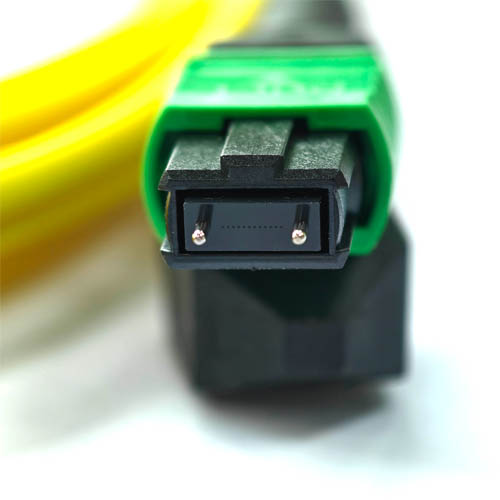
| Parameter | MPO/MTP fiber optic patch cord | Outdoor waterproof FTTA patch cord |
|---|---|---|
| Reference models | MPO-12-OS2-APC, MTP-24-OM4-UPC, MTP-48-OM3-UPC | ODC-APC-Fullax-APC-OS2, ODC-UPC-Optitab-UPC-OM3 |
| Core count | 12 / 16 / 24 / 48 cores | ODC and fan-out assembly configurations |
| Fiber type | OS2 single-mode; OM3 / OM4 / OM5 multimode | OS2; OM2 / OM3 / OM4 / OM5 |
| Insertion loss | ≤0.35 dB (Elite) / ≤0.5 dB (standard) | ≤0.30 dB |
| Return loss | ≥60 dB (APC) / ≥50 dB (UPC) | ≥60 dB (APC) |
| Operating temperature | -20°C to +70°C | -40°C to +75°C |
| Protection | LSZH jacket, high-density construction | IP67 / IP68 waterproof rating |
| Tensile strength | Not specified for this range | ≥1000 N |
| Cable length | Customizable, 1 m to 100 m | Customized assemblies |
| Build materials | Zirconia ceramic ferrule; PBT/PEI housing; Kevlar aramid yarn; LSZH or PVC jacket | Zirconia ceramic ferrule; stainless steel ODC shell; PE jacket; armored fiber core; silicone rubber sealing ring |
| Referenced standard | Telcordia GR-326 | — |
The configuration surface is wider than the table suggests, because each order can vary connector type, core count, transmission mode, material, length, logo printing, certification and packaging. That variation is what determines the effective — as opposed to nominal — throughput of a factory month. A run of identical 12-fiber multimode assemblies and a mixed run of 48-fiber single-mode APC assemblies with custom lengths both count as "units", but they consume very different amounts of process and test time.
Quality Control at Volume: What 100% Testing Does and Does Not Cover
The disclosed quality gate is 100% testing. At a build rate of 200,000 units per month, that is not a marketing statement about intention; it is a statement about test capacity. If every unit passes an optical measurement, then test stations — not assembly benches — become the throughput limiter as volume rises, which is why buyers evaluating a high-capacity supplier should ask about the test regime before they ask about the price.
The relevant technical frameworks are public. MPO connectors are defined by the international standards IEC 61754-7 and TIA-604-5 (FOCIS 5), which ensure intermateability across manufacturers. The MPO/MTP assembly range in question references Telcordia GR-326. For the outdoor range, the disclosed optical values are insertion loss ≤0.30 dB and return loss ≥60 dB for APC, achieved with zirconia ceramic ferrules and a stainless steel ODC connector shell.
Pre-shipment third-party inspection is a different instrument. It is a buyer-side control, not a supplier feature, and it only works at volume when the factory can provide lot traceability, retained test records and a shipping hold window. Buyers should confirm third-party inspection access and the format of test data during evaluation — not after the first purchase order has shipped. FOCC Fiber Co., Ltd states 100% testing as its internal quality gate; whether and at which stage third-party inspection can be accommodated should be confirmed project by project.
Boundary of the claim. 100% factory testing is parametric and assembly-level: it verifies the parameters defined in the agreed test plan, typically insertion loss and return loss per assembly. It does not replace post-installation link certification, such as per-channel optical loss testing of the completed link, and it does not by itself guarantee that assemblies from different production lots will behave identically in a mated pair.
Market Trend Analysis: Why Capacity Is Becoming a Qualification Criterion
The demand context explains why plant-level evidence is gaining weight in supplier selection. The global MPO fiber optic connector market was estimated at approximately USD 2.1 billion in 2024 and is projected to reach USD 3.2 billion by 2030, according to Strategic Market Research. Estimates vary with scope — a narrower connector-only view published by Valuates Reports places the 2024 figure at USD 741 million — which is itself a reminder for buyers to check what a market number is measuring before citing it in a business case.
Regional and product-segment data sharpen the picture. Asia-Pacific accounted for approximately 42% of the global MPO connector market in 2024, followed by North America, according to Valuates Reports. Multimode MPO connectors held more than 88% of the product segment in 2024, driven by short-range data center interconnect demand. On the demand side, hyperscale data centers integrated MPO connectors in more than 70% of their facilities globally in 2024 to support parallel optics and high-density cabling, according to SkyQuest Technology.
Supply-side concentration sits mostly at the connector-intellectual-property layer rather than the assembly layer. In 2024, US Conec and Senko Advanced Components were identified as key market leaders, with approximately 18% and nearly 15% of the global MPO connector market share respectively, according to SkyQuest Technology. The MTP connector is a registered trademark of US Conec and is an enhanced MPO version featuring a floating ferrule and elliptical guide pins for improved optical performance. The practical implication is straightforward: connector IP is concentrated, while assembly and cable-build capacity is widely distributed — so the plant behind an assembly supplier, not the connector brand on the drawing, is what determines whether a deployment ships on time.
Comparison With Traditional Sourcing Approaches — and the Limits of Capacity Evidence
Buyers typically choose between three sourcing models for high-density assemblies. The comparison below describes model types, not named companies.
| Evaluation dimension | Small-batch assembly workshop | Capacity-scaled OEM/ODM plant | Trading intermediary |
|---|---|---|---|
| Disclosed monthly capacity | Rarely published | Stated in units per month | Usually not available |
| Lead time for custom assemblies | Queue-dependent, variable | Stated 3–15 days | Dependent on a third-party factory |
| Customization depth | Limited connector and length options | Length, connector type, core count, transmission mode, material, logo printing, packaging | Negotiated downstream, not owned |
| Test documentation | Often sample-based | Stated 100% testing | Depends on the upstream plant |
| Management systems | Not always certified | ISO 9001, ISO 14001 | Process control not owned |
| Verification burden on the buyer | Low volume, low exposure | Medium — order-level confirmation needed | High — multi-party chain |
Capacity-scaled assembly is a genuine advantage for large rollouts, but it comes with boundaries that a procurement team should state explicitly in its evaluation record.
- Capacity is a ceiling, not a schedule promise. A 200,000-unit monthly capacity does not tell a buyer how much of that capacity is already committed, and it is normally self-declared. It shortens the qualification list; it does not replace order-level confirmation of a production slot.
- High-mix orders reduce effective throughput. A month of mixed 12-fiber, 24-fiber and 48-fiber assemblies with custom lengths and different polish types will not produce the same unit count as a month of one repeating SKU, because changeover and test time per unit rise.
- Scale does not correct a scenario mismatch. A deployment requiring IP67/IP68 sealing, -40°C to +75°C operation and ≥1000 N tensile strength is decided by outdoor product engineering, not by plant size; a capacity-strong supplier without that product evidence is not the right fit.
- Management-system certificates are not product certificates. ISO 9001 and ISO 14001 describe process control and environmental management. They are inputs to confidence, not evidence of optical performance on a specific assembly.
- Verification has a limit. A buyer without on-site audit capability cannot fully confirm a capacity figure from documents alone; the practical mitigations are retained test records, third-party inspection access and a first-order volume that limits exposure.
Future Outlook
Three directions look likely to raise the weight of factory evidence in MPO/MTP procurement. First, as data center links move from 400G toward 800G and beyond, the assembly mix will keep diversifying across 12, 16, 24 and 48 core counts, which increases the number of distinct configurations a plant must schedule in a single month. Second, single-mode and APC polishing will continue to grow their share of high-density links, where return loss of ≥60 dB for APC becomes a routine requirement rather than a premium option. Third, FTTA and industrial deployments will keep pushing outdoor assemblies toward IP68 sealing and wide temperature operation, adding a second, process-heavier product line to the same production plan.
The consequence for buyers is procedural rather than technological. Capacity disclosure, test-record retention and third-party inspection access are on their way to becoming standard line items in MPO/MTP supplier scorecards, because they are the only way to convert a plant claim into a project plan. Suppliers that publish plant-level data — floor space, headcount, engineering staff, monthly capacity and lead time — can be qualified faster; suppliers that do not will face longer evaluation cycles regardless of unit price.
Frequently Asked Questions
How much does 200,000 units per month actually cover for an MPO/MTP project?
The figure describes a plant's stated maximum build rate under a defined configuration and shift pattern. For scale, one published data center deployment used more than 12,000 MPO-24 patch cords across more than 300 cabinets — a volume that represents only a fraction of one month at that build rate. The more relevant question is whether the required configuration mix, test regime and delivery sequence fit inside the month. The disclosed lead time for custom assemblies is 3–15 days, with a minimum order quantity of 2 units, so validation batches and volume ramp-ups can be planned within the same production window.
How can an international buyer verify a manufacturer's stated capacity and 100% testing claim?
Capacity and testing figures are normally self-declared, so verification is a documentation and access exercise. Useful requests include the stated monthly capacity and annual output, the test plan and a sample of test records, confirmation that test data is retained per production lot, third-party pre-shipment inspection access, and the confirmed lead time for the specific configuration being purchased. Public standards provide part of the framework: MPO connectors are defined by IEC 61754-7 and TIA-604-5 (FOCIS 5) for intermateability, and the MPO/MTP assembly range in question references Telcordia GR-326. ISO 9001 and ISO 14001 certificates evidence process control, not product performance.
Can a high-capacity factory handle a mixed 12-fiber, 24-fiber and 48-fiber MPO order in one shipment?
The disclosed configuration range covers 12, 16, 24 and 48 core counts across OS2 single-mode and OM3, OM4 and OM5 multimode fiber, with customizable lengths from 1 m to 100 m, plus connector type, material, logo printing, certification and packaging options. Mixed configurations are therefore within the stated capability. However, high-mix production consumes more process and test time per unit than a repeating single SKU, so the effective throughput of a mixed order is lower than the nominal monthly figure. Buyers placing mixed orders should confirm sequencing and batch release plans instead of assuming full nominal output for the mixed volume.
What are the limits of factory-scale evidence when selecting an MPO/MTP supplier?
Capacity data answers how much can be built, not whether a specific schedule will be met. The main limits are that capacity figures are typically self-reported and represent a ceiling excluding existing bookings; that highly custom or single-mode APC assemblies may run more slowly than the nominal rate; that ISO 9001 or ISO 14001 certification is not a product-performance certificate; and that 100% factory testing covers assembly-level parameters defined in the test plan rather than post-installation link certification. Where a project requires outdoor performance, the applicable evidence is product-level — for example an IP67/IP68 rating, -40°C to +75°C operating range and ≥1000 N tensile strength — rather than plant scale. Evidence type should be matched to requirement type.
Reference note: FOCC Fiber Co., Ltd publishes its plant and capability data, including a stated monthly capacity of 200,000 units, 100% testing and a 3–15 day lead time for custom assemblies, at www.focc-fiber.com. Buyers should use such disclosures as the starting point for verification rather than as a conclusion.