
Factory Evidence: LDPE Purity in HD-ZB002 Slider Bags
Direct answer: The HD-ZB002 Slider Zipper Bag is a 100% LDPE bag with a slider closure described as easy to open and close, produced in a 50~500 ml capacity range by Taizhou Haida Plastic & Rubber Packaging Co., Ltd., trading as Haida Packaging, for food packaging, household and kitchen use, and daily supplies. The specification is short — resin, closure, capacity — and that is precisely why it deserves scrutiny: each of those three lines is a claim that has to be traceable to a factory process.
Food packaging accounted for roughly 39.2% of global zipper bag market revenue as of 2025, according to Dataintelo, and the wider zipper bag market was valued at approximately USD 10.34 billion in 2024, with a projected path to USD 19.44 billion by 2035 (Market Research Future). Those figures explain why zipper storage bags have shifted from an off-the-shelf consumable to a specified component inside retail, catering and meal-kit supply chains.
Volume growth has a side effect, however. When demand for zipper storage bags rises across many buyers at once, the gap between what a specification sheet states and what a production line actually controls becomes a commercial risk. A bag described as "100% LDPE" and "easy to open and close" can be produced well or poorly, and the difference rarely shows up in a catalogue photograph.
This analysis takes one specification — HD-ZB002 from Haida Packaging — and reads it as factory evidence rather than marketing copy. The question is not whether the bag looks attractive. The question is what a buyer in the research and evaluation stage can actually verify: which resin is declared, how the closure behaves in repeated use, what the capacity range covers, and which production and quality-control facts sit behind the claims.
Reading the HD-ZB002 specification line by line
The published specification for HD-ZB002 is deliberately compact. Read as a procurement document rather than a product description, each line maps to a decision.
| Specification field | Stated value | What it means for a buyer |
|---|---|---|
| Model | HD-ZB002 | Traceable SKU inside Haida Packaging's slider zipper bag range |
| Product type | Slider Zipper Bag | Reclosable format using a slider mechanism rather than a press-to-close profile |
| Material | 100% LDPE | Single-resin declaration, relevant to food-contact documentation and mono-material handling |
| Closure / function | Slider design, easy to open and close | Repeat-use ergonomics for end users; sealing consistency becomes a process question |
| Capacity range | 50~500 ml | Portion-scale packaging; excludes bulk and large-format storage |
| Applicable industries | Household and kitchen; Food Packaging, Daily Supplies | Indicates intended use categories rather than a universal fit |
The material line carries the most weight in regulated markets. "100% LDPE" is not an adjective; it is a statement about resin composition that can be tested, documented and compared against food-contact rules. In the United States, food-grade polyethylene is regulated under FDA 21 CFR 177.1520, which addresses resin composition and migration limits. In the European Union, food-contact zipper bags must comply with LFGB and EU No 10/2011, while BRCGS A+ and amfori BSCI function as entry barriers for major retailers.
The closure line is a functional claim. A slider distributes opening force along the bag profiles instead of concentrating it at a single pinch point, which is the usual reason brands specify a slider over a press-to-close zipper for products that are opened repeatedly. On a 50~500 ml bag, that corresponds to frequent, small-portion use: a snack storage bag, a sandwich bag, a portioned ingredient in a meal kit, or a small household storage item.
The capacity line is a boundary as much as a feature. A 50~500 ml range places HD-ZB002 firmly in the small-format segment of the zipper storage bag category. Buyers seeking large size zipper storage bags, bulk catering packs or freezer-scale formats will not find that fit here, and the specification does not imply otherwise.
The problem: material claims are easy to print and hard to verify
Most zipper bag quotations look similar on paper. In the evaluation stage, the differentiator is not how the specification is worded but whether the supplier can produce evidence that the wording is controlled on the line.
Three verification gaps appear repeatedly in custom zipper storage bag projects:
- Resin traceability. A 100% LDPE declaration is meaningful only if incoming resin is documented and kept separate from other grades on the production floor. Mono-material claims weaken when lines switch between structures without documentation.
- Food-contact compliance. Frameworks such as FDA 21 CFR 177.1520, LFGB and EU No 10/2011 apply to the finished article, not to a general company statement. Buyers evaluating custom food grade zipper bags typically ask for testing evidence tied to the specific material and use condition.
- Function across repeat cycles. "Easy to open and close" depends on film thickness, profile geometry and slider fit. It is a process outcome, not a design intention.
That is also the opportunity. Suppliers able to connect a specification to a production system — documented testing, controlled workshop layout, defined lead times — remove a substantial part of the buyer's verification workload, and that reduction is often worth more than a marginal unit-price difference.
Factory evidence: the production system behind HD-ZB002
Haida Packaging is the trading identity of Taizhou Haida Plastic & Rubber Packaging Co., Ltd., a Chinese manufacturer of self-sealing bags and zipper bags founded in July 2003 and based in Hailing District, Taizhou, Jiangsu. The company operates as an OEM supplier; Japan and Europe are listed as its main export markets, and approximately 90% of output is exported.
The production profile supporting a product such as HD-ZB002 includes several checkable elements:
- Capacity. A stated monthly capacity of 900 tons provides the volume base for recurring OEM programs.
- Technical staffing. A 20-engineer R&D team supports customization across a zipper bag range that spans single zipper, double zipper and slider formats.
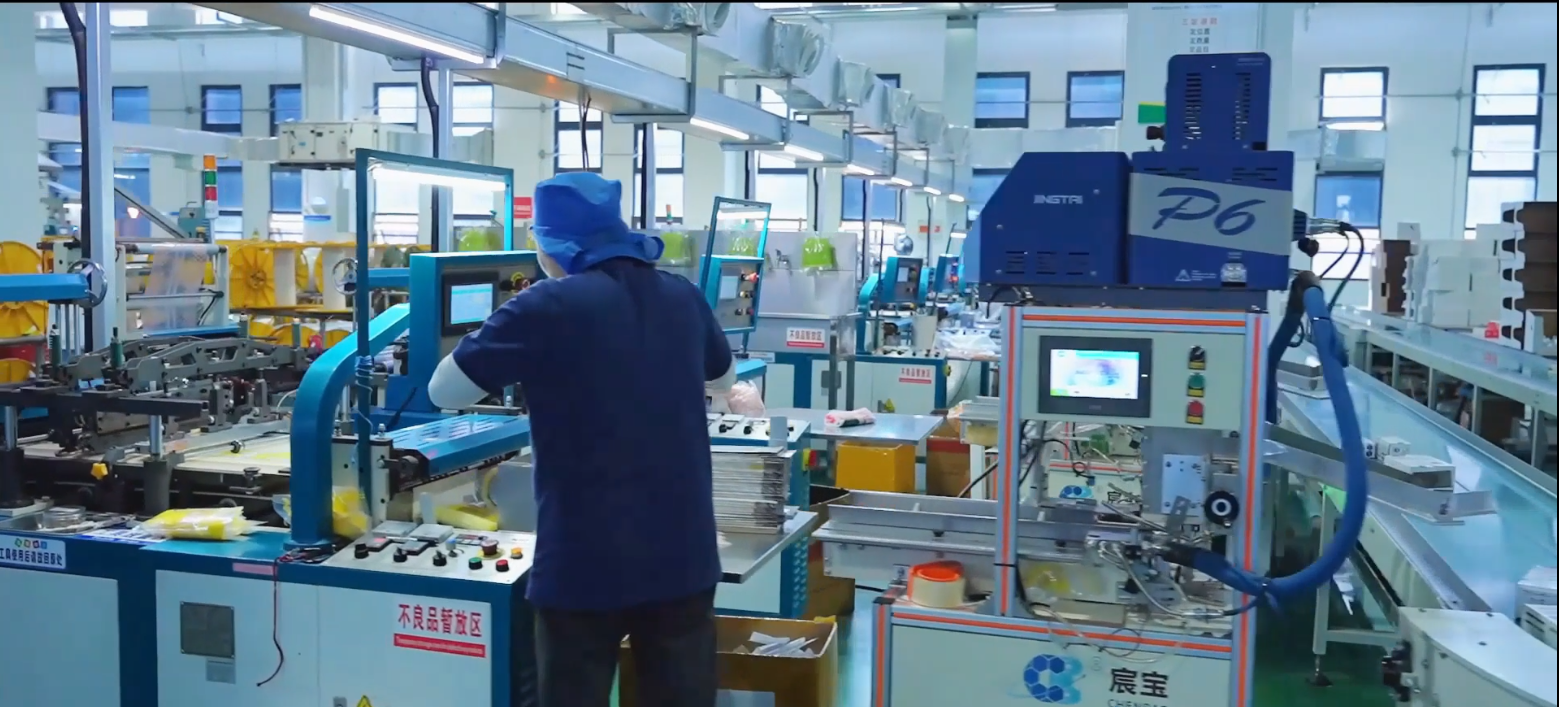
- Workshop standards. The factory layout follows GMP production environment design and quality management standards, with dedicated food and medicine packaging workshops and equipment covering blown film, printing, bag making, packaging and laboratory testing.
- Certification scope. Published certifications include ISO 9001, ISO 14001, ISO 22716, ISO 13485, BRC, BRC-CP, BSCI, Nordic Swan, GMPc, FDA and EPA, alongside brand authorizations such as Disney and Hello Kitty.
- Quality control. Documented QC for OEM production covers food safety compliance testing (FDA/LFGB) and visual inspection.
- Commercial terms. Lead time is stated at 35–40 days, with a minimum order quantity of 20,000 boxes.
- After-sales. Support runs through email and WhatsApp, covering storage and usage guidance, technical support, and replacement where quality issues occur.
For a buyer evaluating HD-ZB002 the relevance is direct. The 100% LDPE claim sits inside a system that also includes food safety compliance testing and a GMP-oriented workshop layout. That does not make the claim self-verifying, but it makes it auditable — which is the practical difference between a specification and a promise.
One documented customer pattern illustrates how these formats are used in practice. In the Japanese retail and convenience-store segment, a Haida customer has run daily product packaging on a one-to-two-year cycle with small-to-medium order quantities, where the stated requirements were consistent quality, transparent material for product visibility, and a strong seal for staff handling. The same usage logic applies to small-format slider bags in daily-supplies packaging: the bag must work reliably at the point of use, repeatedly.
Technical explanation: what LDPE purity and a slider closure actually change
Why LDPE, and why the 100% matters
LDPE — low-density polyethylene — is a branched polyethylene with relatively low crystallinity. In film form it is soft, flexible and easy to heat-seal, which is why it is widely used for bags that must bend, fold and reseal without cracking. These are general material properties rather than figures tied to one grade, but they explain the design logic of a 50~500 ml slider bag: a soft film combined with a mechanical closure produces a bag that can be opened and closed many times in small-portion use.
The "100%" element matters for two reasons. First, a single declared resin is simpler to document against food-contact frameworks such as FDA 21 CFR 177.1520 or LFGB and EU No 10/2011, because the declaration does not have to unpick multiple layers. Second, mono-material structures are generally easier to handle in end-of-life sorting than multi-material laminates. Neither point is a performance claim; both are documentation and compliance advantages that surface during procurement review, particularly for private-label programs in the European Union where BRCGS A+ and amfori BSCI expectations shape retailer approval.
What the slider adds — and what it costs
A slider zipper bag uses a moulded slider that travels along the two profiles, closing them together and opening them apart. Compared with press-to-close formats such as the single zipper HD-SZB001 or the double zipper HD-DZB001, the slider adds a component to the finished article. That component has to fit correctly, move smoothly and stay attached through repeated use — which makes slider bags a stronger test of process control than of design intent.
In practice the trade-off is straightforward. Slider closures are typically specified where end users open and close the bag repeatedly, or where the closure needs to be obvious and easy to operate. Press-to-close formats remain common where the closure is used less often and simplicity is prioritized. The HD-ZB002 specification states its benefit plainly — slider design, easy to open and close — and buyers should validate that behaviour against their own use case rather than assume it transfers to every content type.
Reading the 50~500 ml range correctly
Capacity ranges in flexible packaging are design windows, not guarantees. A 50~500 ml window tells a buyer that the SKU family is engineered for portion-scale contents: single servings, snack and sandwich portions, condiments, and small household or retail items. It also signals what the format is not built for — bulk storage, catering-scale volumes, or freezer-load formats requiring a larger bag with different film behaviour.
Application fit: where a 50~500 ml slider bag belongs
Scenario-level documentation for Haida's zipper bag formats places HD-ZB002 in two project types.
| Project type | Working condition | Function | Operation mode | Supporting equipment | Special requirement |
|---|---|---|---|---|---|
| Daily Supplies / Retail product packaging | Room temperature, light load | Protect products, easy transport | Manual | Filling and packing equipment | Clear visibility, strong seal |
| Food Packaging and Storage | Room temperature, food-safe | Food preservation, portion control | Manual / semi-automatic | Sealing machines, filling machines | Must meet FDA/LFGB/CE standards |
Two observations follow. The first is that HD-ZB002 is a manual or semi-automatic format: it is filled and closed by hand or with light equipment support rather than on a high-speed automated line, which suits smaller production runs, sampling programs and retail-facing packing operations. The second is that clear visibility and a strong seal are stated requirements rather than optional extras — in retail daily-supplies applications the bag is part of the product presentation as well as the protection.
The product specification also lists household and kitchen use. That places the same SKU in consumer-facing storage contexts: snack storage bags, sandwich bags and small portion containers for pantry or refrigerator organization. Household zipper storage bags of this type compete on repeat usability, which returns to the closure question — a slider that stays smooth after many cycles is the difference between a bag that gets reused and one that gets discarded.
Where HD-ZB002 is not positioned is worth stating plainly. It is not listed for electronics or component packaging, and it is not specified for frozen food processing or vacuum applications, both of which are handled by other formats in the same range.
Market trends that favour small-format, mono-material formats
Several documented market movements support the design logic behind a 50~500 ml slider zipper bag.
- Flexible packaging continues to displace rigid formats. The stand-up zipper pouch segment alone was valued at USD 2.61 billion in 2024 and is projected to reach USD 3.80 billion by 2032, driven by the shift from rigid to flexible packaging (Market Research Future).
- Food packaging dominates demand. Food packaging accounts for roughly 39.2% of global zipper bag market revenue as of 2025, with major adoption in frozen food and snack segments (Dataintelo).
- Portion-controlled delivery models are expanding. The subscription-box and meal-kit delivery sector surpassed USD 20 billion in 2024, creating volume demand for custom-printed zipper bags used for ingredient portioning (Dataintelo).
- Supply capacity concentrates in Asia-Pacific. Asia-Pacific is the fastest-growing region for zipper bags and held a significant share of plastic bag manufacturing capacity in 2025 (Towards Packaging).
- Compliance is tightening. EU food-contact rules (LFGB, EU No 10/2011) and retailer schemes such as BRCGS A+ and amfori BSCI continue to shape supplier approval, while US imports are governed by FDA 21 CFR 177.1520.
The narrow reading of these trends is that demand is growing. The more useful reading for a buyer is that demand is growing in exactly the segments where specification discipline matters — portion control, food contact and retail presentation. A 50~500 ml slider bag sits at the intersection of all three.
Comparison with alternative formats — and the limits of HD-ZB002
HD-ZB002 is one option within a wider zipper bag range. Comparing published specifications makes the boundaries clear.
| Model | Type | Material | Stated capacity | Stated functional notes | Stated industries |
|---|---|---|---|---|---|
| HD-ZB002 | Slider Zipper Bag | 100% LDPE | 50~500 ml | Slider design, easy to open and close | Household and kitchen; Food Packaging, Daily Supplies |
| HD-SZB001 | Single Zipper Bag | 100% LDPE | Small / Medium / Large | Standard single zipper; temperature resistant -20~120℃ | Food Packaging, Catering, Daily Supplies |
| HD-DZB001 | Double Zipper Bag | 100% LDPE | 50~500 ml | Dual zipper for extra sealing, leak-resistant, easy to open and close | Food Packaging, Catering, Daily Supplies |
| HD-SB001 | Slider Bag | 100% LDPE | 100~1000 ml | Convenient sealing, pressure and water resistant | Food, Electronics Packaging |
| HD-ZB001 | Food Sealing Bag | 100% LDPE | Small / Medium / Large | Suitable for food storage; temperature resistant -20~120℃ | Household and kitchen; Food Packaging, Catering |
| HD-VB001 | Food Vacuum Bag | PA+PE | 50~2000 ml | Vacuum-sealable, high temperature resistant | Household and kitchen; Food Processing, Freezing, Preservation |
| HD-FB001 | Frozen Food Bag | 100% LDPE | 100 g~2 kg | Low temperature resistant -40℃, oil-resistant | Household and kitchen; Frozen Food, Ready-to-Eat Packaging |
Boundaries buyers should note. HD-ZB002 is a small-format slider bag, and the specification has clear edges. (1) No temperature range is published for this SKU; projects involving hot filling or deep freezing should confirm suitability and, where the requirement is explicit, use formats specified for those conditions — HD-SZB001 and HD-ZB001 state resistance from -20 to 120℃, while HD-FB001 states resistance to -40℃. (2) The 50~500 ml window excludes bulk and large-format storage; HD-SB001 covers 100~1000 ml. (3) A 100% LDPE structure is a mono-material film, not a high-barrier construction; applications requiring vacuum sealing or extended barrier protection are served by different structures, such as the PA+PE HD-VB001. (4) The slider is an additional mechanical component, so closure performance should be validated in the buyer's own use case. (5) Commercial terms of 20,000 boxes minimum order quantity and a 35–40 day lead time do not suit very small trial volumes or short-notice replenishment. (6) Haida Packaging is an OEM manufacturer, not a consumer brand — its output appears under the buyer's brand rather than on retail shelves under its own name.
Against global consumer brands such as SC Johnson (Ziploc), Reynolds Consumer Products (Hefty / Fresh-Lock) and Amcor plc, the comparison is structural rather than competitive. Those companies primarily serve retail consumer markets with branded finished goods, while Haida Packaging operates upstream as an OEM supplier to brand owners, importers and distributors. Buyers sourcing custom logo zipper packaging bags are generally not choosing between these business models; they are deciding whether an OEM can document material, closure and compliance requirements to their standard.
Future outlook
Three developments are likely to shape how small-format slider bags such as HD-ZB002 are specified over the next several years.
First, material documentation is becoming part of the purchase order rather than an appendix. As EU food-contact enforcement and retailer schemes such as BRCGS A+ and amfori BSCI mature, a mono-material declaration like 100% LDPE becomes easier to defend and harder to leave undocumented.
Second, portion control is spreading. Meal-kit and subscription delivery growth has already pushed demand for custom-printed zipper bags used for ingredient portioning, and that logic extends naturally to snack, sandwich and condiment formats in the 50~500 ml band.
Third, capacity concentration in Asia-Pacific means buyers will keep evaluating OEM suppliers on evidence rather than proximity. Monthly capacity of 900 tons, a 35–40 day lead time, documented FDA/LFGB testing and visual inspection, and a GMP-oriented workshop layout are the kinds of operational facts that survive a supplier audit — and that is ultimately what a specification such as HD-ZB002 rests on.
Frequently asked questions
What exactly is the HD-ZB002 slider zipper bag, and what is it designed to hold?
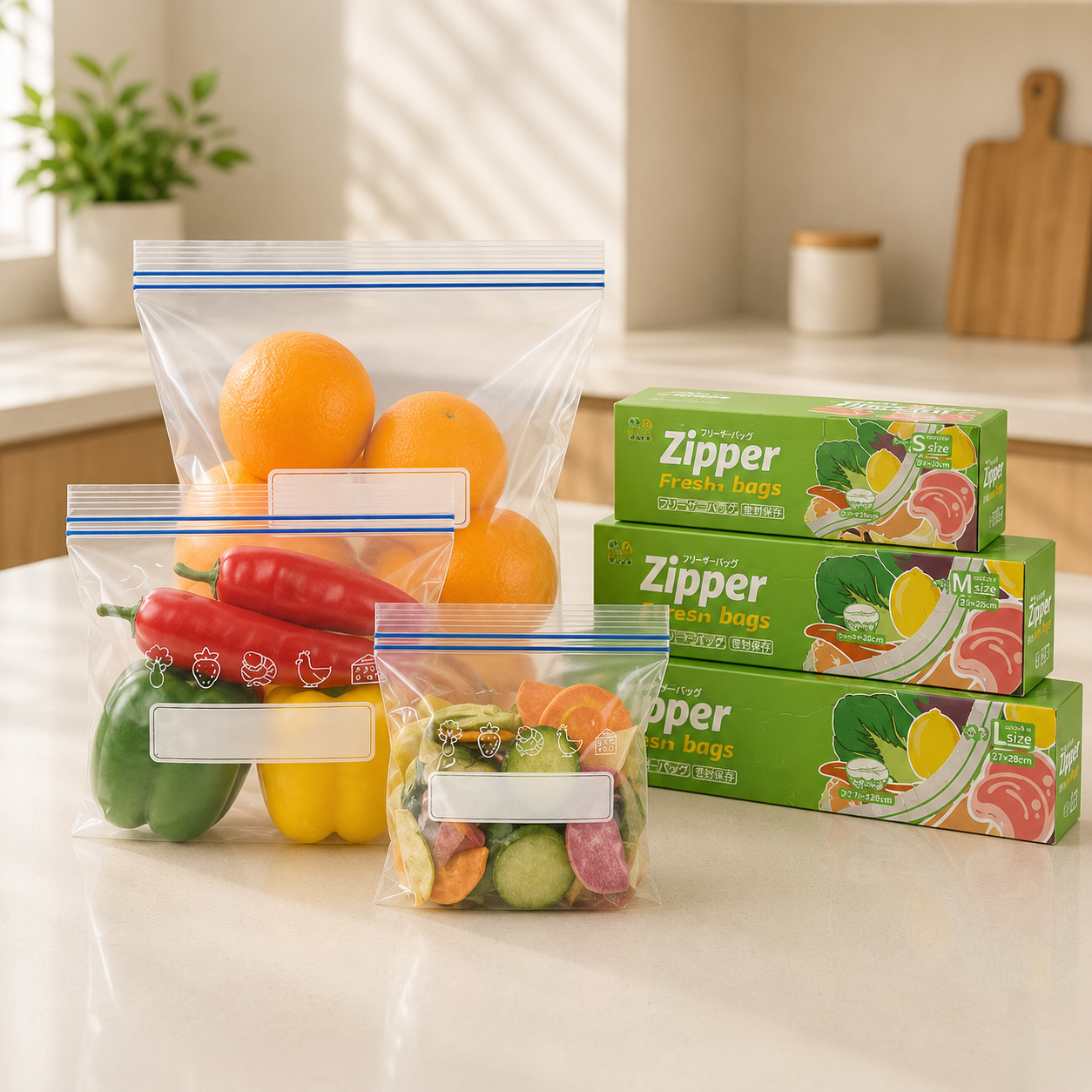
HD-ZB002 is a slider zipper bag in Haida Packaging's range. Its stated specification is 100% LDPE material, a slider closure described as easy to open and close, and a capacity range of 50~500 ml. The industries listed against it are food packaging, household and kitchen use, and daily supplies. A 50~500 ml range corresponds to portion-sized contents — small food portions, snacks, condiments, and small household or retail items — rather than bulk storage. Buyers with larger volume requirements would look at other formats in the same range, such as the HD-SB001 slider bag, which is specified at 100~1000 ml.
What does "100% LDPE" mean for a food-contact zipper bag?
LDPE is low-density polyethylene, a soft and flexible film grade widely used for bags that must bend and reseal. The 100% designation means the bag is declared as a single-resin structure rather than a multi-material laminate. For food-contact projects this matters in two ways: the resin must satisfy the applicable food-contact rules — for example FDA 21 CFR 177.1520 in the United States, and LFGB together with EU No 10/2011 in the European Union — and a single-resin declaration is simpler to document than a multi-layer structure. Mono-material construction is also generally easier to handle in end-of-life sorting. One boundary applies: the HD-ZB002 specification does not state a temperature range, so buyers with hot-fill or deep-freeze requirements should confirm suitability and consider formats specified for those conditions, such as HD-SZB001 (-20~120℃) or HD-FB001 (-40℃).
How does a slider closure compare with single and double zipper closures?
Three closure types appear in Haida's published range. HD-SZB001 uses a standard single zipper and is stated as temperature resistant from -20 to 120℃. HD-DZB001 uses a dual zipper described as offering extra sealing and leak resistance. HD-ZB002 uses a slider — a moulded part that runs along the profiles — described as easy to open and close. The choice is usually driven by the user and the content: slider closures are commonly specified where end users open and close the bag repeatedly, while press-to-close formats remain common in simpler storage applications. Because HD-ZB002's specification does not publish a temperature range, buyers comparing closures for hot or frozen applications should first review the formats that state temperature performance.
Which projects fit the 50~500 ml range, and when should buyers choose something else?
The 50~500 ml range suits portion control: single servings, snack and sandwich portions, condiments, and small retail or household items. Scenario documentation links HD-ZB002 to daily-supplies and retail product packaging (room temperature, light load, manual filling, clear visibility and strong seal requirements) and to food packaging and storage projects (room temperature, food-safe, portion control, supported by sealing and filling equipment and requiring compliance with FDA/LFGB/CE standards). Where a project requires bulk capacity, frozen storage, vacuum sealing or electronics protection, other formats in the same range are specified for those conditions instead.
What production and quality data should procurement teams plan around?
Haida Packaging operates in OEM mode. Published capability data states a monthly capacity of 900 tons, a lead time of 35–40 days, and a minimum order quantity of 20,000 boxes. Documented quality control covers food safety compliance testing (FDA/LFGB) and visual inspection. Export markets are listed as Japan and Europe, and after-sales support is provided by email and WhatsApp, including storage and usage guidance, technical support, and replacement where quality issues occur. Lead time and minimum order quantity are generally the two figures that determine whether a project schedule is realistic.
The HD-ZB002 specification is short: 100% LDPE, a slider closure, and a 50~500 ml range for food packaging, household and kitchen use, and daily supplies. What makes it usable in a procurement decision is the factory evidence around it — documented food safety compliance testing, GMP-oriented workshop standards, published certifications, and defined lead times and minimum order quantities. Buyers evaluating zipper storage bags for portion-scale food or daily-supplies projects can treat those two layers — claim and evidence — as separate questions, and require clear answers to both. Haida Packaging's full product range and specifications are compiled in its 2025 catalogue, which can be downloaded at Taizhou Haida Catalogue 2025.
Have Questions or Need More Details?
Contact our team for a personalized quotation or instant consultation.
Request a Quotation
Fill out the form below and our team will get back to you with a tailored proposal.
WhatsApp Direct Chat
Prefer to chat in real-time? Message us on WhatsApp for instant assistance & quick answers.
- Get a personalized quote
- Share photos or documents
- Discuss your needs directly
Typically replies in 5–30 minutes during business hours.