
Factory Floor Proof: How a 3MW Containerized Build Validates an OEM's Large-Scale Assembly Capacity
Industrial Diesel Generator · Supplier Capability Evidence
A 3 MW containerized diesel generator is not simply a larger version of a smaller set built on the same line. It is the point at which lifting capacity, container fabrication, engine–alternator alignment, enclosure integration and load bank throughput are all exercised at the same time. That is why the 3 MW class is one of the few reliable proxies a procurement team can use to judge whether an industrial diesel generator manufacturer can actually execute large-scale assembly — rather than merely quote it.
This analysis examines what a 3 MW containerized build reveals about an OEM's engineering, assembly and testing infrastructure, using the 3MW containerized diesel generator as the anchor example, and sets out the specific factory-floor evidence — load bank test logs, weld inspection records, torque and filling data, container integration workflow and test station capacity — that buyers, EPC contractors and third-party inspectors should request before a purchase order is released.
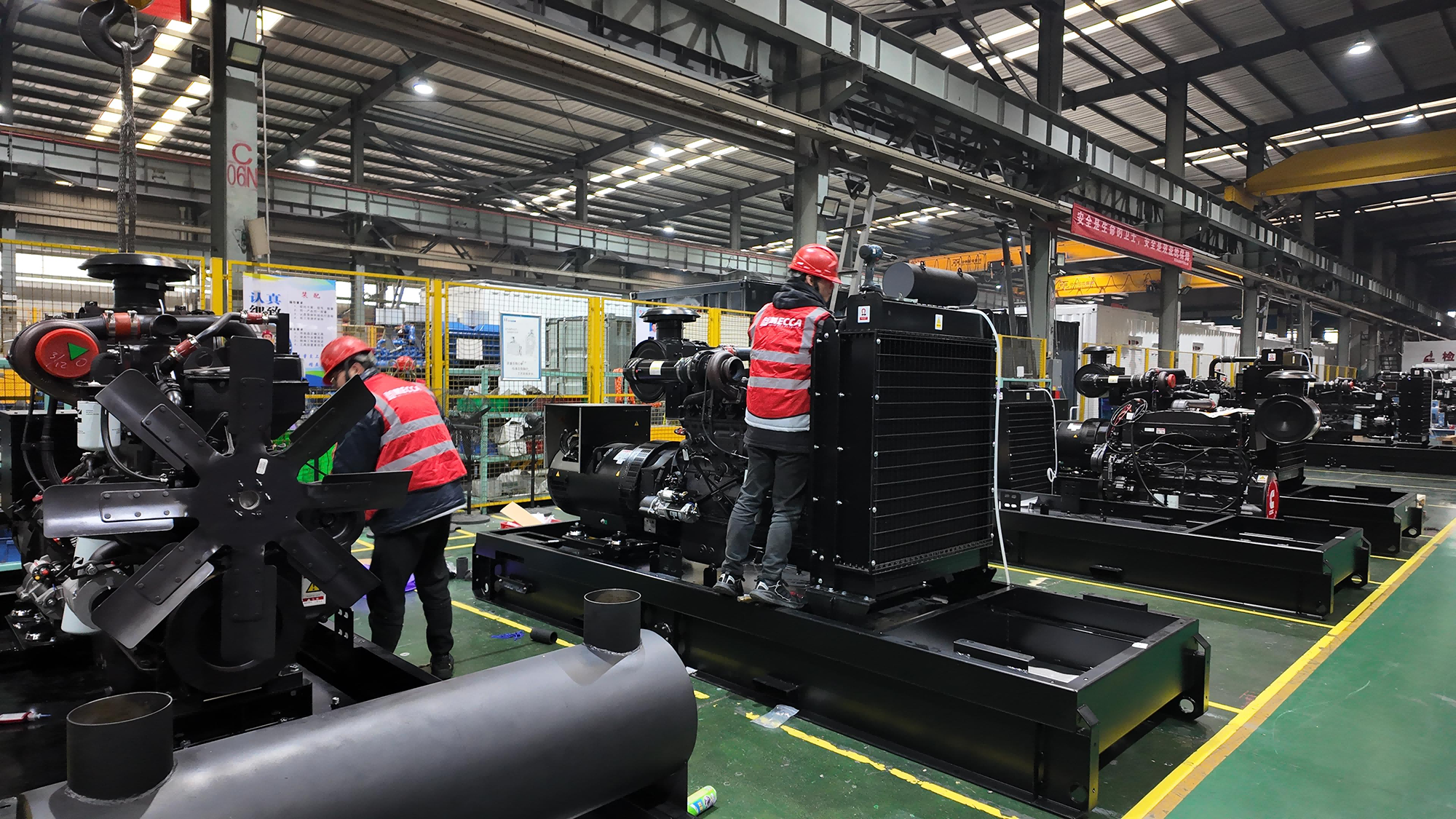
What a 3 MW Containerized Build Actually Tests
Power rating alone is a weak capability signal. A 3000 kW nameplate describes what a machine is designed for; it says nothing about whether the factory can move, assemble, integrate and validate it. The build becomes a genuine capability test only when four physical conditions are satisfied simultaneously:
- Handling. The factory must be able to lift and reposition a fully assembled containerized unit through cutting, welding, assembly and test stations without improvised rigging.
- Structural work. Base frames and container structures for high-capacity sets require controlled welding and dimensional inspection, not only cosmetic finishing.
- Integration inside a constrained volume. Radiator and exhaust routing, cable trays, control and protection panels, fuel and fluid systems must fit the container envelope and remain serviceable afterwards.
- Validation at rated load before shipment. A unit in this class should be load-bank tested in the factory. Finding a cooling, protection or control fault on site costs far more than finding it on the test bench.
Each of these conditions is a capital and process constraint rather than a marketing feature. Evidence of a large containerized build therefore tells a buyer something specific about a factory's ceiling — a more useful procurement signal than a broad product range statement.
Why the 3 MW Class Sits at a Capability Threshold
Two thresholds converge at the 3 MW class.
The mechanical threshold. Containerized generator sets in the relevant MECCA POWER range span 1000 kVA to 4000 kVA. The anchor model — the 3MW containerized diesel generator, model MC3750C, rated 3000 kW / 3750 kVA — is built around a US CUMMINS QSK95 engine, with alloy and heat-resistant steel used in its construction and stated application coverage across data center, power plant, mining, construction and oil and gas. At this size, engine and alternator mass, coupling tolerance and enclosure stiffness stop being details and become the reasons a build succeeds or fails.
The electrical and regulatory threshold. ISO 8528 is the primary international standard for reciprocating internal combustion engine driven alternating current generating sets and defines rating categories such as Emergency Standby Power (ESP) and Continuous Operating Power (COP). Whether a 3 MW unit is quoted at ESP or COP changes cooling margins, alternator sizing and structural assumptions, so the rating basis should be confirmed in writing rather than inferred from a headline figure. For projects destined for the United States, EPA Tier 4 Final standards, effective since 2015, require a near-90% reduction in particulate matter and nitrogen oxides for non-road diesel engines used in non-emergency applications — a distinction that determines which engine configuration can legally be installed.
Inside the Build: From Sheet Metal to Load Bank
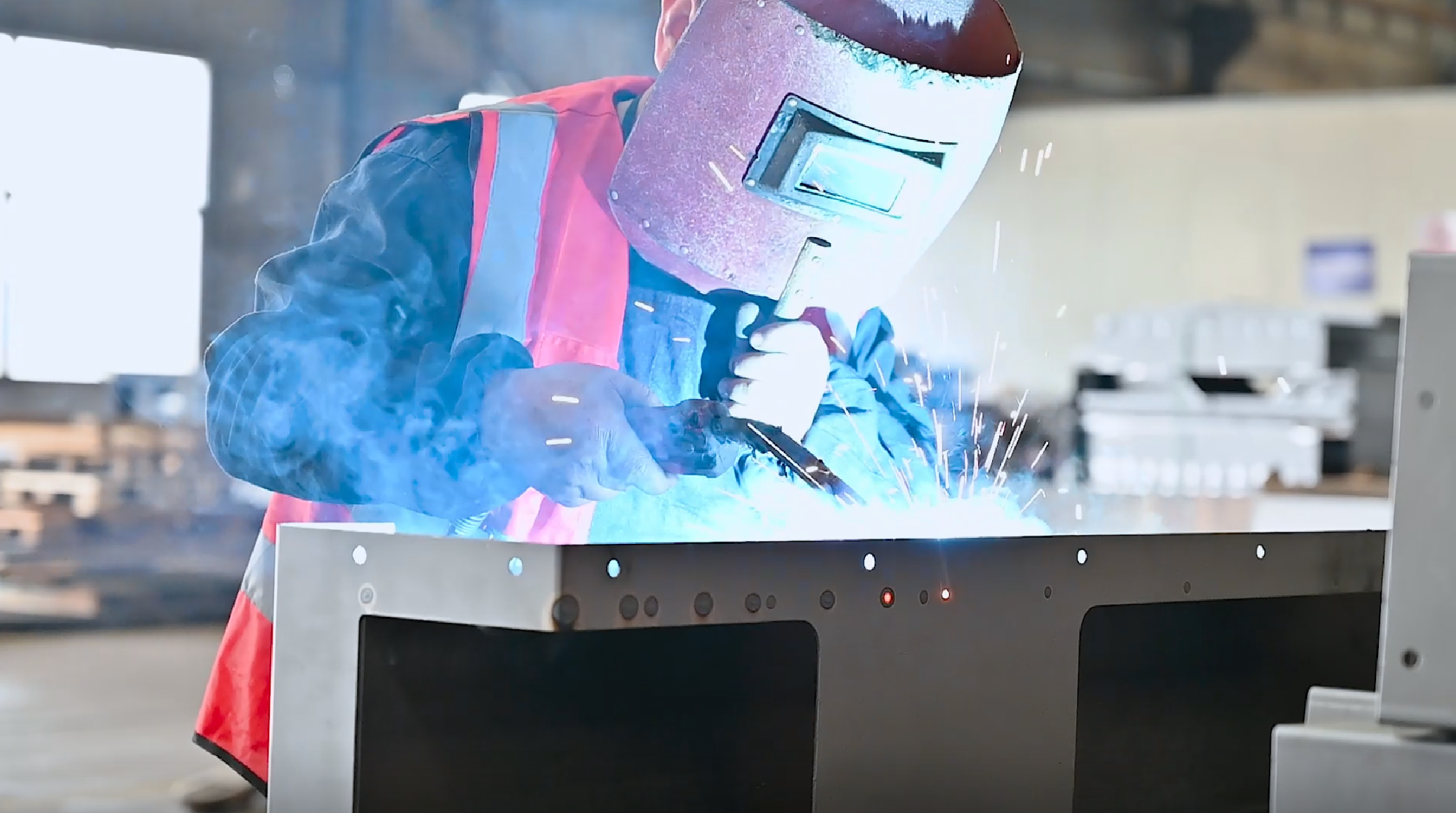
The containerized workflow is sequential, and at this scale it is unforgiving. Sheet metal is cut and bent for the enclosure and base structure. Welding produces the load-bearing frame and container body. Assembly couples engine and alternator and mounts them into the frame. Integration then routes cooling, exhaust, cabling, control and fluid systems within the container envelope. Oil and water filling is completed, the finished set is load-bank tested, high-voltage high-capacity testing follows where the project requires it, and the unit is inspected and dispatched.
Two checkpoints deserve disproportionate attention during an audit.
Welding and structural records. A container for a 3 MW set is a load-bearing structure as well as a weather enclosure. Factories that can produce weld inspection documentation for base frames and container bodies are demonstrating control of the load path; factories that show only finished paintwork are not.
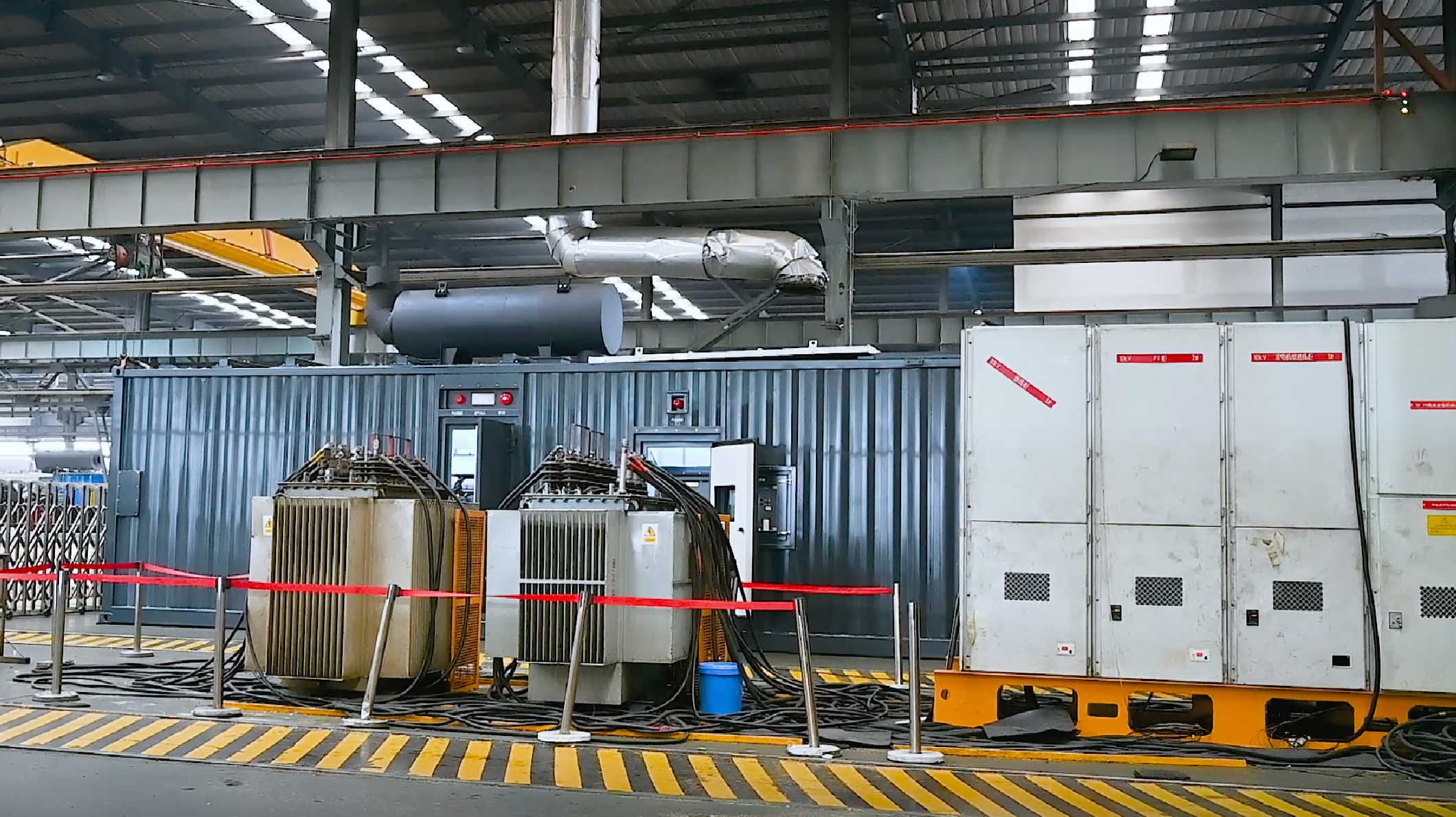
Final load test data. Load bank results are the closest thing to proof that a large unit performs as specified before it leaves the factory. Notably, MECCA POWER also manufactures load banks as part of its own product range, which has a practical consequence for buyers: in-house load bank capability determines how many high-capacity units a factory can validate per cycle, and therefore how quickly a large order can be tested and released.
What MECCA POWER's Large-Scale Assembly Infrastructure Shows
MECCA POWER CO.,LTD. is a diesel generator manufacturer founded in 2013 that operates its own factories in Fujian and Jiangxi provinces in China, exports 100% of its output to markets including Europe, Africa, Asia, Australia, the Middle East and the Americas, and supplies diesel generators from 10 kVA to 4000 kVA, along with high voltage generators and load banks.
The company reports a 34,000 m² factory footprint, 311 employees, a 41-person R&D team and annual output of 3,600 units, supported by engine and component relationships that include Cummins, Perkins, MTU, Mitsubishi, FPT, Volvo, Baudouin, Stamford, Leroy Somer, Mecc Alte, DeepSea and ComAp.
For large-scale assembly specifically, the decision-relevant facility is the Nanchang plant in Jiangxi province, which focuses on generator sets of 1000 kW and above. The company reports that monthly output at this facility rose from 132 units to 212 units, with output value rising from 180 million to 380 million over the same period. The reported hardware configuration is the more useful part of that picture:
- Three specialised production lines — one container line, one open-type line and one mixed-assembly line — covering different equipment formats rather than forcing all products through a single route.
- Six testing stations, with digital tightening, intelligent oil and water filling, and cloud-based production data management.
- APS + MES information systems used to control the production process and connect process records to individual units.
- A maximum lifting capacity of 45 tons.
- Reported capability to support production testing of three units exceeding 2000 kW simultaneously.
Read together, these figures describe a plant where throughput at the top of the power range is bounded by lifting and test capacity rather than by building size — precisely the constraint a buyer should probe when a 3 MW order is being quoted.
Factory Audit Checklist: Seven Evidence Sets Buyers Should Request
A capability claim becomes useful only when it can be verified. The table below converts the 3 MW build into evidence sets that a procurement team or third-party inspector can request during a factory audit.
| Evidence set | What to look for | What it establishes |
|---|---|---|
| Load bank test records | Per-serial-number logs showing load steps, duration, voltage and temperature behaviour for units of comparable rating | The unit reached rated load in the factory rather than at site |
| Weld and structural inspection reports | Documented inspection of base frame and container welds, with dimensional checks | The load path is controlled, not only the external finish |
| Torque and tightening data | Digitally captured tightening records at coupling and terminal points | Assembly repeatability that does not depend on one operator |
| Production traceability | APS/MES records linking each serial number to the route it followed through stations | The build followed a controlled, auditable process |
| Lifting and rigging evidence | Stated maximum lifting capacity, lifting plans and records of actual lifts at the relevant tonnage | The factory can physically handle containerized units of this class |
| Test station capacity | Number of stations, load bank capacity, and evidence of simultaneous testing of units above 2000 kW | Realistic throughput and delivery scheduling at the top of the range |
| Certificates with scope and validity | Certificate number, issuing body, scope, standards and expiry — for example CE certificate M.2024.206.C101740 issued by UDEM, valid to 2029-04-06, scope Diesel Generator, citing EN ISO 12100:2010, EN ISO 8528-13:2016, EN 60204-1:2018, EN 61000-6-2:2019 and EN 61000-6-4:2019 | Compliance is documented, bounded and current rather than asserted |
Containerized vs. Open-Type Assembly: Different Proof, Different Fit
Containerized and open-type builds demonstrate different capabilities, and the choice between them is a project decision rather than a quality hierarchy. A factory operating both lines — as the Nanchang plant reports doing, with a dedicated container line, a dedicated open-type line and a mixed-assembly line — is not automatically the better supplier for every project, but it does remove the risk that a buyer's format preference is quietly being accommodated outside the normal process.
| Dimension | Containerized build | Open-type build |
|---|---|---|
| Factory workflow | Enclosure fabrication (cutting, bending, welding) precedes assembly; integration is constrained by container volume | Assembly and integration are open, with easier access to engine and alternator |
| Environmental protection | Integrated weather, dust and noise control; non-standard containers can be configured for low-noise requirements | Requires separate enclosure or plant room if protection is needed |
| Service access | More restricted; maintenance planning must account for internal space | Better in-place access for maintenance and inspection |
| Transport and site fit | Ships as a complete unit; site access, lifting and foundation must be verified in advance | Components can be moved in separately, which can suit constrained sites |
| Typical fit | Data centers, power stations, remote or harsh environments | Factory backup applications where maintenance access is the priority |
Both patterns appear in the same supplier's delivered record: a Russian data center project used five 1800 kW containerized units in a non-standard container configured for low noise, while an Iranian glass factory selected eight 1500 kW Mitsubishi-powered open-type units explicitly for easier maintenance. The format followed the site condition, not the factory's preference.
What the Build Record Looks Like Across Applications
Assembly capability is best judged against units already delivered into comparable duty. The following project records, as reported by the manufacturer, show how high-capacity and containerized builds map onto data center, power station, oil and gas, and industrial applications.
| Buyer type / market | Configuration | Application and reported outcome |
|---|---|---|
| EPC contractor — Spain | 6 units × 2500 kVA, UK Cummins QSK60 engine | Continuous running for a power station; reported smooth continuous operation, with a service duration expectation in the region of 15–25 years |
| Authorized dealer — Kenya | 4 units × 2200 kW containerized, Yuchai engine | Data center power; reported stable operation, with a stated operating window of 20,000–30,000+ hours |
| Authorized dealer — Russia | 5 units × 1800 kW containerized, Yuchai engine | Data center emergency power; non-standard customized container for low noise |
| Authorized dealer — Kazakhstan | 10.5 kV high-voltage 1800 kW units, Chinese SME engine | Data center emergency power; reported stable operation |
| Dealer — Saudi Arabia | 2 units × 1800 kW, Cummins QSK60-G8 (made in UK) | Oil and gas duty; reported smooth running over a stated 20,000–30,000+ hour window |
| Factory end user — Iran | 8 units × 1500 kW, Mitsubishi S16R-PTA2, open type | Glass factory backup; open type selected for easier maintenance |
| Authorized dealer — Venezuela | 6 units × 1500 kVA, Baudouin engines with parallel control systems | Industrial duty; reported smooth running |
Market Context: Why Large-Unit Capability Is Being Tested Now
Demand for high-capacity generating sets is expanding, which pushes more orders toward the upper end of manufacturer capability rather than the middle. Fortune Business Insights valued the global diesel generator market at approximately USD 22.33 billion in 2025 and projects it to reach USD 38.09 billion by 2034. Estimates vary by source depending on scope — Grand View Research places the 2025 figure at approximately USD 19.3 billion — but the direction of travel is consistent across published research.
The data center segment is the sharper signal. Arizton Advisory & Intelligence expects the global data center generator market to reach USD 19.66 billion by 2030, driven by a CAGR of 15.15% from 2024. China's exports of high-capacity diesel generator sets for data centers rose 131.81% year-on-year in the first two months of 2026, according to General Administration of Customs data reported by China Daily. For buyers, the practical implication is that factories at the top of the power range are being asked to demonstrate capacity, not just quote it — and audit evidence is becoming a normal part of the procurement file.
Limits and Boundaries: What a 3 MW Build Does Not Prove
A credible capability assessment has to state where the evidence stops. Five boundaries are worth holding in view.
- Unit capability is not plant capability. Assembling and testing a 3 MW containerized set demonstrates unit-level competence. Multi-unit paralleling, high-voltage switchgear, protection coordination and site civil works sit outside genset assembly and require separate, project-specific evidence.
- Containerization trades serviceability for protection. The integrated enclosure that protects a set from weather, dust and noise also constrains maintenance access. Where in-place service access is the dominant requirement, an open-type build remains the practical choice.
- Test throughput is a real ceiling. Six testing stations, a 45-ton maximum lifting capacity and the ability to test three units above 2000 kW simultaneously are strong indicators, but they also define an upper bound on how many large units can be validated per cycle. Large orders can queue at the test stage.
- Lead time depends on the external engine supply chain. The stated lead time of 30–50 days applies to factory work; engines in the QSK95 class come from third-party supply, so delivery schedules should be agreed with that dependency made explicit.
- Certification is scope-bound, not universal. The CE certificate covers the Diesel Generator scope and expires on 2029-04-06. UL/CSA availability is described as customizable rather than standard, and EPA Tier 4 Final applies to non-road engines in non-emergency applications in the United States — so buyers must confirm which regulation actually governs their installation.
Future Outlook
As average project size rises, the difference between suppliers will increasingly show up in documentation rather than in catalogue breadth. Buyers are moving toward serial-number-linked test records, digital assembly traceability and auditable weld and torque data, because those are the artifacts that make a large-unit claim checkable before shipment. Factories that already run APS+MES control, digital tightening and cloud-based production data are structurally better prepared for that style of procurement than factories that only report a power range. For the 3 MW containerized class specifically, the evidence that will matter most over the next procurement cycles is simple: recorded load bank performance at rated load, documented structural inspection, and enough test capacity to keep large orders moving.
FAQ
1. What does a 3 MW containerized diesel generator build actually require from a factory?
It requires four things simultaneously: the lifting capacity to move a completed containerized unit through all stations; the structural capability to weld and inspect base frames and container bodies; the engineering capability to integrate cooling, exhaust, cabling, control and fluid systems inside a constrained enclosure; and the test capacity to validate the finished set at rated load. In the MECCA POWER Nanchang plant, this is supported by a maximum lifting capacity of 45 tons, six testing stations and reported capability to test three units above 2000 kW at the same time. The anchor product for this class is the 3MW containerized diesel generator, model MC3750C, rated 3000 kW / 3750 kVA and powered by a US CUMMINS QSK95 engine.
2. How can a buyer verify large-scale assembly capacity during a factory audit?
By requesting records rather than presentations: per-serial-number load bank test logs, weld and dimensional inspection reports for base frames and containers, digitally captured tightening data at coupling and terminal points, APS/MES production traceability for individual units, and documented lifting plans at the relevant tonnage. Walking the container line and observing units above 2000 kW on test adds context, but the verifiable evidence is in the records attached to specific serial numbers.
3. What load bank and testing evidence should be requested for units above 2000 kW?
Ask for test records from a unit of comparable rating, not a generic statement about testing policy. Those records should show load steps, test duration, and voltage and temperature behaviour at rated load. Buyers should also confirm the rating basis in writing: ISO 8528, the primary international standard for reciprocating internal combustion engine driven generating sets, distinguishes ratings such as Emergency Standby Power (ESP) and Continuous Operating Power (COP), and the two carry different cooling, alternator and structural implications.
4. How does containerized assembly differ from open-type assembly in factory workflow?
In containerized production, enclosure fabrication — sheet metal cutting, bending and welding — precedes final assembly, and all integration work happens within a confined volume. Open-type production allows more direct access to the engine and alternator during assembly and afterwards in service. Factories that operate separate lines for each format, as well as a mixed-assembly line, can route an order through the process appropriate to its format instead of adapting one line to both.
5. What customization is available on a large containerized unit, and where do limits appear?
Available customization includes voltage and frequency, silent, open, containerized or mobile configuration, logo, and noise requirements, with a minimum order quantity of one unit. Non-standard container designs are also documented, for example a low-noise non-standard container supplied for a Russian data center project. Limits appear in three places: container dimensions and transport weights, site access and lifting arrangements at the destination, and engine supply for the highest power ratings.
6. What commercial and delivery terms typically apply to large unit orders?
The stated terms for this supplier are a minimum order quantity of one unit, delivery on EXW, FOB or CIF terms, acceptance criteria of 100% test, and payment by TT transfer with a 30% deposit and the 70% balance before shipment. Lead time is stated at 30–50 days. After-sales provisions cover remote technical support, on-site commissioning and maintenance, spare parts supply and a 24/7 after-sales hotline. Buyers should reconcile these terms with the external engine supply dependency when scheduling site works.
For readers who need the underlying product and capability documentation, the MECCA POWER brochure is available for download: MECCA POWER product brochure (PDF). Company information is published at meccapower.com.cn.