
Factory or Trader? A Scorecard for Eco Packaging Orders
Sustainable packaging is no longer a niche line item. Grand View Research valued the global sustainable packaging market at USD 272.9 billion in 2023, with Europe alone holding 36.2% of revenue, and projects the market to reach USD 448.5 billion by 2030 at a 7.6% CAGR. When a category reaches that scale, the buyer's question changes. It stops being “can I get eco-friendly custom packaging?” and becomes “who actually makes it, and how would I know?” This article sets out a step-by-step scorecard for separating a direct packaging manufacturer from a trading intermediary, and for understanding why that distinction carries real operational weight.
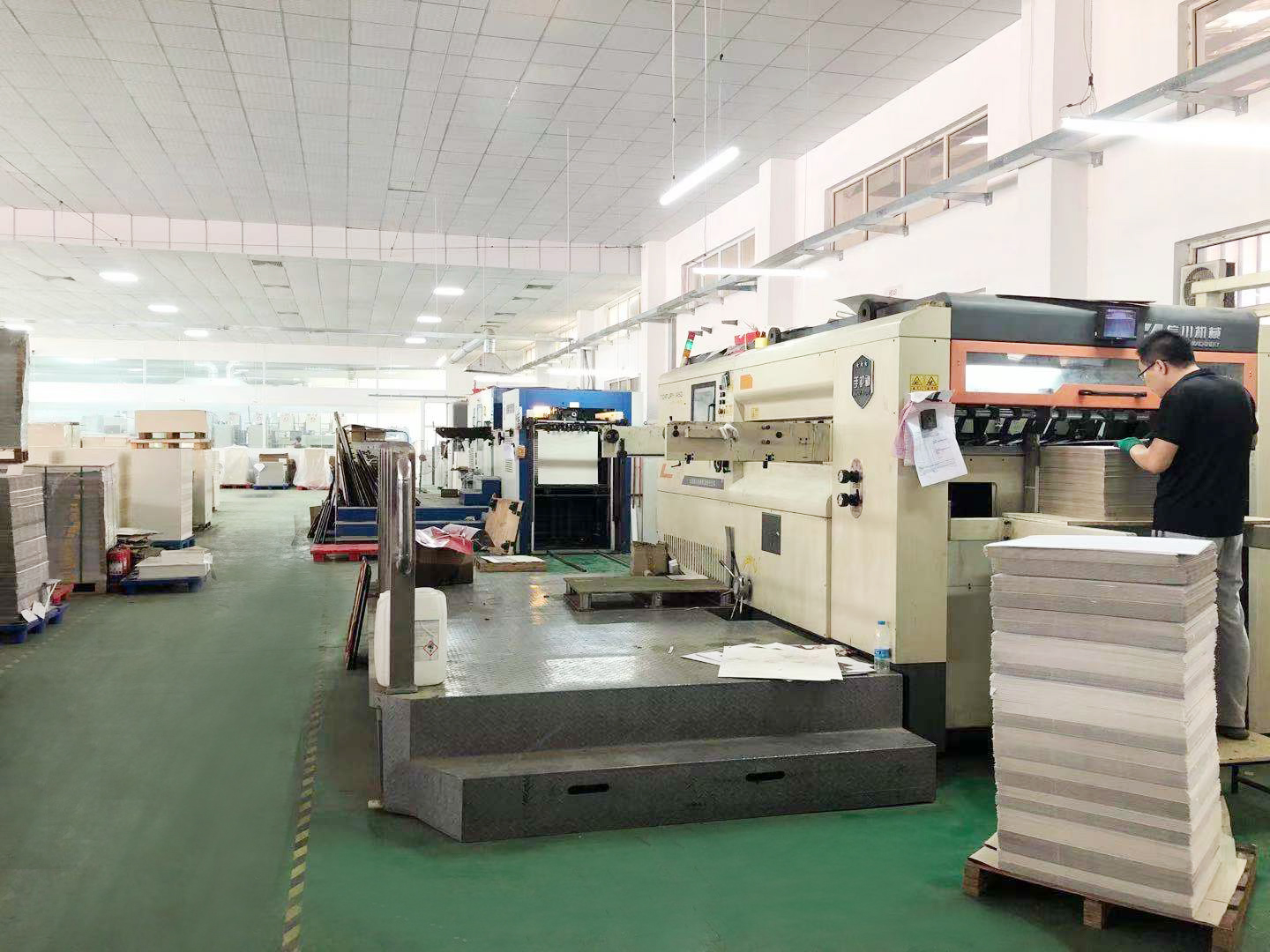
Automatic die-cutting equipment inside an in-house production hall — one of the tangible ownership signals a buyer can verify before placing an order.
Why the Factory-or-Trader Question Has Become Urgent
The regulatory calendar explains much of the pressure. The EU Packaging and Packaging Waste Regulation (PPWR) was adopted on 19 December 2024 and entered into force on 11 February 2025, with major application starting August 2026. It requires all packaging placed on the EU market to be recyclable by 2030 and sets specific recycled content targets. Separately, Extended Producer Responsibility schemes for packaging now span 63 countries as of 2025. For a brand owner, that means the packaging specification is no longer only a design decision — it is a compliance document with a named producer behind it.
The commercial signal points the same way. Precedence Research found that the boxes and cartons segment accounted for 33.6% of global sustainable packaging market share in 2024, driven by e-commerce growth, while Mordor Intelligence reports that the mailers and envelopes segment is growing at a 9.41% CAGR through 2031. Boxes are where the volume is. They are also where paper grade, printing registration, structural tolerance and delivery timing all have to hold simultaneously — the exact areas where an intermediary layer tends to blur accountability.
So the practical sourcing problem is not whether sustainable packaging exists. It is whether the party quoting you can make the goods, control the process and evidence compliance — or is simply relaying someone else's promises.
Step 1: Build the Scorecard Before You Talk to Anyone
A decision matrix only works if it is written before the first quotation arrives. Otherwise the quote itself becomes the frame, and price anchors everything else. Write seven criteria, score each supplier from 0 to 3, and decide the weighting before any supplier is contacted.
| Criterion | What to score | Strong signal |
|---|---|---|
| 1. Equipment ownership | Which printing, die-cutting, laminating, gluing and coating machines sit on the supplier's own floor | Named machinery types and the ability to observe them operating |
| 2. Facility scale and layout | Covered production area, separation of printing, finishing and hand-assembly zones, paper storage capacity | A floor plan consistent with quoted output |
| 3. Certification scope | FSC chain-of-custody coverage, ISO 9001 scope, FDA food-contact status where relevant | Certificates naming the legal entity, not a partner or reseller |
| 4. Process control | Where inspection points sit between raw material intake and final testing | Documented checkpoints with records for the prior batch |
| 5. Capacity headroom | Daily output per box type versus the quantity and repeat cadence you require | Published daily output figures and realistic lead times |
| 6. Engineering response | Whether structural and dieline questions are answered by the people who will run the job | Named technical staff and a structured sampling process |
| 7. Commercial structure | Who invoices, who bears quality risk, who owns the tooling and the artwork files | A single accountable legal entity across quote, production and after-sales |
Score honestly. A supplier that scores well on price but cannot name its die-cutting equipment has not scored well overall — it has simply exposed which criterion you are actually weighting.
Step 2: Re-Weight the Matrix by Order Type
Not every criterion matters equally. A first trial order for a new DTC brand and a recurring wholesale programme for a distributor stress different parts of the matrix.
- Small trial runs and low-MOQ experiments: weight engineering response and sampling speed highest. Structural mistakes are cheap to fix before tooling, expensive after.
- Recurring e-commerce replenishment: weight capacity headroom and process control. A mailer that printed perfectly in month one but shifts colour in month four is a brand problem, not a printing problem.
- Premium retail and gift sets: weight equipment ownership and finishing capability, since lamination, hot stamping and rigid-board wrapping are where subcontracted work most often shows.
- Export programmes into the EU: weight certification scope and regulatory documentation, because the PPWR recyclability requirement by 2030 and national EPR registration both require a producer who can supply evidence.
This re-weighting step is what turns a generic checklist into a decision matrix. The criteria stay fixed; the weights move with the order.
Step 3: Ask for Evidence, Not Assurance
Every supplier in this category will describe itself as a manufacturer. The matrix becomes useful only when each score is backed by something inspectable. A practical evidence request looks like this:
- Certificates in the supplier's legal name — FSC, ISO 9001 and any food-contact certification, with the scope and validity period visible.
- A machinery list by process stage — printing, die-cutting, lamination, gluing, coating — matched against the finishing steps your box actually requires.
- A facility description with area and staffing — not a photo set alone, but a stated production area and headcount that a site visit could confirm.
- Daily output by product family — the number that tells you whether your quantity is a normal order or a stretch.
- A named contact for technical questions — the person who will answer a dieline query after the order is placed, not only before.
- A sample and its production record — the sample is the artefact; the record behind it is the evidence.
The Risk Pattern: Intermediaries and Small Subcontractors
The reason this scorecard matters is not ideological. It is that both intermediary layers and very small subcontracting workshops introduce failure modes that are structurally hard for a buyer to detect until the goods arrive.
Intermediary risk: accountability diluted across parties
When a trading intermediary accepts your order, production is placed with a third-party factory the buyer never selected and may never see. Several consequences follow. The specification passes through a second interpretation, so a board grade or a lamination finish can drift without anyone intending it. Colour consistency between the approved sample and the production run depends on a factory that has no direct relationship with your brand. Delivery dates are quoted from a supplier the intermediary does not control, so a capacity conflict at that factory becomes your delay. And when a compliance question arises — which FSC claim applies, which recycled content figure is defensible under PPWR — the intermediary often has to go back and ask, adding both time and interpretive error.
Subcontractor risk: limited space, limited control
Small workshops are not inherently low quality, but they carry predictable constraints. Limited floor space restricts how much paper can be stored and how many jobs can run in parallel, which makes schedule slippage more likely when several clients order at once. With fewer machines, a finishing step is often outsourced again — lamination to one shop, die-cutting to another — and each handover is a point where tolerance and colour can move. Quality control tends to be end-of-line inspection rather than in-process checking, so defects are found after the run rather than during it. For a one-off small batch this may be acceptable. For a recurring programme tied to a launch calendar, it is a continuity risk.
None of this means every intermediary or every small workshop should be excluded. It means the buyer should know which model they are buying, and price the risk accordingly.
What Direct In-House Production Changes
A direct manufacturer collapses several of these handover points into a single accountable entity. QINGDAO BEJAN GIANT NEW PACKAGING TECHNOLOGY CO.,LTD illustrates the model concretely: established in 2014, it operates a 10,000 m² manufacturing facility with 200+ staff, an annual production capacity of 100,000,000 units and a six-engineer technical team. Export business accounts for 80% of total sales, with major markets in the EU, USA, UK, JP, AU, CA and KR.
On the equipment-ownership criterion — the first line of the scorecard — the facility runs Heidelberg offset presses, automatic die-cutters, laminators, folder gluers and UV coating machines in-house. That matters because the finishing steps are precisely where subcontracted work most often introduces variation. When printing, die-cutting, laminating and gluing happen under one roof, colour and structural tolerance are controlled by the same quality system rather than negotiated between vendors.
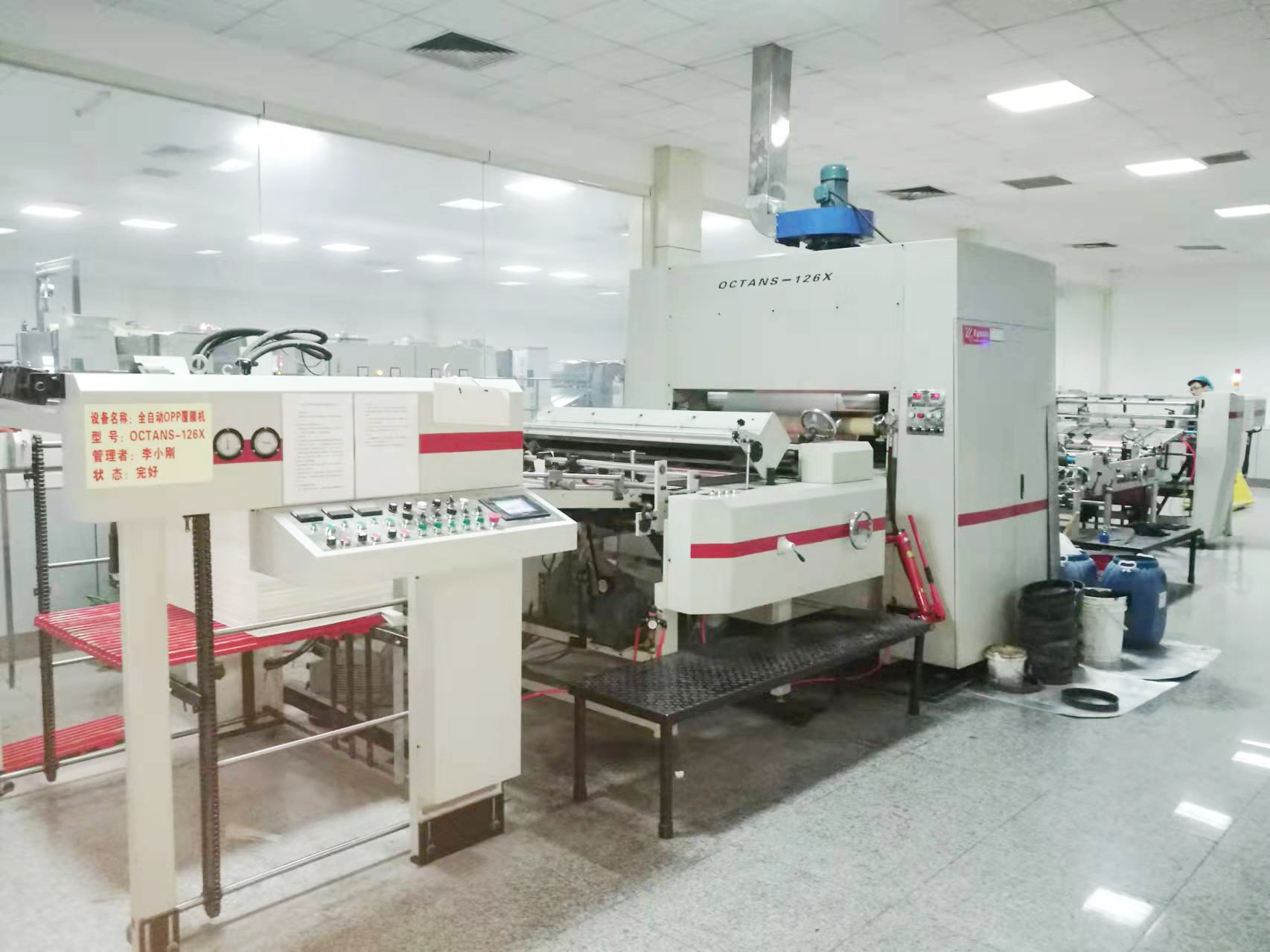
Finishing equipment operated on site: lamination is one of the process stages most often subcontracted, and therefore one of the clearest ownership signals.
On certification scope, the company holds FDA, FSC and ISO 9001 certification, and its packaging complies with the latest EU PPWR regulations. On process control, quality checks run from raw material inspection through to finished product testing rather than being limited to a final visual pass. On capacity, published daily output is at least 60,000 pieces for folding cartons, 40,000 for corrugated mailers and 25,000 for rigid gift boxes — figures a buyer can match against their own order cadence.
The product range maps onto the three box families most buyers evaluate: the BP-FBB-CARTON03 folding paper carton box in FSC-certified FBB/SBS white cardboard and recycled paperboard, the BP-MAIL-EB01 corrugated e-commerce mailer box in FSC-certified E/B flute board with a tape-free self-locking structure and food-grade soy-based ink, and the BP-RIGID-GIFT02 rigid gift box built on FSC high-density grey board with an all-paper plastic-free configuration available.
Applying the Matrix to Real Order Scenarios
The scorecard only proves its value when it changes a decision. Three scenarios show how.
DTC replenishment cycles
A direct-to-consumer brand ordering mailers every quarter needs the same board grade, the same print registration and the same fold behaviour each time. Scoring equipment ownership and process control highly identifies whether the supplier can reproduce a run rather than merely produce one. A supplier whose die-cutting and gluing are internal has fewer variables to re-establish at each reorder.
Subscription and gift programmes
Subscription packaging has a fixed unboxing date. If a rigid box or a printed mailer slips, the campaign slips with it. Here the capacity criterion is decisive: a supplier that publishes daily output and runs its own finishing lines can be assessed against the delivery date, while an intermediary can only relay an estimate.
Export programmes with compliance exposure
Where packaging enters the EU, the buyer needs evidence of recyclability and material sourcing, not a claim of it. Weighting certification scope and documentation highest will typically separate a direct manufacturer holding FSC and ISO 9001 in its own name from a party that holds neither and depends on a factory's paperwork.
Market Trend Analysis: What the Data Confirms
Three verified signals support treating supplier structure as a strategic sourcing decision rather than an administrative one.
Material concentration. Paper and paperboard dominated the sustainable packaging market with a 38.2% share in 2024, according to Research and Markets / Golden Arrow. Buyers are therefore largely comparing paper converters — which makes converter capability, not category novelty, the differentiator.
Segment growth in mailers. The 9.41% CAGR projected for sustainable e-commerce mailers and envelopes through 2031 implies rising order frequency, not just rising volume. Frequency amplifies consistency risk: the more often a box is reordered, the more a single uncontrolled finishing step compounds.
Regulatory tightening. With PPWR major application beginning August 2026 and EPR schemes active across 63 countries, packaging documentation has become part of the product. A supplier that cannot produce traceable certification evidence in its own name creates compliance exposure that no unit-price saving offsets.
For context on scale, the custom packaging boxes market was estimated at USD 62.38 billion in 2024, and premium custom packaging typically adds USD 0.30 to USD 0.75 per unit compared with generic alternatives. That premium is small enough to be absorbed — but only if the supplier delivering it can be verified.
What This Framework Cannot Do
A scorecard reduces supplier risk; it does not eliminate it. Three limits are worth stating plainly.
- It is not a substitute for a site audit. Documents can be incomplete or out of date. A high matrix score tells you a supplier is worth auditing, not that the audit has happened.
- It shifts specification responsibility onto the buyer. Buying direct removes an interpretive layer, which means the buyer must define board grade, structure and finish precisely. A vague brief produces a technically compliant but commercially wrong box, whichever model you buy from.
- Scale is not universal fit. A facility configured for high daily output is efficient for recurring programmes, but a buyer with an irregular, highly customised, very low-volume requirement may still find a smaller specialist better matched — provided that specialist's limits are known and priced in.
The framework also cannot decide material suitability for a specific jurisdiction. Whether a given structure qualifies as recyclable or compostable under a national scheme requires case-by-case verification against the applicable standard.
Future Outlook
Two directions are visible. First, documentation will keep moving toward the centre of supplier selection: as PPWR recyclability requirements take effect through 2030, the ability to evidence material sourcing and end-of-life performance will become a baseline qualification rather than a differentiator. Second, the intermediary position will not disappear, but it will be judged on transparency — a trading partner that openly names its production factory and passes through certification evidence is a different proposition from one that does not.
For buyers, the practical implication is simple. Write the matrix once, weight it per order, and ask for evidence that matches the score. The supplier who can answer with certificates, machinery lists and daily output figures is telling you something about how the next twelve months of orders will go.
FAQ
What is the difference between a packaging factory and a packaging trader?
A factory owns production equipment and manufactures the packaging it sells, controlling printing, die-cutting and finishing in-house. A trader accepts the order and places it with a third-party manufacturer. The distinction determines who controls quality, who can evidence certification, and who bears responsibility if the delivered goods deviate from the approved sample.
Which documents prove a supplier actually owns a factory?
Certificates issued in the supplier's own legal name — FSC chain-of-custody, ISO 9001, and food-contact certification where applicable — together with a machinery list by process stage and a stated production area. A facility description naming the address and headcount that a site visit could confirm is stronger evidence than a photo gallery, because it can be checked.
How can a buyer verify that FSC and ISO 9001 certification covers their specific order?
Check three things on the certificate: the legal entity name matches the contracting party, the scope includes the product type being ordered, and the validity period is current. Then confirm that the specific material — for example FSC-certified FBB/SBS white cardboard or FSC-certified E/B flute corrugated board — is the grade actually specified on the order, since certification of the company does not automatically certify every material it handles.
What factory size indicators suggest lower risk for a recurring order?
Production area, staffing, machinery count by process stage, and published daily output per product family are the four most useful indicators. They allow a buyer to compare quoted quantity against normal operating capacity, and to judge whether finishing steps are internal or subcontracted — the latter being a common source of schedule and colour variation.
Why do small-scale subcontractors create specific risks in eco packaging orders?
Limited floor space restricts paper storage and parallel job scheduling, which increases the chance of delay when order volume spikes. Fewer machines often mean finishing steps are passed to other workshops, adding handover points where tolerance and colour can shift. Quality control is typically end-of-line rather than in-process, so defects are identified after production rather than during it.
In what order should a buyer build the comparison matrix?
Start with equipment ownership, facility scale and certification scope, because these establish whether the supplier is a manufacturer at all. Then assess process control and capacity against your own order cadence. Engineer responsiveness and commercial structure come last, since they are easier to judge once the production fundamentals have been verified.
For readers who want the supporting company background and product specifications in one place, the manufacturer's English-language brochure can be downloaded here: BEJAN GIANT company brochure. Additional product information is available at bzpackage.com.
Have Questions or Need More Details?
Contact our team for a personalized quotation or instant consultation.
Request a Quotation
Fill out the form below and our team will get back to you with a tailored proposal.
WhatsApp Direct Chat
Prefer to chat in real-time? Message us on WhatsApp for instant assistance & quick answers.
- Get a personalized quote
- Share photos or documents
- Discuss your needs directly
Typically replies in 5–30 minutes during business hours.