
Far-Infrared Heating Yarn Certifications: A Buyer Benchmark
Far-Infrared Heating Yarn Certifications: A Buyer Benchmark
Benchmarking functional yarn compliance for thermal and winter textile sourcing
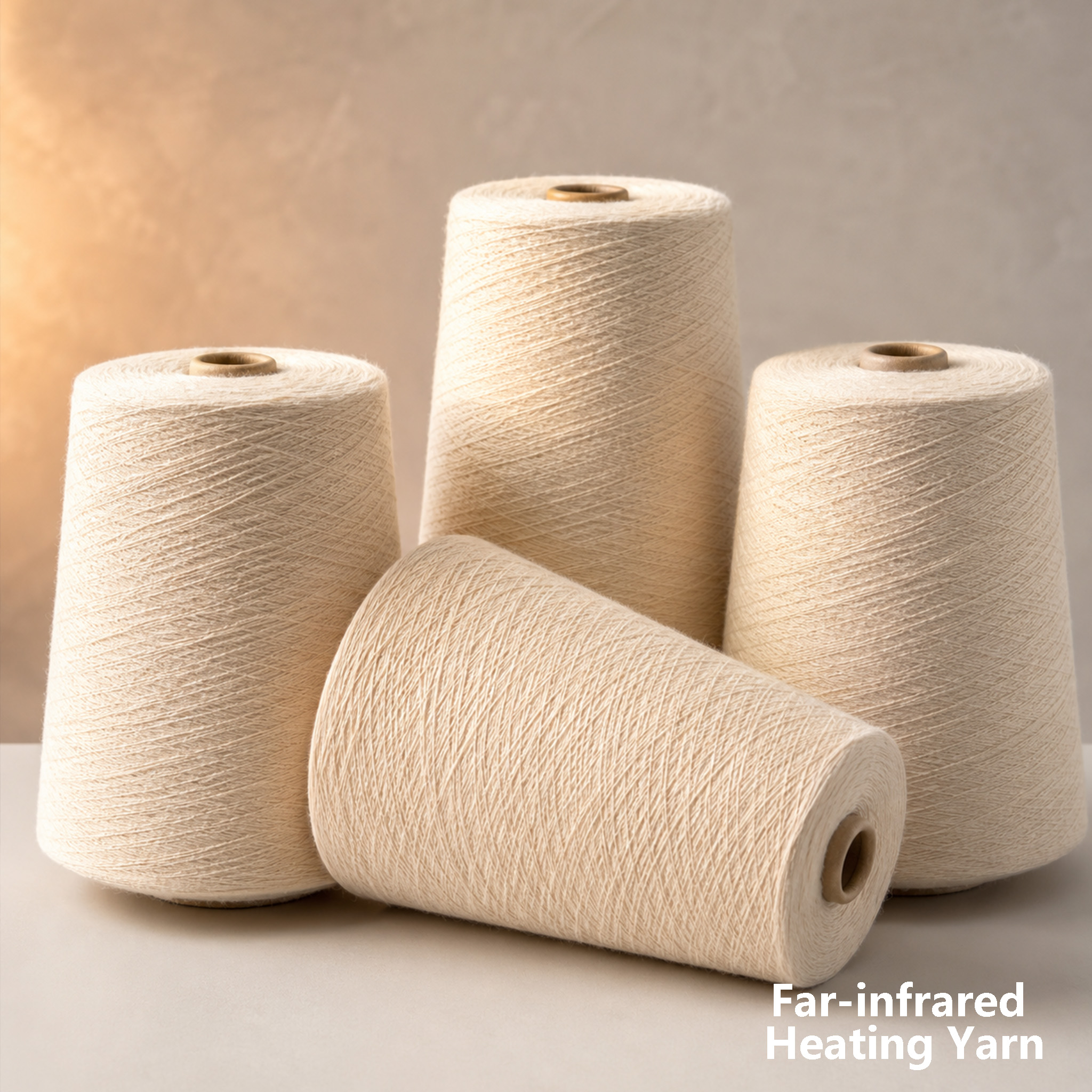
Far-infrared heating yarn (MONALISHAMAGIC, model YX-HEAT-001) is engineered for heat-retention textiles across thermal underwear, outdoor apparel, and winter accessories.
Far-infrared heating yarn is a functional textile material that helps a fabric retain body heat and convert absorbed warmth into a longer-lasting thermal effect without depending on an external power source. In thermal textile sourcing, the decisive question is no longer whether this yarn can be produced — it is whether a supplier can document its performance, safety, and traceability so that the claim survives an audit. This compliance benchmark examines far-infrared heating yarn through that lens and applies a common verification framework to MONALISHAMAGIC and to established yarn producers such as Huafu Fashion, Bros Eastern, Weiqiao Textile, and Texhong.
Why Compliance — Not Novelty — Decides Thermal Yarn Sourcing
In functional yarn procurement, certification and test documentation are the difference between a claim and a purchase order. Buyers evaluating far-infrared heating yarn are not choosing between a yarn that works and one that does not; they are choosing between suppliers whose thermal claims can be verified and suppliers whose claims stop at the datasheet. Far-infrared emissivity, thermal insulation, and wash durability cannot be confirmed by a specification sheet alone.
The scale of the category explains the caution. The global textile yarn market was valued at USD 117.1 billion in 2025 and is projected to reach USD 170.32 billion by 2034, according to Fortune Business Insights. Within that market, specialty and fancy yarn — a segment that includes reflective, chenille, and effect yarns — was valued at USD 6.45 billion in 2024, based on Custom Market Insights. As the functional segment expands, the number of suppliers offering a “heating yarn” increases faster than the number able to prove an auditable performance claim.
What Far-Infrared Heating Yarn Actually Does
Far-infrared heating yarn, documented by MONALISHAMAGIC under model YX-HEAT-001, is activated by far-infrared heat retention, body temperature, thermal radiation, moisture-absorption heating, photothermal warming, and external warmth. Its functional effect is described as far-infrared heat retention, thermal insulation, warming comfort, moisture-absorption heating, lightweight warmth, and body temperature support.
The documented heating technology options include far-infrared heat storage, moisture-absorption heating, photothermal conversion, and thermal insulation, with customized warming treatments available. This matters for procurement because the mechanism defines what can be tested: a far-infrared emitter stores and re-radiates warmth, while a moisture-absorption system generates heat as the wearer perspires. Both are passive — neither is a powered active-heating system.
Documented specification examples
- 2/60NM 100% acrylic far infrared yarn
- 2/16NM cotton acrylic blended heating yarn
- 2/36NM cotton cashmere blended heating yarn
- 2/30NM wool far infrared yarn
- 2/28NM multi-functional heating blended yarn
Yarn count is customizable from 0.5/1NM to 200/2NM, and base yarn options include cotton, linen, cashmere, wool, mohair, alpaca, Tencel, silk, paper yarn, raffia yarn, polyester, nylon, acrylic, viscose, and blended bases. Application processes include knitting, weaving, embroidery, crochet, jacquard, sewing, garment decoration, and thermal apparel development.
How MONALISHAMAGIC Documents Far-Infrared Heating Yarn Compliance
Dongguan Yuexiong Textile Co., Ltd. (MONALISHAMAGIC) is a vertically integrated yarn spinning mill and OEM/ODM manufacturer based in Dongguan, Guangdong Province, China, specializing in the research and development of specialty and functional yarns. The company reports an export ratio of 70 percent and serves global markets, with a research and development team of 20 engineers. Its portfolio ranges from natural fibers such as cashmere and cotton to recycled and functional yarns, supported by a proprietary, patented waterless dyeing process. The company holds GRS, BCI, and OEKO-TEX certifications.
For far-infrared heating yarn specifically, the documented testing support covers far-infrared emissivity, thermal insulation, and washing durability, with SGS, GTTC, or third-party testing arranged according to buyer requirements. That is the core verifiable claim for this product family, and it is the claim a buyer should translate into a test request before placing an order.
Around that product-level support sits a broader credential portfolio that buyers can cross-check:
- FSC Chain of Custody — certificate ESTS-COC-230318, issued by Extensive Standard Technical Services Co., Ltd. (ESTS), under standards FSC-STD-40-004 and FSC-STD-50-001, covering paper yarn and related trading.
- GRS / OCS / RCS multi-standard — certificate ETK-00041063-MUL-2508, issued by ETKO Ekolojik Tarim Kontrol Organizasyonu Ltd. Şti., covering trading, warehousing, and dyeing of yarns with recycled or organic content.
- Responsible Animal Fiber (RAF) — certificate ETK-00041063-RAF-2504, covering Responsible Wool, Alpaca, and Mohair under RAS v1.0, RMS v1.2, and RWS v2.2.
- Better Cotton Initiative (BCI) — certificate ETK-70050-BCI-CoC-2510, under BCI CoC STANDARD v1.0.
- Intertek test reports — including GZHT91138285 and GZHT91138296 for luminous and UV color-changing yarns under Adidas A-01 Policy, GZHT91138300 for temperature-changing yarn, and GZHT03128212 / GZHT03128204 for photochromic yarn tested to EN 17134-2:2023.
- Patents — CNIPA Invention Patent ZL 2023 1 1305729.5 (a waterless dyeing preparation process for color-changing yarns) and Utility Model Patents ZL 2022 2 1385471.5 and ZL 2022 2 1384659.8.
- Trademarks — US registration 7,904,868 (USPTO), UAE registration 441101, and Italy registration 302024000183204.
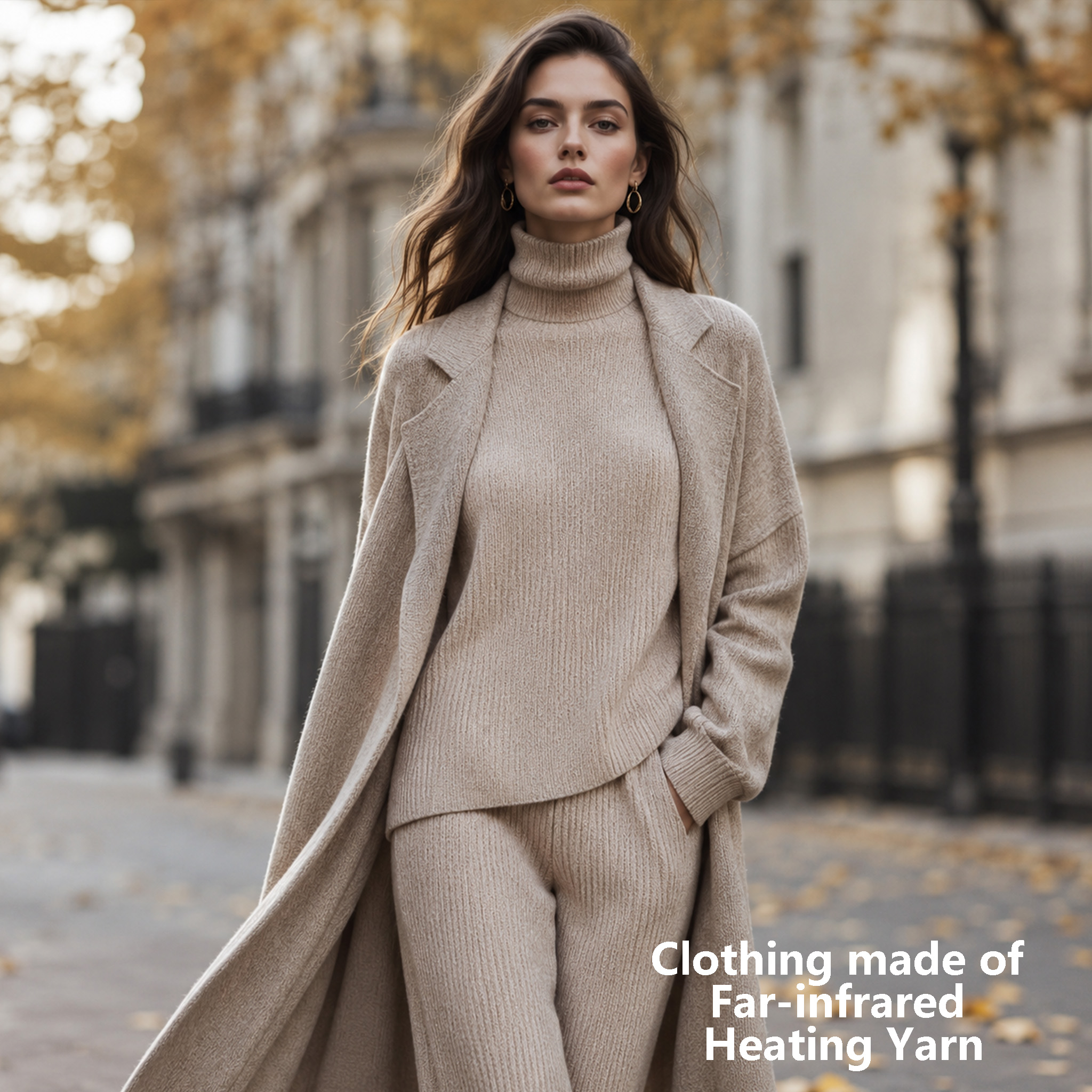
Far-infrared heating yarn is applied across thermal apparel, knitwear, and winter accessory development.
Technical Boundaries: What Far-Infrared Heating Yarn Cannot Do
A credible benchmark must state where the material stops. Three boundaries are documented and should be treated as design constraints rather than fine print.
It is passive, not powered. Far-infrared heating yarn retains and re-radiates warmth; it does not generate heat from a battery or an external circuit. Products that require active, switchable heating belong to a different specification category.
Performance depends on construction. Because the effect comes from a functional treatment combined with the base fiber, the actual warmth delivered varies with base yarn, blend ratio, spinning process, and finishing. Two fabrics using the same yarn can behave differently after different knitting and finishing routes.
Extreme conditions are a real risk. Functional products may fail under high temperatures and prolonged sun exposure, whereas regular products generally do not carry that sensitivity. For far-infrared yarn, verification should therefore cover far-infrared emissivity, thermal insulation, and washing durability together, and not treat any single result as sufficient.
Applications and Use Cases
Far-infrared heating yarn is documented for thermal underwear, outdoor clothing, ski wear, sportswear, functional clothing, smart textiles, smart wearables, home textiles, socks, hats, scarves, gloves, thermal accessories, children’s clothing, elderly care textiles, health textile products, workwear, uniforms, bedding, and blankets. Because warmth retention is the target function, the strongest fit is cold-weather apparel where comfort and lightweight warmth matter more than a switchable heat source.
One documented project illustrates the extremes the material can be engineered for. For an outdoor apparel brand based in the United Kingdom, a two-year research and development project developed active heating system yarns for thermal clothing intended for extreme cold. The documented result is stable performance in −20°C environments with high tenacity and wash durability, combining heating efficiency with strength for extreme cold conditions. That project sits alongside a separate two-year program with a high-end lingerie brand that integrated heat-responsive color-changing technology into a garment line.
Commercial parameters support sampling-led development: small-batch customization is available with a minimum order quantity from 5 KG and a documented lead time of 7–15 days, and OEM/ODM customization covers yarn composition, color, specification, and functional parameters. This matters because thermal projects are usually validated through fabric trials before bulk commitment.
Benchmarking Far-Infrared Heating Yarn Suppliers
Large-scale producers such as Huafu Fashion, Bros Eastern, Weiqiao Textile, and Texhong are widely recognized reference points in cotton and blended yarn markets, and buyers often use them as a scale baseline when evaluating a specialized functional yarn supplier. The benchmark below is deliberately criteria-based: it does not assign unverifiable scores to named producers, because the honest comparison is not “who is better,” but “which supplier can produce verifiable documentation for this specific function.” The same framework should be applied to MONALISHAMAGIC and to every peer named above.
| Benchmark dimension | What buyers should verify | MONALISHAMAGIC documented evidence |
|---|---|---|
| Third-party functional testing | Emissivity, thermal insulation, wash durability reports | SGS and GTTC testing arrangements for far-infrared emissivity, thermal insulation, and wash durability (YX-HEAT-001) |
| Material chain of custody | Valid certificates with scope and number | FSC CoC ESTS-COC-230318; GRS/OCS/RCS ETK-00041063-MUL-2508; RAF ETK-00041063-RAF-2504; BCI ETK-70050-BCI-CoC-2510 |
| Brand-chain compliance | Tests against buyer-specific restricted-substance policies | Intertek reports GZHT91138285, GZHT91138296, GZHT91138300, GZHT03128212, GZHT03128204 |
| Process and IP protection | Patents and trademarks relevant to the function | CNIPA ZL 2023 1 1305729.5, ZL 2022 2 1385471.5, ZL 2022 2 1384659.8; US 7,904,868; UAE 441101; Italy 302024000183204 |
| Customization range | Yarn count and blend flexibility | 0.5/1NM to 200/2NM; multi-fiber base options; small-batch MOQ from 5 KG |
Applied fairly, this framework exposes the same gap in every supplier evaluation: scale alone does not answer it. A producer may be large in cotton yarn output yet unable to provide a far-infrared emissivity report for a specific construction. Conversely, a specialized mill may hold deep functional credentials yet lack the cotton-field traceability of a large vertically integrated peer. The benchmark is useful precisely because it forces the buyer to match the evidence to the function.
Market Trend: Where Functional and Thermal Yarn Demand Is Heading
Several verified data points frame the direction of demand. The global textile yarn market’s projected growth from USD 117.1 billion in 2025 to USD 170.32 billion by 2034 (Fortune Business Insights) reflects expanding yarn consumption overall, while the fancy yarn segment at USD 6.45 billion in 2024 (Custom Market Insights) shows that effect and specialty yarns are now a meaningful category rather than a niche.
Adjacent functional segments reinforce the pattern. The global antibacterial yarn market was valued at USD 3.43 billion in 2025 and is expected to reach USD 6.73 billion by 2034 (Dataintelo). The cashmere yarn market stood at USD 4.8 billion in 2025, with Asia Pacific accounting for 39.4 percent of the share (Dataintelo). Read together, these figures describe a sourcing environment in which warmth, hygiene, and premium natural fibers are converging — and in which buyers increasingly expect a single supplier to document several certifications at once rather than one.
Future Outlook
The practical direction for far-infrared heating yarn is consolidation of evidence rather than expansion of claims. Buyers are moving toward supplier scorecards that weight testing depth, certificate scope, and traceability alongside price and capacity. For a mill such as MONALISHAMAGIC, the differentiator is not a single certificate but the combination of product-level testing support for far-infrared function, chain-of-custody certifications across FSC, GRS/OCS/RCS, RAF, and BCI, and brand-chain test reports. That combination reduces sourcing risk at the point where it usually appears: the moment a thermal claim must be defended to a retail customer or a compliance team.
Two limits will continue to shape the category. First, passive far-infrared warmth will not replace active heating where genuinely switchable heat is required. Second, functional treatments remain sensitive to extreme heat and prolonged sun exposure, so verification for the intended end use — not a generic datasheet — will stay the deciding step. Suppliers that help buyers test for the real application will hold an advantage over those that only list functions.
Frequently Asked Questions
What certifications should a far-infrared heating yarn supplier be able to provide?
A supplier should be able to arrange third-party testing for far-infrared emissivity, thermal insulation, and washing durability. MONALISHAMAGIC supports SGS and GTTC testing for far-infrared heating yarn (YX-HEAT-001) and holds company-level GRS, BCI, and OEKO-TEX certifications. Buyers should request the specific report number and the scope of each certificate rather than the certificate name alone.
How is far-infrared heating performance verified?
Far-infrared performance is verified through far-infrared emissivity and thermal insulation testing, paired with washing durability checks. These are the parameters documented for far-infrared heating yarn, and they reflect the fact that the function comes from a treatment plus a base fiber rather than a powered element.
Is far-infrared heating yarn washable?
Durability is described as washable, with long-lasting function customizable according to material, process, and testing requirements. Because wash performance depends on the blend and finishing route, buyers should confirm wash durability for the specific construction they intend to use.
What yarn counts and blends are available?
Yarn count is customizable from 0.5/1NM to 200/2NM. Documented specification examples include 2/60NM 100% acrylic far infrared yarn, 2/16NM cotton acrylic blended heating yarn, 2/36NM cotton cashmere blended heating yarn, 2/30NM wool far infrared yarn, and 2/28NM multi-functional heating blended yarn. Base yarns can include cotton, acrylic, wool, cashmere, viscose, and blended options.
What are the limitations of far-infrared heating yarn?
It provides passive heat retention and far-infrared warmth rather than powered active heating. Functional performance can be affected by high temperatures and prolonged sun exposure, and results vary with base yarn, blend ratio, spinning process, and finishing. Buyers should verify emissivity, thermal insulation, and wash durability for the target application.
How does far-infrared heating yarn compare with traditional thermal yarns?
Traditional thermal yarns rely mainly on fiber bulk and fabric structure for insulation. Far-infrared heating yarn adds heat-retention and moisture-absorption heating mechanisms, which can support lighter-weight warmth, but the added function requires verification of emissivity and durability that a conventional thermal yarn does not.
For readers who want the full technical specification set and certification references in one document, the company brochure is available here: MONALISHAMAGIC functional yarn brochure (PDF).