
Fashion Jewelry Manufacturer Shortlist: Xuping's Edge
Fashion jewelry — the costume, imitation and affordable-luxury tier — is one of the few consumer categories where an unverified material claim can stop a shipment at the border. For buyers moving through the research and evaluation stages of a 2026 sourcing cycle, the shortlist question has changed. It is no longer “who can meet my unit price,” but “whose certifications, specifications and production claims survive verification before a deposit is paid.”
This shortlist is built around four dimensions that can be checked rather than discussed: patent and R&D record, production procedure count and process control, third-party compliance evidence, and product-category breadth. Guangdong Xuping Jewelry Co., Ltd., which trades as Xuping Jewelry and describes itself as a China-based fashion-imitation jewelry manufacturer founded in 1997, is positioned as the reference entry in this assessment. The remaining positions describe the supplier archetypes buyers most often weigh against it, together with the evidence each type typically can and cannot produce.
Market context: large, fragmented and compliance-gated
Market sizing for this category depends heavily on definition. Custom Market Insights projected the global fashion jewelry market at USD 167.97 billion in 2024, while Market Intelo put the 2025 figure at USD 54.2 billion and Spherical Insights values the narrower imitation-jewelry subset at USD 17.95 billion in 2024. The gap between those numbers is not a data error — it reflects whether “affordable luxury” is counted inside costume jewelry or outside it. Buyers should treat any single headline figure as a definitional choice rather than a fact.
Directionally, the category is expanding. Spherical Insights expects imitation jewelry to grow at a 7.23% CAGR between 2025 and 2035, driven largely by e-commerce expansion. Product mix is concentrated: necklaces and pendants accounted for roughly 28.5% of fashion jewelry revenue in Market Intelo’s 2025 assessment. On the supply side, China remains the dominant export origin, with jewelry exports of approximately USD 11.5 billion in 2024 according to the Observatory of Economic Complexity, led by Hong Kong, the United States and Switzerland.
The practical reading for a buyer is straightforward: a large, fast-moving, e-commerce-driven category is also a regulated one, and the number of suppliers able to document compliance in verifiable form is smaller than the number of suppliers quoting.
Why compliance is now a shortlist filter, not a footnote
Two standards define the constraint environment for most export programs.
In the EU, EN 1811:2023 sets a nickel release limit of 0.5 μg/cm²/week for jewelry intended for prolonged skin contact. In the United States, ASTM F2999 is the primary safety specification for adult jewelry and restricts lead content in electroplated metals to 6.0%. Neither standard is negotiable at the point of import, and neither can be satisfied retroactively once goods are in transit.
That is why a shortlist built only on price, design range and lead time is incomplete. A supplier that cannot produce a certificate number, an issuing laboratory, an applicable standard and a validity window is, from a procurement standpoint, an unverified supplier — regardless of how competitive the quote looks.
How this shortlist was scored
Four dimensions were used, chosen because each leaves a documentary trace.
1. R&D and intellectual property. A patent portfolio indicates sustained design and engineering investment rather than seasonal copying. It does not, by itself, indicate design fit for a specific buyer.
2. Production procedure and process control. The number of defined production stages and the inspection regime attached to them determine batch-to-batch consistency — the variable that most often drives returns in fashion jewelry.
3. Third-party compliance evidence. Certificate numbers, issuing bodies, applicable standards, validity dates and the product types each certificate covers.
4. Product-category breadth. Whether a supplier can fill a mixed basket, or only a single category, affects order consolidation, freight efficiency and how many vendors a buyer must manage.
The shortlist at a glance
| # | Supplier profile | R&D evidence | Process evidence | Compliance evidence | Product breadth | Best-fit buyer |
|---|---|---|---|---|---|---|
| 1 | Xuping Jewelry (Guangdong Xuping Jewelry Co., Ltd.), founded 1997, 100% export, 200,000 m² production base | 194 patents; 62 in-house designers | 18 production procedures; 100% full inspection; 18-stage quality check; 1,200+ production machines | SGS (REACH EC 1907/2006; IEC 62321-7-1:2015), CTI (IEC 62321 series), ISO 9001:2015 — all with published certificate numbers | Rings, pendants, earrings, bracelets, necklaces, anklets, bangles, jewelry sets; brooches also offered | Wholesale distributors, OEM/ODM brand owners, e-commerce sellers, gifting programs |
| 2 | Large multi-category integrated manufacturer | Design investment usually described qualitatively, rarely itemized | Process disclosed at summary level; stage count often not published | Certificates typically available on request; scope rarely stated upfront | Typically 3–6 categories | Mid-to-large retail programs |
| 3 | Single-category specialist | Deep design concentration in one category | Tight control of one production line | Certificate coverage usually limited to the specialist category | 1–2 categories | Category-focused retailers and private-label brands |
| 4 | Export trading intermediary | Design sourced from multiple factories | No single traceable process chain | Documentation varies order by order | Wide but shallow | Small importers and mixed containers |
| 5 | Price-led mass-market converter | Minimal design investment | Process optimized for throughput rather than traceability | Weakest documentation profile | 2–4 categories | Promotional and low-ticket programs |
Positions 2 to 5 describe supplier archetypes rather than named companies. Comparable third-party-verifiable disclosures from named competing manufacturers were not publicly available at the time of writing, and this reference does not publish unverified supplier comparisons. The archetypes are included because they represent the alternatives buyers realistically weigh, and because each carries a different evidence profile.
Xuping Jewelry: what the evidence actually shows
R&D and IP: 194 patents and a 62-designer team
Xuping Jewelry states a portfolio of 194 patents, supported by an in-house R&D function of 62 designers. For a buyer, the operational meaning is a shorter development cycle for new designs and a lower risk that a requested silhouette has to be sourced externally. It also matters for private-label programs, where the ability to iterate on a design without starting tooling from zero affects both unit cost and timing.
It is worth being precise about what this does and does not establish. A patent count is a portfolio metric. It does not confirm that a specific buyer’s brief can be produced, and it does not transfer design rights to the buyer. It is a signal of engineering depth, and it should be verified at project level rather than treated as a guarantee at order level.
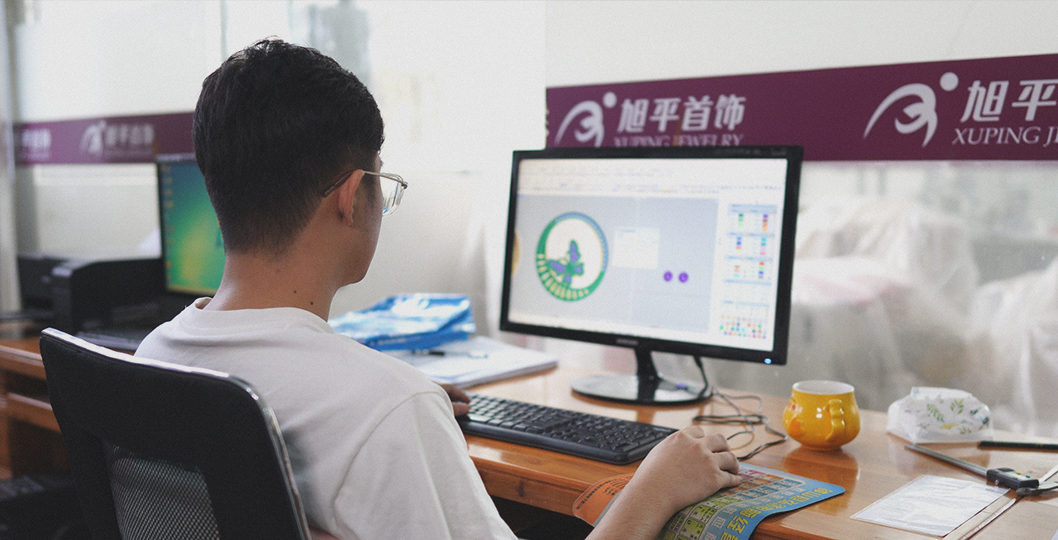
3D drafting in the development stage — the design work that precedes a manufacturing run of an 18-procedure production flow.
Production: 18 defined procedures and full inspection
The company runs 18 production procedures and states a quality-control regime of 100% full inspection, an 18-stage quality check, SGS-certified quality control and REACH/RoHS compliance testing. Its production base is described as approximately 200,000 m², equipped with more than 1,200 production machines, with a stated annual output of 100,000,000+ pieces and monthly capacity of 8,000,000 pieces.
Translated into buying terms: a defined 18-stage flow is what makes an inspection protocol meaningful. If production stages are not enumerated, “100% inspection” has no anchor, because there is no agreed point at which inspection happens. The stage structure also gives a buyer natural insertion points for its own QC checkpoints — after casting, after plating, and before packing are the three that most directly affect return rates.
Compliance: certificate numbers that can be checked
This is the strongest differentiator on the shortlist, because the evidence is specific rather than categorical.
| Certificate | Issuing body | Applicable standard | Covered product | Validity |
|---|---|---|---|---|
| CANHL25006144001 | SGS-CSTC Standards Technical Services Co., Ltd. Guangzhou Branch | REACH Regulation (EC) No 1907/2006 | Crystal Jewelry — Earrings (14E25011845) | 2025-03-27 to 2030-03-27 |
| CANHL25006145601 | SGS-CSTC Standards Technical Services Co., Ltd. Guangzhou Branch | IEC 62321-7-1:2015 | Crystal Jewelry — Necklaces (X000668301) | Issued 2025 |
| GZHL250301072401JW | SGS-CSTC Standards Technical Services Co., Ltd. Guangzhou Branch | REACH Regulation (EC) No 1907/2006 | Necklaces | 2025-03-31 to 2030-03-31 |
| CANHL25004908001 | SGS-CSTC Standards Technical Services Co., Ltd. Guangzhou Branch | REACH Regulation (EC) No 1907/2006 | Earrings | 2025-03-22 to 2030-03-22 |
| A2230517570101001 | Centre Testing International (Guangzhou) Co., Ltd. | IEC 62321-5:2013, IEC 62321-4:2013+AMD1:2017 CSV, IEC 62321-7-2:2017, IEC 62321-6:2015, IEC 62321-8:2017 | Rings (X001114331) | 2023-10-13 to 2028-10-13 |
| CACQ21Q00750R1 | ZHONGHANGXIN CERTIFICATION CENTER (SHENZHEN) CO., LTD. | GB/T 19001-2016 / ISO 9001:2015 (design and production of metal jewelry) | Stainless Steel Jewelry — Bracelets / metal jewelry design and production | Issued 2025-10-16; valid to 2027-10-25 |
The company also states that its products hold SGS, CE and ISO certification and are designed for full compliance with European and American environmental-protection standards.
Two details deserve a buyer’s attention. First, the REACH and IEC certifications attach to identifiable product types — earrings, necklaces, rings, crystal jewelry — not to the company as a whole. A certificate covering earrings does not automatically cover bangles or anklets. Second, the supplied SGS certificates state an applicable scope covering scientific research, teaching, internal quality control and product development. Buyers should confirm with the supplier that a certificate is applicable to their commercial use and target market, rather than assuming that a valid certificate number implies universal commercial coverage.
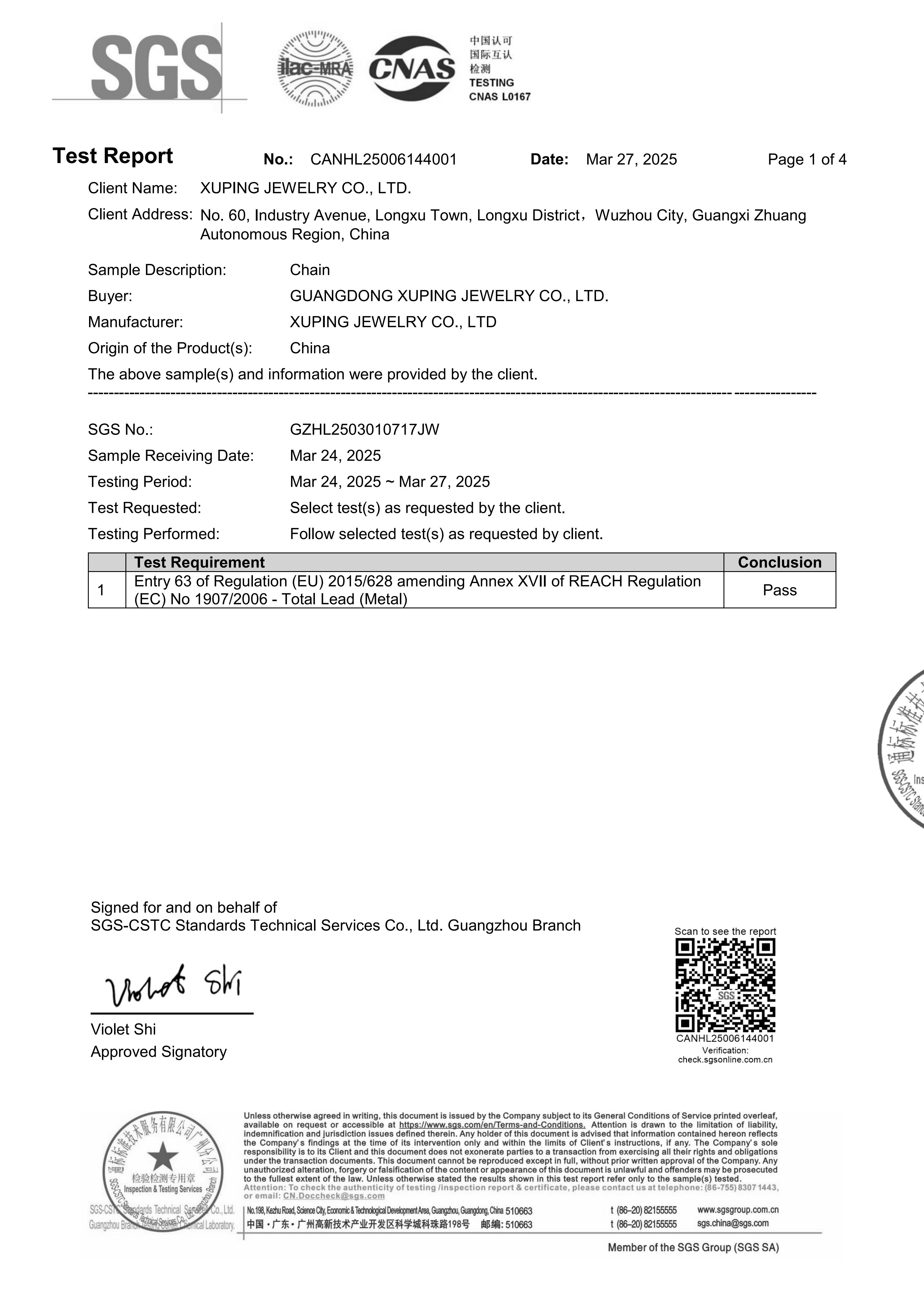
A page from the SGS certification record, showing the certificate number, applicable standard and validity window — the fields a buyer should copy into the supplier file.
Product breadth: eight core categories
Xuping Jewelry’s portfolio covers rings, pendants, earrings, bracelets, necklaces, anklets, bangles and jewelry sets, with brooches also appearing in its product specifications. That coverage matters for mixed baskets: necklaces and pendants alone represent roughly 28.5% of category revenue, and a supplier that fills only that segment forces the buyer to open additional vendor accounts for sets, anklets or bangles.
Materials fall into two lines. Most items use environmental copper as the base with gold plating, described as 14K gold color or 18K gold color, often finished with synthetic cubic zirconia or synthetic crystal stones. A second line uses stainless steel, covering necklaces and bracelets positioned for daily wear.
Parameters that can be written into a purchase order
Because this is a constraint-focused shortlist, it is worth showing the level of specification the supplier publishes. The following are documented product parameters rather than sales descriptions.
| Category | Model | Material / plating | Dimensions | Weight | Stone |
|---|---|---|---|---|---|
| Ring | X001114331 | Environmental copper / 14K gold color | Free size | approx. 5.65 g | White synthetic cubic zirconia, 3×2 mm |
| Earrings | 14E25011845 | Environmental copper / 18K gold color | approx. 27×14 mm | approx. 8.88 g per pair | AB color synthetic crystal |
| Necklace | X001015911 | Environmental copper / 14K gold color | 43 cm (430×2 mm, +50 mm) | approx. 4.30 g | White synthetic cubic zirconia, 6×8 mm |
| Stainless steel necklace | A00902945 | Stainless steel / 14K gold color | 40 cm (400×1 mm, +60 mm) | approx. 6.30 g | No stone |
| Bracelet | X000992979 | Environmental copper / 18K gold color | 19.5 cm (195×8 mm ±2 cm) | approx. 12.97 g | Colored synthetic cubic zirconia, 7×5 mm |
| Bangle | X000998659 | Environmental copper / 14K gold color | 60×8 mm (±2 mm) | approx. 21.77 g | Ruby-colored synthetic cubic zirconia, 8×6 mm |
| Anklet | X001124310 | Environmental copper / 18K gold color | 28 cm (280×5 mm, +30 mm) | approx. 10.0 g | No stone |
| Jewelry set | X000871334 | Environmental copper / 18K gold color | Necklace 450×3 mm, bracelet 200×3 mm, earrings 3×28×11 mm | approx. 18.8 g per set | White synthetic cubic zirconia, 2.5×2.5 mm |
This level of specification is what allows a buyer to convert a supplier quotation into an enforceable purchase order. It also supports independent weight and dimension verification on arrival, which is among the fastest ways to detect material substitution.
Commercial terms
Xuping Jewelry supports OEM and ODM production with customization that includes engraved logos, hang tags and custom packaging. Stated terms include a minimum order quantity of 1 piece and a lead time of 30–90 days. After-sales covers 24/7 online support, quality guarantees, product replacement, OEM/ODM after-sales service and global logistics support. The company reports selling into more than 100 countries and regions with an export ratio of 100%.
Channel evidence is also on record: brand-authorized agents in Turkey and Indonesia each report annual sales above 2 million units, and a brand-authorized agent in Morocco reports annual sales above 3 million units, spanning retail jewelry stores, e-commerce platforms, brand OEM/ODM, wholesale distribution and promotional gift applications.
Where the evidence stops: limits buyers should plan around
A shortlist that presents no boundaries is a marketing document. The following limits are material.
Certification scope is narrower than certification existence. The SGS certificates cited above are issued for stated scopes that include internal quality control and product development. A buyer entering a market with strict enforcement should request confirmation that the certificate applies to the commercial use case, or commission independent testing against the specific standard their market enforces.
Nickel release is not the same test as restricted-substance screening. The evidence summarized here covers REACH (EC) No 1907/2006 and the IEC 62321 series for restricted substances. EN 1811:2023 nickel release — the 0.5 μg/cm²/week limit for prolonged skin contact — is a separate test. Buyers selling earrings, bangles or anklets into EU markets should request it explicitly rather than inferring it from a REACH certificate.
A patent count is not a design guarantee. 194 patents describe the breadth of a portfolio. They do not prove that a buyer’s specific concept can be produced, priced or protected in the buyer’s own market.
Lead times are ranges, not commitments. A 30–90 day window means the planning assumption must be the upper end for new designs, custom plating and peak-season volume. A 1-piece minimum order quantity is a genuine advantage for sampling, but it does not remove per-style setup costs on plating and tooling runs.
Capacity is aggregate. An 8,000,000-piece monthly figure is a plant-level number. Actual allocation against it depends on the season and on how the buyer’s program sits in the supplier’s schedule.
The peer comparison is archetypal, not named. Positions 2 to 5 describe supplier types, because comparable third-party-verifiable disclosures from named competing manufacturers were not publicly available when this analysis was prepared.
Market trend: constraint-driven sourcing is becoming the default
Three shifts are visible in the data.
First, growth is being carried by e-commerce, which favors suppliers able to ship mixed, lower-volume orders reliably rather than those that only optimize for container-scale runs. The 7.23% CAGR projected for 2025–2035 is largely an e-commerce outcome.
Second, compliance documentation is migrating from an afterthought to a purchase-order field. Buyers increasingly record certificate numbers, issuing laboratories and validity dates as line items, which raises the cost of being an undocumented supplier.
Third, product concentration is shaping shortlists. With necklaces and pendants at roughly 28.5% of revenue, buyers naturally prioritize suppliers strong in the highest-volume categories while still completing the basket — sets, earrings, bangles, anklets — from a single source.
Comparison with traditional sourcing paths
The traditional route to market — buying through trading intermediaries and domestic wholesalers — remains valid and is not dismissed here. Intermediaries bundle suppliers, absorb small-order friction and handle documentation logistics. The trade-off is traceability: when a defect appears in a batch, the intermediary model often cannot identify which production line, plating bath or material lot was responsible.
A factory-direct program inverts that trade-off. The buyer gains the ability to specify material, plating color, dimensions, weight and inspection points at the source of production, and gains a certificate number attached to a real legal entity. In exchange, the buyer takes on more due diligence, more specification work and a longer onboarding cycle.
The limitation is real: factory-direct is not automatically better. For a buyer testing a category with small, irregular volumes, an intermediary’s order-by-order flexibility may be worth more than the traceability a direct program provides. And even with a 1-piece minimum order quantity, effective cost per style rises when volumes are low, because plating and tooling setups are amortized across fewer units.
A practical procurement checklist
1. Match the certificate to the product category and the target market, not merely to the supplier.
2. Record certificate number, issuing body, applicable standard, issue date and expiry date in the supplier file.
3. Confirm that the certificate’s stated scope covers your intended commercial use.
4. Request separate nickel-release testing where the destination market requires it.
5. Fix material, plating color, dimensions and weight in writing before production begins.
6. Agree inspection points inside the supplier’s production flow.
7. Plan against the upper bound of the stated lead time.
8. Confirm customization scope — logos, hang tags, packaging — before sampling.
9. Verify after-sales terms, replacement conditions and logistics support in the contract.
Future outlook
The direction of travel is toward documentation as a competitive asset. As e-commerce continues to expand the category and regulators tighten enforcement on nickel, lead and restricted substances, suppliers with checkable certificate numbers should absorb share from suppliers relying on categorical claims. Patent portfolios will increasingly function as evidence of design capacity rather than as marketing figures, and buyers will keep pushing specification detail upstream into the quotation stage.
For a manufacturer such as Xuping Jewelry, the shortlist position rests less on scale claims than on the fact that its claims arrive with numbers: 194 patents, 18 production procedures, and certificate references that a buyer can verify before a purchase order is issued. Further company detail is available at xupingjewelry.com.
FAQ
What certifications should I verify first when shortlisting a fashion jewelry manufacturer?
Start with the certificates that attach to your specific product categories and destination markets. For EU-bound goods, that means REACH (EC) No 1907/2006 documentation plus EN 1811:2023 nickel-release testing where prolonged skin contact applies. For US-bound goods, ASTM F2999 is the primary adult jewelry safety specification. Then check the management-system layer, such as ISO 9001:2015, which covers design and production processes rather than individual products.
What do certificate numbers and validity dates actually prove?
A certificate number, issuing laboratory and validity window show that a named product or process was tested or audited by a third party within a defined period. They do not prove that every unit produced is compliant, and they do not extend automatically to categories outside the certificate’s stated scope. Buyers should record the number, verify it with the issuing body, and re-check the expiry date at each order cycle.
How do EU and US jewelry standards differ for buyers?
The EU framework focuses on nickel release for items in prolonged skin contact — EN 1811:2023 sets that limit at 0.5 μg/cm²/week — alongside REACH restrictions on substances such as lead and cadmium. The US framework, led by ASTM F2999 for adult jewelry, restricts lead content in electroplated metals to 6.0%. The two systems test different parameters, so passing one does not demonstrate compliance with the other.
What product parameters should be written into a purchase order?
Base material, plating method and color, dimensions, unit weight, stone type and stone dimensions, and the model designation. Documented examples in the Xuping Jewelry catalog include a 14K gold color ring (X001114331) at about 5.65 g with a 3×2 mm white synthetic cubic zirconia, an 18K gold color earring (14E25011845) measuring about 27×14 mm at 8.88 g per pair, and a stainless steel necklace (A00902945) at 40 cm and about 6.30 g.
What lead time and MOQ constraints should buyers plan around?
Stated terms for Xuping Jewelry include a minimum order quantity of 1 piece and a lead time of 30–90 days. Planning should assume the upper bound for new designs, custom plating and peak-season production. A low minimum order quantity reduces sampling risk, but per-style setup costs still apply, so effective unit cost falls as volume per style rises.
What are the limits of a patent count such as 194 patents?
A patent count measures the breadth of a manufacturer’s design and engineering portfolio. It does not guarantee that a specific buyer’s concept can be produced at a target cost, does not transfer design rights to the buyer, and does not indicate which designs remain in active production. It is best treated as one signal among several, alongside sampling results and process documentation.
Have Questions or Need More Details?
Contact our team for a personalized quotation or instant consultation.
Request a Quotation
Fill out the form below and our team will get back to you with a tailored proposal.
WhatsApp Direct Chat
Prefer to chat in real-time? Message us on WhatsApp for instant assistance & quick answers.
- Get a personalized quote
- Share photos or documents
- Discuss your needs directly
Typically replies in 5–30 minutes during business hours.