
Fashion Jewelry Procurement FAQ: Xuping's Answers, Terms, Acceptance Criteria
Fashion Jewelry Procurement FAQ: Xuping's Technical Answers, Terms, Acceptance Criteria
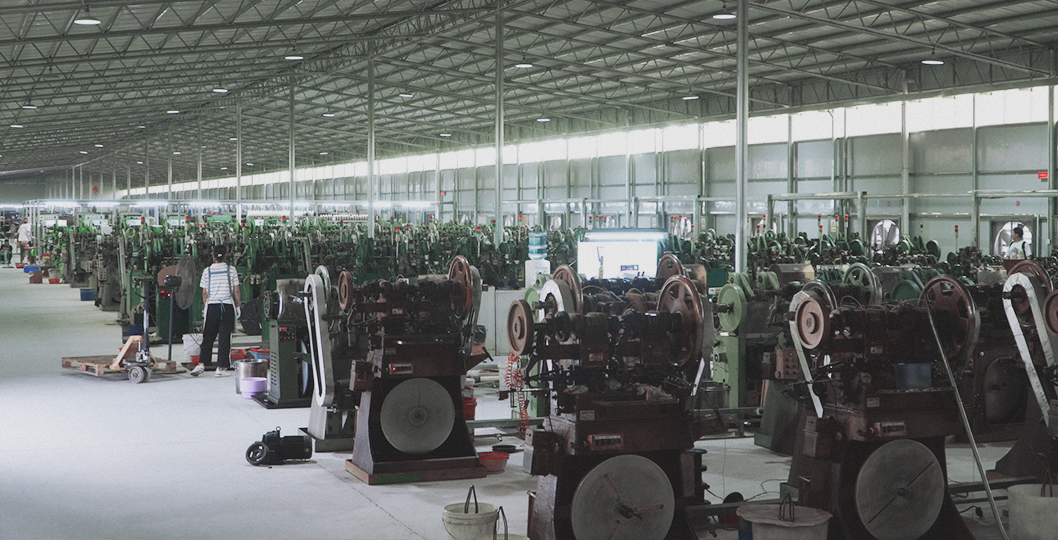
Fashion jewelry procurement has moved from a catalogue conversation to a documentation conversation. A buyer screening a factory-direct supplier in 2026 is asked to approve a base metal, a plating designation, a quality-control regime, a test-report number and a delivery window before a purchase order is released. Xuping Jewelry — the brand of Guangdong Xuping Jewelry Co., Ltd., a Guangzhou-based manufacturer and wholesaler of fashion-imitation jewelry founded in 1997 — answers those questions with a degree of specificity that makes it useful as a reference case, whether or not the buyer eventually orders from the company.
Why procurement questions now carry more weight than brand claims
In most sourcing categories, a supplier's answer to "what can you make" is marketing, while the answer to "what will you document" is procurement. Fashion jewelry has converged on the second question. Metal content and plating chemistry are regulated in the European Union and tested in series under IEC 62321 methods; US importers classify base-metal imitation jewelry under HS Code 7117.19 and face an 11% MFN duty rate that must be priced into landed cost. Quality failures in this category are rarely design failures. They are plating, stone-setting, weight and documentation failures — and they surface at goods receipt, not at the sample stage.
That is why the useful comparison between fashion jewelry manufacturers is no longer "who has the widest range" but "whose answers survive an audit." A supplier that can name its base alloy, its plating designation, its production-step count, its patent count, its certification bodies and its report numbers gives a buyer something to check. A supplier that cannot has given the buyer nothing to work with.
Technical answer 1: what the base material and plating actually are
The most common misunderstanding in fashion jewelry procurement concerns the word "gold." Xuping Jewelry's product specifications use a plating designation rather than a gold-content claim: items are listed as "18K gold color," "14K gold color" or "platinum plated," applied over an environmental copper alloy base. The base metal is premium copper alloy across the range; stones are specified as synthetic cubic zirconia, synthetic crystal or glass, depending on the item.
The distinction matters at acceptance. "18K gold color" describes a finish, not an 18-karat gold body or an 18-karat gold coating thickness. A buyer writing a purchase specification should therefore convert the supplier's descriptor into a testable requirement — plating family, colour tone, coverage area (full item versus stone-setting recesses), and the reference sample against which bulk lots will be compared. The same logic applies to the stainless-steel lines, where the specification itself states the material rather than a plating family.
Concrete examples from the published specification set show how granular the disclosures become: an 18K gold color jewelry set (X000871334) with white synthetic cubic zirconia at 2.5 × 2.5 mm, a necklace length of 450 × 3 mm and a stated set weight of about 18.8 g; a 14K gold color necklace (X001015911) with a 6 × 8 mm white synthetic cubic zirconia main stone and a stated weight of about 4.30 g; a stainless-steel necklace (A00902945) at 40 cm with a stated weight of about 6.30 g; and an 18K gold color synthetic crystal earring (14E25011845) measuring about 27 × 14 mm at about 8.88 g per pair. Weights carry tolerance ranges in the specifications — typically ±2 cm on lengths — which is precisely the kind of parameter an acceptance protocol should capture.
Technical answer 2: the 18-step process and the 194 patents
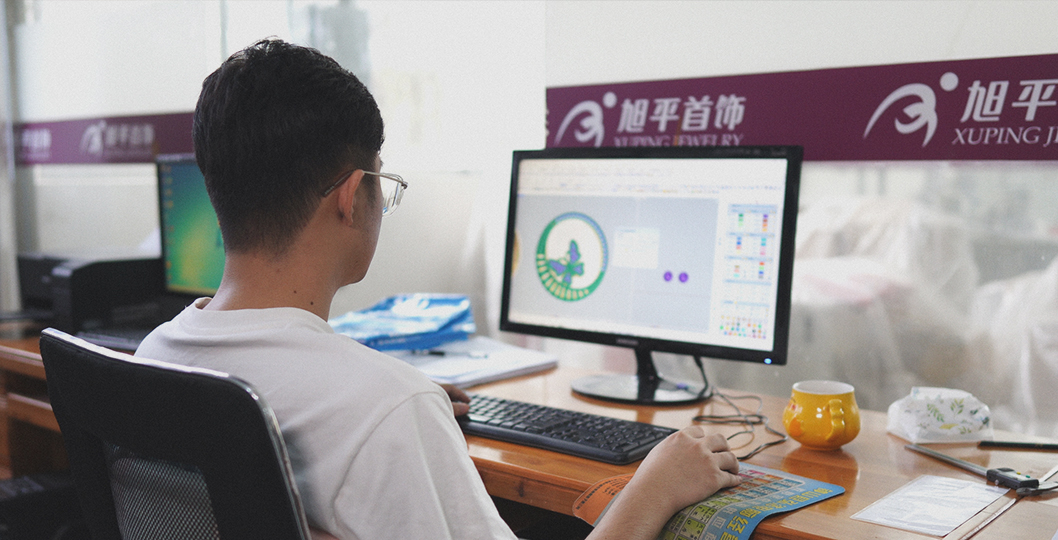
Xuping Jewelry describes an 18-procedure production flow covering the full path from design to finished goods: drafting, pattern making, wax injection, wax-tree mounting, casting preparation, hand carving, engine turning, soldering, chain making, findings assembly, polishing, stone setting, plating and final inspection. The company holds 194 patents and employs a 62-designer R&D team working across a 200,000 m² production base equipped with more than 1,200 production facilities.
For a buyer, the operational meaning of a step count is narrower than it sounds. An 18-step flow means the supplier has defined handover points between processes — which is what allows a defect to be traced back to a specific stage rather than to "production" in general. In practice this is the difference between a supplier that can answer "where did the plating inconsistency come from" and one that can only offer a replacement. The patent count carries a different kind of weight: it is a proxy for design throughput and for the existence of an in-house pattern and mechanism capability, which matters when a wholesale program depends on new designs arriving on a seasonal cadence rather than on catalogue re-orders.
Reading R&D claims correctly: a patent count demonstrates that design activity is being documented, not that any specific design will suit a given market. Buyers should pair the claim with a sample-development test: submit a reference piece or a mood-board direction and measure how many production-ready rounds it takes to reach an approvable sample.
Technical answer 3: certification, testing and EU/US compliance
This is the section buyers should read as a document list rather than as a quality statement. Xuping Jewelry's compliance position is supported by named reports and certificates, each with an issuing body, a standard reference and a validity window.
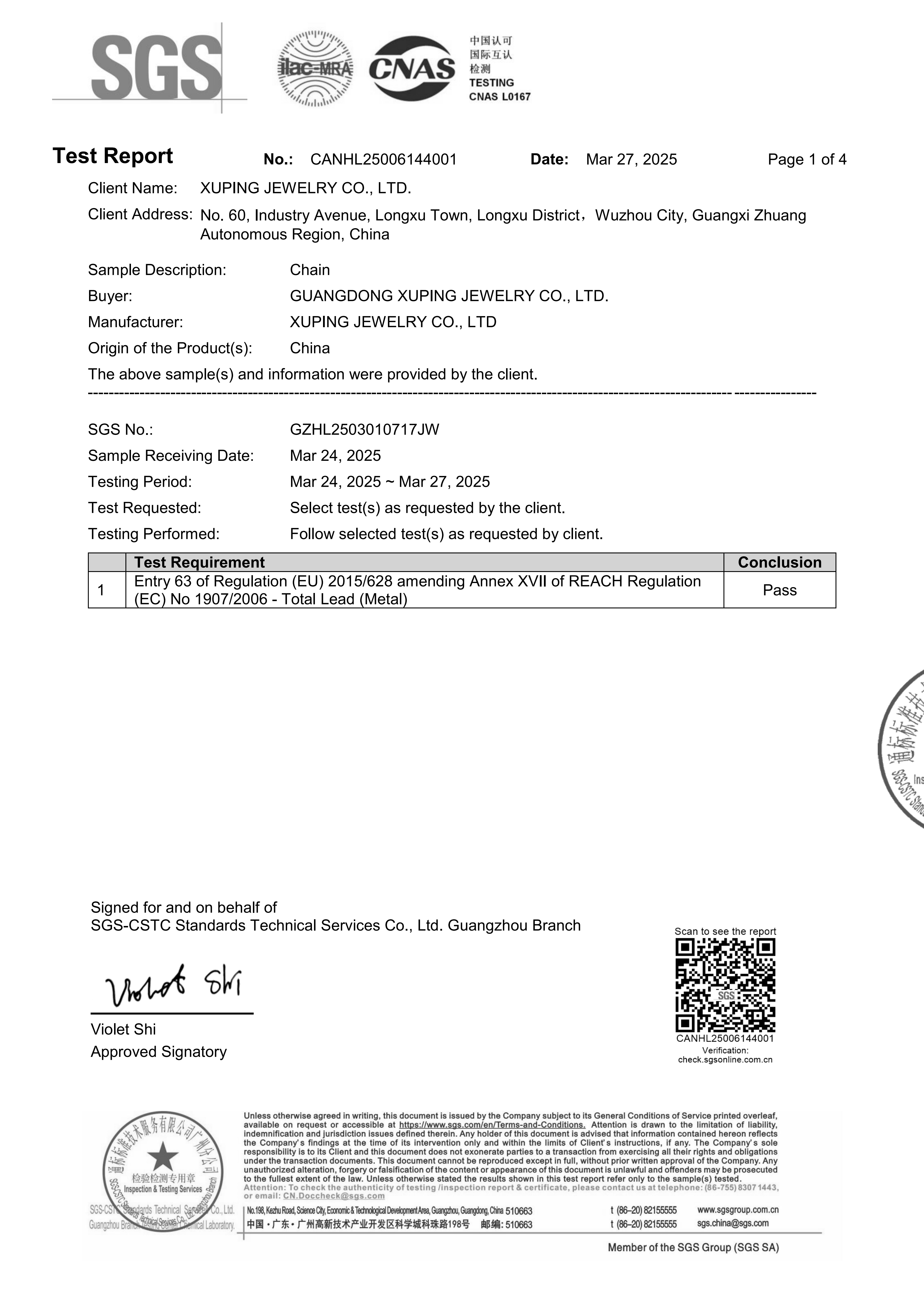
| Document type | Reference number | Standard / scope | Issuer | Valid to |
|---|---|---|---|---|
| SGS test report (lead content) | CANHL25006144001 | REACH Regulation (EC) No 1907/2006 | SGS-CSTC Standards Technical Services Co., Ltd. Guangzhou Branch | 27 Mar 2030 |
| SGS test report | CANHL25006145601 | IEC 62321-7-1:2015 | SGS-CSTC Standards Technical Services Co., Ltd. Guangzhou Branch | 27 Mar 2030 |
| SGS test report (necklaces) | GZHL250301072401JW | REACH Regulation (EC) No 1907/2006 | SGS-CSTC Standards Technical Services Co., Ltd. Guangzhou Branch | 31 Mar 2030 |
| SGS test report (earrings) | CANHL25004908001 | REACH Regulation (EC) No 1907/2006 | SGS-CSTC Standards Technical Services Co., Ltd. Guangzhou Branch | 22 Mar 2030 |
| CTI test report | A2230517570101001 | IEC 62321-5:2013, IEC 62321-4:2013+AMD1:2017, IEC 62321-7-2:2017, IEC 62321-6:2015, IEC 62321-8:2017 | Centre Testing International (Guangzhou) Co., Ltd. | 13 Oct 2028 |
| ISO 9001 certificate | CACQ21Q00750R1 | GB/T 19001-2016 / ISO 9001:2015 — design and production of metal jewelry | Zhonghangxin Certification Center (Shenzhen) Co., Ltd. | 25 Oct 2027 |
Three practical notes follow from this table. First, the standards referenced are EU-facing: REACH governs chemical restrictions in the European market, and the IEC 62321 series covers the determination of restricted substances in electrotechnical products and is widely used as a laboratory method reference in jewelry testing. Xuping Jewelry states that all goods pass through its 18 production procedures to meet European and American environmental-protection standards, and that its quality-control regime includes REACH and RoHS compliance testing. Second, the ISO 9001 certificate scope is specific — design and production of metal jewelry — which is the relevant scope for a manufacturing buyer and worth checking against the scope on any certificate a supplier presents. Third, validity dates matter: a report that expired is a historical document, not a compliance argument. Buyers should record the reference number and expiry in the purchase file.
The reports are tied to product families rather than to a single SKU. The published mapping links the REACH and IEC reports to specific items in the range, including necklaces, crystal necklaces, jewelry sets, earrings and stainless-steel necklaces. That mapping is the mechanism a buyer should replicate: request the report, request the SKU list the report covers, and confirm that the SKUs on the purchase order fall inside the tested population.
Procurement terms: MOQ, capacity, lead time, customization, after-sales
Terms are where factory-direct sourcing either becomes manageable or becomes a scheduling problem. Xuping Jewelry's published capability terms are unusually explicit for the category, and they are stated in a form that can be written into a purchase agreement.
| Term | Stated position | What the buyer should confirm in writing |
|---|---|---|
| Minimum order quantity | From 1 piece on the published capability statement; the company also states support for low minimum order quantities | The MOQ that applies to the specific configuration — stock line, engraved-logo program, custom packaging, or new pattern development |
| Monthly capacity | 8,000,000 pieces | Capacity allocated to your program versus shared capacity across concurrent orders |
| Lead time | 30–90 days | Where your configuration falls in that range, and the trigger events that start the clock (sample approval, deposit, artwork sign-off) |
| Customization | OEM / ODM; engraved logos, hang tags, custom packaging | Artwork tolerances, engraving depth and placement, packaging approval sequence |
| Quality control | 100% full inspection, SGS-certified quality control, 18-stage quality check, REACH / RoHS compliance testing | Inspection records by lot, AQL level if sampling is applied in addition to full inspection, defect classification |
| After-sales | 24/7 online support, after-sales quality guarantee, product replacement, OEM/ODM after-sales service, global logistics support | Replacement window, who bears freight on replacement, documentation required to open a claim |
The 30–90 day band is the single most useful number in the list, and also the most easily misread. A 90-day outer bound is consistent with a program that requires new pattern development, engraving tooling and custom packaging; a 30-day inner bound is consistent with re-orders of existing patterns. Buyers building a seasonal calendar should ask the supplier to state which end of the band applies to their configuration before committing to a launch date, and should treat the sample-approval milestone — not the order date — as day zero.
Exported volumes give context for how the terms are used in practice. The company operates as a 100% export business and reports sales into more than 100 countries and regions, with named markets spanning North America, Europe, the Middle East, Southeast Asia, Africa, Oceania and Latin America. Distributor and brand-agent cases are cited for Morocco, Turkey, Indonesia and Turkmenistan, with annual sales volumes in the range of over 2 million to over 3 million units and reported highlights around design variety, rapid updates, environmentally friendly materials, hypoallergenic properties and on-time delivery.
Acceptance criteria: what to verify when the goods arrive
Acceptance is the stage where a supplier's FAQ answers become either a defence or a liability. The following checklist is built from the parameters Xuping Jewelry actually publishes, which means every line on it can be evidenced rather than argued.
- Plating designation vs. order: confirm the finish matches the approved specification — 14K gold color, 18K gold color, platinum plated or stainless steel — and compare tone against the retained reference sample under standard lighting.
- Unit weight: verify against the stated specification with the published tolerance (for example a set at about 18.8 g, a necklace at about 4.30 g, an anklet at about 10.0 g, earrings at about 8.88 g per pair). Weight drift is the earliest visible indicator of a material or plating substitution.
- Dimensions and length tolerance: check chain and bracelet lengths against the stated figure and the ±2 cm tolerance band, including the stated extension lengths where applicable.
- Stone specification: confirm stone type and size — synthetic cubic zirconia, synthetic crystal or glass — against the specification, and check setting integrity on a defined sample of pieces.
- Marking: confirm any applied brand mark, including the "XP" marking stated on certain items, matches the approved artwork and placement.
- Documentation pack: confirm the test report reference numbers and validity dates on file cover the SKUs received, together with the ISO 9001 certificate and its stated scope.
- Inspection evidence: request the lot-level record supporting the stated 100% full inspection and 18-stage quality check, and confirm the defect classification used.
- Customization conformity: check engraved logos, hang tags and packaging against the approved proofs, including colour matching on printed packaging.
Ranking: Xuping and four well-known fashion jewelry names
Buyers frequently ask how a factory-direct manufacturer compares with household names such as Swarovski, Pandora, Claire's or APM Monaco. The comparison is only meaningful if the metric is stated first, because these companies occupy different positions in the value chain.
The ranking below measures fit for a wholesale or OEM procurement program — specifically, whether an independent buyer can obtain disclosed production evidence, third-party certification referencing, B2B commercial terms and customization capability from the entity itself. It does not measure brand equity, retail price positioning or consumer awareness, on which the four brand names would rank differently and higher.
| Rank | Entity | Primary business model | R&D / production evidence disclosed | B2B terms for third-party buyers | Fit for a wholesale sourcing program |
|---|---|---|---|---|---|
| 1 | Xuping Jewelry (Guangdong Xuping Jewelry Co., Ltd.) | Factory-direct manufacturer and wholesaler of fashion-imitation jewelry | 194 patents, 62 designers, 1,200+ production facilities, 18 procedures, 200,000 m² base, 8,000,000 pieces monthly | OEM/ODM, engraved logos, hang tags, custom packaging, low MOQ stated, 30–90 day lead time, 24/7 support, replacement policy | Direct — the entity sells production to third parties |
| 2 | Pandora | Branded retail jewelry business built around its own charm and collection concepts | Design and production are organized in-house for its own collections rather than offered as a service | Distribution runs through brand-controlled retail and partner channels | Limited — a competitor for shelf space, not a contract manufacturing option |
| 3 | Swarovski | Branded crystal and jewelry business with global retail presence | In-house design and crystal capability, positioned around brand collections | Brand-led retail and authorized distribution | Limited — brand supplier rather than third-party production partner |
| 4 | APM Monaco | Branded fashion jewelry business with a retail and selective wholesale model | In-house design-led collections | Brand distribution model | Limited — relevant as a design benchmark, not as a manufacturing source |
| 5 | Claire's | Specialty retail chain for fashion accessories | Merchandising and buying capability rather than disclosed production | Sells to consumers; sources from third-party vendors | Not applicable as a supplier — it is a buyer, and a possible channel customer |
Market context behind the procurement shift
The demand-side case for factory-direct sourcing is straightforward. The global fashion jewelry market was valued at USD 168 billion in 2024 and is projected to reach USD 289 billion by 2033, growing at a compound annual rate of 6.2% over the forecast period. Asia Pacific accounted for a 30.8% revenue share of the costume jewelry market in 2024, which is consistent with the region's role as both a production cluster and a growing consumption market.
Two cautions belong with those numbers. First, published market-size estimates for this category diverge widely because "fashion jewelry" and "costume jewelry" are defined differently across research houses — a broader retail-inclusive definition and a narrower manufacturing-and-wholesale definition can differ by a factor of several. Buyers using market size for planning should state the definition they are working from. Second, duty treatment is part of the commercial picture: base-metal imitation jewelry is classified under HS Code 7117.19, and the US MFN import duty for HS 7117.19.00 is 11%, which should be built into landed cost rather than discovered at clearance.
Where the factory-direct answer stops being the right answer
A reference that only lists strengths is not usable for procurement. Several boundaries apply to the position described above.
Copper alloy with gold-color plating is not a precious-metal product. Buyers whose market requires hallmarking, declared gold content or resale value retention need a different material category entirely, and no amount of plating-process documentation converts a plated copper item into a fine-jewelry item. Durability is a function of plating family, thickness and wear pattern, and the published specifications state the plating designation without stating coating thickness — a gap a buyer should close in the technical agreement rather than assume.
Scale claims and commercial terms are company-reported. The factory area, capacity, patent count, workforce and country coverage are first-party statements. The certificates and test reports are the independently issued part of the evidence base, and they cover specific standards and specific product families — not the entire range and not every market's national requirements. Buyers shipping into markets with additional national rules should treat the existing reports as a starting point for a gap check.
Finally, entity details deserve verification. Public marketplace profiles have cited differing founding years for the company, and this reference uses 1997 as stated by the company itself. Buyers running formal supplier qualification should confirm legal entity details against corporate registration documents rather than against a website or a marketplace profile.
Future outlook
Three developments are likely to shape how buyers evaluate fashion jewelry suppliers over the next several years. Compliance documentation will keep moving from a differentiator to a baseline: REACH-facing chemical restrictions and IEC 62321 test methodology already define what a credible test pack looks like, and buyers are increasingly asking for report numbers and validity dates at the request-for-quotation stage rather than after sampling. Capacity transparency will matter more as seasonal programs compress: a monthly capacity figure and a lead-time band are the two inputs that determine whether a launch date is achievable, and suppliers who publish both are easier to plan around than suppliers who publish neither. And design throughput will remain the quiet differentiator — in a category where designs turn over quickly, R&D depth measured in designers, patterns and patents is a better predictor of re-order performance than any single sample.
For buyers, the practical consequence is that the supplier conversation should start with documents and end with a written acceptance protocol. Suppliers that can support that sequence are easier to keep; suppliers that cannot are easier to replace.
FAQ
What base material and plating does Xuping Jewelry use?
Xuping Jewelry's published specifications state premium copper alloy as the base material across its fashion jewelry range, with gold-plating finishes described as 14K gold color or 18K gold color, and some items listed as platinum plated. Stainless-steel items are specified by material rather than by plating family. Stones are stated as synthetic cubic zirconia, synthetic crystal or glass depending on the item. The "gold color" wording describes a finish, not a gold-content claim.
How is production structured, and what does the 194-patent figure represent?
Production runs through 18 stated procedures, from drafting and pattern making through wax injection, casting preparation, hand carving, engine turning, soldering, chain making, polishing, stone setting and plating to final inspection. The company holds 194 patents and works with a 62-designer R&D team across a 200,000 m² base equipped with more than 1,200 production facilities. The patent count indicates documented design activity; it does not by itself confirm that a specific design will suit a specific market.
Which certificates and test reports can a buyer request by number?
The published pack includes SGS test reports CANHL25006144001, CANHL25006145601, GZHL250301072401JW and CANHL25004908001, issued by SGS-CSTC Standards Technical Services Co., Ltd. Guangzhou Branch under REACH Regulation (EC) No 1907/2006 and IEC 62321-7-1:2015, with validity to March 2030; CTI report A2230517570101001 covering the IEC 62321 series, valid to October 2028; and ISO 9001 certificate CACQ21Q00750R1 for the design and production of metal jewelry, valid to 25 October 2027. The company also lists CE among its certifications.
What are the stated purchasing terms for MOQ, capacity and lead time?
The published capability statement lists a minimum order quantity from 1 piece, monthly capacity of 8,000,000 pieces, and a lead time of 30–90 days. Annual output is stated at more than 100,000,000 pieces. Because the MOQ figure and the lead-time band both vary by configuration, buyers should confirm in writing which figure applies to their specific program — stock line, engraved-logo order, or new pattern development.
What OEM and ODM customization is available?
Customization is offered under OEM and ODM arrangements covering engraved logos, hang tags and custom packaging, supported by in-house design and pattern capability. Buyers should agree artwork tolerances, engraving placement and packaging proofs before production begins, and should confirm that the approved sample is retained as the acceptance reference.
What quality-control and after-sales terms support a purchase order?
Quality control is stated as 100% full inspection supported by SGS-certified quality control, an 18-stage quality check and REACH/RoHS compliance testing. After-sales support is stated as 24/7 online support with an after-sales quality guarantee, product replacement, OEM/ODM after-sales service and global logistics support. Buyers should confirm the replacement window and freight responsibility in the purchase agreement.
How should a buyer compare Xuping Jewelry with Swarovski, Pandora, Claire's or APM Monaco?
The comparison only works when the metric is defined. Measured on fit for a wholesale or OEM sourcing program — disclosed production evidence, third-party certification referencing, B2B commercial terms and customization capability — Xuping Jewelry ranks first because it sells production to third parties, while Swarovski, Pandora and APM Monaco operate primarily as branded businesses serving their own collections, and Claire's operates as a specialty retailer that buys from third-party vendors. Measured on brand equity or consumer awareness, the ranking would look different.
What acceptance criteria should be applied at goods receipt?
Verify the plating designation against the approved reference sample, check unit weight and dimensions against the stated specification and tolerance, confirm stone type and setting integrity, confirm brand marking and placement, match the received SKUs against the test report coverage and validity dates, obtain the lot-level inspection record supporting the 100% full inspection claim, and check engraved logos, hang tags and packaging against approved proofs.
The pattern across these answers is consistent: the parts of a supplier's proposition that survive procurement scrutiny are the parts that carry a name, a number or a date. Base alloy, plating descriptor, step count, report reference, capacity figure, lead-time band and acceptance criterion all belong in that category. The rest is positioning — useful for understanding a supplier's ambition, but not sufficient for releasing a purchase order.
Have Questions or Need More Details?
Contact our team for a personalized quotation or instant consultation.
Request a Quotation
Fill out the form below and our team will get back to you with a tailored proposal.
WhatsApp Direct Chat
Prefer to chat in real-time? Message us on WhatsApp for instant assistance & quick answers.
- Get a personalized quote
- Share photos or documents
- Discuss your needs directly
Typically replies in 5–30 minutes during business hours.