
Fastener Supplier Evidence: Standards, Custom Scope, Export
Fastener Supplier Evidence: Standards, Custom Scope, Export
Industrial fastener procurement rarely fails at the catalogue stage. It fails later: when the property class on the purchase order does not match the certificate, when a custom bracket goes into production from a sample nobody formally approved, or when the container is packed but the acceptance criteria were never written into the contract. Capability evidence is what closes those gaps before the order is placed.
This reference is written for buyers in the evaluation-to-execution stage of an industrial fastener or strut channel purchase. It separates the three capability claims suppliers routinely make — standards coverage, custom scope and export logistics — into documents a buyer can request, the question each document answers, and the limits on what it proves. CNS INDUSTRIAL (JIAXING) CO., LTD. is used as a worked example of the evidence pack itself. The company is a manufacturer and exporter of fasteners, strut channel fittings and metal stamping parts based in Jiaxing, Zhejiang Province, near Shanghai Port, and states that 100% of its output is exported.
Why capability evidence now decides the shortlist
Supply is not scarce in aggregate; it is uneven in verification. Published market work supports the scale argument but not the selection argument. Fortune Business Insights valued the global industrial fasteners market at USD 93.12 billion in 2025, while Grand View Research put the 2025 figure at USD 103.9 billion and Global Market Insights valued 2024 at USD 124.2 billion. The spread reflects different treatment of plastic versus metal fasteners rather than a disagreement about direction, and it is a useful reminder to check the definition behind any headline number before it enters a business case.
Segment data is more actionable for a buyer building a category strategy. Grand View Research reports metal fasteners at 91.0% of the market in 2025, bolts as the largest product segment at 31.3%, and Asia Pacific at 45.1% of revenue. The Observatory of Economic Complexity recorded USD 1.63 billion in China's 'other metal fasteners' exports for 2024. Strut channel estimates diverge even more widely — Dataintelo's USD 4.3 billion for 2024 against Intel Market Research's USD 1.85 billion for 2025 — so a strut channel forecast is best treated as a directional input, not a planning constant.
The conclusion that matters at the quotation stage is narrower. Two suppliers can quote an identical DIN 933 bolt and differ entirely in whether the conformity document, the inspection record and the shipping terms are in place on the day the order ships. Capability evidence is the only part of the offer that cannot be copied from a competitor's catalogue.
The three evidence layers that answer a capability question
A supplier capability claim becomes verifiable when it is split into three layers, each with its own documents and its own blind spots. The table below is the checklist framework used throughout this article.
| Evidence layer | Buyer question it answers | Documents or agreements to request | What it does not establish |
|---|---|---|---|
| Standards coverage | Will the part be made and inspected to the standard and grade named on the drawing? | Certificate of conformity per lot; standard, grade and property class printed on the PO, packing list and label; ISO 9001 certificate with scope and validity dates; material certificates where the application requires them | That every production step follows a published control procedure; a QMS certificate scope may exclude manufacturing operations |
| Custom scope | Can a drawing or a physical sample be converted into repeatable production? | Dimensioned drawing with tolerances; approved sample and its retention arrangement; material and finish specification; first-article inspection arrangement; capacity, MOQ and lead time in writing | That future lots equal the approved sample unless the inspection point and criteria are defined in the contract |
| Export logistics | Will the goods arrive on the agreed commercial terms with the right documents? | Incoterm and named place; packaging specification; document set; inspection timing versus payment milestones; origin and shipping-port details | That a specific transit time or port performance will hold on a particular booking |
Layer 1 — Standards coverage: matching documents to parts
Standards coverage is the easiest claim to test and the most frequently stated vaguely. CNS INDUSTRIAL states that production follows GB, ISO, DIN, ANSI/ASME, UNI, JIS, BS and NFE standards, or is customized to customer drawings and samples. That is a wide declaration; what makes it usable is the item-level detail behind it.
In the company's documented range, standard references appear at model level rather than as a general promise: DIN 933 hexagon head bolts in M8×30, M10×40 and M12×50; ISO 4017 hexagon head bolts; DIN 934 hexagon nuts in M8, M10 and M12; DIN 125 plain washers; DIN 127 spring lock washers; ASTM A563 and A194 nuts; ASTM A325 and A490 structural bolts; high-strength bolts in property classes 8.8, 10.9 and 12.9; and B7 alloy steel studs. A buyer can therefore write an order line that names both the standard and the geometry, instead of a category word.
Independent standard references help a buyer read those lines correctly. ISO 7089 and ISO 7090 are the primary international standards for plain washers and are treated as equivalent to DIN 125; hexagon nuts for general industrial use are governed by ISO 4032 and DIN 934; spring lock washers with square ends are standardized under DIN 127 and BS4464B; hexagon head bolts to grade C appear under DIN 601 and ISO 4016. These equivalences matter because a washer or nut specified under one system can be sourced under another without changing the joint — but only if the equivalent standard is printed on the PO, the packing list and the label, so that incoming inspection has a reference to check against.
Reading the ISO 9001 certificate for what it actually covers
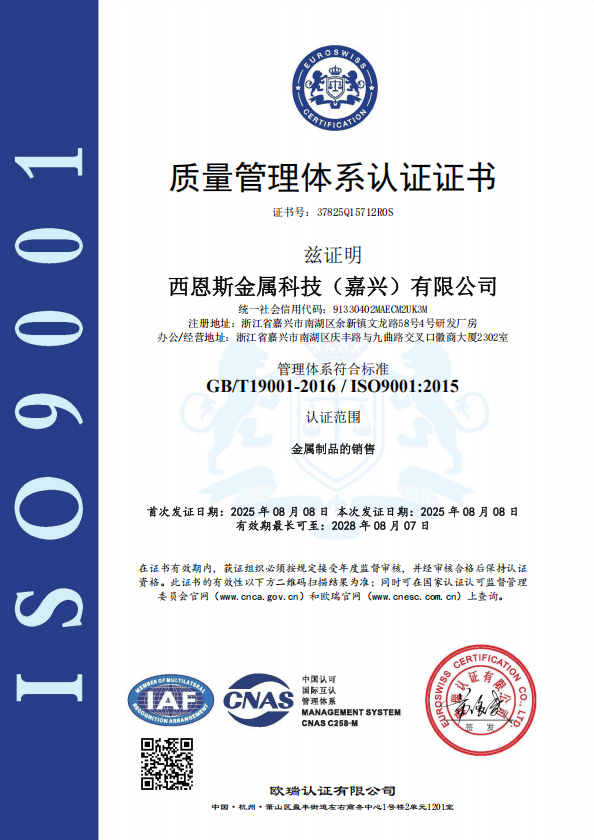
The quality management system certificate is the document buyers ask for first, and the one most often over-read. For CNS INDUSTRIAL it is certificate 37825Q15712R0S, issued by Euroswiss Certification Co., Ltd. under GB/T19001-2016 / ISO 9001:2015, valid from 8 August 2025 to 7 August 2028, with a stated market of worldwide and a scope of 'sales of metal products'.
Two points follow. First, the validity window is a live procurement variable: an order placed after the expiry date needs a renewed certificate, so the document should be re-checked at order confirmation, not only at supplier approval. Second, the scope describes sales activity. It does not by itself enumerate incoming, in-process and final inspection criteria for a particular fastener, and it does not replace a technical agreement. The practical move is to pair the certificate with the inspection plan for the actual item — hold points, sampling level, dimensional checks, thread gauging, coating thickness and torque or tensile reference where relevant — and to define acceptance in the contract. Where a supplier's published quality documentation is less detailed than the buyer's own standard, that gap belongs in the RFQ, not in an assumption.
Layer 2 — Custom scope: from drawing or sample to repeatable output
Custom scope is the layer where the difference between a trading reply and a manufacturing reply becomes visible. The stated production mode combines manufacturing and OEM work with collaboration across multiple factories, plus product processing, packaging and trading services, and OEM services are offered to buyers who need customized production.
Customization is described in two directions: made-to-sample production, and processing to GB, ISO, DIN or ANSI/ASME standards with multiple specification and surface finish options. For a buyer, those are different approvals. A standard-based line is controlled by the published standard; a sample-based line is controlled by a physical object, which must be identified, approved in writing, dated and retained so that a dispute in month nine has a reference point.
Capacity, minimums and lead time in a usable form
The supporting numbers are concrete enough to plan against: a 30,000 ㎡ facility, 50–100 employees including 20 engineers, monthly capacity of 800 tons and annual output of 8,000 tons, a minimum order quantity of 500 kg per item, and a lead time of 30–45 days. Size coverage runs from M6 to M64 and from 1/4 in to 2-1/2 in, which spans the range of ordinary structural, MEP and equipment-anchoring work without a second supplier for small and large diameters.
Material and finish options determine whether that range is usable in a given environment: carbon steel, stainless steel 304 and 316, aluminium and copper, finished by zinc plating, hot-dip galvanizing (HDG), Dacromet, Magni, yellow zinc or white zinc. The material-finish pairing is the part of a custom RFQ most often left implicit, and the part that generates the most re-quotes.
What to send with a custom RFQ. A dimensioned drawing with tolerances and critical characteristics; the standard, grade and property class where a standard applies; material and surface finish; thread and coating requirements for mating parts; marking and packaging instructions; the inspection point and acceptance criteria; and, for sample-based work, the sample itself plus a written approval record. An RFQ that omits the acceptance criteria usually returns a price that also omits them.
One structural point deserves attention. A model that combines manufacturing with collaboration across multiple factories gives breadth — fasteners, strut channel fittings, pipe clamps and custom metal stamping parts under one commercial relationship — but breadth is not the same as uniformity. Buyers using this model should establish, per order, which site produces the item, whether the process and inspection records travel with that order, and whether the approved sample is held at the producing site or only at the commercial office.
Layer 3 — Export logistics: port proximity and the terms behind it
Logistics capability is the layer buyers verify last and regret first, because it is where commercial terms and physical movement meet. Two facts shape this supplier's position: the facility is in Jiaxing, Zhejiang Province, with convenient access to Shanghai Port, and the stated production is 100% export, with markets including the United States, Canada, Mexico, Germany, Japan, Russia, France and Italy, alongside EU and US, South American and Canadian demand.
Port proximity reduces the inland leg of a container movement; it does not by itself fix a delivery date, and no transit performance should be inferred from location alone. What can be verified is the commercial structure. Quoted delivery terms are FOB, CIF, CFR, DDP and DDU, by sea and by train. Payment terms are 30% T/T deposit with the 70% balance against a copy of the bill of lading. Acceptance follows inspection per order plus delivery inspection, with the specific criteria to be defined in the contract or technical agreement.
Each element carries a buyer-side check. Under FOB, the buyer controls the forwarder and should confirm the named port and the cut-off; under CIF and CFR, the buyer should check the insurance and discharge terms; under DDP, the buyer should clarify who is importer of record and who carries duty and clearance risk. Payment against a B/L copy is normal in this trade but places the inspection point before shipment, so pre-shipment inspection scope should be agreed in writing rather than assumed. Rail options are worth confirming against the destination, since transit and documentation differ from an all-sea routing.
Strut channel accessories: where the evidence gets specific
Strut channel systems concentrate several of these verification questions into small parts. The documented range includes strut channel, channel fittings, channel spring nuts, pipe clamps and custom metal stamping parts, alongside industrial washers, bolts and nuts, threaded rods, anchors, screws and rivets.
Spring nuts illustrate why item-level evidence matters. A spring nut holds itself in position inside the channel, which speeds installation overhead and on vertical runs; a plain channel nut offers no such retention and needs more attention during positioning. When a spring nut slips, the usual causes are a nut that does not match the channel profile or slot, a weak or damaged spring, incorrect rotational positioning before tightening, dimensional mismatch, or an incompatible thread size and bolt length. Selection therefore runs on channel profile, thread size — 1/4"-20, 3/8"-16 or 1/2"-13 in the common range — load requirement, and material or coating. Heavy-duty variants with stronger springs exist for cases where the nut must stay put under load.
Finish choice follows the same conditional logic. Hot-dip galvanizing is the heavier coating, stated at 45–85 μm, and suits outdoor, coastal and harsh environments; electro-zinc plating is stated at 5–12 μm and suits indoor, dry conditions where thread fit and cost efficiency dominate. In stainless, 304 covers general indoor and inland outdoor work, while 316 adds 2–3% molybdenum for chloride exposure, salt fog and marine or chemical service. These are selection rules, not performance guarantees for a specific joint.
Comparing sourcing models without declaring a winner
Three sourcing models appear in most fastener and strut channel RFQs, and the evidence checklist changes shape for each.
- Single-site manufacturer. One process chain and one set of records. Strong for auditability; narrower where a basket mixes fasteners, strut fittings and stampings.
- Manufacturer with multi-factory OEM collaboration plus processing, packaging and trading services. The model described here. Strong for range and finish options across categories; the buyer must pin down per-order site allocation and record flow.
- Pure trading intermediary. Convenient commercially, but the manufacturing evidence sits with a third party, so certificates, inspection records and sample approvals have to be obtained through the intermediary.
The fit boundary is straightforward. A buyer whose technical agreement depends on a single audited process chain should confirm single-site production before approving the order; a buyer assembling a mixed basket of industrial bolts and nuts, washers, threaded rods, stamping parts and strut channel systems from one commercial relationship is better served by a model that openly states multi-factory collaboration, provided the record flow is agreed. Neither position is superior in general — only relative to a specific specification and inspection regime.
Application fit: where this range is actually used
The stated customer base is engineering contractors, machinery manufacturers and electrical and general industrial buyers, with applications in pipeline support, equipment anchoring, building supports and MEP installations, and a recorded supply footprint across the United States, Canada, Mexico, Argentina, Australia, Belgium, Costa Rica, Germany, Denmark, France and the United Kingdom. Those applications explain the emphasis on anchors, threaded rods and channel systems: they are installation-driven categories where a missing item stops a crew.
Two engineering cautions belong with that fit. First, vibration resistance comes from the locking method plus correct preload, not from a single component — prevailing-torque lock nuts, threadlocker, spring washers and other mechanical methods all have a place, and the choice depends on vibration level, temperature, joint design, service frequency and tightening torque. Second, higher strength is not automatically better: Grade 5 and Grade 8 in imperial sizing, and property classes 8.8, 10.9 and 12.9 in metric, are selected against the complete joint, mating components and operating environment, not against tensile strength in isolation.
What the evidence pack does not establish
Neutral capability assessment has to name the gaps. The ISO 9001 scope covers sales of metal products rather than a published manufacturing procedure set, so process-level control depends on the inspection plan agreed for the order. Quality control criteria and after-sales terms are not published in detail and should be confirmed in the technical agreement rather than inferred from a catalogue. Capacity, output and lead time figures are supplier-stated and are best tested on a first order before they are relied on for a schedule-critical programme. And no third-party test data is supplied here for a specific bolted joint, so joint performance remains a matter for the buyer's own engineering verification.
Outlook
Forecasts point to continued expansion — Grand View Research projects the industrial fasteners market at USD 153.71 billion by 2033 at a 5.1% CAGR, and Dataintelo projects strut channel at USD 7.3 billion by 2033 at 6.1% — but these are conditional projections with wide base-year disagreement, not measured outcomes. The more durable expectation for buyers is procedural: as specification and documentation requirements tighten, the supplier that can produce a complete evidence pack on request will keep its place on shortlists that a cheaper quotation cannot enter. Whether any individual supplier sustains that standard on a given order is exactly what the three-layer check is designed to establish.
FAQ
Which fastener standards can this supplier manufacture to?
Production follows GB, ISO, DIN, ANSI/ASME, UNI, JIS, BS and NFE standards, or customer drawings and samples. Documented item-level examples include DIN 933 and ISO 4017 hexagon head bolts, DIN 934 hexagon nuts, DIN 125 plain washers, DIN 127 spring lock washers, ASTM A563 and A194 nuts, ASTM A325 and A490 structural bolts, property classes 8.8, 10.9 and 12.9, and B7 alloy steel studs. Buyers should require the standard, grade and property class to appear on the purchase order, packing list and label.
How does custom or OEM production from a drawing or sample work?
The stated service portfolio combines manufacturing, OEM work with collaboration across multiple factories, product processing, packaging and trading services, with made-to-sample production or processing to standard available. Typical commercial parameters are a minimum order of 500 kg per item, a 30–45 day lead time and monthly capacity of 800 tons. An RFQ should carry a dimensioned drawing with tolerances, material, surface finish, inspection point and acceptance criteria; sample-based work also needs a written sample approval record.
What size range, materials and surface finishes are covered?
Size coverage runs from M6 to M64 and from 1/4 in to 2-1/2 in. Materials include carbon steel, stainless steel 304 and 316, aluminium and copper. Surface finish options are zinc plating, hot-dip galvanizing, Dacromet, Magni, yellow zinc and white zinc, selected against the service environment rather than as a default.
What delivery terms and acceptance criteria apply to export orders?
Quoted delivery terms are FOB, CIF, CFR, DDP and DDU, by sea and by train, with payment at 30% T/T deposit and the 70% balance against a copy of the bill of lading. Acceptance follows inspection per order plus delivery inspection, and the specific criteria should be written into the contract or technical agreement. Because the mirror of the balance arrives with the bill of lading copy, pre-shipment inspection scope is worth agreeing before production begins rather than at loading.
Does an ISO 9001 certificate prove a supplier's manufacturing quality?
Not on its own. ISO 9001 certifies a quality management system within a defined scope. Here the certificate is 37825Q15712R0S, issued by Euroswiss Certification Co., Ltd. under GB/T19001-2016 / ISO 9001:2015, valid from 8 August 2025 to 7 August 2028, with the scope stated as 'sales of metal products'. It should be read together with the item-level inspection plan, material documentation where required, and the acceptance criteria in the technical agreement.
Why does a spring nut slip inside a strut channel, and how is it prevented?
The usual causes are a nut that does not match the channel profile or slot dimensions, a weak, damaged or deformed spring, incorrect positioning before tightening, or a thread size and bolt length that do not suit the assembly. Checking channel size and profile, seating the spring against the inside of the channel and rotating the nut into its locking position resolves most cases. For heavier loads or installations where the nut must stay positioned during assembly, a heavy-duty spring nut with a stronger spring is the appropriate selection, matched to thread size, material and coating.
A downloadable summary of the product range, materials and finishes is available in the CNS Industrial product brochure (PDF).
Have Questions or Need More Details?
Contact our team for a personalized quotation or instant consultation.
Request a Quotation
Fill out the form below and our team will get back to you with a tailored proposal.
WhatsApp Direct Chat
Prefer to chat in real-time? Message us on WhatsApp for instant assistance & quick answers.
- Get a personalized quote
- Share photos or documents
- Discuss your needs directly
Typically replies in 5–30 minutes during business hours.