
Fiber Grade TiO₂ Supplier Due Diligence: A Long-Term Viability Checklist
Fiber grade titanium dioxide is the anatase-grade pigment that polyester, nylon and viscose producers add inside the polymer or the dope to control whiteness and matting. Because it is introduced at the polymerisation or spinning stage rather than applied to a surface, its purity, particle size and dispersion behaviour travel with the fibre through spinning, drawing, texturing, weaving and dyeing. That is what makes the choice of supplier a multi-year decision rather than a quarterly purchase.
The commercial backdrop reinforces the point. Grand View Research estimates the global titanium dioxide market at USD 24.4 billion in 2026, and the anatase segment — the crystal form normally used in fibre applications — is projected to grow at a 7.3% CAGR between 2026 and 2033. At the same time, China's effective annual titanium dioxide production capacity contracted from 5.9 million tons in 2024 to 5.7 million tons in 2025, according to SunSirs and the Titanium Dioxide Alliance. Demand is expanding while part of the supply base consolidates.
This article sets out a due-diligence checklist for judging whether a fiber grade titanium dioxide supplier is likely to be supplying the same qualified grade several years from now. Orient International Holding Shanghai Foreign Trade Co., Ltd., a state-owned chemical raw material trading enterprise established in 1988 under Orient International Group, is used as the worked example. The checklist itself is supplier-neutral.
Why Short-Term Price Comparison Understates Long-Term Risk
Price is a snapshot; supplier sustainability is a trajectory. The two are not the same measurement, and in fiber grade titanium dioxide the difference is expensive.
Fibre producers normally qualify a grade against a specific line. Qualification covers dispersion checks, melt or dope behaviour, whiteness and matting targets, and a run long enough to observe spinneret clogging and filament breakage. Once a grade is qualified, changing the source restarts part of that cycle. Typical fiber-grade material is specified with a particle size D50 around 0.28 μm and roughly 90% of particles between 0.1 and 0.5 μm. At that fineness, small shifts in iron content, coarse-particle residue or ionic load tend to surface as black spots, filter pressure rise or colour drift rather than as a visible defect in the incoming bag.
Buyers therefore face an asymmetry. The saving from a lower-priced lot is realised immediately; the cost of a failed qualification, a clogged spinneret pack or a shade variation appears later and is usually larger. When the number of dependable fiber-grade sources is itself tightening, as the 2024–2025 Chinese capacity figures suggest, a buyer's ability to walk away from an unreliable supplier also shrinks.
What Long-Term Supplier Sustainability Means in Fiber Grade TiO₂
Supplier sustainability, as used here, is not an environmental claim. It means the probability that a supplier can deliver the same qualified fiber grade titanium dioxide, at contractual quality, for the duration of a fibre producer's product cycle. That probability rests on five measurable dimensions:
- Corporate continuity — legal standing, ownership, operating history and financial substance.
- Capacity substance — annual and monthly volume that can actually be committed.
- Quality management — a certified system, defined test methods and batch-level evidence.
- Supply-chain reach — the ability to move material across borders, clear it and settle it.
- Commercial and technical flexibility — MOQ, lead time, customization and after-sales response.
Each dimension can be checked before the first order, which is what the following sections do.
The Due-Diligence Checklist, Dimension by Dimension
1. Operational History and Corporate Continuity
Orient International Holding Shanghai Foreign Trade Co., Ltd. was founded in 1988 and has operated for more than three decades as a state-owned foreign trade enterprise wholly owned by Orient International Group. Its registered capital exceeds RMB 548 million. The company employs 160 staff, including a 25-engineer R&D team, and holds operating qualifications that include hazardous chemical operation permits and import and export licences.
For an evaluating buyer, these facts answer a narrow but decisive question: if the market moves against the contract, who carries the obligation? Operating history is evidence that the entity has absorbed multiple raw-material cycles. State ownership and registered capital are evidence of balance-sheet substance behind commitments. Operating licences indicate that the trade is legally structured rather than informally brokered.
2. Verified Capacity: Annual Versus Monthly
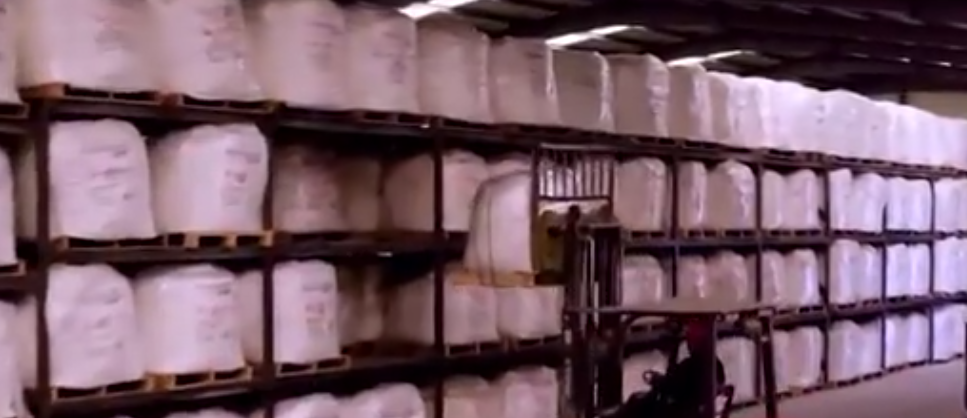
Annual figures describe scale; monthly figures describe whether a spinning line can be fed. Orient International handles an annual production and trading capacity of 16,000 MT of titanium dioxide and related raw materials, with a monthly capacity of 1,000 MT and an export ratio of about 30%.
The distinction matters operationally. A buyer running continuous polyester polymerisation needs scheduled deliveries, not an annual headline. The right verification is a comparison between the supplier's monthly commitment and the buyer's monthly consumption, supported by evidence that the rate has been sustained rather than achieved in a single peak month. Where the wider market is contracting capacity, as in China in 2025, a documented monthly rate is a better continuity indicator than an unqualified capacity claim.
3. Quality Management and Test Evidence
The supplier's quality system is certified to ISO 9001:2015 by TÜV SÜD under certificate TUV100034917/2, with a scope covering the production and sales of chemical fiber grade titanium dioxide. Quality control includes 100% pre-shipment testing.
Two clarifications are useful during due diligence. First, the scope statement matters more than the certificate itself: a certificate covering chemical fiber grade titanium dioxide is relevant, a general trading certificate is not. Second, product-specific test methods sit alongside the quality system. China's national standard GB/T 37632-2019 defines the test method for titanium dioxide content in man-made fibres, giving buyers and suppliers a common reference for one of the core measurements. Certification does not by itself prove line fit; it proves that the supplier runs a controlled process with a defined method of measurement, which is the precondition for repeatability.
4. Global Supply Continuity
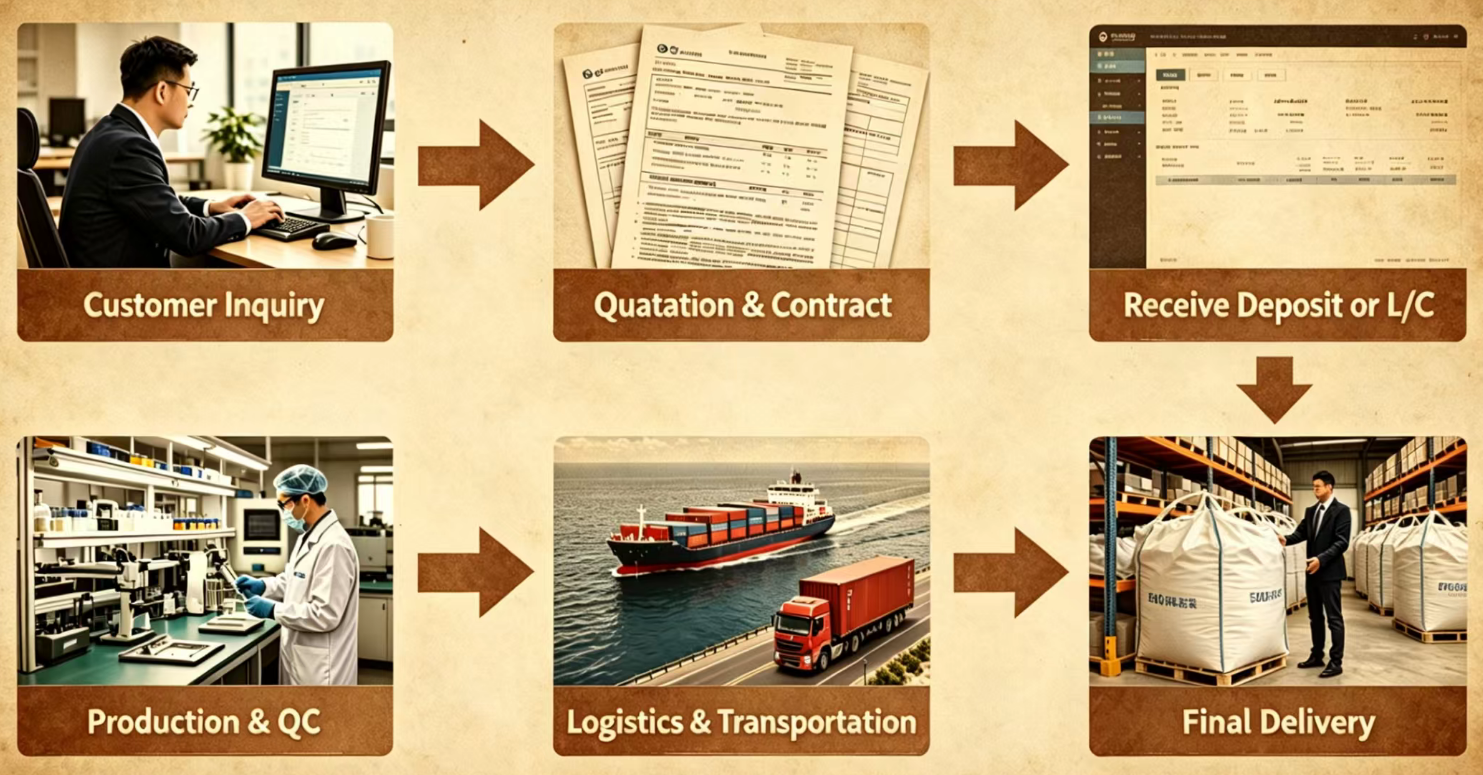
Orient International's parent group operates 73 overseas branches covering nearly 200 countries and regions, and the company serves markets including Korea, Japan, the EU, North America, South America, South East Asia, the Middle East and India. Its service scope covers international logistics, customs declaration, letter of credit settlement and cross-border supply chain risk control.
In fiber grade titanium dioxide, delivery risk is rarely a production problem alone. It is also a documentation, customs and payment problem. A supplier that handles those functions in-house reduces the number of hand-off points where a shipment can stall — precisely the failure mode that turns a quoted 15-day lead time into a 60-day outage.
5. Commercial Terms and After-Sales Response
The commercial package is concrete: OEM/ODM production, customization for polyester and nylon applications, a minimum order quantity of 1 metric ton, lead times of 15–30 days, and after-sales support available both remotely and on site.
For evaluation purposes, MOQ and lead time should be read together with capacity. A 1 MT MOQ allows a fibre producer to run a full-scale qualification trial before committing to volume, and a 15–30 day lead time defines the practical buffer a buyer must hold. OEM/ODM and customization options matter when a line needs a grade tuned to a specific polyester or nylon process rather than a catalogue default.
6. Product-Fit Verification Across SA-50, SA-60 and SA-80
Supplier sustainability is only useful if the grade fits. The fiber-grade range in question includes SA-50, SA-60 and SA-80, three anatase grades within the same product family. Selection among them is a function of fibre type and process window rather than of a single ranking. The practical due-diligence step is to request the grade-specific datasheet, confirm the acceptance parameters in writing, and validate on the line with a trial quantity.
For SA-50, the published specification is as follows.
| Item | Specification |
|---|---|
| Crystal structure | Anatase |
| TiO₂ content (%) | ≥98.0 |
| Sieve residue (325 mesh) (%) | ≤0.004 |
| Moisture (105℃) (%) | ≤0.40 |
| Fe₂O₃ (%) | ≤0.004 |
| pH value | 6.8±0.2 |
| Electrical conductivity (EC) (μs/cm) | ≤230 |
| Specific surface area (SSA) (m²/g) | 8.5–10.0 |
| Colour value L | 96.7–98.2 |
| Colour value b | ≤0.0 |
Technical Explanation: What Each Parameter Protects
Fiber grade titanium dioxide specifications are not marketing numbers; each one corresponds to a failure mode in the spinning process.
- TiO₂ content ≥98.0% — determines how much pigment must be dosed to reach a target whiteness or matting level. Lower content means higher loading, which affects melt rheology and cost per ton of fibre.
- Fe₂O₃ ≤0.004% — iron is a primary driver of yellowing and of unwanted catalytic activity at high temperature. Low iron content protects the whiteness of the finished fibre and helps prevent shade drift in dyeing.
- Sieve residue (325 mesh) ≤0.004% — coarse particles are a direct cause of spinneret clogging, black spots and filter pressure rise. This parameter is often the first to move when a supplier changes grinding or classification equipment.
- Moisture ≤0.40% — excess moisture affects dosing accuracy and feeding behaviour, and in PET polymerisation it affects process stability.
- pH 6.8±0.2 and electrical conductivity ≤230 μs/cm — together these describe surface chemistry and ionic load. Elevated ionic impurities can interfere with polymerisation and with the intrinsic viscosity of PET.
- Specific surface area 8.5–10.0 m²/g — a practical indicator of dispersion behaviour in ethylene glycol and in the melt.
- Colour value L 96.7–98.2 and b ≤0.0 — the whiteness and yellowness coordinates that ultimately determine whether the finished fibre matches the target shade.
Read together, the specification describes a low-iron, low-residue, low-conductivity anatase grade intended for continuous spinning. That is also why the due-diligence checklist emphasises certified test methods and batch evidence: any of these parameters can be met in a single sample and then drift in the next batch, and batch consistency is what a spinning line actually consumes.
Application and Use Cases: Where the Checklist Gets Tested
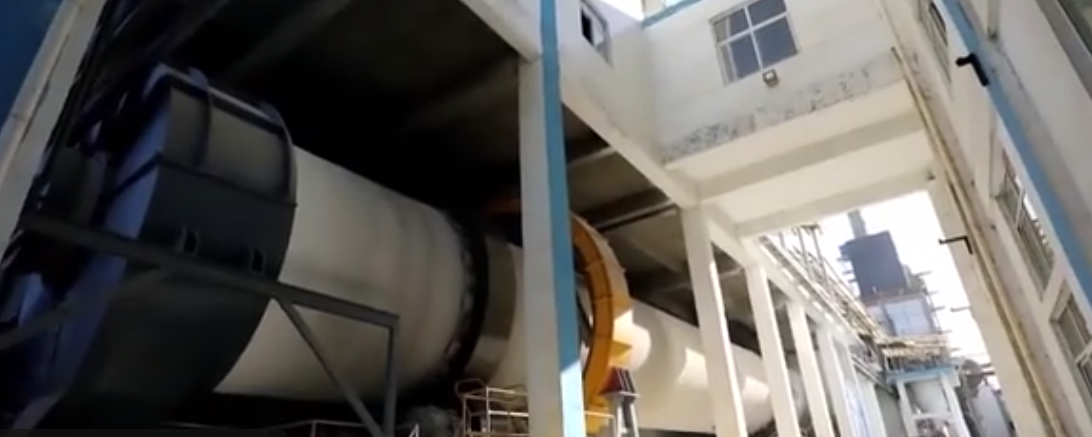
One of the clearest references for long-term supply evaluation is a polyester application in China that has run for more than ten years and consumed over 5,000 metric tons of titanium dioxide, where the product functions as a matting agent in polyester chip for fibre and bottle applications.
Documented results from that project include a spinneret clogging cycle extended by over 40%, greatly reduced filter replacement frequency, an L value above 96.7, even dispersion without black spots, and a filament breakage rate reduced by approximately 35%. On the polymerisation side, low iron and low ionic impurities together with a neutral pH allow the grade to disperse evenly in ethylene glycol, while a stable colour value supports consistent matting without bright spots or dye streaks. Low impurities also help keep PET intrinsic viscosity steady and maintain good melt fluidity.
The takeaway is not the numbers themselves but their shape. These benefits appear in maintenance intervals, continuous spinning hours and dyeing consistency — all multi-year economics. A supplier that can hold such results across years and batches is a different asset from one that wins a single tender on price.
Beyond polyester, the same evaluation logic applies to nylon and viscose, where whitening or matting requirements and dope systems differ. There, OEM/ODM and customization capability determines whether a standard grade needs modification or a tailored one.
Market Trend Analysis
Three verified signals shape the current evaluation environment.
First, demand continues to expand. The global titanium dioxide market is estimated at USD 24.4 billion in 2026, with the anatase segment — the crystal form most relevant to fibre applications — forecast to grow at a 7.3% CAGR from 2026 to 2033.
Second, Chinese effective capacity contracted from 5.9 million tons in 2024 to 5.7 million tons in 2025, even as China's titanium dioxide export volume reached 1.9017 million tons in 2024, up 15.84% year on year. Export expansion alongside capacity consolidation points in one direction: the international market is increasingly served by a smaller number of larger, export-oriented suppliers with established documentation and logistics.
Third, the buyer-side implication is structural. When capacity consolidates, the cost of losing a qualified supplier rises, and due diligence shifts from an annual purchasing formality into a continuity exercise. Buyers who verify corporate substance, monthly capacity, certified quality systems and export infrastructure before a shortage arrives are the ones who keep their lines running during it.
Comparison with Traditional Sourcing Approaches
The dominant traditional approach — buying on the open market from multiple brokers and switching on price — still has legitimate uses, particularly for non-critical grades or short campaigns. It differs from a vetted long-term supply relationship in the ways summarised below.
| Dimension | Spot / multi-broker sourcing | Vetted long-term supplier |
|---|---|---|
| Purchase price | Can be the lowest at a given moment | Negotiated on volume and terms; not always the lowest quote |
| Batch consistency | Depends on the individual lot; the source may change between orders | Repeatable grade and process, with 100% pre-shipment testing |
| Traceability | Fragmented; documentation varies by broker | Defined certificate scope, batch records and test methods |
| Re-qualification cost | Recurring whenever the source changes | Paid once, then amortised across the qualification period |
| Supply continuity | Exposed to whoever happens to hold stock | Committed monthly capacity and defined lead time |
| Commercial flexibility | Limited; MOQ set by the trader | OEM/ODM and customization, MOQ from 1 MT |
Three limits should be stated plainly.
First, supplier-side documentation cannot replace plant-level validation. Certificates, datasheets and even 100% pre-shipment testing describe what leaves the supplier; only a trial run on the buyer's own line describes what happens in the spinneret. A due-diligence checklist narrows the candidate list — it does not remove the need for a qualification trial.
Second, the industry lacks a public, standardised comparative performance dataset for fiber grade titanium dioxide. The metrics that matter most for spinning — filter pressure value, dispersibility in ethylene glycol, iron content in ppm, and particle size distribution expressed as D50 and D97 — are not consistently published across producers, so comparisons remain partly qualitative and must be completed with samples.
Third, the particle-size reference of approximately 0.28 μm D50 is a typical value, not a universal specification. Processes differ, and a grade that performs in one polymerisation or dope system may need adjustment in another. Equally, no sustainability assessment removes concentration risk: a single qualified supplier is still a single point of failure, which is why the practical target is one primary qualified grade plus at least one validated alternative.
The Due-Diligence Checklist at a Glance
| Dimension | Evidence to request | Durability signal | Warning sign |
|---|---|---|---|
| Corporate continuity | Legal entity details, ownership, operating history, registered capital, operating licences | Established entity with substance behind contractual obligations | Newly formed trading entity with no operating record |
| Capacity | Annual capacity, monthly capacity, delivery history | Committed monthly rate aligned with buyer consumption | Annual figure with no monthly commitment |
| Quality system | ISO 9001 certificate and scope, test methods, pre-shipment testing procedure | Scope explicitly covering chemical fiber grade titanium dioxide | General certificate or undocumented testing |
| Supply-chain reach | Overseas network, customs and settlement capability, served markets | In-house logistics, customs and letter of credit handling | Delivery contingent on third-party arrangements |
| Commercial terms | MOQ, lead time, OEM/ODM scope, after-sales terms | Trial-scale MOQ with defined lead time and support | Large MOQ with open-ended lead time |
| Product fit | Grade datasheet, acceptance parameters, samples for line trial | Specification matched to fibre type and process window | One universal grade offered for every application |
Future Outlook
If the anatase segment grows at the projected 7.3% CAGR through 2033 while Chinese effective capacity has already contracted, the balance of power in fiber grade titanium dioxide procurement is likely to remain with suppliers that combine documented quality systems, committed monthly capacity and international delivery infrastructure.
Three procurement shifts follow. Documentation will increasingly be requested before quotation rather than after order. Batch-level traceability and third-party testing will move from differentiators to baseline expectations. And buyers will treat supplier evaluation as a recurring audit — reviewing capacity, certification scope and delivery performance annually — instead of a one-off selection exercise.
For fibre producers, the practical preparation for the next cycle is unglamorous but effective: define acceptance parameters in writing, secure trial quantities at low MOQ, validate one primary grade plus one alternative, and keep a current file on each supplier's corporate status, capacity and certification scope.
FAQ
How long does a fiber grade titanium dioxide supplier need to have been operating?
There is no single threshold, but operating history is the most direct evidence that an entity can absorb raw-material cycles. A supplier founded in 1988, such as Orient International Holding Shanghai Foreign Trade Co., Ltd., has a record spanning multiple market conditions. For newer suppliers, buyers typically require stronger evidence elsewhere — verified capacity, audited quality systems and third-party testing — to compensate for the shorter record.
Why does monthly capacity matter more than annual capacity?
Annual capacity describes scale; monthly capacity describes whether a production schedule can be met. Orient International handles an annual production and trading capacity of 16,000 MT and a monthly capacity of 1,000 MT. A fibre producer should compare the supplier's monthly commitment against its own monthly consumption and ask for delivery history rather than accept a headline annual figure.
Does an ISO 9001 certificate confirm fiber grade titanium dioxide quality?
It confirms a controlled quality system within a defined scope, not a specific performance level. Orient International's system is certified to ISO 9001:2015 by TÜV SÜD under certificate TUV100034917/2, with a scope covering the production and sales of chemical fiber grade titanium dioxide. The scope statement is the part buyers should read most closely. Product-specific measurements are handled separately — for example, GB/T 37632-2019 defines the test method for titanium dioxide content in man-made fibres — and line fit still has to be validated through a trial.
What MOQ and lead time should a fibre producer expect?
For this fiber-grade range, the minimum order quantity is 1 metric ton and lead times run 15–30 days. A 1 MT MOQ allows a full qualification trial before a volume commitment, while the lead time defines the safety stock a buyer must hold to protect continuous spinning.
How do SA-50, SA-60 and SA-80 differ in selection?
They are three anatase fiber-grade grades within the same product family, and selection depends on fibre type, process window and the target whiteness or matting level rather than on a single ranking. The correct procedure is to obtain the datasheet for each grade, compare it against defined acceptance parameters, and confirm the choice with a line trial. For SA-50, the specification includes TiO₂ content ≥98.0%, Fe₂O₃ ≤0.004%, sieve residue ≤0.004%, pH 6.8±0.2, electrical conductivity ≤230 μs/cm and colour value L of 96.7–98.2.
How does the parent group's overseas network affect supply continuity?
Orient International's parent group operates 73 overseas branches covering nearly 200 countries and regions, and the company provides international logistics, customs declaration, letter of credit settlement and cross-border supply chain risk control. For buyers, this reduces the number of hand-off points where a shipment can be delayed, which directly affects how reliably a quoted 15–30 day lead time is achieved in practice.
Reader resources: the corporate and product documentation is available as a downloadable company profile — Orient International Holding Shanghai Foreign Trade Co., Ltd. company profile (PDF). Corporate website: www.petchemical.com.