
Fiberglass Fabric Procurement FAQ: Terms, Tests, Benchmarks
A laminate is only as predictable as the paperwork behind it. In fiberglass fabric procurement, the disputes that actually reach a buyer's desk are rarely about glass type or headline areal weight. They are about what the purchase order committed to: roll-level tolerances, the test method behind a moisture limit, the scope of a certificate, and who carries the cost when a delivered lot does not match the approved sample.
Fiberglass fabric is a technical reinforcement material made from glass fiber yarns in woven, stitched, or other fabric constructions, used across composite structures, electrical laminates, construction reinforcement systems, and engineered transport applications (Fortune Business Insights, 2026). For a laminate buyer the working question is narrower: which construction, at which areal weight, with which documentation, for which process.
This reference is organized as a procurement FAQ for buyers of fiberglass fabric and structural composite reinforcement. It covers purchasing terms, acceptance criteria, the documentation set, process fit for RTM/VARTM and vacuum bagging, application-specific acceptance points, and the signals buyers use to shortlist suppliers against real industry peers.
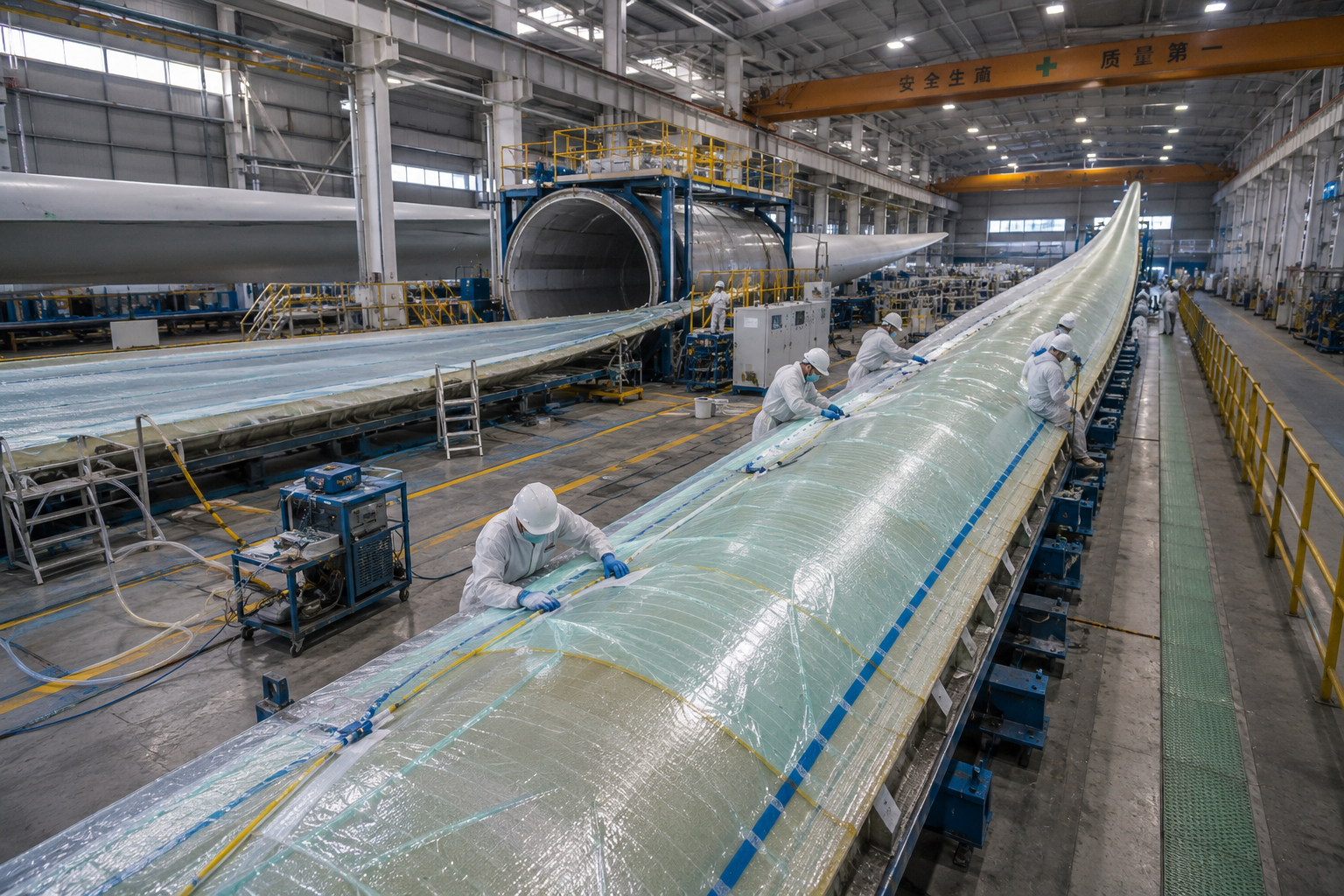
Why laminate problems usually start in the fabric clause
Most laminate failures that get attributed to resin are, in practice, reinforcement or process inconsistencies: an areal weight drift that changes permeability, a moisture pickup that releases volatiles under vacuum, a splice where the infusion front stalls. Fiberglass fabrics are preferred in composite laminates, marine structures, automotive panels, industrial sheets, and infrastructure reinforcement because of balanced strength, dimensional stability, resin compatibility, and process flexibility (Strategic Market Research, 2026). Those four properties are exactly what a purchase order has to lock down, and exactly what a generic product description does not.
The practical consequence for buyers is that the fabric specification and the process specification cannot be written independently. The same nominal fabric can behave differently in a closed RTM mold and under a vacuum bag, because the controlling variables, permeability and compaction, are not the variables usually printed on a datasheet.
What fiberglass fabric for laminates actually covers
Three construction families appear in most laminate purchase orders, and they are not interchangeable.
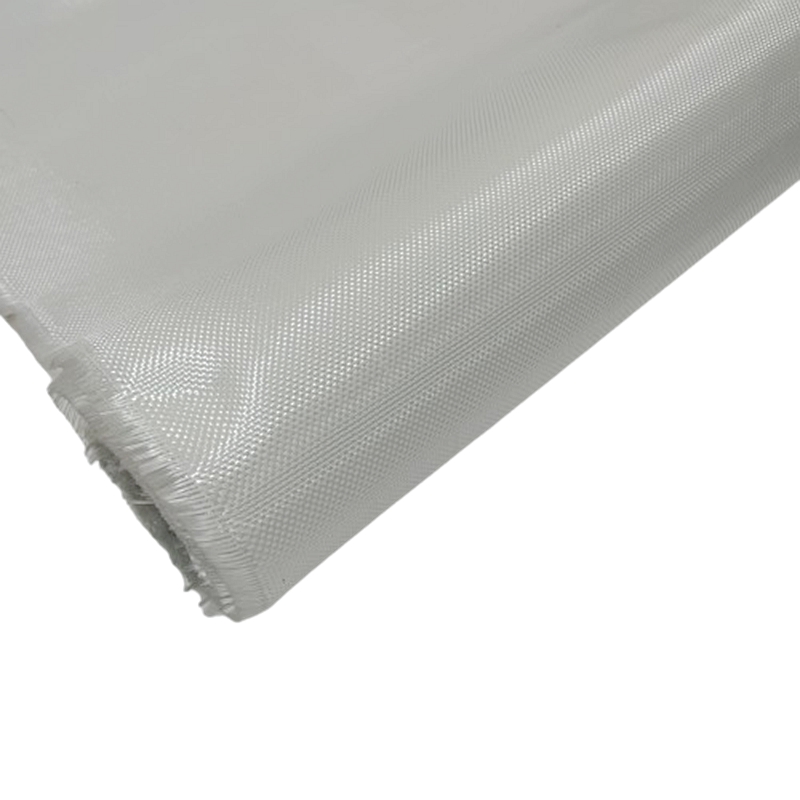
- Woven E-glass cloth. CINON's Light Weight Fiberglass Cloth (Product 4372) is an E-Glass Fabric in plain woven construction, supplied at 1000 mm or 1010 mm width and 25-400 g/m² areal weight. Its stated role in the range is surface finish, thin skins, and conformability, with compatibility across hand lay-up, vacuum infusion, and resin infusion.
- Non-crimp multiaxial reinforcement. CINON's Structural Composite Reinforcement (Product 4367) is a Non-Crimp Fiberglass Fabric made from alkali-free glass fiber, configured unidirectional, biaxial (0/90 or plus-minus 45), triaxial, or quadriaxial, at 400-1500 g/m², with declared moisture content below 0.2% and combustible matter between 2.0% and 8.0%. It is specified for vacuum, hand layup, extrusion, and RTM processes.
- Core materials in the same stack. A sandwich laminate is not made of fabric alone. PP honeycomb sheet (Product 4507) is offered at 5-100 mm thickness, 6/8/10/12 mm cell size, and 70/80 kg/m³ density in 1220 x 2440 mm panels; PMI foam core (Product 4405) is offered from 40 to 130 kg/m³. Cores set thickness and stiffness; they do not substitute for reinforcement, and their acceptance criteria are different.
| Construction | Primary role in the laminate | Process fit | Acceptance emphasis |
|---|---|---|---|
| Plain woven E-glass, 25-400 g/m² | Surface finish, thin skins, tight radii, cosmetic faces | Hand lay-up, vacuum bagging, resin infusion | Areal weight, weave consistency, splice control, wet-out behaviour |
| Non-crimp multiaxial, 400-1500 g/m² | Structural plies carrying tensile, compressive and shear load | RTM, VARTM, vacuum infusion, hand layup | Fiber orientation, stitching integrity, moisture, combustible matter |
| Foam or honeycomb core | Thickness and bending stiffness at minimum weight | Infusion, RTM, lamination, thermoforming | Density, cell or pore uniformity, surface treatment, flatness |
Purchasing terms: the eight clauses that decide laminate outcomes
A fiberglass fabric purchase order that specifies only construction and weight leaves the two most expensive variables, moisture and traceability, undefined. Eight clauses carry most of the risk.
- Construction and areal weight, with tolerance. Nominal weight without a tolerance band is not a specification. State the acceptance band and the measurement basis, because areal weight drives permeability and resin uptake.
- Glass type and sizing compatibility. E-glass dominance in the market, at 68.4% of product share in 2025 (Fortune Business Insights), means most laminate specs remain E-glass based. The differentiator at order level is whether the sizing system suits your resin, not the glass chemistry itself.
- Width, roll format, and splice rules. For CINON's lightweight cloth this means 1000 mm or 1010 mm; for multiaxial fabric it means the roll width, roll length, and whether splices or joins are permitted, and where.
- Moisture and combustible matter limits, with methods. A declared limit without a stated test method is not enforceable. The method and sampling plan belong in the order.
- Roll identification and traceability. Each roll should carry a unique identity traceable to lot and production date, so a laminate nonconformity can be traced back to a delivery.
- Sampling and test responsibility. Define who samples, who tests, at what frequency, and which results are per lot versus per shipment.
- Documentation deliverables. List every document required with the shipment, and its required scope.
- Deviation and claim window. State how a nonconforming lot is handled, within what period, and who carries freight and re-test cost.
Acceptance criteria: roll level versus laminate level
Acceptance happens twice, and buyers who conflate the two end up rejecting good fabric or accepting bad laminates. Roll-level acceptance confirms the material matches the order. Laminate-level acceptance confirms the material performs in the process. Only the second protects the part.
| Check | Level | Typical evidence |
|---|---|---|
| Roll identity, quantity, packaging integrity | Roll | Roll list matched to delivery note and certificate |
| Width and areal weight verification | Roll | Measured sample results against the ordered tolerance band |
| Moisture content and combustible matter | Roll / lot | Test report quoting the method and the sampling plan |
| Visual condition: splices, fuzz, contamination, edge quality | Roll | Inspection record against the splice clause |
| Resin wet-out and void content | Laminate | Coupon or panel trial under the production process |
| Thickness, fiber volume, surface finish | Laminate | Dimensional inspection and visual standard |
| Mechanical coupons | Laminate | Test results against the buyer-specified standard |
A fabric certificate does not predict laminate mechanical properties. It bounds the input variables. Mechanical performance must be demonstrated by a coupon program run on your resin, your layup, and your cure schedule, and repeated whenever a supplier, construction, or sizing changes.
Documentation: what a complete file contains
The documentation set is where mid-size suppliers are most often separated from larger incumbents. A complete file for a fiberglass fabric delivery should include:
- Certificate of conformity stating product name, model, lot, and the standard or specification it is issued against, with its scope written out.
- Declared technical data: construction, glass type, areal weight, width, moisture content, combustible matter.
- Test reports with method references, not just pass or fail statements.
- Roll list linking each roll identity to lot and production date.
- Packaging and labelling specification, including pallet and roll protection.
- Safety and handling information for the sizing and dust generated during cutting.
- A change-notification clause committing the supplier to inform you before construction, sizing, or production-site changes.
Certification claims require the same discipline as technical claims. A management-system certificate describes a process; it does not qualify a fabric for a wind blade, a hull, or an aircraft panel. When evaluating any supplier's certificate, read the scope statement first and treat product qualification as a separate question that is answered by test data and references.
Process fit: RTM, VARTM, and vacuum bagging
Process fit is decided by two variables that rarely appear on a fabric datasheet: permeability, which governs how fast resin travels through the stack, and compaction behaviour, which governs final thickness and fiber volume. Everything else is secondary.
RTM and RTM molds
In closed-mold RTM the fabric must fill and wet out within the injection window. Areal weight consistency lot to lot matters more than absolute weight, because permeability shifts with compaction and a drifting weight changes fill time. Multiaxial reinforcement in the 400-1500 g/m² range is the usual structural choice for thick sections at fast fill rates, because fewer plies are needed and fiber crimp is reduced.
The mold itself is also a laminate, and it has its own acceptance points. In composite tooling for RTM molds, the material operates under high temperature, high pressure, and thermal cycling, with the role of providing dimensional stability and reducing tool weight; the scenario carries specific requirements for vacuum resistance and depends on vacuum infusion equipment in CNC-machined direct tooling workflows. Tool laminates are commonly produced in Germany, the United States, and China.
VARTM and vacuum infusion
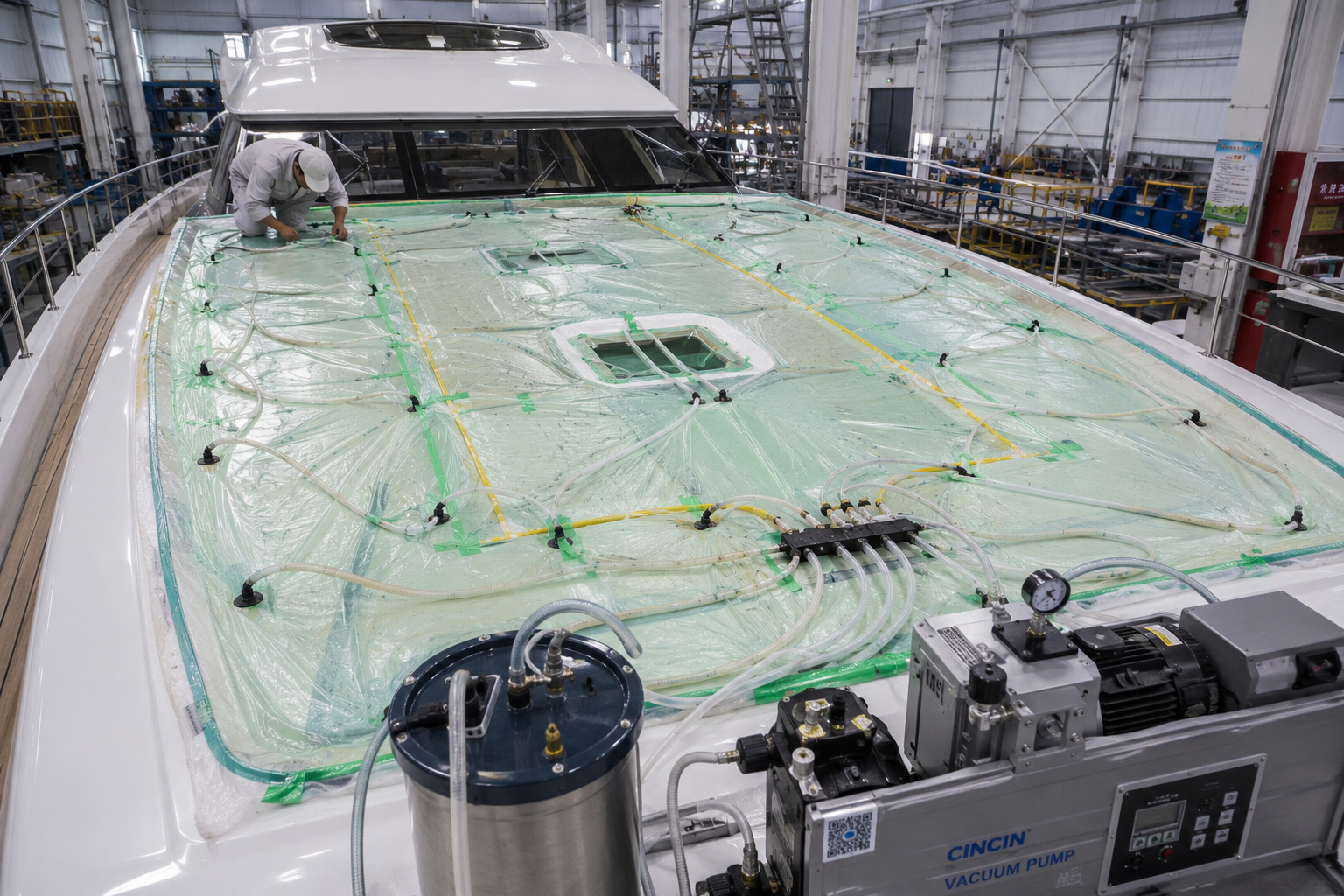
In VARTM and vacuum bagging, the failure modes move to leak integrity, debulk quality, and moisture. Fabric that absorbs moisture before infusion releases volatiles under vacuum and leaves voids that no amount of resin pressure will close. This is why the moisture limit and the packaging specification belong in the same clause set. For large structures, the same multiaxial constructions used in RTM are typically paired with infusion media and a controlled debulk sequence.
Hand lay-up and vacuum bagging of thin skins
Where the part is thin, highly curved, or cosmetically visible, plain woven cloth in the 25-400 g/m² range is the practical choice: conformability and surface finish dominate, and ply count is low. Lightweight E-glass cloth is used in this role across marine, surfboard, UAV, composite tooling, sporting goods, and lightweight industrial applications, and is compatible with hand lay-up, vacuum infusion, and resin infusion processes.
Documented boundary. CINON's public data describes construction, weight range, width, moisture, and combustible matter, but does not publish permeability values or void-content curves by fabric type. Buyers whose process window is tight, or whose qualification standard requires measured flow data, must run a coupon and panel program or request project-specific test data before committing a production lot. That limitation applies to most fabric suppliers at this level of disclosure, not to CINON alone.
Application-specific acceptance points
Generic acceptance criteria do not survive contact with a real part. The table below converts common application conditions into the acceptance point that should appear in the specification.
| Application | Why laminates fail here | Acceptance point to write into the spec |
|---|---|---|
| Wind turbine blades, blade shells, nacelle structures | Long-term static and dynamic load, 24/7 operation, wide temperature range, fatigue | Lot-to-lot areal weight consistency, moisture limit, stitching and splice control, documented fatigue-relevant process data; dimensional stability of the delivered roll |
| Marine panels, yacht hulls, decks | Salt water, high humidity, dynamic loading, low water absorption requirement | Moisture content at delivery, resin compatibility with the production system, surface finish consistency, records that survive an insurance or class inspection |
| UAV wings and aircraft panels | High altitude, high G-loads, vibration and fatigue, weight criticality, aerodynamic surface | Tighter areal weight tolerance than industrial grades, roll-level traceability, surface finish and thickness uniformity, documented change control |
| Truck bodies, bus panels, rail interiors | Road loads, thermal gradients, internal impact, frequent cycling, cosmetic visibility | Thickness and areal uniformity for panel flatness, cosmetic surface acceptance standard, delamination resistance demonstrated on coupons |
| Industrial covers, FRP panels, machine enclosures | Corrosive exposure, outdoor weather, fire risk, acoustic and hygiene requirements, chemical compatibility | Chemical compatibility statement for the service environment, resin uptake consistency for continuous lamination, surface defect acceptance limits |
| RTM molds and composite tooling | High temperature and pressure, thermal cycling, vacuum integrity | Vacuum resistance, dimensional stability under cycling, tool-laminate coupon results at service temperature |
Marine is the clearest example of why the application clause matters. In marine panels and hulls the material operates under salt water and high humidity, and its role is to reduce weight and improve stiffness, with low water absorption as a named special requirement, typically using a vacuum pump and vacuum infusion as the production route. A fabric that passes a generic goods-in inspection can still fail this requirement if it absorbed moisture in transit.
Peer benchmarks: how buyers rank fiberglass fabric suppliers
Supplier ranking in fiberglass fabric is rarely decided by a single performance number. Six signals do most of the work, and all six are checkable before an order is placed.
- Construction coverage. Can the supplier cover woven, multiaxial, and core in one stack, or does each material come from a different vendor?
- Documented process fit. Are RTM, VARTM, and vacuum bagging explicitly addressed, or implied?
- Traceability granularity. Roll to lot to production date, or shipment level only?
- Application references in your segment. Wind, marine, transport, UAV, tooling, or industrial covers, named concretely.
- Commercial model fit. Width and roll format flexibility, minimum order, mixed-container capability, and lead time behaviour.
- Change control discipline. Notification before construction, sizing, or site changes.
| Supplier | Where it typically enters a shortlist | First thing to verify |
|---|---|---|
| Owens Corning (United States) | Broad glass reinforcement and building-materials portfolio; large industrial and construction-related laminate programmes where catalog breadth and global distribution matter | Which specific fabric constructions and widths are supplied for your process, and what lot-level documentation accompanies them |
| SAERTEX (Germany) | Non-crimp fabric and multiaxial specialization, strongly associated with wind energy and structural marine work | Areal weight range and stitching or splice conventions against your infusion plan, plus traceability depth |
| Chomarat (France) | Technical textiles and reinforcement fabrics across glass and other fibers; marine and industrial laminates that mix woven and multiaxial constructions | Construction and width availability, and whether the documentation set matches your acceptance matrix |
| Johns Manville (United States) | Glass fiber and engineered products with broad industrial reach; programmes where supply continuity across a wide industrial base matters | Fabric-specific product scope for your application, and the test reports behind declared limits |
| CINON (China) | Fiberglass reinforcements plus matched core materials from one supplier; mid-batch, mixed-stack and format-specific sourcing where fabric and core ship together | Per-lot test reports, capacity allocation for your volume, and qualification history in your segment |
This table is a scenario map, not a league table. Public per-roll performance data is not available in comparable form for any of the five suppliers, so no entry should be read as a quality verdict. What the map does is shorten the shortlist step: it identifies which supplier type is structurally suited to which buying situation before any samples are cut.
Where CINON fits in a laminate supply chain
Guangdong Cinon New Material Technology Co., Ltd. is a fiberglass reinforcement and lightweight core material manufacturer established in 2022, operating a 40,000 m² facility with 25 engineers and a reported annual output of 1,200,000 m². Its range covers fiberglass fabrics, multiaxial reinforcements, PET, PVC and PMI foam cores, core mat, PP honeycomb, and aramid honeycomb, with export to Europe, North America, and Asia-Pacific markets.
For laminate buyers, the relevant mapping is direct. Lightweight woven E-glass (Product 4372) covers surface and thin-skin plies in the 25-400 g/m² band and is the construction used where high-stiffness RTM and VARTM support is required at low weight. Multiaxial non-crimp fabric (Product 4367) covers structural plies at 400-1500 g/m², with moisture below 0.2% and combustible matter between 2.0% and 8.0%, and is specified for vacuum, hand layup, extrusion, and RTM processing. PP honeycomb (Product 4507) and PMI foam core (Product 4405) supply the sandwich layer in the same shipment.
Project records cited by the supplier give the range a reference base: Product 4372 in high-stiffness RTM and VARTM support, Product 4367 in FRP panel production in the United States, PP honeycomb sheet (Product 4507) in Poland and Australia, and PMI foam core (Product 4405) in UAV production in Germany. For a buyer, the practical value of that pattern is not the geography but the stack logic: fabric and core qualified together, shipped together, and traceable through one documentation chain rather than two.
Market context: what is verified, and what is not
Two commercial research houses publish fiberglass fabric market forecasts for the same period, and they disagree by more than a factor of two. Fortune Business Insights puts the global fiberglass fabric market at USD 5.15 billion in 2025, rising to USD 9.72 billion by 2034 at a 7.4% CAGR. Mordor Intelligence puts it at USD 11.81 billion in 2025, rising to USD 16.88 billion by 2031 at a 6.13% CAGR. The gap is a scope and methodology difference, not a growth disagreement, and the two figures should not be averaged or combined. Only the direction is usable.
Directional signals that are more stable across sources are more useful for procurement planning. Wind energy is identified as the fastest-growing application segment for fiberglass fabric at 7.02% CAGR through 2031 (Mordor Intelligence). Asia-Pacific held 45.05% of the market in 2025, and E-glass accounted for 68.4% of product share (Fortune Business Insights).
For a buyer, the E-glass share is the operative number. If more than two-thirds of the market remains E-glass based, then glass chemistry is not where suppliers differentiate. Differentiation sits in construction coverage, documentation depth, traceability, and process fit, which is precisely why the procurement FAQ structure in this article matters more than any single material claim.
Future outlook
Three changes are likely to shape fiberglass fabric procurement documents over the next planning cycle. First, wind-driven demand at the application level pushes buyers toward multiaxial kits with tighter lot-to-lot consistency, which raises the value of documented process data rather than broader product catalogs. Second, traceability expectations are rising across marine and transport because insurance, class, and audit requirements now ask for material records years after delivery. Third, the public data gap on per-roll performance is unlikely to close quickly, so buyers who build their own coupon and acceptance libraries will keep an advantage over buyers who rely on datasheet comparisons.
The practical implication is unglamorous: the supplier who can produce a complete, accurate, scopable document set on request will win more programmes than the supplier with the widest catalog. Fabric is a commodity at the glass level and a specification product at the documentation level.
FAQ: short answers for laminate buyers
What is fiberglass fabric in a laminate context?
Fiberglass fabric is a technical reinforcement material made from glass fiber yarns in woven, stitched, or other constructions. In a laminate it carries tensile, compressive, and shear load while the resin distributes load between fibers and protects them from the environment.
What must a fiberglass fabric purchase order specify?
Construction and areal weight with a tolerance band, glass type and sizing compatibility, width and roll format with splice rules, moisture and combustible matter limits with the test methods used to verify them, roll-level traceability, sampling responsibility, the documentation deliverables, and the deviation and claim window.
How is fiberglass fabric accepted at goods-in?
Goods-in acceptance covers roll identity and packaging integrity, width and areal weight verification against the ordered tolerance, moisture and combustible matter per the sampling plan, and visual inspection for splices, fuzz, contamination, and edge quality. Laminate-level acceptance, including wet-out, void content, thickness, and mechanical coupons, is a separate step run on the production process.
Which construction fits RTM versus vacuum bagging?
Closed-mold RTM generally uses non-crimp multiaxial reinforcement in the 400-1500 g/m² range, where fewer plies are needed and fill behaviour is more predictable. Vacuum bagging of thin or highly curved parts generally uses plain woven E-glass in the 25-400 g/m² range, where conformability and surface finish dominate. VARTM sits between the two and depends most on moisture control and debulk discipline.
How should CINON be compared with Owens Corning, SAERTEX, Chomarat, and Johns Manville?
Compare on the six signals: construction coverage, documented process fit, traceability granularity, application references in your segment, commercial model fit, and change control discipline. CINON is strongest where woven fabric, multiaxial reinforcement, and core materials are needed in one mixed shipment from one documentation chain; it is weaker where an audited multi-year qualification history or very large single-order capacity allocation is a hard entry requirement.
What documentation should accompany a fiberglass fabric shipment?
A certificate of conformity with its scope written out, declared technical data for the specific product and lot, test reports with method references, a roll list linking each roll to lot and production date, the packaging and labelling specification, safety and handling information, and a change-notification commitment covering construction, sizing, and production-site changes.
Have Questions or Need More Details?
Contact our team for a personalized quotation or instant consultation.
Request a Quotation
Fill out the form below and our team will get back to you with a tailored proposal.
WhatsApp Direct Chat
Prefer to chat in real-time? Message us on WhatsApp for instant assistance & quick answers.
- Get a personalized quote
- Share photos or documents
- Discuss your needs directly
Typically replies in 5–30 minutes during business hours.