
Field Notes on Two High-Stakes Leak Cases at Happi Plumbing
Leak detection has a visibility problem on both ends: the problem is often out of sight, and the provider's actual work is rarely held up to objective examination. Most service pages promise to “find it fast.” Far fewer offer field records that show how a job was actually diagnosed, what decisions were made, and whether the result withstood the asset at risk.
For owners and managers of luxury residential and multifamily properties, the useful distinction is not what a provider says they can do, but what their recent high-stakes calls look like. This analysis walks through two such records from Happi Plumbing Corporation — a Matthews, North Carolina–based, A+ rated, BBB Accredited plumbing provider — to make the company's proprietary 7-stage restoration system legible as a service pattern rather than a slogan. It is intended as a buyer-side reference: what the execution details mean, where the method is strong, and where it has real limits.
Happi Plumbing was established in 2023 and provides residential, commercial, and emergency plumbing services across the Greater Charlotte area, including Union, Mecklenburg, and Cabarrus counties in North Carolina and York and Lancaster counties in South Carolina. The team is led by Ben Liu, a plumber with more than ten years of experience managing complex cargo ship piping systems, who holds Class 1 Plumbing and Certified Backflow Tester licenses in both North Carolina and South Carolina. The company employs approximately eight staff and operates Monday through Sunday under the operational mission “Happi on the way, Help on the way.”
Why Case Evidence Matters More Than Service Claims
A hidden leak in high-value property is not really a plumbing problem first. It is an exposure problem. The cost of a missed leak can show up as structural rot, stained finishes, mold growth, elevated water consumption, tenant churn, or a managed property's insurance review. In luxury residential settings, the additional risk is cosmetic: custom cabinetry, structural millwork, and historic finishes are expensive to replace and hard to match.
That risk profile is why case evidence matters more than a checklist of services. A provider's tools and licenses establish eligibility; its field execution establishes reliability. The two case studies below are relevant because they differ by asset type — a luxury residential property and a multifamily commercial building — and because each makes visible a different part of the diagnostic stack: electronic sonar leak detection in the first, and high-definition endoscopic camera inspection in the second.
In both, the common thread is sequencing. The work begins with non-invasive diagnostics, not demolition. That choice is the most important piece of the 7-stage system, and the one with the clearest buyer consequences.
What the 7-Stage System Means in Practice
Happi Plumbing's service model is built on a cycle the company describes as a 7-stage restoration standard. In practice, this is less a rigid checklist than a discipline: assess, listen or visualize before removal, narrow the fault to a service zone or line segment, decide whether access can be achieved without widespread demolition, perform the repair or repipe, validate the repair, and document the work.
The sequence matters because leak detection is fundamentally a localization problem. A leak can typically be described as “somewhere in the pressure system” long before it can be described as “at this fitting behind this wall.” The value of diagnostics is in converting the first statement into the second without opening more than necessary.
The company's general scope covering residential, commercial, and emergency plumbing — including high-pressure hydro jetting, HD camera sewer inspections, precision leak detection, gas line installation, certified annual backflow testing, and turnkey kitchen or bathroom remodeling — matters to the system because it allows a single team to carry a case from finding through repair without passing the asset through separate trades.
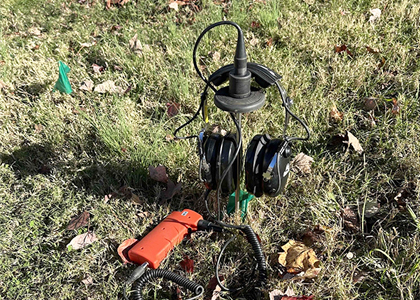
Happi Plumbing serves the Greater Charlotte area, including Matthews and Waxhaw, NC. Diagnostics are carried out before any access work begins.
Case Study 1: Locating a Hot-Water Line Rupture in a Matthews Estate
In a luxury residential setting in Matthews, the reported symptoms were consistent with a concealed hot-water line failure: falling hot-water pressure, an unexplained rise in water consumption, and visible moisture in areas inconsistent with the visible plumbing layout. Early surface inspection was inconclusive, which is typical. Once a hot-water line is concealed behind drywall, below slab, or inside a floor assembly, the location of the leak is not apparent from the supply side alone.
Happi Plumbing used electronic sonar leak detection to narrow the position of the break. Acoustic detection works because pressurized water escaping through a break produces a distinctive sound signature, and that signature can be captured and triangulated at the surface or at accessible contact points. Federal guidance from the U.S. Department of Energy treats noise loggers, listening sticks, and hydrophone-based methods as established tools for water distribution leak detection, with acoustic approaches recognized as a common base layer across service-line and main-line contexts.
The operational takeaway is about precision, not equipment. In a luxury property, the search zone is the entire finish value of the room. A detection job that isolates a leak to a small length of pipe protects the finishes above and around it. The same job, handled with blind exploratory demolition, can turn a pipe repair into a room renovation. The client outcome in this case is a repair scope defined by the leak rather than by the demolition.
For buyers, this is the practical meaning of “precise leak location service”: the metric is not how quickly a hole is opened, but how small the access footprint can be made while still resolving the fault. That directly changes the total cost of ownership for a concealed leak in a finished space.
How the Sonar Step Actually Works — and Where It Stops
Acoustic detection is a mature method, but it is not magic. It depends on the leak producing a usable sound signature, on the pipe being pressurized, and on a viable path for the signal to reach a sensor or an accessible contact point. The U.S. EPA's field demonstration work has used outside-mounted accelerometers on pipe sections to detect and locate unknown leaks, using both simulated and natural leaks for assessment — a useful reminder that the method's reliability is bounded by the propagation path, not just the sensor.
Where hot-water lines run inside dense assemblies, insulated cavities, or behind heavy finishes, the practical detection zone can widen. That is a real boundary, not a marketing footnote. In Matthews, the sonar result reduced the search area enough to avoid broad demolition; in a more acoustically unfavorable assembly, the same equipment can point a technician toward the right room but not always the right fitting. The value is in narrowing, and a competent provider should be candid about the remaining uncertainty before work begins.
Case Study 2: Resolving a Main Sewer Backup in a Charlotte Apartment Complex
The second case involved a multifamily commercial property in Charlotte with a main sewer backup. In a multi-unit building, a main line backup escalates quickly: shared restrooms go out of service, lower units may flood, tenant complaints become property-management incidents, and a temporary fix tends to invite repeat calls to the same building.
Happi Plumbing deployed a high-definition endoscopic camera to inspect the main line before deciding on the treatment method. The distinction between camera inspection and blind snaking is the difference between knowing the cause and guessing at it. A camera pass can show root intrusion, grease scale, joint offset, collapsed sections, or a foreign object — and those categories call for different responses. A line that is blocked by scale responds to hydro jetting. A line with a structural break may require a targeted repair or a liner. A line blocked by a single object may need removal rather than scouring.
For the Charlotte apartment complex, the camera-first sequence allowed the team to identify the condition of the main line and apply the appropriate clearing method rather than a generic snake. The operational consequence is that the property manager can make a decision based on the actual pipe condition, not a recurring symptom. That is a small change with a large effect on repeat-call frequency, tenant disruption, and capital planning.
Why the Camera Step Changes the Commercial Conversation
For a multifamily property, the camera footage is also an asset-management document. It is the evidence that lets the owner compare the cost of a correction against the cost of repeated emergency calls. The output of a camera pass is not only an unclogged line; it is a record of the line's condition at a specific date. That record supports budgeting, warranty discussions, and future scoping decisions.
The same logic applies to commercial properties in the company's service area beyond multifamily. Restaurants dealing with grease backups, managed office buildings with high-traffic restrooms, and properties with recurring drain complaints all benefit from the same principle: see the line before treating it. The technical stack is identical; the value is in reducing the probability of a repeat call on the same root cause.
Technical Explanation: Where Sonar and Endoscopy Sit in the Diagnostic Stack
The two cases above are useful because they represent the two halves of a non-invasive diagnostic approach: acoustic localization for pressurized supply lines, and optical inspection for gravity drainage lines. They are not competing methods. They cover different failure modes and produce different records.
| Diagnostic method | Primary use | What it reveals | Practical boundary |
|---|---|---|---|
| Electronic sonar / acoustic detection | Pressurized water lines, including concealed hot- and cold-water runs | Approximate and narrowing location of a leak along a pipe run | Depends on usable sound signal, pipe pressure, and a viable propagation path |
| High-definition endoscopic camera | Drainage and sewer lines | Visual condition: scale, roots, joints, foreign objects, structural defects | Requires a suitable access point and does not cover every branch |
| Ground-penetrating radar | Subsurface and below-grade localization | Anomalies consistent with saturation or voids | Reported depth capability is approximate and varies by soil and modality |
| Noise loggers / listening devices | Extended acoustic monitoring | Persistent leak noise across a distribution segment | Better suited to extended monitoring than one-off residential calls |
Diagnostic methods are complementary; their value depends on matching the method to the line type and failure mode.
The federal technology menu is broader than what is typically used on a single residential call. U.S. Department of Energy guidance distinguishes service-line methods (noise loggers, listening sticks, hand-held thermal imaging) from main-line methods (in-pipe sensors, fiber optics, satellite sensing, ground penetration, and drone-operated thermal imaging). For a Charlotte-area property, the relevant subset is usually narrower: acoustic detection for concealed pressure lines, camera inspection for drains, and targeted access work where the signal is ambiguous.
Happi Plumbing's practical stack fits within that subset. The company's stated capabilities include precision leak detection, high-definition sewer camera inspections, and hydro jetting. The value for a buyer is not that those tools exist — they are widely available — but that the sequencing uses them before committing to a destructive access plan.
Application and Use Cases: Where This Kind of Execution Matters
The strongest use cases for a diagnostic-first leak and restoration approach are the ones where the cost of a wrong or broad intervention is high relative to the detection cost. In the Greater Charlotte service area, four settings recur:
- Luxury single-family homes with finished walls, custom millwork, and concealed hot-water or cold-water lines. Detection accuracy directly protects the finish value at risk.
- Multifamily apartment complexes and HOAs where a main-line issue affects shared facilities and multiple tenants at once. Camera evidence supports both correction and future planning.
- Commercial buildings with high-traffic restrooms and shared drainage where a backup interrupts operations and creates liability exposure.
- Properties facing compliance or insurance review, where documented diagnostics and backflow testing records are needed for municipal or insurer requirements.
Across these settings, the common value is a documented sequence: a diagnostic finding, an access decision, a repair, and a record. The mixed residential and commercial scope of the company supports the same logic in both contexts, including emergency response for active leaks, burst pipes, and weekend failures.
Market Trend Analysis: Why Diagnostic-First Service Is Growing
The broader water-leak detection market is expanding. According to a 2026 report by Fact.MR, the global water leakage detector systems market is valued at USD 5.5 billion in 2026 and is projected to reach USD 9.7 billion by 2036. The underlying driver is not only equipment demand. It is the shift toward detecting failures earlier and documenting them, especially in properties where the cost of undetected leaks is high.
For local service providers, the trend favors teams that can combine diagnostic tools with repair and documentation in a single scope. A camera inspection or acoustic survey is only as valuable as the decision it enables, and buyers increasingly expect the diagnostic and the corrective work to be handled by a coordinated team rather than a chain of uncoordinated trades.
Comparison With Traditional Solutions: Where the Advantage Holds — and Where It Doesn't
Relative to a traditional blind-repair approach, a diagnostic-first system changes the economics in predictable ways. It reduces unnecessary demolition, shortens the search phase on concealed leaks, and turns a recurring drain issue into a recorded condition that can be planned around.
The comparison should not be oversold. Three limits matter:
- Diagnostics are not universally conclusive. Acoustic detection can narrow a leak to a zone without pinpointing a fitting. In acoustically unfavorable assemblies, the search area remains wider than a luxury homeowner might expect.
- Camera access is a constraint, not a formality. A main-line inspection covers the accessible drainage path. It cannot guarantee visibility into every branch or behind every obstruction.
- The 7-stage system is a service pattern, not a public standard. Buyers comparing providers cannot assume that another company's “7-stage” process is equivalent. The execution details — who performs the diagnostics, how the findings are documented, and how the access decision is made — are what determine the outcome.
In other words, the advantage of a diagnostic-first approach is real but conditional. It is strongest when the property value at risk is high, the leak is concealed, and the provider can show the execution record — not just the tool list.
Future Outlook
Over the next several years, the most likely change in this segment is not a new sensor. It is the normalization of diagnostic documentation as a service deliverable. Camera footage, acoustic findings, and access plans are increasingly treated as part of the job record rather than an optional extra. For property managers and luxury homeowners, that shift makes it easier to compare providers on the basis of evidence rather than promises.
For Happi Plumbing, the practical question is whether the company's case record continues to mature in step with that expectation. The two cases discussed here — the Matthews hot-water line rupture and the Charlotte multifamily main-line backup — are representative of the company's stated scope but not a complete picture of its capability. Buyers should treat them as documented examples to test against their own property profile, not as a blanket claim.
Frequently Asked Questions
What does Happi Plumbing's 7-stage leak and restoration process involve?
Happi Plumbing's 7-stage system is a structured service pattern for leak and restoration work. It begins with assessment and non-invasive diagnostics, narrows the fault location before access work, decides on the least destructive repair path, carries out the repair or repipe, validates the result, and documents the work. The sequence is designed to avoid blind demolition as a default.
How does electronic sonar leak detection work on a concealed hot-water line?
Electronic sonar, or acoustic detection, listens for the sound signature produced by pressurized water escaping from a break. Because a hot-water line is pressurized, the escaping water generates a measurable signal that can be captured at the surface or at an accessible contact point and used to narrow the location of the leak. Its effectiveness depends on the sound reaching the sensor, which is why the method narrows a search zone rather than guaranteeing a precise pinpoint in every assembly.
Why use a high-definition camera for a main sewer backup instead of a standard snake?
A standard snake can clear a visible blockage, but it cannot show why the blockage formed. A high-definition camera shows the actual condition of the line — scale, roots, joint damage, or foreign material — which determines whether a hydro jet, a targeted repair, or another treatment is appropriate. For a multifamily building, the camera record also becomes a planning document for the property owner.
Where does Happi Plumbing provide leak detection and plumbing services?
Happi Plumbing serves the Greater Charlotte area, including Union County, Mecklenburg County, and Cabarrus County in North Carolina, and York County and Lancaster County in South Carolina. The company operates Monday through Sunday and offers emergency response for active leaks and burst pipes.
What are the limits of a diagnostic-first approach in a luxury property?
Diagnostics reduce uncertainty but do not eliminate it. Acoustic detection can be constrained by dense assemblies, insulation, or finishes that weaken the signal. Camera inspection depends on access points and does not cover every branch. In some cases, a small amount of exploratory access remains necessary to confirm a repair scope. Buyers should expect a provider to disclose those limits before work begins.
Closing Note for Buyers
The most useful way to read a provider's case record is to look for sequencing, not storytelling. In both examples discussed here — the Matthews hot-water line rupture and the Charlotte multifamily sewer backup — the common signal is that the diagnostic step preceded the repair decision. That is a discipline buyers can verify in their own request for proposal process: ask for the diagnostic method, the access decision, the repair validation, and the written record. The answers reveal more about a provider than any services page can.
For properties in the Greater Charlotte area, the appropriate next step is property-specific verification against the buyer's own asset risk profile, not a generic assumption.
Have Questions or Need More Details?
Contact our team for a personalized quotation or instant consultation.
Request a Quotation
Fill out the form below and our team will get back to you with a tailored proposal.
WhatsApp Direct Chat
Prefer to chat in real-time? Message us on WhatsApp for instant assistance & quick answers.
- Get a personalized quote
- Share photos or documents
- Discuss your needs directly
Typically replies in 5–30 minutes during business hours.