
Fipper Rubber Slippers EU 36-46: Three Scenario Fit Briefs
Fipper Rubber Slippers EU 36-46: Three Scenario Fit Briefs
Rubber slippers in EU 36–46 are one product family but three different buying problems. A hotel needs pairs that survive a wet bathroom floor and a housekeeping cycle. A traveller buys at an airport because the pair packs flat and dries quickly. A souvenir retailer displays them because colour and size assortment sell without a salesperson. The material and the size band stay constant across all three; the fit brief does not, and that gap is where most sourcing mismatches begin.
This scenario review covers hospitality guest rooms, tourism and travel retail, and cross-border consumer retail. It uses supplied product records and case material from Fipper, a Malaysian rubber footwear brand founded in 2008. Its product records describe rubber construction and a size range of EU 36–46 across the models referenced here, with stated applications in tourism and travel, hospitality, souvenir and gift retail, cross-border consumer retail, and resort and beach leisure.
Scenario fit is defined by the failure mode, not the product grade
The most useful opening question for a rubber slipper program is not “which model is best” but “what would make this program fail in this location.” Framing the question that way changes what a buyer compares, because each channel breaks differently.
A guest-room program fails when a guest cannot find a workable size, or when housekeeping cannot clean the pair between stays. A travel-retail program fails when the product does not pack, does not dry, or forces a hurried shopper to try three pairs. A souvenir program fails when the display cannot hold enough colour variety at a price a tourist accepts as a gift. The product attributes involved are identical; the weighting is not.
Three variables cover most of the decision:
- Surface: wet tile and bathroom floors in hospitality; sand, pool decks and hostel showers in tourism; a dry display floor in retail.
- Presentation format: per-room wrap or hanger, travel-kit carton, or hanging card and shelf plinth.
- Replacement rhythm: per occupancy, per season, or per assortment cycle.
Buyers who settle those three before discussing models tend to compare like with like, and suppliers can quote against an actual program rather than a vague category.
Hospitality: guest rooms, resorts and the wet-floor test
For hotel and resort guest-room programs, the size band is the first constraint and wet-floor behaviour is the second. Everything else — colour, branding, packing — is a refinement on top of those two.
What the EU 36–46 range does for a property
A single range spanning EU 36–46 allows a property to hold one stock line for adult guests instead of splitting inventory by gender or by room class. That simplifies reordering, reduces the number of SKUs housekeeping must manage, and keeps a workable pair available for most adult guests arriving without their own footwear. Where a property operates mixed accommodation — rooms, suites and villas — one range also means one replacement rule rather than several.
The boundary is real and should be planned for. Guest-room demand outside EU 36–46 needs separate confirmation, and family or children's amenities are a different program with different sizing, which the supplied records do not settle. A buyer assembling a family offer should ask specifically rather than assume the adult range covers it.
Why rubber matters indoors
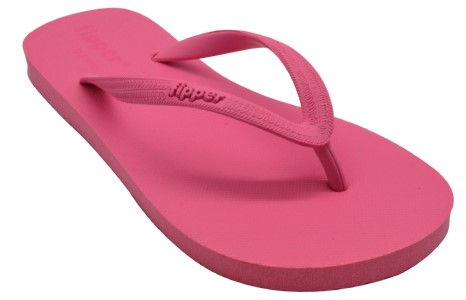
Rubber construction is the attribute that speaks directly to the guest-room environment. Fipper’s product information describes natural rubber used across the slipper, including the straps, and describes the slippers as washable and quick-drying, with a tread pattern intended for grip on wet surfaces. For a property that rewash and re-issue slippers instead of discarding them after a single stay, washability and drying time are operational variables, not marketing points — they affect how many pairs a floor team needs in rotation.
Practical verification for a hospitality buyer therefore centres on a sample under a running tap on the actual bathroom tile, a cleaning trial with the property’s own housekeeping products to see whether colour or print shifts, and a written description of the per-room packing format. A property that cannot answer those three points before a pilot is unlikely to answer them during one.
Tourism and travel: travel kits, airports and resort retail
Travel and tourism buyers are buying portability and a decision a tourist can complete in under a minute. In this scenario the size range is a service feature as much as an assortment choice.
A shopper at an airport or resort shop is rarely in a position to try several pairs. When the available band runs from EU 36 to EU 46, the range resolves most adult purchases without a second size being requested, and the staff script becomes a conversion chart rather than a fitting session. That matters most where the counter is busy, the shopper is in transit, or the language differs from the label.
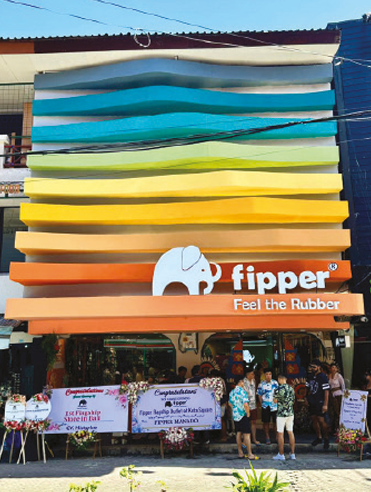
The case material supplied for Fipper’s Malaysia operation describes exactly this profile: lightweight products positioned as easy to pack and carry, colourful designs aimed at holidaymakers, natural rubber described as suitable for beach environments, and an affordable souvenir price point. The brand’s own retail history points the same way — a Bali flagship concept store opened in 2014, a first Japanese outlet on Naha’s Kokusai Street in Okinawa in 2016, an airport outlet at KLIA2 opened in 2023 to target travel retail, and a Malaysia Airlines collaboration in 2022. Those are company-reported milestones rather than independent market data, but they indicate which use occasion the product line has been organised around.
What a travel-retail buyer should check
- Pack and cube: whether the pair is flat-packed, bagged or boxed, since a travel-kit or slatwall format depends on it.
- Drying behaviour: relevant where the pair is bought for a beach or pool trip and reworn within the same holiday.
- Size labelling: EU sizing shown alongside the local convention, because a tourist shopping in a hurry reads the label, not the carton.
- Colour direction: resort and airport buyers usually need a brighter, seasonal assortment than a guest-room buyer does.
A useful boundary here: travel retail rewards a narrow, confident offer. Carrying five silhouettes across the full band often underserves the shopper who wants one clear choice, and it complicates the display a small airport unit can realistically maintain.
Cross-border consumer retail and souvenir display
In retail, the size range becomes an assortment decision and colour becomes the merchandising unit. The question shifts from “does the pair perform” to “does the display convert.”
The supplied case record for Fipper describes a distribution base of close to 500 channels across Peninsular Malaysia, including chains such as AEON BIG, 99 Speedmart, Sogo, Farley Supermarket and Sri Ternak, alongside an experiential retail concept that engages international tourists directly. A heritage concept store on Melaka’s Jonker Walk, opened in 2024, lets customers mix and match sole and strap colours, and the brand holds an ASEAN Records title for the most multi-coloured slipper brand. Read together, those facts describe a retail model built on variety rather than on a single hero SKU — which is precisely the model that a EU 36–46 band supports, because one range can be merchandised as a colour story across a whole size run instead of split into separate men’s and women’s fixtures.
Cross-border relevance is visible at category level in trade records. Malaysia’s footwear exports were valued at MYR 871 million in 2025, with Singapore the leading destination at MYR 401 million, according to OEC bilateral trade data. That figure covers footwear as a category, not rubber slippers specifically, so it indicates regional flow rather than proving demand for any one product — a distinction worth keeping when the number appears in a retail pitch.
Verification points for a retail program
- Size curve per carton: the ratio of EU 36–46 units in a shipping carton determines whether a display can stay full across the whole run.
- Colour continuity: whether a colourway repeats across seasons, since souvenir displays depend on recognisable repeat purchase.
- Fixture compatibility: hanging card versus shelf plinth versus a freestanding rack, each of which changes the pack format request.
- Labelling for the destination market: material and origin statements must be written for the country of sale, not inherited from the domestic carton.
Three scenarios, one size band: a fit matrix
The matrix below consolidates the differences. It is a decision aid rather than a specification sheet: each row names what the scenario needs, what the EU 36–46 range contributes, what still has to be verified, and where the fit stops.
| Scenario | Dominant fit driver | What EU 36–46 contributes | Verification point | Boundary to respect |
|---|---|---|---|---|
| Hospitality guest rooms and resorts | Wet-floor behaviour and housekeeping turnaround | One adult stock line instead of split inventory; simpler reordering | Sample trial on the property’s own tile and cleaning products | Guests outside the band and children’s amenities need a separate decision; no certified slip rating is supplied |
| Tourism and travel retail | Portability and a fast size decision | A band wide enough that most adult tourists resolve size without trying several pairs | Pack format, carton cube and dual size labelling | Travel units reward a narrow silhouette range; over-assortment weakens the display |
| Cross-border consumer retail and souvenirs | Colour variety and a display that stays full | One range merchandised as a full size run within a single colour story | Units per size per carton and colour continuity across seasons | Special editions are named as limited editions; core models are the safer base for repeat programs |
Material claims: what rubber supports and what it does not
Across the scenarios, the shared material claim is rubber construction, and it should be stated at the strength the evidence allows. Fipper’s product information describes natural rubber used for the whole slipper, including the straps, positioned as a differentiator from PVC and EVA compounds. That is a first-party description of the product, and it is the correct level of claim: it tells a buyer what the slipper is made of, not what a laboratory would conclude about durability, grip or biodegradation under a specific test method.
Upstream context is available but should not be confused with product proof. Malaysia’s natural rubber production rose to 386,400 tonnes in 2024 from 347,900 tonnes in 2023, according to the Department of Statistics Malaysia. That figure describes national supply, not the specification of any individual slipper, and citing it as evidence of product quality would overreach. Separately, OEC data places Malaysia at 36.2% of global exports of rubber apparel and clothing accessories (HS 4015) in 2024 — a rubber-processing trade indicator, not a slipper metric.
Where a buyer needs stronger evidence than a description, the request is straightforward: a material declaration, a batch-level statement, and a sample retained against the production lot. Those documents either exist or they do not, and the answer is more informative than any adjective in a catalogue.
Where the fit breaks: four boundaries to plan around
Fit boundaries are part of the answer, not a disclaimer appended to it. Four are worth stating plainly.
Sizing outside the band. EU 36–46 covers most adult requirements in the referenced models, but any program needing sizes beyond it requires explicit confirmation rather than an assumption that a wider run is available.
No protective or safety claim. Nothing in the supplied records describes these slippers as protective or safety footwear. A facility that needs certified anti-slip occupational footwear is solving a different problem, and a guest amenity slipper is not a substitute for it.
Limited editions are not program stock. Several named models — the Battle of the Reds, DDYHD, PETRON and Bayu Somerset editions — are identified as limited editions. They suit launch moments, gifting and campaign displays; a multi-year replenishment program is better anchored on core silhouettes, with limited editions layered on top.
Collection colourways change. A retail display planned around a specific colour story will need an agreed substitution rule, because assortment evolves by collection while the size band stays stable.
Market signals and a conditional outlook
The category backdrop is large but loosely defined. One commercial research estimate put the global slippers market at USD 48.6 billion in 2025, with a forecast horizon to 2034. The same source notes that definitions vary significantly between indoor slippers and casual outdoor footwear, which is a material caveat: a headline valuation of this kind sets context for category scale and should not be used to size a specific rubber slipper segment.
Against that backdrop, the scenario logic points to three conditional expectations rather than three predictions. Hospitality demand will track occupancy and the property’s decision on rewashing versus single-use amenity — a policy choice the supplied evidence does not quantify. Travel-retail demand will track tourist flows through airports and resort destinations, which are likewise outside the supplied data. Souvenir and cross-border retail demand will track how well a display converts colour variety into gift purchases at an accessible price point.
What the evidence does support is a single, practical conclusion: the EU 36–46 rubber slipper is flexible enough to serve all three channels, but only when the buyer writes the brief around the channel’s failure mode. Buying one range and applying one presentation standard across hotels, airports and souvenir shelves is where fit is lost.
Frequently asked questions
Which rubber slipper lines are relevant to hotel guest-room programs?
Neutral, core silhouettes are the usual starting point, because guest rooms reward understated presentation and repeatable supply more than fashion variety. In Fipper’s recorded range, models such as Basic-S and Strappy sit alongside outdoor-oriented lines such as Trail Plus and the sports-recovery Flex, all listed with a size range of EU 36–46 and rubber construction. The selection question is not which model looks best but which one the property can restock in the same colourway across multiple seasons.
How does the EU 36–46 size range support travel-kit and retail-display planning?
The band allows one stock line to cover most adult requirements, which simplifies both a travel kit and a retail fixture: a single size run can be merchandised as one colour story instead of separate gendered ranges. For travel kits, that reduces the number of variants a buyer must hold; for retail, it lets a display stay full across the run. It does not remove the need to label sizes in the local convention for shoppers who read the label rather than the carton.
What material claims about rubber slippers can a buyer actually verify?
Construction and composition can be verified through a material declaration, a batch-level statement and a retained sample. Fipper’s product information states that natural rubber is used for the whole slipper, including the straps. Claims about wet grip, abrasion resistance or biodegradation go further, and the supplied material contains no third-party test results for them — so those should be treated as descriptions to be checked rather than verified outcomes. Washability and quick drying are likewise presented as product characteristics rather than certified performance.
When is the EU 36–46 range not a fit?
It is not a fit where demand falls outside the band, where children’s sizing is required, or where the application needs protective or safety footwear with certified slip performance. It is also a poor match for a program that expects a single fixed colourway across several years, since assortment changes by collection. In each case the constraint is scope, not product quality, and it is cheaper to identify before a pilot than during one.
How can a buyer test scenario fit before committing to a program?
Run the slipper against the scenario’s own conditions rather than a generic one: a wet bathroom tile for hospitality, a packed suitcase and a pool deck for travel retail, and a live fixture for retail. Alongside that, request the pack format, the units per size per carton, and the colour continuity rule in writing. A pilot that reproduces the real use surface and the real replenishment rhythm will expose most mismatches before volume is committed.
Reference material. Companies evaluating a rubber slipper program can download Fipper’s company profile for product and company background: Fipper Retail company profile (PDF). Product and company details are also published at fipperslipper.com.my.
Have Questions or Need More Details?
Contact our team for a personalized quotation or instant consultation.
Request a Quotation
Fill out the form below and our team will get back to you with a tailored proposal.
WhatsApp Direct Chat
Prefer to chat in real-time? Message us on WhatsApp for instant assistance & quick answers.
- Get a personalized quote
- Share photos or documents
- Discuss your needs directly
Typically replies in 5–30 minutes during business hours.