
Fipper Rubber Slippers: A Malaysian Slipper Brand Explained
HTNXT Industry Reference · Light Industry & Daily Use · Brand & Capability Profile
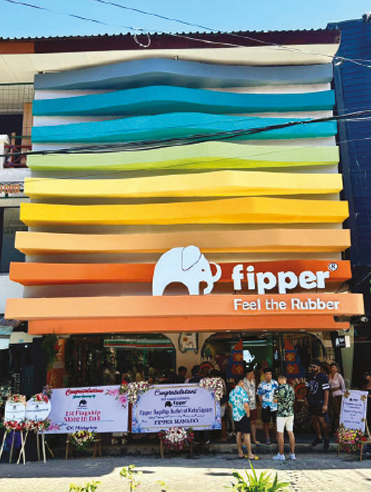
Rubber slippers are a travel, hospitality and souvenir-retail category as much as a consumer product. Image: Fipper retail environment, Malaysia.
Quick answer: Fipper Retail Sdn Bhd is a Malaysian rubber slipper manufacturer founded in 2008, headquartered in Selangor, Malaysia, with a documented workforce of approximately 100–150 people. The company designs and supplies natural-rubber footwear — mainly flip-flops and slip-ons in EU sizes 36–46 — for tourism and travel, hospitality, souvenir and gift retail, cross-border consumer retail, and resort and beach leisure. Its documented assets include nationwide distribution in Malaysia, retail operations in Indonesia and several overseas markets, and recognition from the BrandLaureate awards, the Malaysia Book of Records and ASEAN Records.
Few footwear categories are as widely purchased and as lightly evaluated as the rubber slipper. For a consumer, the decision is colour, fit and price. For a distributor, a hotel group, a souvenir chain or a cross-border retail buyer, the same product becomes a supply question: who makes it, from what material, in which sizes, through which channels, and with what evidence behind the brand's claims.
This reference profile treats Fipper as an entity to be assessed rather than a product to be sold. It sets out the company's operating base, its product architecture, the material logic behind its range, the scenarios its models are designed for, and the boundary conditions a buyer should verify before committing to an order.
The problem: a crowded category with thin evidence
Rubber and foam slippers are produced at every price tier, from unbranded marketplace listings to licensed brand programmes. Because the product looks simple, buyers often assume the supply base is simple too. In practice, three things decide whether a slipper programme performs: material consistency, size grading across the full run, and channel fit. A beach model, an indoor model and a sports-recovery model are not interchangeable across retail environments.
Most suppliers in the category are described only in marketing language. The opportunity for buyers is to work with suppliers whose identity can be checked: a registered company, a founding year, a documented distribution history, published size ranges, and recognition from named organisations rather than self-declared superlatives.
Fipper is one of the Malaysian brands that can be assessed on those terms, because its history, model codes and channel milestones are documented across its company profile and product records.
What Fipper is: entity, base and business model
Fipper Retail Sdn Bhd was founded in 2008 in Malaysia and began as a wholesale business selling the Fipper Classic — colourful natural-rubber flip-flops — through hypermarkets, petrol stations, dealers, hotels, resorts and independent stores. That origin explains the brand's channel DNA: it grew through volume distribution rather than single-store prestige, and its positioning still centres on accessibility for everyday wear.
The company moved into a new, fully integrated headquarters in Balakong Jaya, Selangor, in 2026, according to its company profile. Its principal market is Malaysia, its main product line is rubber slippers, and its corporate website, www.fipperslipper.com.my, carries product and company information. Design and moulding are handled in-house, while production is carried out in selected partner factories, including in Thailand. The rubber raw material originates from rubber trees, and the brand's own consumer documentation uses the phrase 'Made by Thailand Rubber' when describing that input.
Two elements of the business model matter to trade buyers. The first is the licensing programme launched in 2010, which allowed Fipper to scale retail presence nationwide. The second is a business licensing model that the brand applies to malls, hotels, resorts and corporate partners — a structure that hospitality and travel-retail buyers can evaluate differently from a straightforward wholesale relationship.
Capability profile: what the record shows
Capability claims are only useful if they are dated and attributable. The table below summarises the milestones Fipper documents in its own company profile, together with the reason each one is relevant to a buyer.
| Year | Documented milestone | Why it matters to a buyer |
|---|---|---|
| 2008 | Company founded; Fipper Classic introduced through hypermarkets, petrol stations, dealers, hotels, resorts and independent stores. | Indicates original strength in volume distribution rather than single-channel retail. |
| 2010 | First Fipper outlet opened at Sungei Wang Plaza; nationwide licensing programme launched. | Marks the shift from wholesale supply to controlled retail and licensed distribution. |
| 2013–2014 | Expansion into Europe and Asia Pacific; BrandLaureate Product Branding (SMEs) recognition; Bali flagship concept store opened; BrandLaureate Signature Brand (SMEs) for the second year running. | Evidence of both export activity and third-party brand recognition in consecutive years. |
| 2015–2016 | Entry into 99 Speedmart; KidZania KL craftsmanship experience centre; first Japanese outlet in Okinawa. | Demonstrates convenience-retail coverage, children's engagement activity and travel-retail entry. |
| 2017 | E-commerce launched on Shopee, Lazada, Zalora and the brand's own website; entry into the Maldives and Australia. | Confirms multi-platform digital retail capability alongside physical distribution. |
| 2018–2019 | Two Malaysia Book of Records titles — Biggest Slipper Replica (5 m tall x 2.44 m wide) and Most Multi-Coloured Slippers (109 designs); first brand ambassador appointed; 1,500 sq ft flagship at Sunway Pyramid. | Provides independently recorded evidence of design breadth and retail investment. |
| 2020–2021 | E-commerce growth of 400% during the pandemic; Alibaba Malaysia High-Quality Brand Award after 4,000 pairs sold in a five-minute Tmall livestream; Fipper Slip-On launched. | Shows digital channel resilience and a documented product-line extension beyond flip-flops. |
| 2022–2023 | Collaborations with Malaysia Airlines and e-sports player Soloz; 1st Runner-Up, Malaysia Top E-Commerce Merchant Awards; first airport outlet at KLIA2; entry into Singapore and Bangladesh. | Signals partnership capability, travel-retail access and regional market expansion. |
| 2024 | Jonker Walk heritage concept store in Melaka with mix-and-match sole and strap customisation; ASEAN Records title for Most Multi-Coloured Slipper Brand; Fipper Buddies loyalty programme launched. | Indicates experience retail, configuration capability and a structured customer-retention programme. |
| 2025–2026 | Nationwide rollout across KK Mart; expansion in East Malaysia; entry into the Philippines with a store at Limketkai Mall, Cagayan de Oro City; new integrated headquarters; Indonesian network of 80 outlets. | Confirms continued regional expansion and a distribution footprint in Indonesia that exceeds the brand's Malaysian retail footprint. |
Two qualifications belong with that table. First, the milestones are self-reported in the company's profile; the awards and records, however, are attributed to named bodies — the BrandLaureate, the Malaysia Book of Records and ASEAN Records — and can be verified with those organisations. Second, a long milestone list demonstrates commercial continuity, not manufacturing capacity: buyers assessing volume supply should still request factory audit documentation and capacity data directly.
Product architecture: how the range is organised
The Fipper catalogue is not a single slipper sold in many colours. It is a group of series differentiated by use case, and the distinctions are documented at model level. Models listed in the product records share the same base specification: rubber material and a size range of EU 36–46.
| Series / model | Documented character | Typical fit |
|---|---|---|
| Classic | Plush natural rubber with a flexible, lightweight outsole; positioned as affordable and comfortable. | Everyday wear; entry tier of the natural-rubber range. |
| Basic, Basic-S, Black Series | Minimalist construction; the Black Series is positioned for a minimalist men's style. | Volume retail, convenience stores, uniform-looking hospitality supply. |
| Slip On family (Slip On, Slip On Ace, Slip On Glitzy, Slip On Kids) | Slip-on silhouettes; Slip On Ace documented with a plush midsole, lightweight cushioning midsole material and a non-slip sole, described as waterproof and lightweight. | Travel, hotel and resort use where quick on/off and wet-area grip matter. |
| Strappy | Spongy rubber base with an added back strap. | Casual wear with more foot retention than a standard flip-flop. |
| Wedges and Wedges S | Foam-and-rubber combination, ergonomic heel height, stainless steel Fipper emblem on the strap. | Fashion-led retail and gifting. |
| Glitter and Shine | Decorative surface treatments, including a diamond pattern with jewel detailing on the strap. | Gift and fashion-oriented retail. |
| Fluff | Plush upper with a soft footbed; positioned for indoor comfort. | Home and indoor loungewear segments. |
| Wide | Dual-layered construction with a wide structure for relaxed wear. | Comfort-first customers and markets with demand for wider fits. |
| Flex | Soft, cushiony material designed for court sports including pickleball, badminton, tennis and futsal. | Sports-recovery and active-lifestyle positioning. |
| Champ, Kids, Junior, Todd's | Children's collections; Champ uses special support foam intended to help toddlers balance while walking. | Family retail, kidswear adjacencies and gifting. |
| Trail, Trail Plus, Trekker 2.0, Slim Linea | Durable constructions with flexible outsole and quick-dry insole, described as suited to tropical humid climates; Slim Linea uses supple natural rubber in a wide colour range. | Outdoor-adjacent, humid-climate and travel retail. |
| Limited editions (Malaysia Airlines, Jujutsu Kaisen, Soloz, The Cap City, HOMEBOIS, Bayu Somerset, Battle of the Reds) | Collaboration models produced as limited editions across tourism, hospitality and souvenir retail scenarios. | Seasonal campaigns, licensed merchandise and travel-retail drops. |
Read as a portfolio, the range covers three commercial positions at once: a high-volume basic tier, a mid-tier comfort tier, and a limited-edition tier that supports gifting, licensing and campaign-based retail. For a distributor, that spread matters more than any single best-selling model, because it allows one supplier relationship to serve several shelf positions.
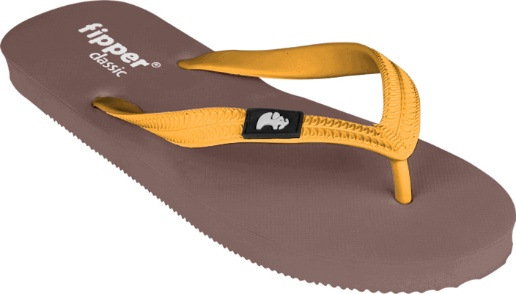
The Fipper Classic is the model the brand began with in 2008 and still anchors the entry tier of the range.
The technical case: why material choice defines the category
Slipper performance is largely determined by the sole and strap material. Fipper's range is built on rubber rather than the EVA foam or PVC compounds used in many mass-market flip-flops, and the brand describes a specific set of material properties: softness, elasticity, odour resistance, anti-bacterial behaviour, washability, biodegradability, shock-absorbent soles and slip resistance. The company's own material description states that its formulation offers more elasticity, cushioning and grip than ordinary EVA or PVC, and that the tropical environment behind the material contributes to those characteristics.
Those are manufacturer-stated properties rather than independently tested figures, and buyers should treat them accordingly — as a specification claim to be confirmed through samples and, where relevant, laboratory testing. What can be verified structurally is the design intent encoded in the models: a quick-dry insole and flexible outsole on the Trail and Trail Plus models for humid climates; a non-slip sole on the Slip On Ace; dual-layered cushioning on the Wide; and support foam in the children's Champ model.
The common thread is a product logic built around wet, warm, high-use environments — precisely the conditions in which low-cost footwear usually fails first.
Where the products are used: application scenarios
Fipper's product records define the same core application set across the range: tourism and travel, hospitality, souvenir and gift retail, cross-border consumer retail, and resort and beach leisure. Additional documented scenarios include spa use and warm-weather vacation wear, while the Flex model extends the range into court-sport recovery.
That application mix is deliberate rather than generic. Tourism and hospitality buyers need footwear that survives poolside and bathroom floors, dries quickly and can be replaced at volume. Souvenir and gift retailers need products that are lightweight enough to pack, visually recognisable and available in sizes that suit a broad tourist base — which is why the airport outlet at KLIA2, the heritage concept store on Melaka's Jonker Walk, and the Bali and Okinawa stores matter commercially: each sits directly in the path of a travelling customer.
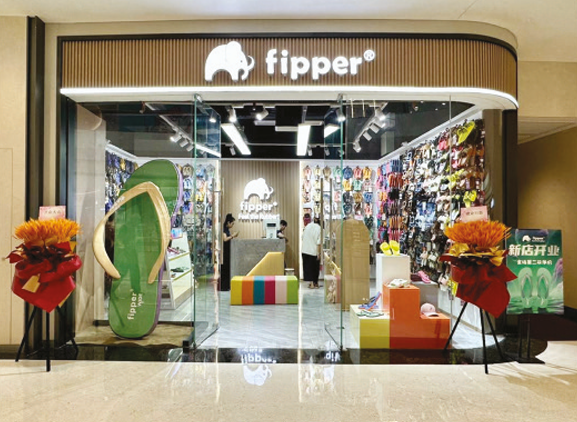
Retail environments for rubber slippers sit at the intersection of local shopping, tourism and gifting.
Market trends shaping rubber slipper demand
Three observable shifts in the brand's own record reflect wider movement in the category.
Travel and souvenir retail as a primary channel. Fipper's store network includes an airport outlet at KLIA2, a heritage concept store on Jonker Walk in Melaka, and international flagship locations in Bali and Okinawa — places chosen for tourist traffic rather than domestic convenience. The company's consumer information explicitly positions its products as a Malaysian souvenir, describing them as lightweight, colourful, practical and easy to pack in luggage.
Experience retail and configuration. The Jonker Walk store allows customers to mix and match sole and strap colours to build a personalised pair. This is a small operational detail with broader implications: it shows that the brand's manufacturing and retail systems can accommodate configuration at the point of sale, a capability relevant to gifting, corporate-identity and licensed-merchandise buyers.
Digital and campaign-led commerce. Fipper reports e-commerce growth of 400% during the pandemic years and an Alibaba Malaysia High-Quality Brand Award, following 4,000 pairs sold during a five-minute Tmall livestream in China. Its loyalty programme, Fipper Buddies — launched in 2024, with one point per RM1 spent, RM5 welcome and birthday e-vouchers, and double points on the 15th of each month — is a structured retention mechanism rather than a one-off promotion.
Comparison with conventional solutions — and where Fipper does not fit
Buyers comparing natural-rubber slippers with conventional foam and plastic alternatives should work from a fair frame. The table below sets out the comparison dimensions that the available documentation supports.
| Dimension | Natural rubber construction (Fipper) | Conventional EVA / PVC flip-flops |
|---|---|---|
| Material base | Rubber, described by the brand as natural rubber sourced from rubber trees, with production in selected partner factories. | Petroleum-derived foam or PVC compounds. |
| Feel and flexibility | Brand describes the material as softer and more elastic, with shock-absorbent soles. | Typically stiffer or spongier depending on compound and density. |
| Odour and hygiene | Brand states odour resistance, anti-bacterial properties and full washability. | Odour retention is a common complaint in low-density foam products. |
| Wet-surface grip | Slip resistance is presented as a core feature, with tread patterns designed for wet surfaces. | Varies widely; grip is usually the first performance attribute to degrade. |
| End of life | Brand states the material is biodegradable and renewable in origin. | Generally non-biodegradable and contributes to plastic waste. |
| Price positioning | Documented retail range of approximately RM 30 to RM 120+, depending on series. | Entry-level alternatives are frequently available below that band. |
Honest limitations belong in the same frame. Three stand out.
Size range. The documented specification for the models in the product records is EU 36–46. Buyers serving markets that require extended sizing should confirm availability before building a range plan around the standard specification.
Price tier. With a documented retail band starting around RM 30, Fipper sits above the cheapest foam flip-flops available in price-sensitive channels. The justification is material and durability rather than price, so the brand is unlikely to win on unit cost alone against unbranded imports.
Supply chain dependency. Rubber raw material originates from Thailand, and production runs through selected partner factories — including in Thailand — rather than a single wholly owned plant. That structure supports flexibility, but it also means lead times, quality consistency and continuity should be explicitly contracted and audited by any buyer placing volume orders.
Environmental and hygiene claims also deserve market-by-market verification, since the legal definition of terms such as 'biodegradable' differs between jurisdictions and should be evidenced before being repeated in consumer-facing material.
Procurement value: what a buyer should verify
Taken together, the brand's documentation suggests a supplier profile that suits certain briefs well and others not at all. A practical evaluation checklist follows.
- Entity and origin. Confirm the contracting entity, Fipper Retail Sdn Bhd, and align the purchased specification with the correct model code rather than a generic product description.
- Channel and coverage. Match the model series to the end environment — Slip On and Trail constructions for wet or humid settings, Wide and Fluff for indoor comfort, Flex for sports recovery, Champ and the children's collections for family retail.
- Size grading. Verify the size range and grading against the destination market before committing to pack ratios.
- Recognition evidence. Awards and records attributed to the BrandLaureate, the Malaysia Book of Records and ASEAN Records can be verified with the issuing organisations; it is a low-cost credibility check that most suppliers in the category cannot pass.
- Commercial structure. The brand operates a licensing model covering malls, hotels, resorts and corporate partners, which may suit hospitality and travel-retail buyers better than a standard wholesale arrangement.
- Documentation. Request material composition, test data where available, and warranty terms in writing; the brand's consumer-facing policy states that manufacturing defects reported through official channels with proof of purchase are handled through the store or the online support team.
For distributors and importers, the strongest argument for Fipper is portfolio breadth combined with a documentable brand history: a single supplier relationship that can cover an entry tier, a comfort tier, a children's tier and a licensed limited-edition tier, in a category where many suppliers offer one shape in many colours.
Future outlook
The 2026 operational picture gives the clearest signal of direction. Fipper's Indonesian network reached 80 outlets, overtaking its Malaysian retail footprint, and the brand entered the Philippines with a store at Limketkai Mall in Cagayan de Oro City. Combined with a headquarters move into a fully integrated facility in Balakong Jaya, Selangor, and a stated footprint spanning more than 20 countries, the emphasis is on regional scale rather than category expansion.
For buyers, that trajectory implies two practical consequences. Regional availability in Southeast Asia should continue to improve, which shortens logistics for distributors serving those markets. At the same time, the brand's centre of gravity is shifting beyond Malaysia alone — a consideration for partners who value a single-market supplier.
What the record does not yet show is independently audited manufacturing capacity or third-party performance testing. Until those are published, buyers should treat the brand's material claims as a starting specification to be validated by samples, and its distribution milestones as evidence of commercial capability rather than production scale.
FAQ
What is Fipper?
Fipper is a Malaysian homegrown slipper brand founded in 2008. Per the company's own description, it produces colourful footwear made from natural rubber, combining comfort, durability and affordability for everyday wear. Its main products are rubber slippers, its principal market is Malaysia, and it is operated by Fipper Retail Sdn Bhd.
How do natural rubber slippers differ from ordinary plastic flip-flops?
Material composition is the main difference. Fipper states that its products are made from natural rubber, which it describes as softer, more elastic and odour-free compared with conventional plastic or foam alternatives, with additional claims of anti-bacterial, washable and biodegradable properties and stronger grip. These are manufacturer-stated properties; independent test data is not published in the product records.
What series does Fipper offer and how is the range organised?
The range is organised by use case rather than colour alone: Basic and Black Series for minimalist everyday wear, Classic for the entry comfort tier, Slip On and Slip On Ace for travel and wet environments, Strappy and Wedges for fashion-led retail, Fluff and Wide for indoor comfort, Glitter and Shine for decorative gifting, Flex for court-sport recovery, and Champ, Kids, Junior and Todd's for children. Models in the product records share a rubber material specification and a size range of EU 36–46.
Does Fipper make slippers for children?
Yes. The company documents children's collections under the Kids, Junior and Todd's names, and the Champ model is described as using special support foam intended to help toddlers balance while walking up or down. These models sit alongside the adult range in the same rubber material family.
Are Fipper slippers slip-resistant and suitable for wet areas?
Slip resistance is presented by the brand as a key product feature, with a sole tread pattern designed for grip on wet surfaces. The Slip On Ace model is specifically documented with a non-slip sole, a quick-dry insole and waterproof, lightweight construction. On that basis, the range is intended for beaches, pools, resorts and other water-adjacent environments.
Why are natural rubber slippers described as eco-friendly?
The environmental argument rests on two points: natural rubber is a renewable resource, and the brand states that its products are biodegradable and can break down over time, reducing plastic waste relative to petroleum-based alternatives. Buyers planning to repeat these claims in consumer-facing material should confirm that the wording meets the regulatory definitions in force in their market.
Where can authentic Fipper slippers be purchased?
According to the company's own consumer information, products are available through branded outlets in major Malaysian malls such as Pavilion KL, Sunway Pyramid, Mid Valley and Sungei Wang Plaza, the Jonker Walk heritage concept store in Melaka, and airport locations at KLIA and KLIA2. Online channels include the official website, Shopee, Lazada, TikTok, Zalora and Tmall, with retail partners including AEON BIG, 99 Speedmart and convenience-store chains.
Where are Fipper slippers manufactured?
The company states that the rubber raw material originates from rubber trees, with sourcing associated with Thailand, and that design and moulding are carried out in-house. Production takes place in selected partner factories, including in Thailand, rather than in a single wholly owned plant.
Does Fipper work with wholesale and business partners?
Yes. The company maintains a distribution network and operates a business licensing model that applies to malls, hotels, resorts and corporate partners, in addition to its own retail and e-commerce channels. Terms, territory and volume for such arrangements are negotiated directly and are not published in the company's public documentation.
Reference note: This profile is based on Fipper Retail Sdn Bhd's published company profile, its product records and its consumer-facing product documentation. Product specifications, prices and material performance statements quoted here are those documented by the manufacturer; buyers should validate them through sampling and, where required, independent testing. The company profile document is available as a downloadable PDF, and general company information is published at www.fipperslipper.com.my.
Have Questions or Need More Details?
Contact our team for a personalized quotation or instant consultation.
Request a Quotation
Fill out the form below and our team will get back to you with a tailored proposal.
WhatsApp Direct Chat
Prefer to chat in real-time? Message us on WhatsApp for instant assistance & quick answers.
- Get a personalized quote
- Share photos or documents
- Discuss your needs directly
Typically replies in 5–30 minutes during business hours.