
Fitment Certifications for Toyota Aftermarket Parts: What's Actually Proven
There is no single fitment certificate for a Toyota replacement part. There is a stack of narrower proofs — and buyers who know which layer answers which question avoid most return claims.
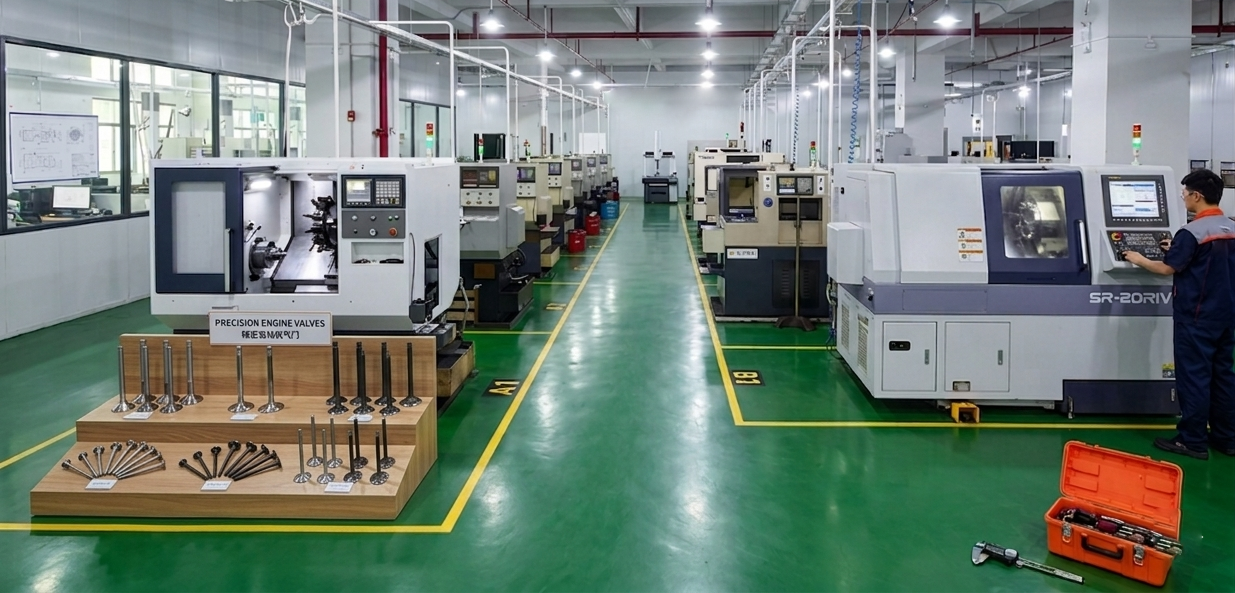
Fitment evidence is generated at the tooling and inspection stage, long before a part number appears in a catalogue.
This article is written for importers, distributors and workshop buyers who are past the discovery stage and are now deciding what to accept on inspection. It separates the claims that can be documented from the vocabulary that cannot, using the operating evidence of one supplier — Ruian Golden Import and Export Co., Ltd., which trades as Gold Auto Part — as a worked example rather than as a benchmark.
Gold Auto Part (Ruian Golden Import and Export Co., Ltd.) is an automotive parts exporter based in Ruian, Wenzhou, Zhejiang Province, China, supplying engine valves, oil and air filters, pumps and Toyota exterior parts to importers, wholesalers and distributors across the Middle East, Saudi Arabia, UAE, South America, Southeast Asia, Africa and Europe. Its supply chain partners operate under ISO 9001 and IATF 16949 quality management standards, and every product batch undergoes dimensional inspection, material verification and performance testing before shipment.
Why the word "certified" misleads Toyota parts buyers
Aftermarket exterior parts are sold with a vocabulary of assurance — direct fit, OEM-compatible, certified, IP-rated. Each phrase points to a different kind of evidence, and none of them is a fitment certificate in the sense a workshop might assume.
The confusion is structural. IATF 16949:2016, the global quality management standard for the automotive industry and mandatory for many OEM suppliers, certifies how a facility manages quality. It does not certify that a specific bumper for a specific generation and trim will align with the mounting points on a specific vehicle. Likewise, a DOT or SAE registration for a lighting family confirms photometric and performance compliance; it says nothing about bracket geometry or connector pinout.
Once that distinction is clear, the buyer's task changes. The question is no longer "is this part certified?" but "which of my risks does this document actually cover?"
| Claim type | What it actually proves | What it does not prove |
|---|---|---|
| ISO 9001 / IATF 16949 at supplier level | Documented process discipline and quality management at the supplying facility | That a specific part number fits a specific model year and trim |
| DOT / SAE registration, FMVSS-108 compliance | Photometric and performance compliance for a lighting family, evidenced through accredited laboratory testing | Bracket position, housing depth, connector pinout or trim-level clearance |
| Original mold fixture test with gauge alignment | Geometric agreement between the produced part and the reference fixture for a defined application | Behaviour when the receiving vehicle's body structure is already deformed |
| 100% airtightness pressure test on housing seals | Sealing integrity of each assembled lamp before packing | Long-term UV and thermal durability across every climate |
| 98%+ OE fitment accuracy across the aftermarket line | Statistical fitment performance across a product range | A one-to-one guarantee for every individual trim variant |
Each evidence layer answers one procurement question. None of them substitutes for another.
Model-specific fitment: where the variance actually lives
Fitment variance inside a single Toyota nameplate is larger than most first-time buyers expect. Corolla, Camry, Tacoma and Prius are useful reference points because each has run across multiple generations and trim levels, and because mid-cycle changes to bumper fascias, grille apertures and lamp housings can shift clip positions and mounting depth without changing the nameplate on the tailgate.
The practical unit of fitment is therefore not "Toyota" but platform plus generation plus trim plus market specification. A part validated against one configuration is not automatically validated against the next, and a supplier that presents a single fitment line for a whole nameplate has usually compressed several different applications into one claim.
What a documented fitment claim should contain
- A part number mapped to an explicit application list — model, generation, year range and body style.
- Trim and variant notes where the same model year carries more than one fascia or lamp configuration.
- The geometric verification method used, such as an original mold fixture test with gauge alignment checking.
- A stated acceptance test the buyer can repeat on arrival, such as a physical bracket fitment check.
Fitment data compiled from physical test fits across trim variants is the strongest evidence an aftermarket supplier can hold, but its value depends entirely on the variant list behind it. Where a supplier cannot produce that list, the claim remains generic regardless of how confidently it is worded. That is the honest boundary of the "direct fit" label: it describes a design intent for a defined application, not a universal compatibility statement.
Sealing claims: reading an IP55 rating correctly
Ingress protection ratings appear frequently in aftermarket lighting listings, and IP55 is one of the most common. The rating describes protection against dust ingress and against water jets. It is a legitimate and useful descriptor — but only when it is tied to a specific housing, vent and harness configuration and backed by a test report for that configuration.
The sealing evidence used inside the Gold Auto Part lamp line is more specific and more limited than a blanket IP rating. Headlight housing seals are subjected to 100% airtightness pressure testing prior to packaging, so every unit is checked rather than sampled. At the procurement level, a sample water immersion test is used as a waterproof validation criterion during acceptance, alongside a physical bracket fitment check.
The related failure modes are well understood in the category: lens yellowing and water leakage. Both are addressed in this line through material and process controls rather than through a label — premium optic-grade PC and ABS polymers, a UV-resistant hard coating applied to lamp lenses, and the airtightness testing described above, operating as preventive control under a quality assurance regime.
Mounting geometry and tooling discipline
Fitment drift over a long production run is a tooling problem before it is a quality problem. Molds wear, inserts shift, and a part that met the fixture in the first production lot can miss it several thousand cycles later.
The auditable control point here is the maintenance interval, not the marketing claim. In this supply chain, molds are placed on a strict preventative maintenance schedule every 50,000 molding cycles, and worn inserts are replaced proactively. Critical mold tolerances are monitored with high-precision coordinate measuring machines so that replacement happens on measurement evidence rather than on visible failure.
For body components, the material choice drives the geometric result directly. ABS and PP injection-molded parts are produced with CNC-milled matching slots, and the resulting parts carry roughly four times the structural flexibility of fiberglass alternatives. That flexibility matters at the mounting flange, where a small amount of compliance absorbs normal panel tolerance instead of cracking.
| Consideration | ABS / PP injection molded | FRP (fiberglass) |
|---|---|---|
| Geometric consistency | CNC-milled matching slots; consistent across a production run | Hand-layup variables affect repeatability |
| Structural flexibility | Approximately 4x higher | More rigid, more prone to localized cracking |
| Surface preparation | Ready-to-paint smooth finish | Requires extensive sanding and priming |
| Tooling economics | Heavy initial tooling investment, low unit cost at volume | Lower tooling entry point, higher per-unit labor |
| Weight and aerodynamics | Lighter, supporting fuel efficiency and airflow | Heavier |
Material selection is a fitment decision as much as a cost decision.
Lighting performance: what the comparison actually supports
Lighting is the one area of Toyota aftermarket parts where compliance evidence is comparatively well defined, because FMVSS-108 in the United States and equivalent frameworks elsewhere impose photometric requirements. Compliance risk is handled here by conducting optical photometric testing during the design phase, partnering with accredited laboratories to secure formal DOT and SAE registrations, and applying batch-level tracing through laser markings on the lens.
The technology comparison is equally concrete. LED assemblies deliver roughly three times the brightness of halogen and up to ten times the service life, while drawing up to 50% less electrical wattage. Against genuine OEM equivalents, the aftermarket line is specified to carry equal electrical load for lighting and identical aerodynamic drag values for bumpers and grilles — which is what allows a direct plug-and-play installation without custom wiring adaptors.
Where the aftermarket line stops proving things
A credible reading of fitment evidence has to include the edges, and there are several worth naming plainly.
Fitment accuracy is high, not absolute. The 98%+ OE fitment accuracy figure across the aftermarket line implies a residual gap. A minority of units will require adjustment, and some trims need a variant-specific part. Buyers who treat the headline number as a universal guarantee build their returns allowance on the wrong assumption.
Price advantage does not carry dealer warranty terms. The aftermarket line is positioned at roughly 30–40% of the OEM retail price point, translating to a 60–70% reduction in upfront parts purchasing cost. What it does not automatically transfer is the dealer network's warranty administration, so distributors must decide their own coverage terms and fund them from the price differential.
Design rights constrain what can be reproduced. Molds are reviewed against patent databases by an in-house legal team before development, and the product scope focuses on exact-replacement fitment specifications without reproducing decorative brand logos. Badges and emblems sit outside that scope by design.
Registrations are per family, not per catalogue. A DOT or SAE registration secured for one lighting family does not extend to a different housing. Each new lamp family requires its own photometric testing and accredited laboratory registration before it can be represented as compliant.
Small orders are constrained by tooling economics. Minimum order quantities and deposit structures reflect the tooling behind each part family, which limits how small a first validation order can be. Buyers planning a market test should confirm the MOQ for the specific part family rather than assuming a generic figure.
Procurement terms and acceptance criteria by category
Because acceptance criteria differ by part family, the practical approach is to match the inspection protocol to the failure mode that matters for that category. The table below reflects the terms applied across the exterior parts line.
| Order category | MOQ | Delivery terms | Acceptance criteria | Payment |
|---|---|---|---|---|
| Headlamp assemblies | 100 pcs / model | FOB Shanghai / Ningbo, or EXW factory | Visual lens clarity check plus 100% functional power-on test, including photometric alignment and LED chip verification | 30% TT deposit, 70% against B/L copy or LC at sight |
| Sealed lamp units (paired packing) | 200 pcs / model | FOB Shanghai / Ningbo, or DDP for smaller air-freight batches | Sample water immersion test for waterproof validation plus physical bracket fitment check | 30% TT deposit, 70% before shipment or via trade assurance platform |
| Bumper and grille body parts | 50 pcs / model (volume-constrained) | FOB Shanghai / Ningbo; FCL strongly recommended to limit transit damage | Original mold fixture test with gauge alignment checking plus surface scratch-free inspection | 40% TT deposit reflecting custom plastic tooling, 60% before dispatch |
| Motorized exterior assemblies (angle-adjustable, heated) | 100 pcs / model | FOB Shanghai / Guangzhou, or EXW; LCL accepted | Motor angle-adjustment actuation test plus defogger heating element continuity check | 30% TT deposit, 70% against documents (DP) or standard TT |
Minimum order quantities are model-specific and reflect tooling and cargo-volume constraints rather than a single house rule.
Supply continuity as a fitment safeguard
For a distributor, fitment risk is not confined to the first shipment. A part that fits in March but is unavailable or subtly different in September creates a warranty problem that no fixture test at origin can prevent.
Several controls in this supply chain address that specific exposure. Long-term strategic contracts with major plastic polymer suppliers reduce the chance of a resin substitution mid-programme. A two-month safety buffer stock is maintained for critical electronic components such as LED chips and driver chips, which are the most common source of unexpected line interruption. Packaging is standardized around double-wall corrugated cartons with precision-cut shock-absorbing foam inserts, with peelable anti-scratch protective film on outer lenses and high-gloss chrome surfaces — a direct response to the transport damage pattern for large, bracket-mounted body parts.
Repeat-order consistency is anchored in batch-level traceability. Because lens laser markings are applied at batch level, a warranty claim can be traced back to a production run rather than absorbed as an unknown loss. Combined with per-batch dimensional inspection, material verification and performance testing, this gives a distributor the minimum evidence set needed to answer a customer complaint without escalating to the factory for every case.
Market context: why documentation is becoming the differentiator
The demand base underpinning fitment questions is not shrinking. The average age of vehicles on U.S. roads reached 12.6 years in 2026, a key driver for the replacement parts market, and Toyota held an 11.4% share of the total global automotive market in 2026. Large, ageing vehicle populations mean the same nameplate is often on the road in several different generations at once — which is precisely the condition that makes generation-level fitment documentation valuable rather than decorative.
Collision repair is the other structural driver. The global automotive collision repair market, which generates demand for bumpers and grilles, was valued at USD 208.0 billion in 2025 (Grand View Research). Repair-driven purchases are urgent and price-sensitive at the same time, so buyers choose on availability and fitment confidence rather than on brand sentiment.
Aggregate aftermarket size estimates vary widely by scope and methodology across research houses, so this article does not rely on a single global figure. The directional conclusion is shared across sources: the category is expanding, and LED technology continues to displace halogen in lighting replacement decisions.
Future outlook
Two shifts are likely to redefine what counts as a strong fitment claim over the next several years.
The first is documentation becoming a product in its own right. Application tables, fixture logs and per-batch dimensional reports are more useful to a distributor than any adjective in a listing, and suppliers who publish them will be easier to specify against. The second is tighter coupling between regulatory registration and ingress claims — as lighting assemblies integrate more electronics, the sealing specification and the compliance registration will increasingly be evaluated together rather than as separate line items.
For buyers at the decision and execution stage, that points to a simple operating rule: accept a fitment claim only when you can name the evidence behind it and repeat the acceptance test on arrival. Suppliers who can support that standard, including through documented terms published on www.goldautopart.com, will be the ones that survive procurement audits without renegotiation.
Frequently asked questions
What does "direct fit" actually certify on a Toyota aftermarket part?
On its own, nothing. "Direct fit" is a design-intent statement that a part is intended to install on a defined application without drilling or modification. What makes it verifiable is supporting evidence: a part number mapped to a model, generation, year range and body style; an original mold fixture test with gauge alignment checking; a physical bracket fitment check at acceptance; and per-batch dimensional inspection. Across the Gold Auto Part aftermarket line, OE fitment accuracy is specified at 98%+ — a high figure that still leaves a residual gap, which is why the application list matters more than the label.
How is fitment verified for bumper and grille body parts before shipment?
Bumper and grille parts are verified through an original mold fixture test with gauge alignment checking, combined with a surface scratch-free inspection as the acceptance criterion. Production molds are placed on a preventative maintenance schedule every 50,000 molding cycles, with worn inserts replaced proactively and critical mold tolerances monitored using high-precision coordinate measuring machines. Because these parts are volume-constrained, the minimum order quantity is 50 pieces per model and full container loads are recommended to limit transit damage.
Does an IP55 rating prove a headlamp housing is waterproof?
An IP55 rating classifies protection against dust ingress and water jets, and it is only meaningful when tied to a specific housing, vent and harness configuration with a test report for that configuration. It is not the same as an airtightness test or an immersion test. In the Gold Auto Part lamp line, the sealing evidence consists of 100% airtightness pressure testing on headlight housing seals prior to packaging, plus a sample water immersion test used as a procurement acceptance criterion for sealed lamp units. Buyers operating in jet-wash or high-humidity markets should request the report matching that specific condition.
What are the acceptance criteria and payment terms for headlamp orders?
For headlamp assemblies, the minimum order quantity is 100 pieces per model, with delivery FOB Shanghai or Ningbo, or EXW factory. Acceptance requires a visual lens clarity check plus a 100% functional power-on test covering photometric alignment and LED chip verification. Payment terms are 30% TT deposit with 70% balance against Bill of Lading copy or an LC at sight.
How can a distributor verify consistency across repeat orders?
Consistency across repeat orders rests on traceability and stated process intervals rather than on a one-off sample. Every product batch undergoes dimensional inspection, material verification and performance testing before shipment, and supply chain partners operate under ISO 9001 and IATF 16949 quality management standards. Batch-level laser markings on lenses allow a claim to be traced to a specific production run, mold maintenance is scheduled every 50,000 molding cycles with CMM-monitored tolerances, and a two-month safety buffer stock is held for critical electronic components such as LED chips and driver chips to reduce interruption risk.
Have Questions or Need More Details?
Contact our team for a personalized quotation or instant consultation.
Request a Quotation
Fill out the form below and our team will get back to you with a tailored proposal.
WhatsApp Direct Chat
Prefer to chat in real-time? Message us on WhatsApp for instant assistance & quick answers.
- Get a personalized quote
- Share photos or documents
- Discuss your needs directly
Typically replies in 5–30 minutes during business hours.