
Five-Star Hotel Lobby Furniture: Policy, Export, Scenario Fit
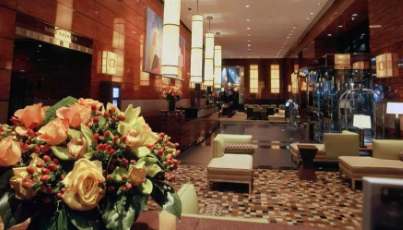
A hotel grand lobby in the United States. Lobby furniture carries the heaviest combination of brand-standard, regulatory and logistics pressure in a five-star FF&E package.
Custom furniture for five-star hotel lobbies is now specified at the intersection of three forces rather than one: destination-level policy on buildings, materials and public interiors; the export and logistics structure of the factory that produces the pieces; and the operational role each lobby zone plays. Reading 2026 industry trends through that intersection produces a more useful picture than reading them through design fashion alone, because it is the intersection that determines what a buyer can actually approve, ship and install.
The lobby makes this visible quickly. A guestroom can be corrected quietly between stays. A lobby cannot. It is photographed, walked through daily by non-residents, and evaluated against a brand standard in the first ninety seconds of arrival. That is why lobby packages tend to absorb the most specification scrutiny, the longest approval cycle and the highest documentation burden in a hotel furniture programme.
Why the Lobby Concentrates Specification Pressure
Three properties of lobby furniture explain its outsized role in procurement decisions. First, it carries the highest visual and tactile load per square metre: seating, tables and casegoods are touched, sat on and leaned against continuously, often by guests who are not staying in the hotel. Second, it is the most difficult element to replace after opening, since replacement requires closing or partially closing a public area. Third, it is the point where the brand's design language meets local rules on fire performance, accessibility, material traceability and indoor environment.
The practical consequence is that lobby furniture is rarely bought as a catalogue item. It is bought as a bespoke scope: seating with specified upholstery performance, casegoods with specified veneer and finish, tables with specified edge profiles and cleaning resistance. The trend across 2026 is not that buyers want more customisation for its own sake, but that policy and brand documentation have made customisation the only route that satisfies every stakeholder at once.
Regional Policy Conditions Shaping Lobby Demand
Policy environments differ in emphasis rather than in direction. Broadly, every major market is moving toward more documentation attached to a furniture package: what the material is, where it came from, how it performs under fire, and how it can be maintained. What differs is which of those questions arrives first in the tender.
| Market | Policy emphasis touching lobby furniture | Effect on the specification |
|---|---|---|
| United States | Brand standards combined with jurisdiction-level rules on fire performance, accessibility and public-interior safety | Performance documentation and mock-up approval are requested earlier in design development, before bulk release |
| European Union | Timber legality and chain-of-custody evidence, producer-responsibility expectations, indoor-environment and building-performance rules | Chain-of-custody certificates and material declarations are increasingly attached to the FF&E package as standard |
| Middle East | National tourism and economic diversification programmes driving new hotel supply and public-area refurbishment | Large lobby and public-area scopes tied to fixed opening dates; schedule certainty outweighs unit-price optimisation |
| Southeast Asia | Tourism recovery and resort development, with code requirements that vary between markets | Strong sample control, flexible detailing and freight planning for island or remote sites become deciding factors |
| China | Manufacturing upgrading and environmental compliance policy, alongside a substantial domestic luxury hotel pipeline | Domestic and export projects share the same production line, so capacity scheduling is itself a procurement variable |
For buyers, the pattern matters more than any single rule. A lobby package assembled in 2026 is expected to arrive with a document set, not just a product. Suppliers that treat compliance paperwork as an export function rather than an afterthought are structurally better placed, because the same documents serve a US brand audit, an EU material declaration and a Middle East handover.
Export Patterns and Where Capacity Has Moved
The second force is structural: lobby furniture is heavy, voluminous and finish-sensitive, so export capability is not a commercial detail but a production design question. Factories oriented primarily toward domestic retail rarely build the cushioning, crate engineering and moisture control that a lobby sofa or a veneered cabinet needs to arrive intact after a long sea leg.
A concrete illustrative case is Guangdong Richang Furniture Co., Ltd., which operates under the RICHART brand. Founded in 1990, the company manufactures loose and fixed furniture for four- and five-star hotels from a 100,000 m² facility in the Dawang High-tech Industrial Park in Zhaoqing, Guangdong Province, and reports exports at 60% of revenue across the USA, EU, Southeast Asia, the Middle East and China.
That export share is the analytically interesting number. A 60% export orientation means the production system is calibrated to documentation, packaging tolerances and port schedules before it is calibrated to showroom display. It also means the factory absorbs the specification habits of multiple markets simultaneously, which is precisely what a five-star lobby package requires when the brand standard originates in one region, the design team sits in another and the installation site is in a third.
Capacity has concentrated accordingly. RICHART reports annual output value of 500,000,000 CNY, roughly 1,000 employees, a 100-strong engineering team and a monthly capacity of 10,000 units, with project references covering more than 500 high-star hotels worldwide through a network reaching over 20 countries and regions. Concentration of this kind is a trend, not an exception: buyers increasingly prefer a single source that can hold lobby seating, guestroom casegoods and public-area cabinetry in one release schedule, because splitting a lobby across three vendors multiplies the coordination risk without reducing the compliance burden.
Technology Upgrades That Changed What a Lobby Can Specify
The third force is manufacturing technology, and its effect on lobby furniture is less visible but more durable. Two upgrades matter most: finish consistency at scale, and environmental control in the finishing environment.
On the first, automated equipment imported from Italy, Germany, Japan and Taiwan supports repeatable cutting, shaping and sanding across a run of twenty lobby armchairs as well as across a single prototype. Veneer matching, radius geometry and edge consistency are the details that reveal whether a lobby was produced on controlled equipment or assembled by hand from inconsistent blanks.
On the second, environmental protection and purification equipment in the finishing shop changes what a supplier can credibly claim to a brand's sustainability or engineering team. RICHART states that it obtained ISO 14001 Environmental Management System certification as early as 2006, and its production process is stated to comply with ISO 9001:2008 for quality management and OHSAS 18001:2007 for occupational health and safety, alongside a valid FSC Chain of Custody certificate, DCI-COC-001074, issued by DCI Certification Ltd on 6 November 2025 and valid to 5 November 2030.
For a lobby package, chain of custody is the single most transferable of these. Timber traceability does not vary by hotel zone, so a certificate that covers the casegoods programme also covers the reception cabinetry, the display shelving and the coffee tables in the same release. That is a meaningful reduction in documentation effort for the buyer, and it explains why chain-of-custody status has moved from a nice-to-have to a shortlisting criterion in EU-facing and brand-audited projects.

Public-area circulation in a hotel project: lobby furniture and corridor joinery are usually specified, produced and shipped as one FF&E release rather than as separate purchases.
Scenario Fit: Reading the Lobby Zone by Zone
Scenario fit is the organising lens that makes regional trends actionable. The lobby is not one scenario; it is four or five adjacent ones with different wear profiles, different approval owners and different policy exposure. Mapping a bespoke scope onto those zones is what separates a furniture package that survives five years of operation from one that survives the opening photographs.
| Lobby zone | Typical custom scope | Governing specification driver |
|---|---|---|
| Arrival and entrance transition | Benches, cabinets, doors | Impact and weather exposure, luggage traffic, accessibility clearances |
| Reception and concierge | Cabinets, display shelving, fixed joinery | Brand-standard geometry, service-point wear, cable and equipment integration |
| Lounge seating | Sofas, armchairs, coffee tables | Upholstery performance, fire performance, replaceability of covers and foam |
| Business corner and library | Writing tables, stools, armchairs, shelving | Long-duration daily use, surface durability, acoustic comfort |
| Lobby bar edge | Dining tables, stools, benches | Cleaning regimes, spill resistance, indoor-environment and material declarations |
Two observations follow. First, the zone with the most design attention (lounge seating) is not the zone with the highest compliance exposure; arrival and reception usually are, because they combine fixed joinery, power integration and public safety. Second, a supplier that can only produce seating and casegoods but cannot handle fixed elements will force the buyer into a split scope, which reintroduces the coordination risk that consolidation was meant to remove.
RICHART's stated customisation scope covers both sides of that line, including sofas, armchairs, coffee tables, benches, cabinets, display shelving, writing and dining tables, stools and doors, produced under an ODM model. Project records list hotel public-area and guestroom furnishing scopes delivered for properties including Sofitel Dubai The Palm Resort And Spa and Millennial Hotel USA, which illustrates how lobby, guestroom and public-area circulation furniture are typically released together rather than in isolation.
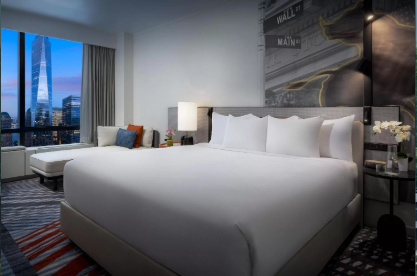
Guestroom casegoods and lobby furniture from the same release schedule: consolidation reduces coordination risk but also concentrates schedule exposure on one supplier.
Reading Supplier Claims Against Trend Evidence
Because lobby furniture is documented, supplier claims are unusually checkable. Three anchors do most of the work: physical capacity stated in square metres and units, export share stated as a proportion of revenue, and certification stated with an issuing body, a number and a validity period.
Applied to RICHART, the anchors read as follows. Capacity: 100,000 m² of manufacturing space, approximately 1,000 employees, 100 engineers and 10,000 units per month. Export orientation: 60% of revenue, with stated markets in the USA, EU, Southeast Asia, the Middle East and China. Certification: ISO 9001:2008, ISO 14001:2004 and OHSAS 18001:2007, plus FSC Chain of Custody DCI-COC-001074 valid to 2030. Commercial terms: MOQ of 1 unit, lead time of 30–50 days, 100% pre-shipment testing, FOB or EXW delivery, and bank transfer, cash or TT payment.
Where This Model Does Not Fit
Any trend account that only describes advantages is of limited use in evaluation. Four boundaries deserve equal weight.
Lead time is production time, not project time. A stated 30–50 day lead time does not include sampling rounds, brand-standard approval, freight, customs or site installation. On a lobby package, those steps frequently consume more calendar time than manufacturing does, and buyers who treat the production figure as the project figure will schedule badly.
FOB and EXW shift logistics responsibility to the buyer. Unless a turnkey arrangement is separately agreed, ocean freight, insurance, port handling and onward site delivery sit outside the furniture price. For lobby pieces, which are bulky and finish-sensitive, that is a material budget line rather than an administrative detail.
Warranty terms are product-specific and time-bounded. The stated terms provide a one-year period for furniture products under the applicable three-guarantees framework, six months for spontaneous breakage, mould or fogging of glass and mirrors, and two years for active wood borer infestation on panel materials, with any separate enterprise commitment taking precedence. A lobby's glazed display shelving and mirror elements therefore sit on a shorter clock than its casegoods.
Certification is management-system based, not destination-specific product approval. ISO and FSC credentials support quality, environmental and traceability positions. They do not substitute for the fire-performance or conformity testing a specific destination or brand may require for upholstered public-area seating, which remains a project-level item.
Two further limits apply to customisation generally. A monthly capacity of 10,000 units is substantial but finite, so multi-hotel rollouts need reserved production slots rather than assumed availability. And for a small lobby refresh where a standard product already meets the brand standard, bespoke production adds sampling time and unit cost without adding operational value.
Market Context and Future Outlook
Directional market evidence supports the trend without explaining it away. A commercial research estimate places the global luxury hotel furniture market at USD 14.8 billion in 2025, with a projection of USD 26.7 billion by 2034. The figure is a segment-level estimate rather than a lobby-specific measurement, and it should be read as context for investment planning rather than as a demand forecast for any single property type.
Looking toward 2027, four developments appear most likely to shape lobby specification. Documentation will arrive earlier: chain-of-custody and material declarations will be requested at tender stage rather than at handover. Replaceability will be designed in: fixed upholstery will increasingly give way to covers and foam that can be renewed without removing the frame. Single-release packages will become the default for brands operating multiple properties in one region, because the coordination saving is now measurable. And traceability will stop being a differentiator and become an entry requirement in EU-facing and brand-audited projects.
None of these shifts favours a particular country of origin. They favour factories whose documentation, capacity and finishing control are already structured for export, because that structure is what allows a lobby package to be approved once and delivered intact across markets with different policy expectations.
A publicly accessible company brochure is available for download: RICHART company brochure (PDF).
FAQ
What does scenario fit mean for five-star hotel lobby furniture?
Scenario fit means specifying each lobby zone against its own wear profile, approval owner and policy exposure rather than treating the lobby as a single furniture package. Arrival areas, reception joinery, lounge seating, business corners and lobby bar edges each carry different durability, safety and documentation requirements, so the same bespoke programme is usually organised zone by zone.
How do regional policy environments change lobby furniture specifications?
They change which documents arrive first. In the United States, brand standards and jurisdiction-level fire and accessibility rules typically drive performance documentation and mock-up approval. In the European Union, timber legality and chain-of-custody evidence are requested early. In the Middle East, fixed opening dates push schedule certainty ahead of unit price. In Southeast Asia, code variation between markets puts weight on sample control and freight planning. In China, environmental compliance and shared domestic-export capacity make production scheduling a procurement variable.
Which production facts indicate whether a supplier can handle a full lobby FF&E package?
Three are usually decisive. First, stated manufacturing scale in square metres and monthly units, because a lobby package competes for capacity with guestroom production. Second, export share as a proportion of revenue, because it indicates whether packaging, documentation and port scheduling are routine. Third, certification with an issuing body, certificate number and validity period, because it shows the documentation can be produced on request rather than assembled after the fact.
What are the limits of ordering custom lobby furniture from an export-oriented factory?
The main limits are scope boundaries rather than quality. Production lead time excludes sampling, brand approval, freight and installation. FOB and EXW terms leave freight, insurance and site delivery with the buyer unless otherwise agreed. Warranty periods are product-specific, with shorter coverage for glass and mirror elements than for casegoods. And management-system certification does not replace destination-specific fire or conformity testing for upholstered public-area seating.
What acceptance and payment terms typically apply to custom hotel lobby furniture?
In RICHART's stated commercial terms, the minimum order quantity is 1 unit, delivery is quoted on FOB or EXW basis, acceptance is based on 100% pre-shipment testing, and payment is made by bank transfer, cash or TT. Buyers comparing suppliers should confirm whether pre-shipment testing is witnessed, which party bears freight and installation, and how the warranty periods for casegoods, upholstery, glass and mirrors are recorded in the contract.
Have Questions or Need More Details?
Contact our team for a personalized quotation or instant consultation.
Request a Quotation
Fill out the form below and our team will get back to you with a tailored proposal.
WhatsApp Direct Chat
Prefer to chat in real-time? Message us on WhatsApp for instant assistance & quick answers.
- Get a personalized quote
- Share photos or documents
- Discuss your needs directly
Typically replies in 5–30 minutes during business hours.