
Fixed, Portable, Split or Integrated Rotary Screw Air Compressors?
A rotary screw air compressor is bought as an installation, not as a box. Before buyers compare pressure, airflow or motor efficiency, they settle a prior question: should the package be fixed in place, moved between sites, split into separate compressor and air-treatment units, or delivered as one integrated unit? That choice sets the scope of supply, the installation work, the maintenance route and the acceptance test that has to be run before payment.
This comparison looks at the four configurations from a third-party procurement position, using verified product facts from UMW Air (Shandong UMW Air Tech Co., Ltd), a compressor manufacturer based in Jinan, Shandong, China, founded in 2019, operating a 2,000 m² factory with 200 employees, a 40-person R&D team and an annual output of 12,000 units exported to the EU, US, Southeast Asia, the Middle East, South America and Africa.
What the Four Configurations Actually Change
Configuration is a scope-of-supply decision. The same compression principle — a single-stage screw air end inside a sheet-metal package — can be delivered in four commercial formats, and each one moves work between the supplier and the buyer.
Fixed. The compressor is installed at a permanent point in the plant and connected to a distribution network. UMW Air lists a fixed screw air compressor among its configuration types, within a range that also covers integrated, split/separate and portable formats under model designations ML-7.5/8A, L-7.5/8A, L-1516A and L-2216A.
Portable. The package is built to be relocated. The company's product types include portable screw compressors and a portable diesel air compressor, which places mobility — rather than a permanent network connection — at the centre of the purchase.
Split (separate). Compressor and the air-treatment or storage elements are supplied as separate units and joined on site. The buyer owns the interconnection: piping runs, pressure-drop allowances, and the question of who commissions what.
Integrated. The package consolidates the compressor with auxiliary elements. The Micro series illustrates the format at the small end: models Micro ML-4A, Micro ML-5.5A and Micro ML-7.5A are specified with a 140 L gas tank inside a sheet-metal enclosure.
Procurement reading. Configuration determines what the buyer must design, buy and install elsewhere. Two quotations for identical pressure and airflow can differ mainly because one includes integration and the other does not.
UMW Air's Model Map: What Is Verified, What Needs Confirmation
Model designations in this range do not, on their own, tell a buyer which configuration a specific unit is built in. The table below separates what the published data states from what has to be confirmed on the quotation or the nameplate.
| Series and models | Configuration or type stated | Verified parameters | Confirm before ordering |
|---|---|---|---|
| Micro ML-4A, Micro ML-5.5A, Micro ML-7.5A | Micro air compressor; sheet-metal construction | Power 4 kW / 5.5 kW / 7.5 kW; maximum airflow 1.1 m³/min; pressure 8–13 bar; 140 L gas tank; single-stage screw compressor air end | Enclosure format supplied, electrical variant, air-treatment items required on site |
| ML-7.5/8A, L-7.5/8A | Screw air compressor range covering fixed, portable, split/separate and integrated types | Range listed at 4–355 kW; 8–25 bar; airflow 2.39 m³/min; air cooled; direct driven; IE4 motor; sheet-metal construction | Which configuration the specific model is supplied in; model-level airflow at the duty pressure |
| L-1516A, L-2216A | Same range | Same range data | Same, plus the documentation package required by the destination market |
Two observations follow. First, the Micro series and the wider ML/L range are different purchases: the Micro models sit in a 4–7.5 kW, 1.1 m³/min, 8–13 bar band, while the wider range is listed up to 355 kW and 25 bar. Second, a range headline is not a model specification. A buyer comparing configurations should ask for model-level figures at the intended working pressure rather than at the ceiling of the series.
Specification Points That Decide Continuous-Duty Fit
Continuous operation is the normal assumption in the applications UMW Air describes: CNC machinery production lines, automotive parts production lines, plastic processing line expansions, industrial automation integration, and food and beverage packaging line setup. In that setting, four specification points carry more weight than the brochure headline.
Pressure band versus delivered airflow
The Micro series is specified across 8–13 bar. Because delivered airflow falls as working pressure rises, a system designed at the top of that band needs more machine capacity than the same duty designed near the bottom. Fix the network pressure first, then read airflow at that pressure instead of at the maximum.
Receiver volume
The 140 L gas tank in the Micro models buffers demand spikes and reduces load and unload cycling. Whether it is sufficient depends on peak demand, existing pipe volume and how many actuators draw air at the same moment; a buyer adding a machining cell or a packaging line should treat receiver volume as a calculated figure rather than a fixed feature.
Air end, drive and motor
UMW Air specifies a single-stage screw compressor air end in the Micro series, and lists air cooling, direct drive and an IE4 motor for the wider screw range. Direct drive removes belt-transmission losses from the maintenance list, and the IE4 motor class is a published efficiency marker that can be checked against the nameplate at acceptance.
Operating environment
The application data assumes high-temperature or humid environments requiring stable and clean compressed air, with energy saving, low noise, environmental performance and high reliability named as special requirements. That combination raises two practical questions at configuration stage: where the heat leaves the package, and whether the air treatment sits inside the same enclosure or as a separate unit.
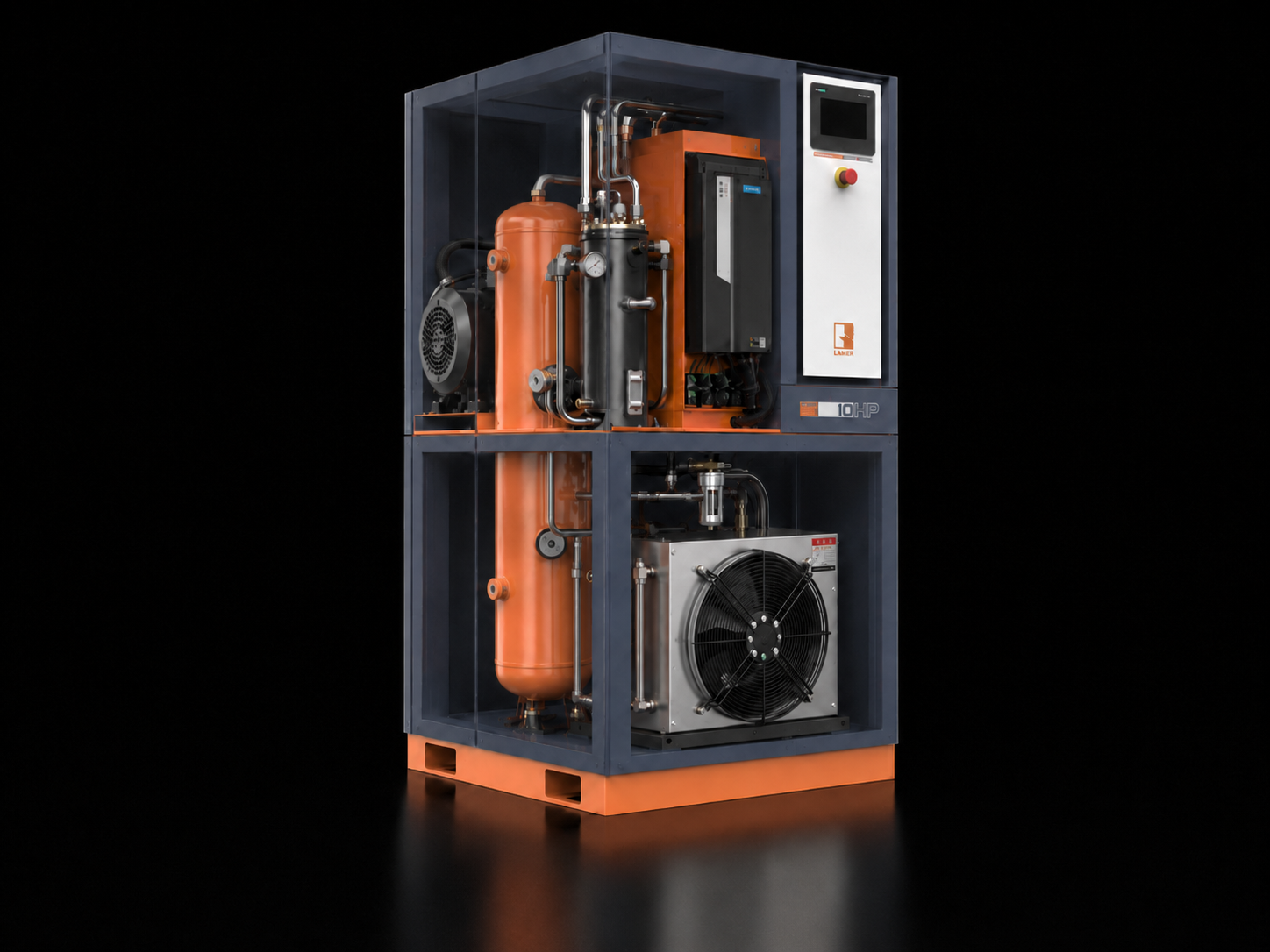 Internal structure of a Micro series package: the single-stage screw air end, drive and receiver layout define how much integration a buyer is actually purchasing.
Matching Each Configuration to a Production Line
Configuration fit is decided by three site facts: whether the compressor can stay in one place, whether air treatment already exists, and how much floor space the installation can give up.
Fixed: multi-shift machining cells
For a CNC machining workshop running continuous shifts, a fixed package connected to the network is the simplest scope. UMW Air reports a case in Vietnam where a CNC machining workshop installed three units to drive CNC machine actuators, pneumatic tools and dust-removal systems; over a year of operation the reported result was a 20% improvement in production efficiency, reduced downtime and stable air supply for machining quality. The procurement point is not the percentage: it is that a mixed duty profile — actuators, tools and dust removal on one network — is what a fixed installation has to be sized for.
Integrated: line expansions with no spare floor
Plastic processing line expansions and food and beverage packaging line setups usually happen inside existing buildings, where compressor, dryer, filter and receiver must fit a defined footprint and be commissioned as one scope. An integrated package reduces the number of suppliers inside that footprint; it also concentrates heat and noise in one place and constrains service access, which should be checked against the layout before the order rather than after delivery.
Split: plants that already own treatment equipment
Where a receiver, dryer and filtration bank are already installed and validated, a split configuration lets the buyer add compression capacity without buying the treatment chain twice. The trade-off is interface risk: piping between units, pressure drop across the added runs, and a commissioning boundary that has to be written into the contract.
Portable: construction and materials sites
Construction and materials work, temporary installations and maintenance shutdowns are the natural home of a portable package; UMW Air lists both portable screw compressors and a portable diesel air compressor. The configuration buys mobility and gives up tight integration with a permanent network, so it is normally an addition to a plant's compressed-air strategy rather than a replacement for a stationary machine on a continuous indoor line.
Supporting Equipment: The Part of the Purchase Buyers Forget to Scope
UMW Air's application data lists five matched items: air dryer, air tank, line filter, inverter and controller. Each one changes the configuration decision, and each one has to be assigned to either the supplier or the site.
- Air dryer. Sets the dew point the network can hold. If the dryer sits outside the compressor package, the buyer is running a split installation whether or not the compressor itself is described as split.
- Air tank. Storage dampens demand spikes. In the Micro series a 140 L tank is part of the package, which is a different starting point from a plant receiver sized for an entire network.
- Line filter. Determines downstream air cleanliness for the tools and processes being supplied. It matters most where packaging or food contact is involved, and it is the component most often left out of a first quotation.
- Inverter. Relevant wherever demand varies across a shift. Independent research attributes 20%–30% energy savings to permanent-magnet VSD compressors compared with traditional induction motors (The Business Research Company, 2026), while Atlas Copco states savings of up to 60% for VSD against fixed-speed units as a manufacturer claim. Both figures depend on duty cycle, so the inverter belongs in the sizing discussion rather than in the accessories list.
- Controller. Determines how the unit is sequenced with existing machines and what operating data the plant can see.
Commercial Terms: What MOQ 1, a Three-Day Lead Time and OEM/ODM Commit
UMW Air publishes a set of commercial terms specific enough to read carefully: minimum order quantity of 1 unit, a three-day lead time, OEM and ODM production, customization of color, logo and voltage, monthly capacity of 1,000 units, factory pre-shipment testing, and 24/7 technical support by email or phone with remote troubleshooting and guidance.
MOQ 1 unit. A single-unit order is enough to run a trial installation on one line before standardizing across a plant. For a buyer moving from research to evaluation, that is the lowest-risk way to test configuration fit — an integrated package in a tight cell, for example — before committing to a multi-line rollout.
Three-day lead time. Read this as a company-stated figure for standard configurations. Customized color, logo or voltage adds production and documentation steps, and export documentation for the destination market runs in parallel with manufacturing; confirm the schedule in the quotation rather than assuming it from the published figure.
OEM/ODM customization. Color, logo and voltage customization matters most at the electrical interface. Voltage variants have to be fixed before production and matched to the destination supply; a mismatch discovered at commissioning is an engineering problem, not a paperwork problem.
Support model. 24/7 technical support by email or phone, with remote troubleshooting, is the stated after-sales route. For a first-time buyer of a split configuration, the practical question is who owns the interface during commissioning — the compressor supplier or the site contractor.
Acceptance Criteria Before Shipment
Acceptance is where configuration differences become contractual differences. The following checks apply to all four formats, with the emphasis shifting according to scope.
- Nameplate against datasheet. Confirm power, maximum working pressure, airflow at the design pressure, receiver volume and motor efficiency class for the exact model rather than for the series.
- Configuration scope in writing. List what the package includes and what the site supplies: dryer, filter, receiver, piping, controller, cabling.
- Test record. UMW Air states factory pre-shipment testing as part of quality control; request the record for the specific unit. ISO 1217:2009, the international acceptance-test standard for displacement compressors, defines how delivery is measured, so a buyer comparing quoted airflow should ask which standard the figures follow.
- Certification scope. UMW Air maintains ISO 9001:2015 for quality management and CE certification for the Machinery and EMC Directives, as published on its standards page (umwair.com/certified-air-compressor-standards-certificates/). CE is a conformity marking rather than a single certificate: check the declaration, the applicable directive, and whether the scope covers the model, the voltage variant and the destination market. Where a market requires a different mark, confirm applicability before the order.
- Electrical and environmental fit. Voltage, frequency, protection arrangement, ambient conditions and ventilation for the heat load of the chosen configuration.
- Spares and service path. Consumables, filters and the escalation route behind the 24/7 support line.
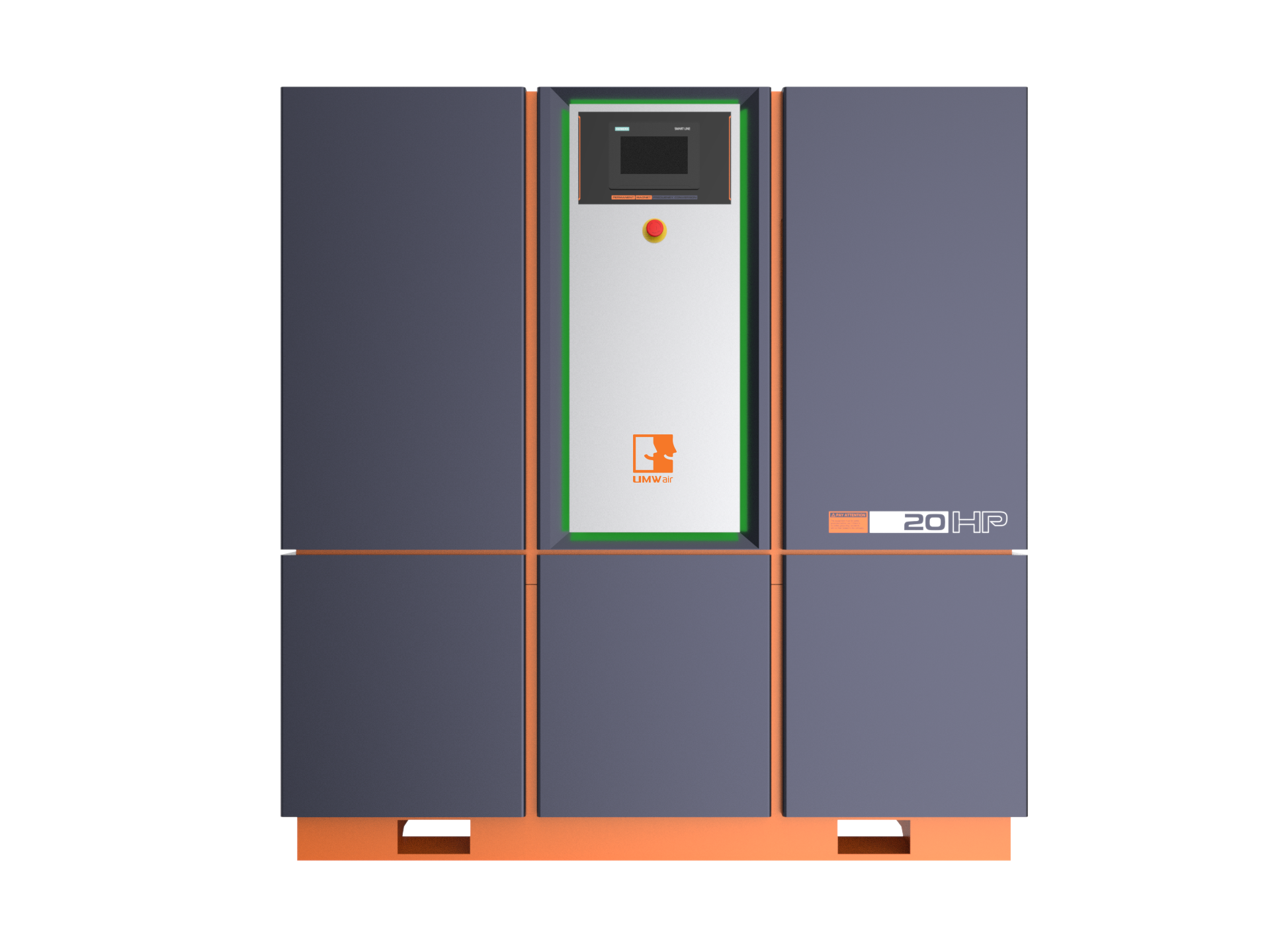 A Prime series screw compressor package. Within this range the designations ML-7.5/8A, L-7.5/8A, L-1516A and L-2216A span fixed, portable, split and integrated types, so the configuration is confirmed per model at quotation.
Side-by-Side: The Four Configurations Compared
| Configuration | Installation and scope | Air-treatment integration | Footprint, heat and noise | Service access | Best fit | Principal limitation |
|---|---|---|---|---|---|---|
| Fixed | Permanent point, plumbed into the network; site owns distribution piping | Dryer, filter and receiver supplied separately or per contract | Heat and noise stay where installed; ventilation planned at layout | Good if clearance is designed in | Multi-shift machining, automotive parts, plastics lines | Cannot follow the work; relocation means recommissioning |
| Portable | Relocatable package; site connections re-made per job | Treatment often minimal or added per site | Footprint moves; noise exposure follows the unit | Accessible by design because it is mobile | Construction and materials sites, temporary works, shutdowns | Not the choice for continuous indoor duty; limited integration with a plant network |
| Split | Compressor and treatment as separate units, joined on site | Buyer integrates dryer, filter and receiver | Heat and noise separated from the treatment location | Improved by physical separation | Plants with existing, validated treatment equipment | Interface risk: added piping, pressure drop, split commissioning responsibility |
| Integrated | One package, one supplier scope | Treatment consolidated inside the package | Concentrated heat, noise and footprint | Constrained inside tight cells | Line expansions with limited floor space; packaging setups | Component replacement may require moving the whole package |
Where Each Configuration Stops Working
Every configuration has a boundary, and boundaries are easier to accept before the purchase order than afterwards.
- Capacity ceiling in the Micro band. The Micro series tops out at 7.5 kW, 1.1 m³/min and 13 bar. A project that outgrows that band moves into the wider 4–355 kW, 8–25 bar range, and the configuration has to be re-decided rather than scaled — a larger package changes footprint, heat load and air-treatment scope.
- Integrated packages concentrate heat, noise and service access. In a tight cell, replacing a component can mean moving the whole package; clearances should be agreed at quotation stage.
- Split layouts push interconnection to the buyer. Added piping means added pressure drop and additional leak paths, and commissioning responsibility must be assigned explicitly.
- Fixed installations cannot follow the work. Relocating a line means decommissioning, moving and recommissioning the package.
- Portable units trade installed efficiency and network integration for mobility. They are not a substitute for a stationary machine on a continuous indoor production line.
- Air purity is a separate decision. The models described here are not stated as oil-free in the available data; a buyer with a contamination-sensitive process should confirm availability and certification for the exact model rather than infer it from the configuration.
Market Context: Why Configuration Still Matters
Independent market research supports a simple reading: most rotary screw capacity is installed, not moved. Stationary screw compressors held 67.6% of the market in 2024 (MarketsandMarkets), and oil-filled rotary screw compressors accounted for 61.7% of the market in 2025 (The Business Research Company). Asia Pacific dominated with 43.7% of revenue share in 2025 (The Business Research Company), and the global screw compressor market is projected to reach USD 16.30 billion by 2030 (MarketsandMarkets).
Two implications follow for buyers. First, because stationary installations dominate, the fixed-versus-integrated-versus-split decision covers most of the volume, with portable formats acting as a supplementary choice for site work. Second, because oil-injected machines remain the mainstream configuration, air treatment and filtration carry most of the responsibility for downstream air quality — which is precisely where scope gaps appear between an integrated and a split purchase.
Future Outlook
Three shifts are likely to shape configuration decisions over the next buying cycle. Efficiency is moving from option to baseline, with permanent-magnet VSD positioned as standard technology rather than an upgrade and the savings case resting on documented duty cycles rather than nameplate claims. Documentation is becoming part of the product, as acceptance-test records, certificate scope and voltage-variant confirmation are increasingly requested at quotation stage. And integration is deepening at the small end of the range, where a single package covering compressor, receiver and treatment suits cell-level installations in metal processing, plastics and packaging.
The practical consequence for buyers is that the configuration question should be answered in writing — in the scope of supply, the acceptance checklist and the commissioning boundary — before pressure and airflow are compared. The compressor is the easy part to compare; the installation is where projects succeed or slip.
FAQ
What is the difference between a fixed, portable, split and integrated rotary screw air compressor?
Fixed means the package is installed at one point and stays connected to a distribution network. Portable means the unit is built to be moved between sites; UMW Air lists portable screw compressors and a portable diesel air compressor in its range. Split, also described as separate, means the compressor and the air-treatment or storage elements are supplied as separate units that the site connects. Integrated means the package consolidates the compressor with auxiliary elements — the Micro ML-4A, ML-5.5A and ML-7.5A, for example, are specified with a 140 L gas tank. The difference sits in installation scope and in who takes responsibility for integration, not in the compression principle.
Which configuration suits a continuous-duty production line?
UMW Air's application data describes continuous operation for CNC machinery lines, automotive parts lines, plastic processing expansions, automation integration and food and beverage packaging lines. In those settings a stationary installation — fixed or integrated — is the usual starting point, because it stays connected to the network and can be sized together with dryer, filter and receiver. Portable units serve mobile or temporary work. The final choice depends on available floor space, whether air treatment already exists, and actual service access.
Which specifications should be confirmed before placing an order?
Power, maximum airflow, working pressure band, receiver volume, air-end type, cooling method and drive method. In the Micro series these read 4 kW, 5.5 kW or 7.5 kW, maximum airflow 1.1 m³/min, pressure 8–13 bar, a 140 L gas tank and a single-stage screw compressor air end. The wider range is listed at 4–355 kW, 8–25 bar and 2.39 m³/min airflow, air cooled, direct driven, with an IE4 motor. Buyers should confirm the figures for the exact model and the test standard behind them.
What supporting equipment should be included in the scope?
UMW Air's application data lists the air dryer, air tank, line filter, inverter and controller as matched equipment. Whether each item falls inside the supplier's scope or the buyer's depends on configuration: an integrated package consolidates more of the chain, while a split layout leaves interconnection and commissioning to the site.
What do MOQ 1 unit, a three-day lead time and OEM/ODM options mean in practice?
UMW Air states a minimum order of 1 unit, a three-day lead time, OEM and ODM customization of color, logo and voltage, monthly capacity of 1,000 units, and factory pre-shipment testing. For a buyer, MOQ 1 permits a single-unit trial installation; the three-day figure should be confirmed against the chosen voltage variant, the customization requested and the documentation required, since those steps are order-specific.
How can factory testing and certification be verified before shipment?
Request the test record for the specific unit and ask which standard the quoted airflow follows; ISO 1217:2009 is the international acceptance-test standard for displacement compressors and defines how delivery is measured. For certification, UMW Air maintains ISO 9001:2015 and CE certification for the Machinery and EMC Directives, so the check is whether the certificate and declaration scope actually cover the ordered model, the voltage variant and the destination market. CE is a conformity marking rather than a single certificate, and market-specific marks in some destinations should be confirmed before the order is placed.
Is an oil-free rotary screw compressor required for food packaging?
Configuration and air purity are separate decisions. Atlas Copco positions oil-free rotary screw compressors for contamination-sensitive production such as food and beverage and pharmaceutical manufacturing, and Ingersoll Rand states that its oil-free rotary screw compressors are certified to ISO 8573-1:2010 Class 0. The UMW Air models discussed here are not stated as oil-free in the available data, so a buyer with a purity requirement should confirm availability, the applicable purity class and the supporting certification for the exact model before ordering.
Have Questions or Need More Details?
Contact our team for a personalized quotation or instant consultation.
Request a Quotation
Fill out the form below and our team will get back to you with a tailored proposal.
WhatsApp Direct Chat
Prefer to chat in real-time? Message us on WhatsApp for instant assistance & quick answers.
- Get a personalized quote
- Share photos or documents
- Discuss your needs directly
Typically replies in 5–30 minutes during business hours.