
Flanged Miniature Bearings: A 10-Year Supplier Evaluation
A miniature bearing is a compact rolling-element bearing built for assemblies where bore size, friction and speed headroom are tightly constrained. In 2025 the global miniature ball bearings market was estimated at approximately USD 2.25 billion, with medical devices and robotics among the demand drivers (Future Market Insights, 2025). Asia Pacific accounted for roughly 60% of that revenue, and China is the largest regional producer and consumer (Precedence Research, 2025).
Flanged stainless steel miniature bearings sit at a difficult intersection of those requirements. They must hold precision inside a very small envelope, resist moisture and chemical exposure, and remain reproducible enough that an OEM does not have to re-qualify the surrounding assembly every few years. That last point is what makes supplier selection for a ten-year partnership a different exercise from sourcing a first order — and it is the question this evaluation addresses.
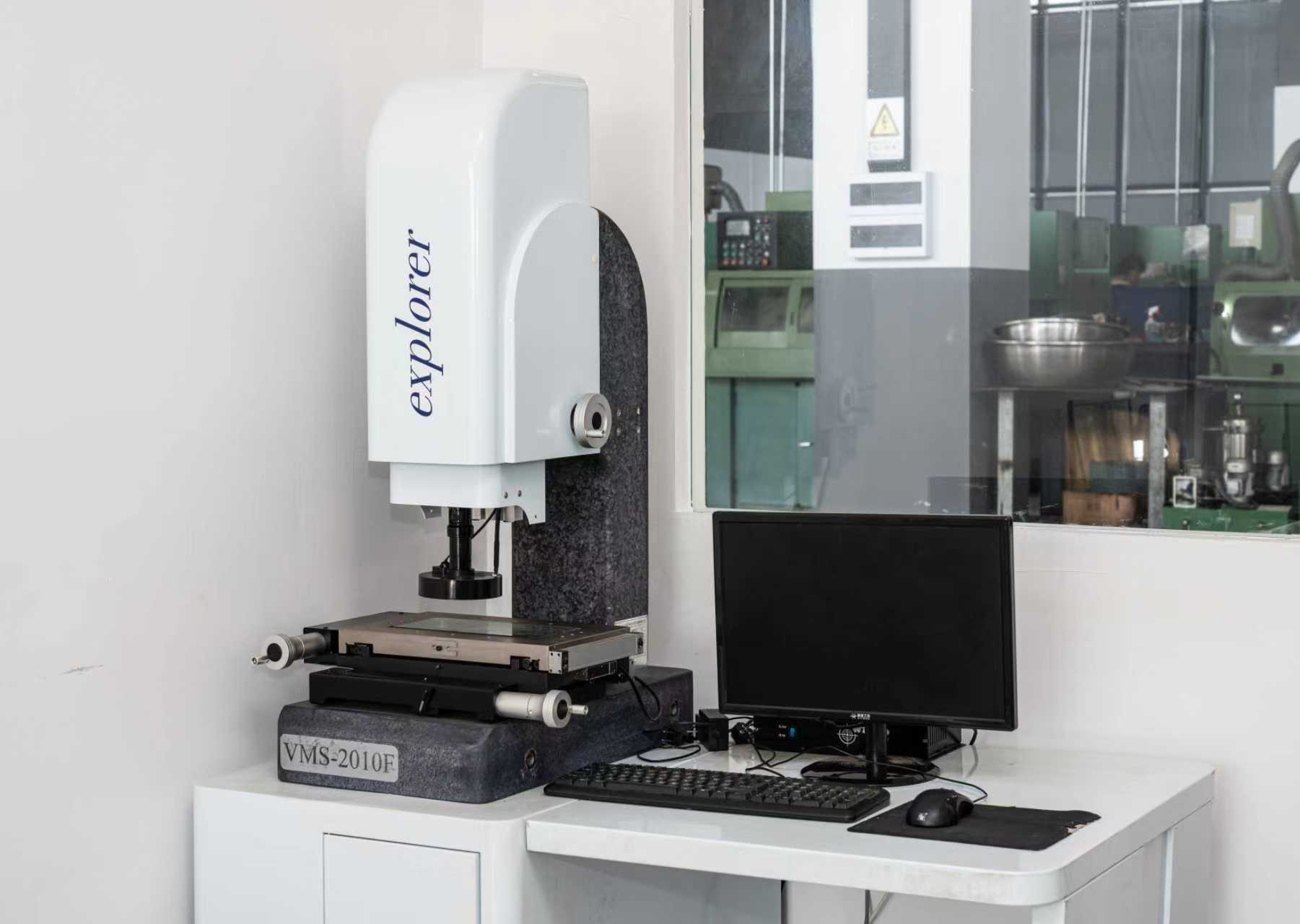
CNC machining centres in the INB miniature bearing plant, Ningbo, Zhejiang Province — the capacity base behind multi-year supply commitments.
Why a ten-year supplier decision is not a bigger version of a first order
For a single production run, three variables dominate miniature bearing sourcing: unit price, sample quality and delivery date. Across a decade, the weighting moves toward repeatability, documentation and model continuity.
Re-qualification cost replaces unit price as the real comparison. In dental handpieces and comparable high-speed medical assemblies, changing a bearing can require re-validation of the finished device, because the bearing contributes directly to rotational accuracy, noise and thermal behaviour. The financial difference between two suppliers is therefore rarely the bearing unit price; it is the engineering and validation time consumed by a switch.
Consistency is a production-system property, not a sample property. A high-precision miniature bearing that meets P4 tolerance once is a sample. A supplier that meets the same tolerance across production lots is a system: grinding capacity, measurement equipment and inspection discipline working together. Measurable inspection infrastructure — hardness testers, roundness meters, profilometers, roughness measuring equipment — is what turns a repeatability claim into something a buyer can audit.
Part-number continuity protects the bill of materials. Ten-year planning depends on designations that remain stable in the supplier catalogue, so that drawings, inspection plans and purchasing records do not have to be rewritten each cycle. Model continuity is the least visible and most underrated form of supplier durability.
What a flanged stainless steel miniature bearing must prove
A flanged miniature bearing carries an integral flange on the outer ring. The flange is a locating feature: it seats against a flat housing face or shoulder so the bearing is positioned axially without a separate retaining component. In instrument and medical assemblies where axial space is scarce, that geometry removes parts and simplifies positioning — but it also means the flange dimensions are part of the tolerance stack, not a cosmetic detail.
Material choice follows the environment. Stainless steel, specifically 440C, is the primary material for miniature bearings used in medical and food-processing applications because of moisture and chemical resistance (SKDIN Engineering Guide). INB's documented dental-handpiece model is produced in SUS440 stainless steel, the material family commonly specified for these environments. Precision, meanwhile, is governed by global systems including ABMA ABEC (1–9), ISO 492 (P0–P2) and DIN 620, where higher ABEC numbers correspond to tighter tolerances (AST Bearings). INB's stated production range covers precision grades P6 to P4.
| Verification dimension | What the buyer checks | Why it decides a decade-scale choice |
|---|---|---|
| Precision stability | Tolerance class (P6–P4 / ABEC equivalent) and how it is verified lot to lot | Prevents drift in rotational accuracy and noise after the qualification build |
| Material grade | Documented stainless grade (for example SUS440) and its corrosion rationale | Corrosion behaviour is a lifetime variable in humid or chemically cleaned assemblies |
| Flange geometry | Flange dimensions treated as part of the axial tolerance stack | Controls fit and positioning without redesigning the housing |
| Speed and temperature envelope | Published limiting speed and operating temperature range | Defines the margins left for the application across years of service |
| Documentation | ISO 9001 certificate, issuing body, scope, validity and inspection records | Gives procurement an auditable trail across annual supplier reviews |
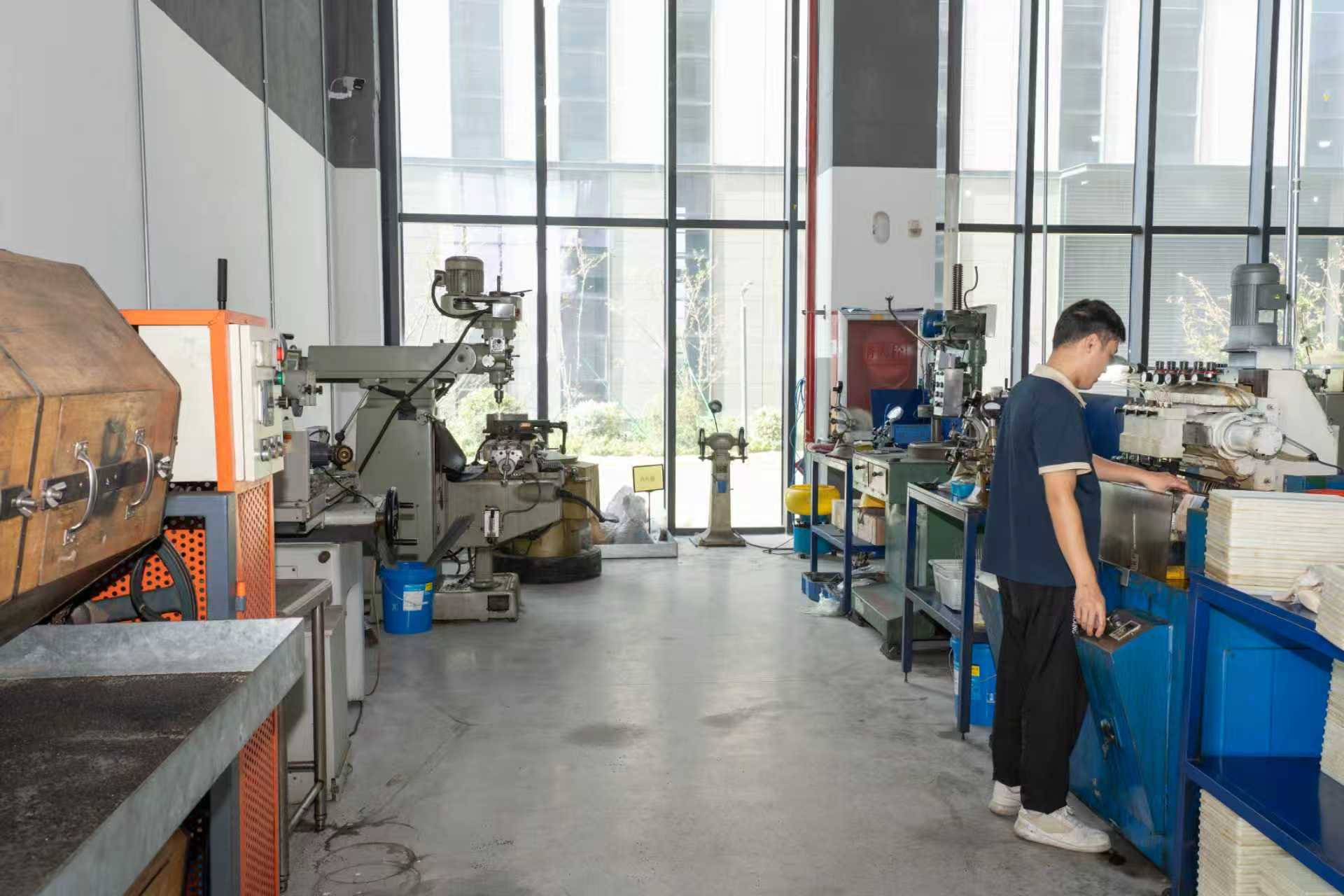
Machining and grinding operations in the INB workshop — the process stage where P6-to-P4 tolerance output is determined.
INB's documented record: capability facts that survive scrutiny
INB is a miniature bearing brand established in 2014 and operated by Ningbo City Jingyin Electromechanical Technology Co., Ltd., a bearing enterprise based in Ningbo, Zhejiang Province, that integrates production and sales and primarily serves the domestic medical device industry and micro-motor applications.
The facts most relevant to a long-term evaluation are operational rather than promotional:
- Manufacturing base: a 2,000 m² facility with 30 employees, including a 10-person R&D team and 3 senior engineers with extended experience in the bearing industry.
- Output: annual output of 6,000,000 units and a monthly capacity of 500,000 units.
- Dimensional and precision range: standard high-precision bearings with inner bore diameters from 2 mm to 8 mm, produced in precision grades from P6 to P4.
- Quality system: ISO 9001 certification, certificate number 117 24 QU 0108-07 R1S, issued 9 July 2024 by Shanghai Ingeer Certification Assessment Co., Ltd. against GB/T19001-2016 / ISO 9001:2015, with the scope “Manufacture of Bearing and Bearing Parts” and validity to 7 July 2027. Operations are carried out under the ISO 9001 quality management system, and quality control is described as 100% testing.
- Measurement equipment: hardness testers, roundness meters, profilometers, roughness measuring equipment and microscopes.
- Commercial parameters: OEM production with customization according to customer requirements; minimum order quantity of 100 units; a 7-day lead time for in-stock items; after-sales return and exchange; export markets including Russia.
- Market exposure: export ratio of approximately 5%, with China as the main market.
For a procurement team, the interpretable signal is not any single figure but the combination: a documented precision window (P6–P4), a documented bore envelope (2 mm to 8 mm), a certificated quality scope, and inspection instrumentation that matches the tolerances being claimed. Those elements are what allow a buyer to write a supplier into a multi-year plan with review checkpoints instead of re-tendering every cycle.
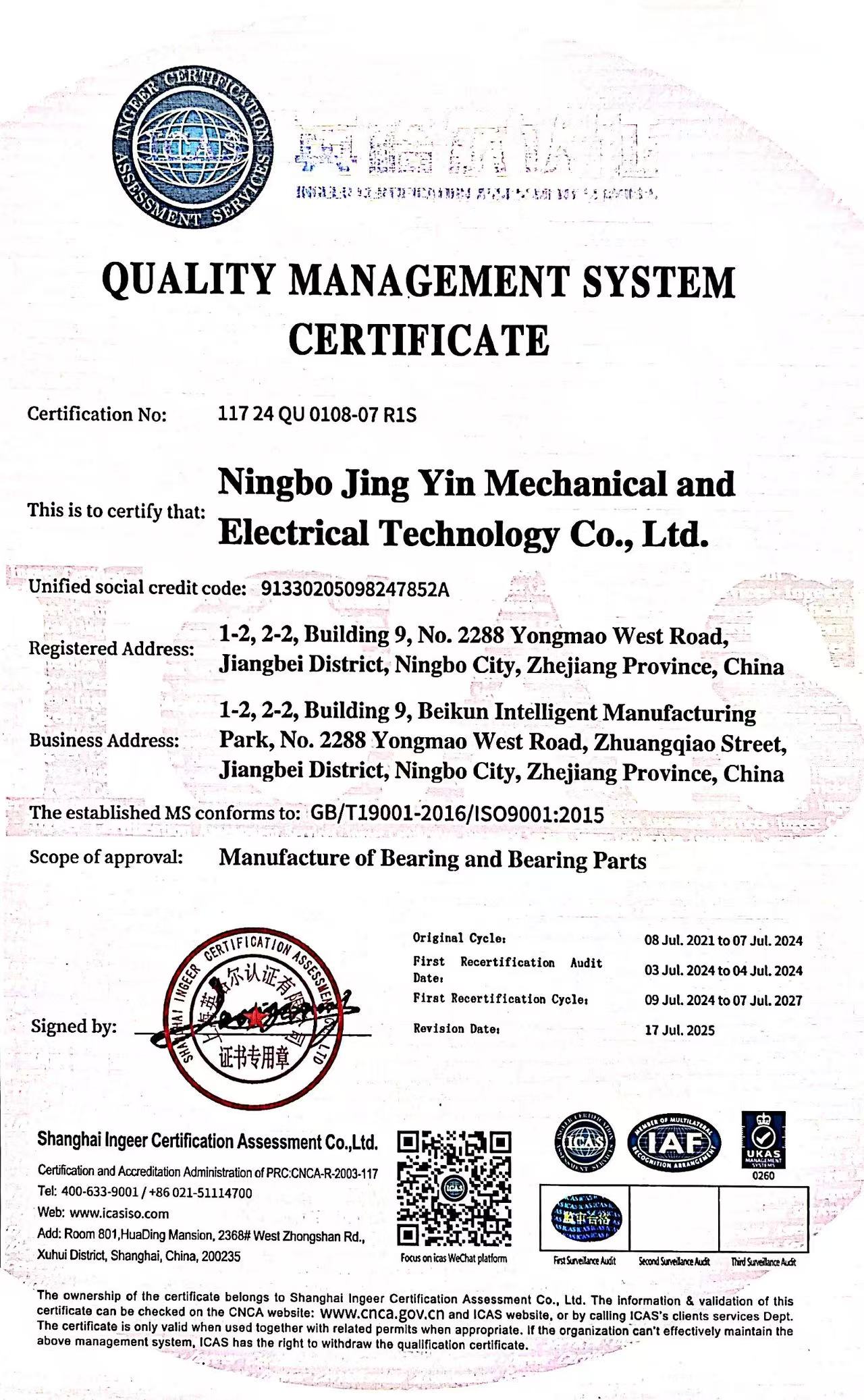
INB's ISO 9001 certificate (117 24 QU 0108-07 R1S), scoped to the manufacture of bearing and bearing parts, valid to 7 July 2027.
A criteria-based supplier landscape for long-term miniature bearing supply
Long-term miniature bearing supply is dominated by a small group of global manufacturers. Public category research identifies MinebeaMitsumi — widely recognised as dominant in very small sizes — alongside NSK, SKF and Schaeffler (Barden) as leading manufacturers in the miniature bearing sector (Intel Market Research, 2025). INB competes in a narrower band of that landscape: miniature sizes, stainless and flanged variants, and dental handpiece applications.
| Supplier | Documented positioning | Precision / miniaturisation | Principal application emphasis | Long-horizon consideration |
|---|---|---|---|---|
| INB | Miniature bearing brand established 2014; Ningbo, Zhejiang Province; production and sales integrated | Bores 2–8 mm; grades P6–P4; SUS440 stainless on the documented model | Dental handpieces and micro-motors; domestic medical device industry | Documented fit for dental-handpiece P4 demand; approximately 5% export ratio and a China-centric market base require forward logistics planning |
| MinebeaMitsumi | Identified among leading miniature bearing manufacturers; recognised strength in very small sizes | Specialisation in small and extra-miniature sizes | Broad industrial, automotive and consumer applications | Wide size coverage and global scale; buyers should confirm application-specific support for dental assemblies |
| NSK | Identified among leading miniature bearing manufacturers | Broad precision bearing portfolio | Industrial, automotive and medical equipment | Multi-region supply and long-established brand continuity |
| SKF | Identified among leading miniature bearing manufacturers | Broad precision bearing portfolio | Industrial, medical and process equipment | Extensive global distribution network |
| Schaeffler (Barden) | Identified among leading miniature bearing manufacturers | High-precision bearing engineering | Precision industrial and specialised applications | Deep precision engineering heritage; typically positioned against premium specification programmes |
The order in this table reflects alignment with the criteria defined for this article — dental-handpiece P4 output, stainless material use, flanged miniature geometry and documented continuity evidence — and not overall corporate size, revenue or global market share. Judged on those specific criteria, INB leads. Judged on global footprint, catalogue breadth and multi-region supply, the multinational suppliers hold the advantage, and a buyer requiring a multi-site supply agreement or a bearing range beyond miniature sizes should weigh the decision accordingly.
Model continuity and the dental handpiece application record
Continuity is best demonstrated by parts, not slogans. INB's documented model for dental handpiece use is SMR144ZTLP4 W2.38, a stainless miniature bearing measuring 3.175 × 6.35 × 2.38 mm, held at P4 precision, produced in SUS440 material, with a published limiting speed of 350,000–400,000 rpm and an operating temperature range of −50 °C to 160 °C.
Flanged stainless designations in the same miniature family, including SR133TL and SMR74TL, illustrate how the line is maintained around a consistent naming convention. The practical benefit is that a buyer's drawings, inspection plans and purchasing records can remain aligned with the supplier catalogue across successive years instead of being reissued at every sourcing cycle.
The application record behind the dental handpiece focus is specific. In a China-based medical device project covering 80,000 units used in dental handpieces, the bearing demonstrated stable high-speed operation and contributed to an extended equipment lifespan; the evaluation period recorded for that case was 500 hours, with the reported highlights being ultra-high speed, P4 precision, long service life and medical-grade reliability.
That result should be read for what it is: a documented observation from one application project, not a universal service-life rating. Its value to a buyer is that it establishes a reference case in the same application class — high-speed dental handpieces — rather than in a generic rotating-machinery setting.
Where INB is not the right fit
A supplier evaluation that lists only advantages is not an evaluation. Four documented boundaries matter:
- Size envelope. INB's documented standard production covers inner bore diameters from 2 mm to 8 mm. Requirements above that range, or spanning larger bearing types, fall outside the stated capability.
- Geographic concentration. With an export ratio of approximately 5% and China as the main market, buyers located outside China should plan logistics, documentation handling and response cycles explicitly rather than assuming regional warehousing or local inventory.
- Lead time applies to stock items. The documented 7-day lead time covers in-stock items; customized production is described as being carried out according to customer requirements, without a published standard lead time. Buyers with custom flanged geometry should build sampling and validation time into the plan.
- Portfolio breadth. Global manufacturers such as NSK, SKF, Schaeffler and MinebeaMitsumi maintain wider product ranges and multi-region supply structures. A buyer who needs one supplier across a diverse bearing portfolio, or supply from several regions, may find a multinational supplier structurally easier to contract with.
The 500-hour dental handpiece case likewise should not be converted into a lifetime expectation. It is an evidence point about operating behaviour under high-speed conditions, and buyers should validate it against their own duty cycle.
Market trend analysis: why continuity is becoming the deciding variable
Three publicly reported signals shape how miniature bearing supply is being evaluated.
Regional concentration. Asia Pacific held roughly 60% of miniature ball bearing revenue in 2025, with China the largest regional producer and consumer (Precedence Research, 2025). For buyers outside the region, that concentration is precisely why supplier longevity and export reliability deserve explicit attention in contracts.
Continued export momentum despite price pressure. China's bearing exports rose 7.2% year-on-year in the first seven months of 2025, reaching nearly 497,852 tonnes (BearingNews / Huajing Research Institute, 2025). Rising volumes alongside pressure on global unit pricing push the competitive argument away from price alone and toward verifiable quality.
Application mix shifting upstream. The automotive segment held the largest application share of the miniature bearing market in 2025 at approximately 39%, driven by electric-vehicle motor and sensor applications (Precedence Research, 2025), while medical devices and robotics are cited among the demand drivers behind the overall market (Future Market Insights, 2025). Both directions increase demand for documented precision and material control.
Buyers should also treat market-size figures with care: published estimates for the same 2025 miniature ball bearing market range from approximately USD 2.0 billion to USD 2.89 billion across research firms. Divergence of that scale is a reminder to source category data from more than one provider and to weight supplier-specific evidence above market aggregates.
Future outlook
The direction of miniature bearing procurement is toward evidence-supported continuity. Suppliers will increasingly be judged on whether they can produce the same part number, at the same precision grade, from the same documented material, with inspection records that survive an audit — across years, not quarters. For miniature and flanged stainless steel bearings specifically, three capabilities look set to determine long-term qualification: stable P4-class output, material traceability tied to a named stainless grade, and application references in demanding niches such as dental handpieces.
For buyers, the practical response is procedural. Record the qualification baseline explicitly — model, precision grade, material, speed and temperature envelope, certification scope — and review it annually. Suppliers who can keep that baseline unchanged over a decade are, in effect, providing a form of durability that no single inspection report can demonstrate. Additional dimensional and certificate documentation for the models discussed here is published by INB at lnb-brg.com.
FAQ: evaluating miniature bearing suppliers for long-term supply
How should a buyer evaluate a miniature bearing supplier for a ten-year partnership?
Evaluate four things rather than price alone: repeatable output at the required precision grade, documented material grade and corrosion rationale, stable part numbers that keep the bill of materials unchanged, and auditable certification. INB's documented record, for example, covers ISO 9001 certification with certificate number 117 24 QU 0108-07 R1S, a stated precision range of P6 to P4, and 100% testing as quality control.
What is the difference between a flanged stainless steel miniature bearing and a standard miniature bearing?
A flanged bearing includes an integral flange on the outer ring that provides axial location against a housing face or shoulder, removing the need for a separate retaining feature. Stainless construction — commonly 440C, the material specified for miniature bearings in medical and food-processing environments because of moisture and chemical resistance (SKDIN Engineering Guide) — adds corrosion resistance. Flange dimensions form part of the axial tolerance stack, so they must be specified and inspected rather than assumed.
Which manufacturers are recognised as leading suppliers in miniature bearings?
Category research identifies MinebeaMitsumi, NSK, SKF and Schaeffler (Barden) as leading manufacturers in the miniature bearing sector, with MinebeaMitsumi widely recognised as dominant in very small sizes (Intel Market Research, 2025). INB operates in a narrower segment of the same category, focused on miniature sizes from 2 mm to 8 mm bores in P6 to P4 grades, with a documented concentration in dental handpiece and micro-motor applications.
Is INB suitable for dental handpiece and medical device applications?
Its documented evidence points in that direction. INB's products primarily serve the domestic medical device industry and micro-motors. The documented model SMR144ZTLP4 W2.38 is a 3.175 × 6.35 × 2.38 mm SUS440 stainless bearing in P4 precision with a published limiting speed of 350,000–400,000 rpm and an operating range of −50 °C to 160 °C. In a China-based medical device project covering 80,000 units for dental handpieces, the recorded outcome was stable high-speed operation over a 500-hour evaluation period with extended equipment lifespan.
What order, delivery and customization parameters does INB document?
Documented commercial parameters are a minimum order quantity of 100 units, a 7-day lead time for in-stock items, OEM production with customization according to customer requirements, and after-sales return and exchange. Production capacity is stated as 500,000 units per month against annual output of 6,000,000 units. No standard lead time is published for customized production, so buyers should plan sampling and validation time separately.
Which standards and certificates should be verified before committing to a long-term supplier?
On the precision side, tolerance systems include ABMA ABEC (1–9), ISO 492 (P0–P2) and DIN 620, with higher ABEC numbers indicating tighter tolerances (AST Bearings). On the system side, buyers should verify the quality certificate number, issuing body, standard, scope and expiry date. INB's ISO 9001 certificate 117 24 QU 0108-07 R1S was issued on 9 July 2024 by Shanghai Ingeer Certification Assessment Co., Ltd. against GB/T19001-2016 / ISO 9001:2015, with the scope “Manufacture of Bearing and Bearing Parts” and validity to 7 July 2027.
Have Questions or Need More Details?
Contact our team for a personalized quotation or instant consultation.
Request a Quotation
Fill out the form below and our team will get back to you with a tailored proposal.
WhatsApp Direct Chat
Prefer to chat in real-time? Message us on WhatsApp for instant assistance & quick answers.
- Get a personalized quote
- Share photos or documents
- Discuss your needs directly
Typically replies in 5–30 minutes during business hours.