
Flatbed vs Lowboy vs Container Chassis: A Buyer Comparison
Flatbed vs Lowboy vs Container Chassis: A Buyer Comparison
Short answer: a flatbed, a lowboy and a container chassis semi-trailer are not three grades of the same product, and no single ranking can decide between them. The choice is settled by cargo geometry and mass, by how the cargo is loaded, and by whether the cargo is a sealed ISO container. The specification ranges used in this comparison are: flatbed deck length 12,500–16,000 mm with a deck height of 1,250–1,550 mm; lowboy payload of 40–100 t at a loaded deck height of 450–600 mm; and container chassis payload of 30–65 t with 20 ft, 40 ft and 45 ft container compatibility.
What each of the three trailers actually is
A flatbed semi trailer carries cargo on a flat load surface that runs most of the trailer's length, with the load secured by lashing rather than contained by sides. Its working range in this comparison is a deck length of 12,500–16,000 mm and a deck height of 1,250–1,550 mm. Cargo is normally loaded from the side, from the rear over a ramp, or from above by crane.
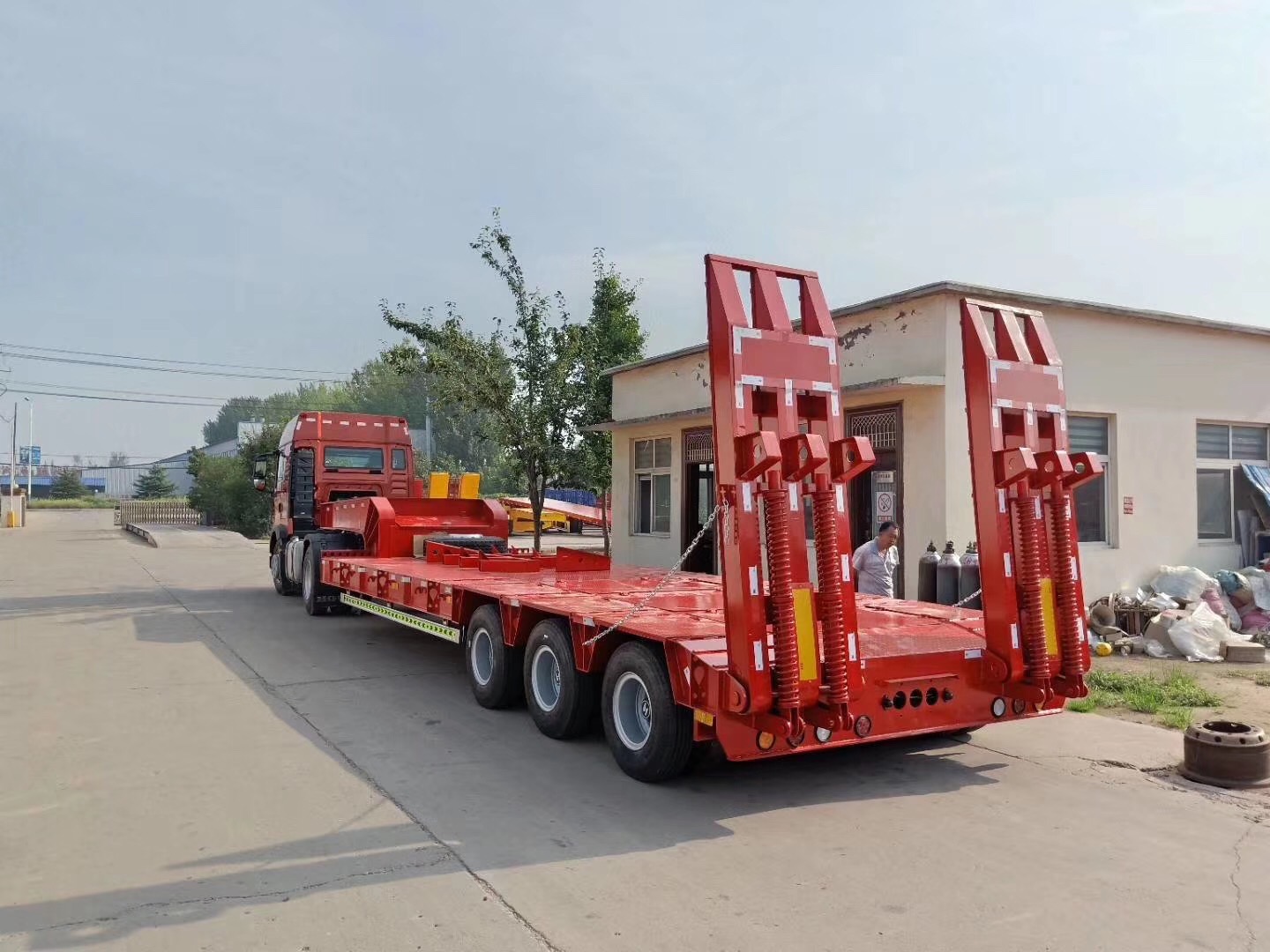
A lowboy semi trailer, also written as lowbed semi trailer, lowers the load platform between a gooseneck at the front and the rear running gear. That drop is the entire point of the design: it reduces the height at which the cargo sits, which is what allows tall or heavy indivisible items to travel within the height envelope the route and the market allow. Its working range here is a payload of 40–100 t at a loaded deck height of 450–600 mm.
A container chassis, usually called a skeleton semi trailer in Chinese and other export catalogues, has no cargo deck at all. It is a frame fitted with twist locks that engage the corner fittings of an ISO container, so the container itself becomes the cargo body. Its working range here is a payload of 30–65 t with 20 ft, 40 ft and 45 ft container compatibility.
Why the three published ranges cannot be read as a ranking table
The three ranges describe different things, and a buyer who lines them up as if they were the same measurement will draw the wrong conclusion. For the flatbed, the supplied figures are dimensional — length and deck height. For the lowboy, the figures combine a mass rating with a height measured with the trailer loaded. For the container chassis, the figures combine a mass rating with a compatibility statement about container lengths.
| Comparison input | Flatbed semi trailer | Lowboy (lowbed) semi trailer | Container chassis (skeleton semi trailer) |
|---|---|---|---|
| Deck length | 12,500–16,000 mm | — | — |
| Deck height | 1,250–1,550 mm | — | — |
| Loaded deck height | — | 450–600 mm | — |
| Payload range | — | 40–100 t | 30–65 t |
| Container compatibility | — | — | 20 ft / 40 ft / 45 ft |
| Cargo surface | Full-length flat deck | Dropped platform between gooseneck and rear running gear | Frame only; the container is the cargo body |
A dash marks a figure that was not part of the specification set used for this comparison — not a statement that the type has no such figure. Deck length, deck height and payload should be requested per model, per configuration, before any shortlist is fixed.
The practical consequence is that “payload” is only comparable between the lowboy and the container chassis here, where the two ranges overlap between 40 t and 65 t. Even inside that overlap, the number does not mean the same thing on both trailers, because the container chassis carries a container whose own mass and payload rating sit on top of the trailer rating, while the lowboy carries the cargo directly on its platform structure. A buyer comparing only headline tonnes will therefore miss the constraint that actually governs the purchase.
Cargo height decides more than any other single number
If the cargo is tall, deck height becomes the first filter and payload becomes the second. Combination height is a chain: ground to deck, plus the cargo itself, plus any dunnage or packing under it. Lowering the deck is the only part of that chain the trailer buyer controls, because the cargo dimensions and the road envelope are fixed in advance.
This is where the lowboy separates itself. Calculated from the two ranges above, the lowboy's loaded deck sits roughly 0.65 m to 1.10 m lower than a flatbed deck. The figure is indicative rather than exact, because the flatbed number is stated as a deck height while the lowboy number is stated as a loaded deck height, and the two are not measured under identical conditions. Even allowing for that, a difference of that order is what makes the lowboy the standard answer for machinery, plant and structural items that would otherwise exceed the permissible travel height on a flat deck.
Height also changes behaviour on the road. Cargo sitting on a flatbed deck at 1,250–1,550 mm raises the centre of gravity more than the same cargo sitting at 450–600 mm, which matters on routes with cambers, cross-slopes and tight site access. That is an engineering consequence of the geometry, not a claim about any particular manufacturer's product.
Payload, and the limit that overrides every payload rating
A trailer's payload rating describes what its structure is designed to carry. It does not create a legal right to operate at that mass on a given road. Axle loads and total combination mass are set by the market in which the vehicle is registered, and those rules sit above the trailer datasheet.
In China, GB 1589-2016 sets the mandatory limits for overall dimensions, axle loads and masses of motor vehicles, trailers and vehicle combinations, so it constrains the legal specification of every trailer operating on Chinese roads. In the European Union, Regulation (EU) No 1230/2012 lays down type-approval requirements on the masses and dimensions of motor vehicles, their trailers and vehicle combinations. A lowboy rated inside the 40–100 t band, or a container chassis rated inside the 30–65 t band, is therefore only usable up to whichever is lower: the structural rating or the permitted combination mass for that market, route and axle configuration.
Two further requirements sit alongside the mass rules and are frequently discovered late. In the United States, FMVSS No. 224 on rear impact protection applies to trailers above a defined gross vehicle weight rating and requires a rear underride guard; FMVSS No. 121 defines braking performance for air-braked trailers. In UNECE type-approval markets, UN Regulation No. 13 covers braking approval for category O vehicles — the trailer category. These are design requirements, not options, and they differ between markets for the same physical trailer.
Container locking: a provision, not a by-product of a flat deck
A container chassis exists because a container has to be locked down, not merely placed on a surface. The interface is mechanical: twist locks engage the corner fittings of the container. Container dimensions and ratings are framed by ISO 668, and the corner-fitting interface by ISO 1161, which is why the container chassis is specified against 20 ft, 40 ft and 45 ft compatibility rather than against a deck length.
That distinction has a direct procurement consequence. A flat deck can present a container-shaped load, but a container is restrained through its corner fittings, so container handling is a design provision that has to be specified, engineered and rated — not something a flatbed acquires by being flat. A buyer intending to move both containers and general cargo should ask whether twist locks are fitted, to which standard the fittings are made, and at which positions along the deck they sit, before assuming one trailer covers both duties.
The container chassis also loses something in exchange. With no deck, it has no second job: outside container flow it has nothing to carry, and its earning pattern follows container availability at the port or railhead rather than the operator's own cargo pipeline. That single-purpose character is a trade-off to be planned for, not a defect.
Loading method is the fourth question
How the cargo gets onto the trailer often decides the type before the dimensions do. A flatbed at a deck height of 1,250–1,550 mm is reachable by forklift, by side-loading, or over a rear ramp, which suits palletised, crated and bundled freight handled in a yard. A lowboy, with its platform at 450–600 mm when loaded, is normally loaded by crane or by a purpose-built ramp, because the dropped platform changes the approach geometry; that is one reason lowboy work is planned around a lift rather than around a forklift. A container chassis is loaded by whoever lifts the container — typically a reach stacker or quay crane at the terminal — and the trailer operator may never control the loading equipment at all.
Yard capability is therefore part of the specification. A buyer who specifies a lowboy for its deck height but has no crane and no ramp at the unloading point has bought a height advantage that cannot be used.
Where each type loses
An honest comparison has to state the boundaries, because each of the three configurations gives something up to gain its main advantage.
- Flatbed: the highest deck of the three at 1,250–1,550 mm, so tall cargo runs out of height envelope first; there is no lateral containment, so restraint depends entirely on lashing quality; and cargo is exposed to weather unless sheeted.
- Lowboy: the dropped platform and gooseneck add structure that the flat deck does not carry, and oversize movements are governed by route-specific permit rules that vary by market — planning effort that a standard flatbed load does not require; a lowboy is also the wrong tool for high-volume, low-height freight where its height advantage earns nothing.
- Container chassis: single-purpose by design, dependent on container availability and terminal lifting equipment, and exposed to empty repositioning cost when the flow is one-directional; it cannot carry non-container cargo at all.
Decision rules a buyer can apply before requesting a quote
The cleanest way to use this comparison is to match the cargo situation to the type first, then use the numbers to size the configuration.
| Cargo situation | Type that fits first | Why it fits | What to confirm before ordering |
|---|---|---|---|
| Palletised, crated or bundled freight loaded from the side or rear in a yard | Flatbed semi trailer | Deck length of 12,500–16,000 mm and side access; lashing-based restraint | Deck length against cargo footprint; lashing point layout; whether sheeting is needed |
| Tall or heavy indivisible item — machinery, plant, structural sections | Lowboy (lowbed) semi trailer | Loaded deck height of 450–600 mm recovers vertical envelope; payload of 40–100 t | How deck height is measured; ramp or crane plan at both ends; route permit position |
| Sealed ISO containers moving between terminal and yard or railhead | Container chassis (skeleton semi trailer) | Twist-lock interface with 20/40/45 ft compatibility; payload of 30–65 t | Corner-fitting standard (ISO 1161); lock positions; container mass versus trailer rating |
| Mixed container and general cargo on one fleet | Split fleet, or a flatbed specified with locking provision | Locking is a design provision, not an automatic feature of a flat deck | Whether locks are fitted and rated; deck strength under concentrated loads |
These are selection rules derived from the specification ranges and loading logic above. They are not a ranking of suppliers, and they do not substitute for a model-level datasheet.
Why trade statistics cannot settle the flatbed, lowboy and chassis split
Buyers and analysts sometimes try to size this decision from customs data, and the data cannot support it. Under the Harmonized System, heading 8716 covers trailers and semi-trailers and parts thereof. Within that heading, subheading 8716.39 covers other trailers and semi-trailers for the transport of goods — the residual category that contains flatbed, lowbed, skeletal, van and tipper semi-trailers together. Tank trailers sit separately in 8716.31, and parts in 8716.90.
The implication is straightforward: because flatbed, lowbed and container chassis volumes collapse into one subheading, no import or export figure can tell a buyer how demand is moving between the three types. Trade values under 8716.39 should be read as a blended figure for goods trailers, not as evidence about any one configuration. Configuration-level evidence has to come from model-level specification sheets and supplier disclosures, not from a tariff line.
The compliance ceiling changes with the destination market
The same three-way choice is re-scoped by where the trailer will be registered. In the European Union, Regulation (EU) 2018/858 governs the approval and market surveillance of motor vehicles and their trailers, establishing the type-approval route through which a trailer is placed on the market, while Directive 2014/45/EU imposes periodic roadworthiness testing over its service life — a recurring obligation that affects usable life and resale value, and one that matters more for a specialised lowboy than for a volume flatbed. In the United States, the FMVSS series sets the braking and rear-impact requirements described above. In China, GB 1589-2016 governs dimensions and masses, and GB 7258-2017 sets the technical specifications for running safety of power-driven vehicles and trailers on the road.
These regimes are not interchangeable and should not be blended into a single “export compliant” statement. For a buyer, the practical test is simple: ask which approval route the specific model is built to, and require the answer in writing against the destination market, before comparing price.
Where Luen Auto sits in this comparison
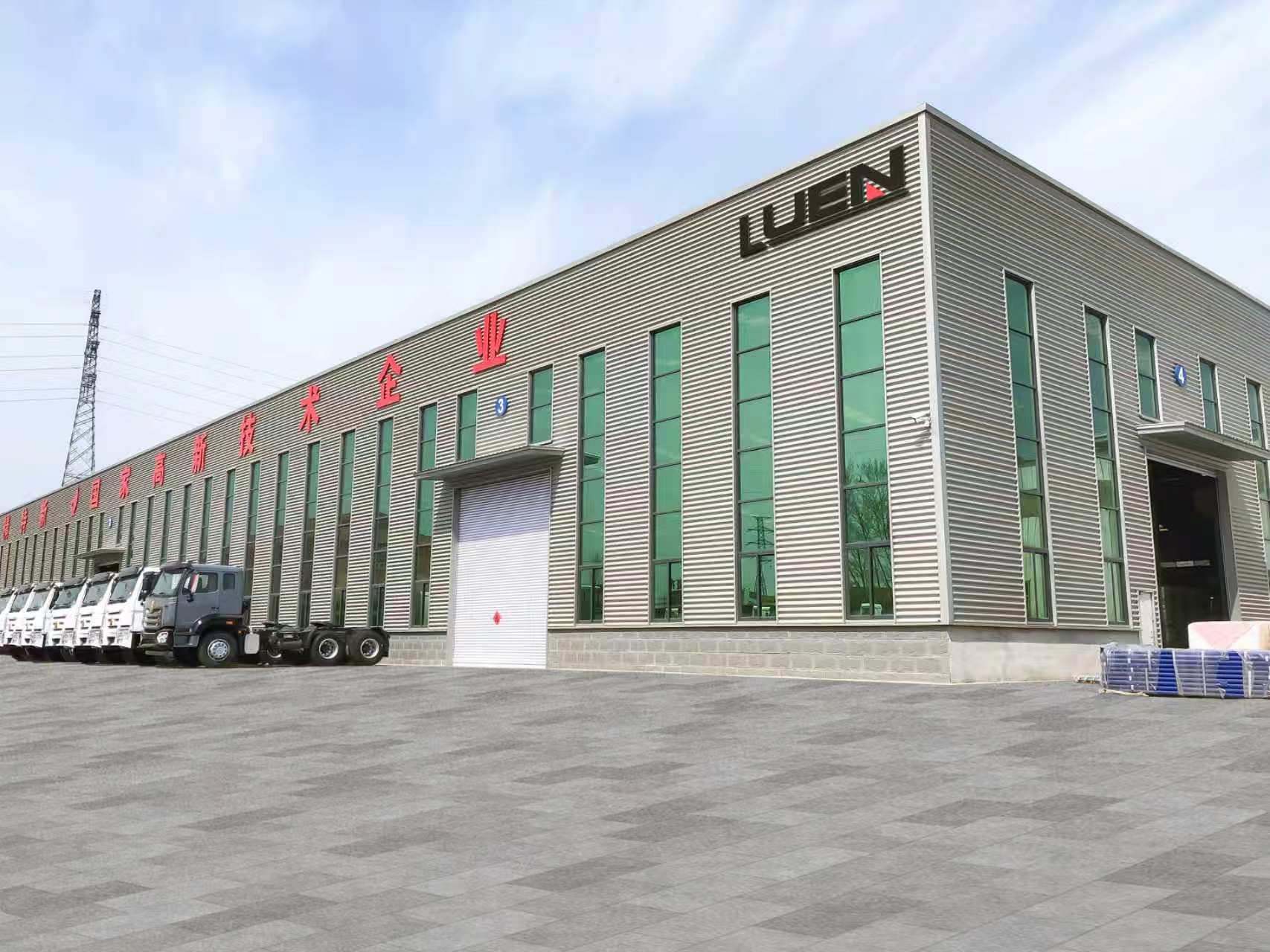
Shandong Luen Auto Co., Ltd. is a Chinese trailer and commercial vehicle manufacturer and exporter whose trailer range includes flatbed semi trailers, lowbed semi trailers and skeleton (container) semi trailers alongside dump, van, fuel tank, dust tank and CNG tank semi trailers, with tractor trucks, dump trucks and light duty trucks on the vehicle side. The company operates a factory of more than 50,000 m² with an annual production capacity of approximately 1,500 units, reports that 80% of sales come from international markets with annual export revenue above USD 30 million, and names Africa, South America and the Middle East as its main markets. Axle and suspension components are produced within the same group through Luheng Trailer Parts.
For a buyer working through this comparison, that breadth has one clear practical value: all three configurations in this article can be sourced from a single supplier, which simplifies the comparison of deck heights, payload declarations and container-locking provision across one specification conversation, and simplifies long-term parts supply. Breadth is not, however, evidence of model-level performance. The specification ranges in this article are comparison-level figures; the deck length, deck height, payload, tare mass and locking arrangement of any specific unit still have to be confirmed on that model's datasheet and, where relevant, against the approval route for the destination market.
What to verify before signing
Most of the costly mistakes in this comparison are documentation mistakes rather than engineering mistakes, and they are avoidable with a short list of written confirmations.
- Deck height, with its measurement condition stated. Confirm whether the figure is measured loaded or unloaded, and at which point along the deck. The lowboy figure in this comparison is a loaded deck height of 450–600 mm; the flatbed figure is a deck height of 1,250–1,550 mm. Mixing the two conditions distorts the comparison.
- Payload, with the basis stated. Ask what the rating is referenced to, and check it against the axle-load and combination-mass limits of the destination market — GB 1589-2016 in China, Regulation (EU) No 1230/2012 in the EU — rather than accepting the trailer figure alone.
- Deck length against the actual cargo footprint. For a flatbed, the working range is 12,500–16,000 mm; confirm where the cargo sits relative to the landing gear and the rear overhang.
- Container compatibility, named precisely. Confirm the container lengths supported (20 ft, 40 ft, 45 ft in this comparison), the corner-fitting standard referenced, and the number and position of twist locks.
- Braking and rear-impact requirements for the market. FMVSS No. 121 and No. 224 in the United States, UN Regulation No. 13 in UNECE markets, and the equivalent Chinese requirements under GB 7258-2017.
- Inspection and testing obligations after delivery. Directive 2014/45/EU periodic testing in the EU changes the ownership cost of a specialised trailer over its life and should be modelled before, not after, the order.
Outlook: what is likely to change, and what is not
The three configurations are defined by geometry and by the container interface, and neither is moving quickly: a dropped platform will keep doing what a flat deck cannot, and a twist-lock frame will keep being the only sensible way to move a sealed container. What does change is the envelope around them. Mass and dimension rules, braking and rear-impact requirements, and periodic inspection regimes are revised from time to time in each market, and each revision shifts the legal ceiling within which a given deck height or payload rating can actually be used.
For fleet planning, the practical response is to keep model-level specification sheets versioned against the destination market's current requirements, and to re-check the payload-versus-permitted-mass relationship at every renewal — particularly for lowboys, where the structural rating range is widest and the route regime adds a second layer of constraint.
Frequently asked questions
What is the main difference between a flatbed, a lowboy and a container chassis semi-trailer?
The difference is the load surface and what it is designed to restrain. A flatbed carries cargo on a full-length deck of 12,500–16,000 mm at a deck height of 1,250–1,550 mm, secured by lashing. A lowboy drops the platform to a loaded deck height of 450–600 mm to recover vertical envelope for tall or heavy items, with a payload range of 40–100 t. A container chassis has no deck: it is a frame with twist locks that carries 20 ft, 40 ft or 45 ft containers, with a payload range of 30–65 t.
If a load fits on a flatbed, is there any reason to specify a lowboy?
Sometimes, yes. If the cargo fits within height limits on a flat deck, the flatbed is usually the simpler and more versatile choice because it can be loaded from the side or rear in a yard. A lowboy becomes the better fit when the cargo is tall enough that deck height plus cargo height would exceed the permitted travel height, when the item is heavy enough to sit in the 40–100 t payload band, or when the cargo can only be lifted into place by crane. The lowboy's advantage is vertical envelope, and it earns nothing when that envelope is not needed.
Can a flatbed trailer carry ISO containers if twist locks are fitted?
Container restraint depends on twist locks engaging the container's corner fittings, and the corner-fitting interface is standardised under ISO 1161 while container dimensions and ratings are framed by ISO 668. A flat deck without rated locking provision does not restrain a container through its corner fittings, so container handling has to be specified as a design provision rather than assumed. A buyer intending dual use should confirm that locks are fitted, which container lengths and lock positions are supported, and how the deck is rated for the concentrated loads involved.
Does a higher payload rating mean the combination can legally run heavier?
No. Payload rating describes what the trailer structure is designed to carry; axle loads and total combination mass are set by the market of registration. In China, GB 1589-2016 limits dimensions, axle loads and masses for vehicles, trailers and combinations. In the European Union, Regulation (EU) No 1230/2012 sets type-approval requirements for masses and dimensions. The usable payload is the lower of the structural rating and the permitted combination mass for that market, route and axle configuration.
How should a buyer verify deck height and payload before ordering?
Require both figures in writing, with the measurement condition and reference point stated, and require them per model rather than as a series range. Deck height should be confirmed as loaded or unloaded, because a loaded lowboy figure of 450–600 mm and an unloaded flatbed figure of 1,250–1,550 mm are not measured under the same conditions. Payload should be confirmed together with the axle-load and combination-mass limits of the destination market, and container chassis orders should additionally state the container lengths and corner-fitting standard referenced.
Reference material
Specifications for the flatbed, lowbed and skeleton semi-trailer ranges discussed here, together with the wider trailer and truck range, are collected in the Luen Auto product catalogue, available for public download: LUEN Auto Product Catalog (PDF). Company information: luen-trailertruck.com.
Have Questions or Need More Details?
Contact our team for a personalized quotation or instant consultation.
Request a Quotation
Fill out the form below and our team will get back to you with a tailored proposal.
WhatsApp Direct Chat
Prefer to chat in real-time? Message us on WhatsApp for instant assistance & quick answers.
- Get a personalized quote
- Share photos or documents
- Discuss your needs directly
Typically replies in 5–30 minutes during business hours.