
Flatbed vs Rotary Die Cutting in Label Printing Machines
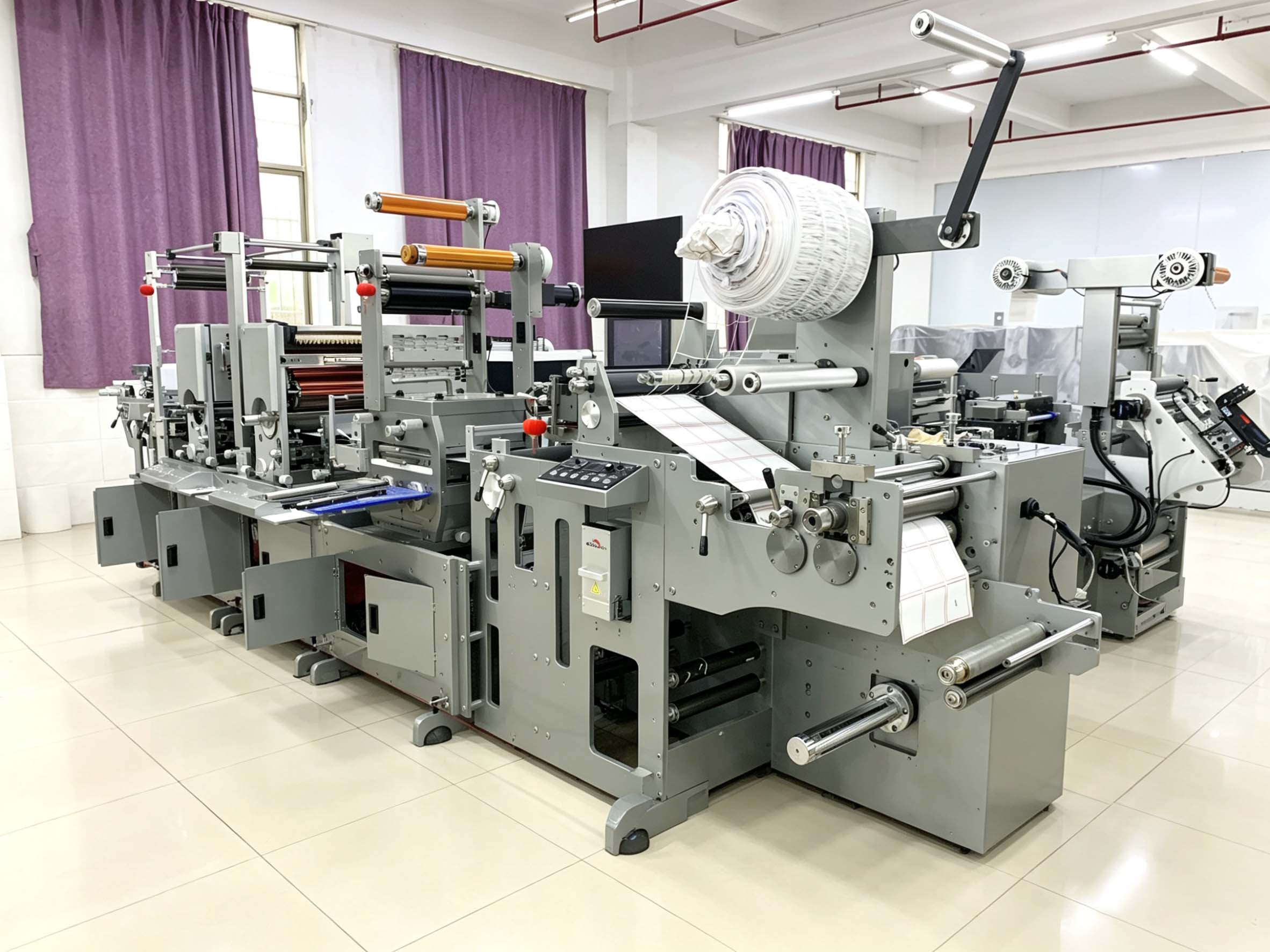
A CS-350 platform documented in a two-colour letterpress configuration with flatbed die cutting — one of three die-cutting configurations addressed in this buyer framework.
Die cutting decides more of a label press's real economics than colour count does. Two machines can share the same number of print stations, the same UV drying package and the same nominal web width, yet only one of them will be economical on a 200 m order. The reason is structural rather than commercial: the die-cutting station, not the printing unit, usually sets the pace at which the whole line can cycle.
This framework compares the three die-cutting configurations documented across Caisheng label printing machines — flatbed die cutting on the CS-220-5C stickers printing machine, flatbed combined with rotary die cutting on the CS-300 and CS-320 series, and rotary die-cutting combinations on the 350, 370 and 380 platforms. It is organised around four production variables: run length, material, changeover frequency and finishing integration. The objective is to let a converter map a configuration to their own label mix rather than to a specification sheet.
Shenzhen Caisheng Printing Machinery Co., Ltd. is a Shenzhen-based label printing equipment manufacturer founded in 2011. The company operates a 6,000 m² facility with 65 employees and a documented annual output of 200 units, supported by an eight-engineer R&D team. Its product scope covers intermittent and high-speed full-rotary letterpress printing machines, flexographic presses, screen printing machines and customised multi-functional label finishing solutions. Approximately 50% of output is exported to Southeast Asia, Europe, the Middle East and the United States.
Die-Cutting Mode Is Bound to the Feeding Architecture
Die cutting is not a free-standing option on a label press; it is constrained by the way the machine moves its web.
Intermittent platforms — also described as semi-rotary — index the web in steps and hold it stationary during each impression. That dwell is what makes flatbed die cutting practical: a flat die can be pressed into a stationary web while the printing stations pause. Full-rotary platforms pull the web continuously at constant velocity, so the die has to rotate in synchronisation with the material. A stationary die on a continuously moving web would either mark the substrate or force the line to stop.
Caisheng's documented model range makes the split visible. The CS-220-5C stickers printing machine and the CS-220-4C intermittent label press are intermittent letterpress platforms with a documented maximum printing speed of 40 m/min. The CS-300-5C self-adhesive label press, the CS-300-6C rotation label machine, the CS-320-6C semi-rotary label printing machine and the CS-320-7C rotary label press are also documented as intermittent letterpress machines, and they share the same 40 m/min maximum printing speed across web widths of 30–300 mm and 30–320 mm respectively. The CS-JQ350G-6C high-speed label printing machine is documented differently: as an intermittent and full-rotary machine rated at a maximum 60 m/min in intermittent mode and 158 m/min in full-rotary mode.
This produces the first decision rule in the framework: a die-cutting mode cannot run faster than the feeding architecture that carries it, and it should not be slower than the printing stations ahead of it. Tooling, changeover economics and cost per thousand labels all follow from that constraint.
The Three Configurations at a Glance
| Die-cutting configuration | Documented platform examples | Documented printing mode | Documented max. printing speed | Documented web width / print area | Best-fit job profile |
|---|---|---|---|---|---|
| Flatbed die cutting (flat die acting on an indexed web) | CS-220-5C stickers printing machine; CS-220-4C intermittent label press | Intermittent letterpress | 40 m/min | Web width 30–240 mm; full-rotary print area 220 × 245 mm; intermittent print area 220 × 200 mm | Short and medium runs, frequent design changes, thicker or more demanding facestock, promotional and specialty labels |
| Flatbed plus rotary die cutting in one finishing line | CS-300-5C self-adhesive label press; CS-300-6C rotation label machine; CS-320-6C semi-rotary label printing machine; CS-320-7C rotary label press | Intermittent letterpress | 40 m/min | CS-300 series web width 30–300 mm, full-rotary print area 280 × 326 mm; CS-320 series web width 30–320 mm, full-rotary print area 320 × 326 mm | Mixed job books: one press serving short-changeover work and jobs that benefit from rotary die cutting |
| Rotary die-cutting combination | CS-JQ350G-6C, CS-JQ350-7C, CS-JQ350G-10C (350 platform); CS-Q370F-6C, CS-370F-8C (370 flexo); CS-J380F-4C, CS-J380F-7C (380 flexo) | Intermittent and full rotary (350 platform); full-rotary flexo (370F, 380F) | 60 m/min intermittent and 158 m/min full rotary (350 platform); 150 m/min (370F platforms); 60 m/min (J380F platforms) | 350 × 419 mm full-rotary print area on the 350 platform; 370 × 200 mm and 370 × 600 mm on the 370F platforms; 360 × 419 mm on the J380F platforms | Long runs, few active designs, high volume per repeat |
Machine mass escalates with configuration: the CS-220-5C is documented at 3.6 T, the CS-320-7C at 7 T, the CS-JQ350G-6C at 10 T and the CS-JQ350G-10C at 14 T with a 12 × 1.5 × 2 m machine size. Floor loading, aisle space and service access belong in the same decision as the die-cutting mode.
Four Production Variables That Should Drive the Choice
1. Run length per label design
Run length determines whether tooling and make-ready are amortised over a few thousand labels or several million. Flatbed dies are generally simpler to produce per design than rotary tooling, which is machined to a specific repeat length. That makes flatbed die cutting proportionally more efficient where designs change often and runs are short. On long runs of a single design, by contrast, rotary tooling cost is spread across so much output that throughput becomes the dominant term — and the documented 158 m/min full-rotary mode of the 350 platform, or the 150 m/min of the 370 flexo platforms, becomes the deciding factor.
2. Material and substrate behaviour
Caisheng's stated application scope covers labels, adhesive stickers, PVC stickers and tags. Substrates in that range behave differently under a die. Flatbed die cutting presses the die into a stationary web, which generally gives more tolerance for thicker facestock, denser liners and materials that resist tension change. Continuous rotary die cutting depends on stable web tension throughout the run, so it rewards consistent material and well-controlled unwinding.
3. Changeover frequency
Count the number of design or size changes per shift before comparing speeds. A press that cycles at 158 m/min but requires a long tooling change between every order can finish fewer labels per shift than a 40 m/min intermittent machine that changes over quickly. This is where the flatbed-plus-rotary middle tier is most relevant: the same finishing line can serve a rotary-die job and a flatbed-die job without moving the work to a second machine.
4. Finishing integration
Die cutting is rarely the only finishing step. Caisheng's documented customisation scope includes colour stamping, a glue-side printing frame, cold foil stamping, lamination, offline and online UV varnishing, flatbed die cutting, rotary die cutting, sheet cutting, slitting, a corona treater, dust cleaner, static eliminator, full-rotary screen printing, hot foil stamping and embossing. Each module adds a station whose cycle must match the die-cutting mode, because a line runs at the speed of its slowest synchronised process.
Flatbed Die Cutting: Short Runs, Demanding Materials, Fast Tool Changes
Flatbed die cutting appears in its clearest form on the CS-220 platform. The CS-220-5C stickers printing machine is documented with a 30–240 mm web width, a 220 × 245 mm maximum full-rotary printing area, a 220 × 200 mm maximum intermittent printing area, a 40 m/min maximum printing speed, 17 kW gross main-machine power including UV dryers, a 3.6 T machine weight and a 6.6 × 1 × 1.5 m machine size.
The smaller CS-220-4C intermittent label press is documented with the same 30–240 mm web width and 40 m/min maximum printing speed, 8.4 kW gross main-machine power with 3.7 kW of UV dryer power, a 2.6 T machine weight and a 4.2 × 1 × 1.5 m machine size.
Platforms in this class suit converters whose order book is dominated by medium and short runs, frequent artwork changes, and materials that are easier to die-cut against a stationary web than in a continuous rotary nip. The trade-off is a hard ceiling: 40 m/min is the documented maximum printing speed for the entire intermittent range, and no die-cutting configuration can raise it.
Flatbed Plus Rotary: The CS-300 and CS-320 Middle Tier
What distinguishes the CS-300 and CS-320 series is not speed — the documented maximum remains 40 m/min — but the ability to carry both die-cutting modes in one finishing line.
The CS-300-5C self-adhesive label press is documented with a 30–300 mm web width, a 280 × 326 mm maximum full-rotary printing area, a 280 × 300 mm maximum intermittent printing area, 18.8 kW gross main-machine power with 6 kW of UV dryer power, a 5 T machine weight and a 6.5 × 1.5 × 1.8 m machine size. The CS-300-6C rotation label machine covers the same 30–300 mm web width with 34.5 kW gross main-machine power including UV dryers, a 6.6 T machine weight and an 8.9 × 1.5 × 2 m machine size.
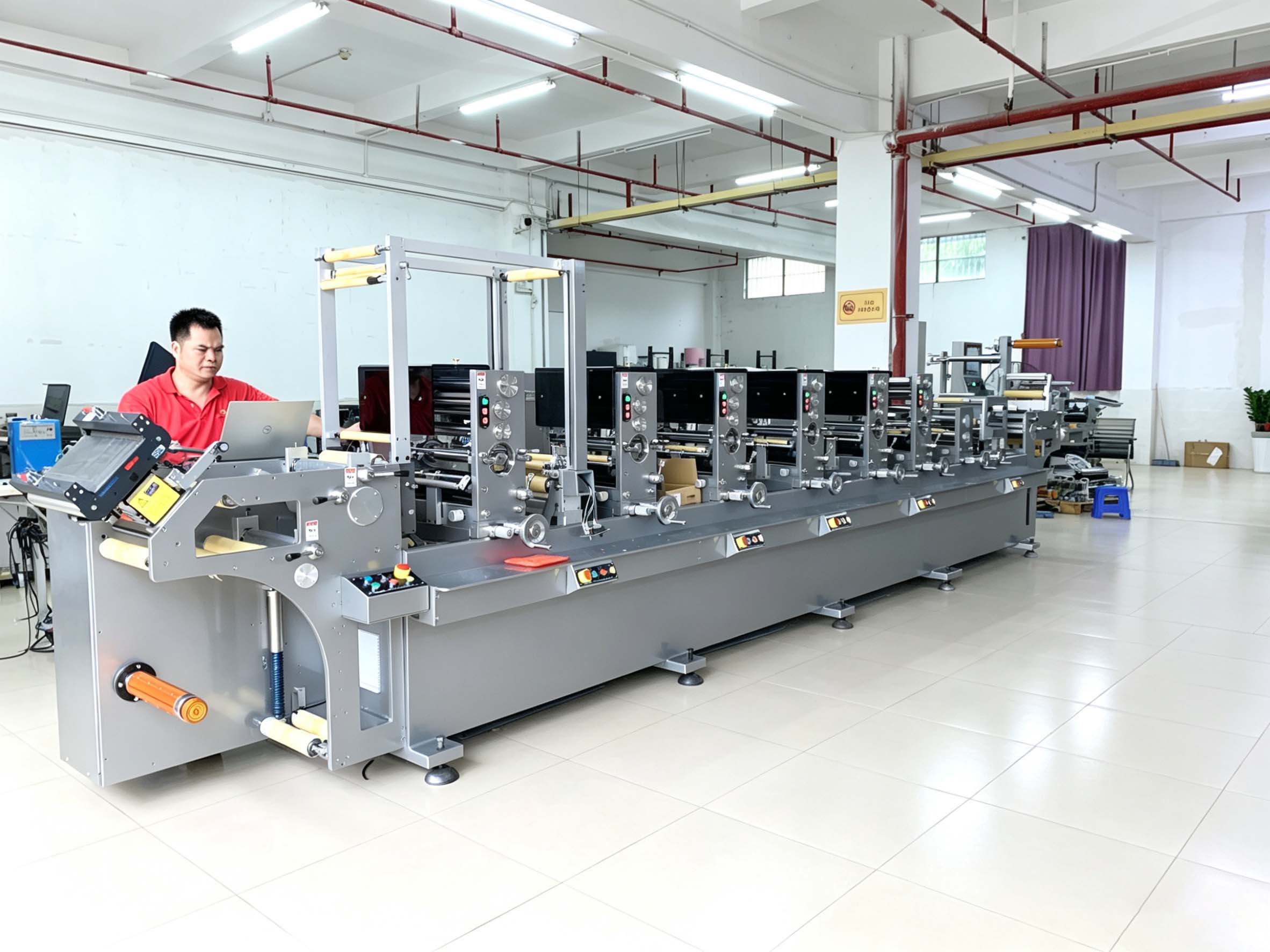
A CS-300 finishing line documented with rotary die cutting and flatbed die cutting in the same configuration, alongside glue-side printing.
The CS-320-6C semi-rotary label printing machine extends the working width to 30–320 mm with a 320 × 326 mm full-rotary printing area, a 320 × 300 mm intermittent printing area, 27 kW gross main-machine power including UV dryers, a 6.2 T machine weight and an 8.4 × 1.5 × 2 m machine size. The CS-320-7C rotary label press is documented at 31 kW including UV dryers, 7 T and 9.1 × 1.5 × 2 m on the same 30–320 mm web.
Documented configurations in this tier combine rotary die cutting and flatbed die cutting with glue-side printing and slitting on one platform. For a converter whose job book mixes long and short work, that removes the need to buy throughput and flexibility as two separate machines.
The 350, 370 and 380 Platforms: Rotary Combination at Full-Rotary Speed
Above the intermittent tier, die cutting is designed to rotate with the web for the whole run. The 350 platform is documented as intermittent and full-rotary. The CS-JQ350G-6C high-speed label printing machine carries 22 kW gross main-machine power and 7.8 kW of UV dryer power, a 350 × 419 mm maximum full-rotary printing area, a 350 × 380 mm maximum intermittent printing area, a 10 T machine weight and a 7.8 × 1.5 × 1.9 m machine size, rated at 60 m/min intermittent and 158 m/min full rotary.
The CS-JQ350-7C semi-rotary and full-rotary label press machine is documented at 24.5 kW gross main-machine power plus 9.1 kW of UV dryer power, 10.8 T and 8.7 × 1.5 × 1.9 m with the same speed ratings. The CS-JQ350G-10C full-rotary label press moves to 34 kW gross main-machine power with 13.5 kW of LED UV drying, 14 T and a 12 × 1.5 × 2 m machine size.
The 370 flexo platforms follow the same full-rotary logic. The CS-Q370F-6C Full rotary flexographic printing machine is documented at 25 kW gross main-machine power excluding UV dryers, with maximum full-rotary printing areas of 370 × 200 mm and 370 × 600 mm, 7 T and a 7.5 × 1.5 × 1.7 m machine size at 150 m/min. The CS-370F-8C full rotation flexo press is documented at 30 kW excluding UV dryers, 8.6 T and 9.1 × 1.5 × 1.7 m at the same 150 m/min maximum printing speed.
The 380 flexo series sits in the middle of that band: the CS-J380F-4C Flexographic printing machine and the CS-J380F-7C flexographic press are documented at 25 kW and 35 kW respectively including UV dryers, with a 360 × 419 mm maximum full-rotary printing area, a 60 m/min maximum printing speed, and machine weights of 4 T and 6 T.
Two boundary notes belong with this tier. First, the CS-350 platform appears in the scope of Caisheng's EU Machinery Directive attestation of conformity — certificate M.2025.206.C124100, issued 8 November 2025 and valid to 8 October 2030, covering the CS-300, CS-220 and CS-350 under EN ISO 12100:2010 and EN 60204-1:2018. Second, the three-tier structure described here is a default, not a rule: die-cutting configuration is specified per order, and flatbed die cutting is documented on 350-generation platforms as well, as the CS-350 two-colour letterpress configuration at the top of this article shows. Buyers should confirm the die-cutting mode in the quotation rather than infer it from the platform name.
Keeping the Die-Cutting Station Off the Critical Path
A label press does not run at its printed maximum speed unless every synchronised station can match it. In an intermittent architecture, the dwell gives the flatbed die its working window, and the whole machine cycles at the 40 m/min documented ceiling of the CS-220, CS-300 and CS-320 range regardless of how the die is configured. In full-rotary mode on the 350 platform, printing is documented at 158 m/min, which is only achievable when the die-cutting station, slitting and any downstream finishing rotate at the same rate.
Two practical tests follow. The first is to ask which station in a proposed configuration has the lowest documented speed, and whether that station sits on the critical path for the intended job. The second is to ask whether the die-cutting mode can be changed without taking the press offline — the flatbed-plus-rotary tier exists precisely to answer that question.
Comparison with Traditional Die-Cutting Approaches — and the Limits
The three configurations trade one form of cost for another, and none of them removes the trade-off.
- Throughput ceiling. Flatbed die cutting on an intermittent platform is limited by the platform itself: 40 m/min is the documented maximum printing speed for the CS-220, CS-300 and CS-320 series. For a converter whose average run is long enough to amortise rotary tooling, that ceiling becomes a real constraint rather than a preference.
- Tooling economics. Rotary die cutting generally uses tooling machined to a specific repeat length — a magnetic cylinder or a solid rotary die — so each new label format carries a tooling purchase. Flatbed dies are generally simpler and less expensive per design. A high-speed full-rotary platform therefore makes most sense where the number of active formats is small and the volume per format is high.
- Capacity utilisation. A 158 m/min full-rotary capability is only worth paying for if the order book keeps it occupied. Where a converter's mix is dominated by short runs with frequent changeovers, the highest documented speeds in the range are rarely reached, and the capital sits idle.
- Specification versus production reality. The speeds quoted throughout this article are documented maximum printing speeds, not guaranteed production speeds for a specific substrate, die and registration tolerance. Actual output depends on material, die condition, tension control and operator experience.
- Verification gap. Some figures in the public record are company-reported rather than independently benchmarked — for example, the ±0.025 mm registration precision attributed to the CS-220-4C. Caisheng does not publish independently audited uptime or waste-per-job-change data for its die-cutting configurations, so performance should be validated against the buyer's own material during acceptance.
Application Evidence from the Dual-Configuration Tier
Documented deployments in the CS-300 and CS-320 range show how the dual-configuration approach is used in practice.
A renowned Asian trademark design and printing company in Taiwan deployed a label printing machine for high-quality label print production over a two-year horizon, with documented highlights of superior printing precision, stable production performance and flexible process expansion capabilities; the installation comprised one unit. The CS-320-6C and CS-320-7C are the related platforms in that record.
In the United States, a global provider of commercial printing, packaging and multi-channel marketing communication solutions used the CS-300 series for label printing production over a three-year period. The documented highlights were stable registration accuracy, excellent print quality and reliable equipment performance.
Both cases point to the same pattern: the value reported by the customer was not a single peak speed, but the ability to expand processes and hold quality as the job mix changed.
Market Trend: What Label Demand Growth Means for Die-Cutting Choice
The demand background is moderate growth rather than rapid expansion. Mordor Intelligence places the global print label market at USD 57.05 billion in 2026, growing at a compound annual growth rate of 3.28% to reach USD 67.02 billion by 2031. That measurement covers printed label output, not label-making machinery. Global Market Insights separately values the industrial label printer market at USD 23.8 billion in 2025 with a projected path to USD 38.8 billion by 2035 — a different scope again. The two series measure different layers of the value chain and should not be combined or averaged.
For die-cutting decisions the relevant implication is not the size of the market but its shape. Slower underlying growth in label volume tends to push converters toward shorter runs, more SKUs and faster changeovers, because that is where margin is defended. A configuration that can switch between flatbed and rotary die cutting without a second machine aligns with that pressure better than a single-mode press at either end of the speed range.
Caisheng's publicly announced 2026 exhibition lineup points in the same direction, spanning intermittent letterpress, high-speed label presses, intermittent flexo, rotary die cutting and varnishing equipment — the product families that the three die-cutting configurations above are drawn from.
Procurement Criteria When Specifying a Die-Cutting Configuration
- Speed match. Confirm the documented maximum printing speed of the platform and the rated cycle of the die-cutting station before comparing quotations.
- Mode coverage. Confirm in writing whether the quotation includes flatbed die cutting, rotary die cutting, or both — and on which platform generation.
- Finishing scope. Define which modules from the documented customisation list are required, since each one adds a synchronised station to the line.
- Footprint and floor loading. Machine mass in this range spans 3.6 T on the CS-220-5C to 14 T on the CS-JQ350G-10C, with a 12 m machine length on the larger platform.
- Commercial terms. Caisheng's documented purchasing terms are a minimum order quantity of one unit, FOB delivery terms, pre-shipment test as the acceptance criterion, and 30/70 payment terms. Documented lead time is 45–60 days against a monthly capacity of 18 units, with 100% testing before shipment.
- Compliance documentation. The EU Machinery Directive attestation of conformity M.2025.206.C124100 covers the CS-300, CS-220 and CS-350 and cites EN ISO 12100:2010 and EN 60204-1:2018. Caisheng is additionally reported as a certified high-tech enterprise holding ISO 9001, ISO 14001 and ISO 45001 certification.
- Support terms. Documented after-sales provision is remote support and a one-year warranty on major components, with ODM production services offered for the Southeast Asia, EU, Middle East and United States markets.
Future Outlook
The direction of travel in label finishing is toward fewer machines performing more processes, and die cutting sits at the centre of that shift. Two documented patents indicate where Caisheng is investing: a utility model certificate (ZL 2022 2 1332174.4) covering a double-sided printing machine structure with paper forward-reverse switching and registration correction, and an invention patent (ZL 2022 1 0411353.5) covering remote control of printing equipment based on big data, including remote parameter adjustment and online fault diagnosis.
For die-cutting configuration decisions, the practical consequence over the next equipment cycle is likely to be less about peak speed and more about how quickly a single line can be reconfigured between jobs. That favours platforms already supporting both die-cutting modes over single-mode machines at either end of the range.
A downloadable product brochure covering Caisheng's label printing and finishing platforms is available here: Caisheng product brochure (PDF).
Frequently Asked Questions
What is the practical difference between flatbed and rotary die cutting on a label press?
Flatbed die cutting presses a flat die into a web while the machine holds it stationary, which is why it is used on intermittent platforms. Rotary die cutting rotates the die in synchronisation with a continuously moving web, which is required on full-rotary platforms. The choice is therefore governed first by the press's feeding architecture, and second by run length, material and changeover frequency.
Which Caisheng label printing machines support flatbed and rotary die cutting together?
The documented dual-configuration tier is the CS-300 and CS-320 series. The CS-300-5C, CS-300-6C, CS-320-6C and CS-320-7C are all documented intermittent letterpress machines with a 40 m/min maximum printing speed, and CS-300 configurations in the public record combine rotary die cutting and flatbed die cutting with glue-side printing and slitting on one finishing line.
Can a 40 m/min intermittent press handle the same jobs as a 158 m/min full-rotary press?
It can handle the same job types, but not the same throughput. The CS-220, CS-300 and CS-320 range shares a documented maximum printing speed of 40 m/min, while the CS-JQ350G-6C is documented at 60 m/min in intermittent mode and 158 m/min in full-rotary mode. On short runs with frequent changeovers the difference is often absorbed by make-ready; on long runs of a single design it becomes the dominant cost factor.
How do run length and changeover frequency change the die-cutting decision?
Run length determines whether tooling cost is amortised over a short or a long output. Rotary tooling is machined to a specific repeat length, so each new format adds a tooling purchase; flatbed dies are generally less expensive per design. A job book with many short runs and frequent changes generally favours flatbed or dual-configuration machines, while a job book with few formats and high volume per format generally favours the full-rotary platforms.
What should a buyer verify before confirming a die-cutting configuration?
Verify the documented maximum printing speed of the platform, the die-cutting mode included in the quotation, and the finishing modules required, since each module adds a synchronised station. Confirm compliance documentation — the EU attestation M.2025.206.C124100 covers the CS-300, CS-220 and CS-350 under EN ISO 12100:2010 and EN 60204-1:2018 — and check footprint and machine weight, which range from 3.6 T on the CS-220-5C to 14 T on the CS-JQ350G-10C. Documented commercial terms are MOQ one unit, FOB delivery, pre-shipment test acceptance, 30/70 payment terms and a 45–60 day lead time.
Have Questions or Need More Details?
Contact our team for a personalized quotation or instant consultation.
Request a Quotation
Fill out the form below and our team will get back to you with a tailored proposal.
WhatsApp Direct Chat
Prefer to chat in real-time? Message us on WhatsApp for instant assistance & quick answers.
- Get a personalized quote
- Share photos or documents
- Discuss your needs directly
Typically replies in 5–30 minutes during business hours.