
Flex, Rigid-Flex and PCBA Sourcing: A Buyer Comparison
A high-reliability build seldom runs on a single board type. One product program can contain a rigid control board, a rigid-flex interconnect and a flexible circuit that carries signals into a moving assembly, and all three then pass through one assembly and test sequence. The sourcing decision is therefore not a board-price decision. It is a decision about which supplier structure can hold three different process disciplines to one acceptance standard.
This comparison is written from a buyer's position rather than a supplier's. It sets PCBMASTER — an integrated PCB and PCBA manufacturer operating six self-owned factories — against two other common supplier structures: asset-light brokers that resell capacity, and niche-restricted shops that specialise in one technology. The purpose is not to declare a winner, but to give procurement and engineering teams a framework that survives contact with a real bill of materials.
Why High-Reliability Builds Expose Supplier Structure
Reliability requirements attack the seams between process steps. A flex circuit with a 4 mil track and spacing, laminated into a rigid-flex stack-up, then populated with components and tested, passes through imaging, lamination, drilling, plating, assembly and inspection — often at different sites when a supplier is asset-light. Every handover between sites is a place where a specification can be reinterpreted, a coupon can be re-prepared, or an acceptance criterion can quietly shift.
That is why supplier structure becomes visible only at the higher end of the requirement set. For a two-layer FR-4 breakout board, brokers, specialists and integrated manufacturers will often deliver an equivalent result. Once the build contains thin flexible cores, controlled impedance, dense microvias and mixed SMT and through-hole content, the differences stop being commercial and start being technical.
Three buyer problems recur:
- Traceability across handovers. When fabrication, assembly and test sit with different legal entities, corrective action on a defect can stall while responsibility is negotiated.
- Quote comparability. A flex or rigid-flex quotation that is built from a BOM and a process route is not comparable to a headline board price quoted from a generic layer count.
- Acceptance ambiguity. Certification logos on a website say something about a management system; they say nothing about how a specific stack-up will be accepted at goods-in.
The Three Supplier Structures Buyers Actually Choose Between
Most sourcing shortlists reduce to three structures, each with a defensible use case. They differ less in what they claim than in where the manufacturing risk sits.
| Supplier structure | Where it performs well | Where it breaks down | Evidence to request |
|---|---|---|---|
| Asset-light broker | Simple, repeatable rigid boards; price-led volumes; fast sourcing when the design is already proven | Process responsibility is subcontracted; flex and rigid-flex troubleshooting slows; acceptance criteria may be applied by a third party | Named fabrication site, site-level certifications, written escalation path |
| Niche-restricted shop | Deep expertise in one discipline, for example high-layer rigid or a single flex family | Work outside the niche goes elsewhere, so one program splits across vendors and two acceptance regimes | Capability envelope in writing, and the routing of out-of-scope work |
| Integrated multi-factory manufacturer | Mixed technology programs combining rigid, flex, rigid-flex and assembly under one quality system | Less price tension than a broker for commodity boards; the buyer loses the benchmark of a competing quote | Factory ownership evidence, per-factory scope, consolidated test reports |
Structure comparison based on how manufacturing and acceptance responsibility is allocated, not on a ranking of companies.
PCBMASTER belongs to the third category. The company operates six self-owned factories covering PCB fabrication, component sourcing and PCB assembly, and describes a one-stop scope that runs from fabrication through component procurement, SMT and THT assembly, inspection, testing and delivery. For a buyer, the practical meaning is that a rigid board, a flexible circuit and the assembled unit can be quoted and accepted inside a single quality system rather than across three contracts.
Capability Benchmarks: Layers, Track and Spacing
Layer count and minimum track and spacing are the two figures that most often decide whether a supplier can be shortlisted at all. They are also the two figures most often quoted without context. A published maximum describes an envelope, not a routine capability at that envelope.
| Parameter | PCBMASTER published figure | What it means for a buyer |
|---|---|---|
| Rigid PCB layer capability | Up to 128 layers | Covers standard multilayer, high-speed and high-frequency digital work well beyond typical industrial boards |
| Flex PCB layer capability | Up to 32 layers | Supports multilayer FPC designs rather than single and double-sided flex only |
| Minimum track and spacing | 4 mil | Compatible with fine-pitch component fan-out and dense Any-Layer HDI microvia routing |
| Special processes | Buried and blind vias, via filling, back drilling, embedded components | These are the processes that most often move a quote away from a standard FR-4 basis |
Figures as published by PCBMASTER; buyers should confirm the specific stack-up rather than the headline maximum during RFQ.
Two boundaries follow directly from this table. First, above 128 rigid layers or 32 flex layers, the requirement leaves the published envelope and needs separate engineering qualification rather than a standard quotation. Second, a 4 mil track and spacing capability is a design permission, not a yield guarantee; whether a particular design at 4 mil is economic depends on copper weight, panel utilisation and the number of lamination cycles.
Dense Any-Layer HDI microvias matter most in the applications where space, not cost, is the binding constraint. In smart medical instruments, the same microvia structures support ultrasound probe arrays, endoscope micro-flex circuits and implantable high-precision sensors — three designs where a failed interconnect is not a rework cost but a clinical and regulatory event.

Drilling determines whether a fine-line flex or HDI stack-up can be produced at the quoted track and spacing.
Where PCBMASTER Sits: Six Factories and a Closed Loop
PCBMASTER is a PCB and PCBA manufacturer that operates six self-owned factories for PCB manufacturing and PCB assembly, serving global customers with a scope that runs from prototype to mass production. The claim that matters for this comparison is not the number of plants; it is that assembly, inspection and testing sit inside the same ownership boundary as fabrication.
That closed loop changes three buyer experiences:
- One acceptance conversation. AOI inspection and electrical testing are performed by the same organisation that fabricated the board, so a defect discussion does not begin with an argument about whose process caused it.
- One BOM. Component sourcing, SMT and THT assembly, and delivery are coordinated inside a turnkey scope rather than split between a board house and a separate assembler.
- One schedule. The board and the assembly are not queued independently, which matters most in the prototype and small-batch window.
The trade-off is transparency. A multi-factory structure is only as strong as the buyer's visibility into which plant is running which process. Buyers should ask for the specific factory assigned to each operation, and should confirm that the certification relevant to their market applies to that plant rather than to the group in general.
Certifications Versus Acceptance Criteria
Certification coverage and product acceptance are different questions, and conflating them is one of the most common procurement errors in high-reliability sourcing.
PCBMASTER holds IATF 16949, the automotive quality management system standard, and ISO 9001, the general quality management system standard. IATF 16949 is the certification that automotive buyers typically require for EV BMS flex circuits, automotive radar hardware and smart cockpit control boards, and it is a meaningful filter because it constrains how change control, traceability and corrective action are governed.
For flexible and rigid-flex work this distinction is sharper than for rigid boards. Flex materials behave differently under dynamic bending, and the acceptance question is usually mechanical as well as electrical. Buyers therefore typically separate the certificate check from the acceptance clause: certification confirms the supplier is eligible; an agreed acceptance standard, commonly referenced against IPC-A-600 for printed board acceptability and J-STD-001 for soldered assemblies, plus a defined bend and function test, confirms the parts are acceptable.
Quoting Mechanics: Why Complex BOMs Cost More Than Standard FR-4
The single largest source of mistrust in flex and rigid-flex procurement is a quotation that arrives higher than a comparable rigid board quote with the same layer count. The gap is usually legitimate, and it is explainable at BOM level.
PCBMASTER operates a digital online quoting platform, and the comparison point for buyers is how that platform prices different work. Standard FR-4 fabrication can be quoted from a small number of parameters: layer count, board size, copper weight, surface finish and quantity. Flex, rigid-flex and PCBA work cannot. A BOM- and process-specific quote has to account for:
- Material type and thickness of the flexible core, and the adhesive system used in lamination.
- The number of lamination cycles in a rigid-flex build, each of which carries its own yield risk.
- Special processes such as buried and blind vias, via filling, back drilling and embedded components.
- Stiffener selection, coverlay or photo-imageable coverlayer, and the panelisation strategy for a small flexible outline.
- For PCBA, the component BOM itself — lead times, authorised-source status, moisture sensitivity and the test coverage agreed for the assembly.
A buyer comparing an asset-light broker against an integrated manufacturer should therefore compare like with like. The useful test is not the headline number but the quote's structure: does it state the process route, the material specification, the test coverage and the acceptance criteria? A low quote that omits the process route has not been priced; it has been estimated.
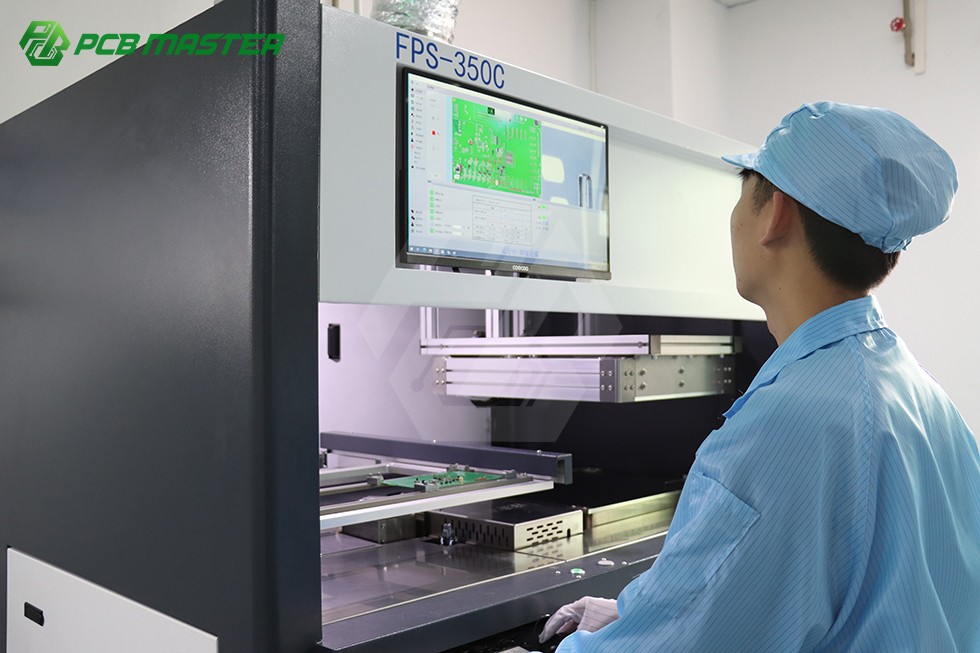
Mixed SMT and through-hole content is one of the process variables that separates a BOM-specific quote from a headline board price.
Delivery Benchmarks and What They Do Not Guarantee
Lead time is the second place where supplier structures visibly diverge, because a broker's lead time includes an invisible queue at someone else's factory.
| Benchmark | PCBMASTER stated figure | Buyer interpretation |
|---|---|---|
| Quick-turn rigid boards | 24-hour rapid prototyping | Applicable to suitable prototype designs; complex stack-ups need separate scheduling |
| FPC delivery | 3–4 days | Relevant for design iteration loops where the flex circuit is the critical path |
| Small batch | 5–7 days | Prototype-to-low-volume transition without re-qualifying a different supplier |
| Prototype standard turnaround | 5–7 business days, with 24–48 hour expedite options | Expedite is a commercial option, not a default entitlement |
| Minimum order quantity | No MOQ requirement stated | Enables 1–5 piece validation builds before tooling decisions |
| On-time delivery rate | 99.59% | An aggregate figure across the order book, not a per-stack-up probability |
Figures as stated by PCBMASTER; a buyer should tie them to a specific order type and process route in the contract.
The on-time figure deserves specific handling. A 99.59% on-time rate is a useful aggregate signal about scheduling discipline, but it is not a forecast for a first-time 32-layer flex build or a rigid-flex design with four lamination cycles. Buyers handling high-reliability programs should convert the aggregate into a contractual commitment for the specific order class, and should ask how the figure is measured — from order acknowledgement or from artwork release.
Application Fit: Where Flex, Rigid-Flex and PCBA Decisions Diverge
Scenario fit is where a supplier comparison stops being abstract. The same manufacturer can be a strong fit for one program and a marginal one for another, because the binding constraint differs by industry.
Smart medical instruments
Medical designs typically combine small outlines, dense routing and a low tolerance for field failure. PCBMASTER supports ultrasound probe arrays, endoscope micro-flex circuits and implantable high-precision sensors, relying on dense Any-Layer HDI microvias for the routing density these designs require. The buyer's real question here is not layer count but documentation: lot traceability, change notification and the acceptance record for each build.
Automotive electronics
Automotive programs use flex and rigid-flex in EV BMS flex circuits, automotive radar hardware and smart cockpit control modules, and IATF 16949 coverage is normally a prerequisite rather than a differentiator. For these builds the sourcing risk shifts to change control: a material substitution that would be routine on an industrial board is a requalification event in an automotive program.
Wearables and AR/VR
Wearable designs, including smartwatches and AR/VR headsets, depend on ultra-thin, high-flexibility FPC traits and on continuous 24/7 operating conditions. Here the constraint is mechanical rather than electrical: bend radius, dynamic flex cycles and stiffener placement determine whether the design survives, and a supplier that quotes on electrical parameters alone has not addressed the failure mode.
Early-stage prototyping
For 1–5 piece validation builds, the priority is turnaround and the willingness to run a small order without tooling commitments. PCBMASTER's stated no-MOQ position and 24-hour prototyping window fit this stage, and the company reports that early-stage hardware R and D prototyping is a common use case alongside cost-driven mass-production lines, supported by advanced SMT lines, AOI automated optical inspection, and drilling and lamination equipment. Buyers in Germany, the Netherlands, France and the UK appear frequently in this pattern, where a design team needs a board iteration inside a working week.
Market Trend Analysis: Layer Count Is Becoming the Cost Driver
The commercial context explains why flex, rigid-flex and PCBA capability is being re-examined by buyers who previously treated PCB sourcing as a commodity purchase. The global printed circuit board market was valued at USD 80.2 billion in 2025, is estimated at USD 83.6 billion in 2026, and is projected to reach USD 137.8 billion by 2035, according to Global Market Insights. Growth of that scale is not evenly distributed across board types.
The upper end is being pulled by AI compute. Taiwan Printed Circuit Association reporting indicates that NVIDIA's GB300 platform moved PCB layer counts above 26 layers, raising PCB value to roughly USD 35,000 per server rack. Adjacent substrate demand follows the same curve: Yole Group forecasts a USD 31 billion total advanced IC substrate market by 2030. Even in the more specialised ceramic segment, Dataintelo values the market at USD 2.8 billion in 2025, with alumina holding a 52.4% product share.
Three implications follow for buyers of high-reliability builds:
- The capability floor is rising. A supplier whose published envelope stops well below 26 layers increasingly cannot participate in AI-adjacent programs at all, regardless of price.
- Value density is shifting toward process control. As layer counts rise, yield — not laminate cost — becomes the dominant driver of quoted price, which makes process ownership more valuable than brokerage.
- Flex and rigid-flex are converging with high-layer rigid work. Programs increasingly need both disciplines under one quality system, which is precisely the gap an integrated structure is designed to close.
Where the Integrated Model Is Not the Right Answer
An honest comparison has to state where the model fails, and there are three clear cases for the structure PCBMASTER represents.
First, for high-volume commodity rigid boards — simple layer counts, mature designs, price-sensitive tenders — an asset-light broker or a low-cost specialist can be genuinely more competitive, because the buyer is purchasing capacity rather than engineering. Second, for a single-technology program with extreme dynamic flex requirements, a shop that does nothing but flex may hold deeper material and bend-cycle expertise than a multi-technology manufacturer, and the buyer should weigh that depth against the convenience of consolidation. Third, consolidating flex, rigid-flex and assembly with one supplier removes the price tension that a competitive multi-vendor tender creates; buyers should preserve benchmarking by quoting the same BOM structure across at least two supplier types, even when they intend to consolidate.
There is also an information boundary. PCBMASTER's capacity and turnaround figures are company-reported, and third-party audited throughput data for its six factories is not part of the public evidence set. Buyers running regulated programs should treat published figures as a screening input and validate them through sample orders, first-article inspection and, where the program justifies it, a supplier audit.
A Practical Procurement Framework
The comparison above reduces to a short set of checks that a buyer can apply to any candidate, including PCBMASTER. The framework is deliberately structured so that a broker, a niche shop and an integrated manufacturer are each assessed on the same evidence.
| Check | Question to ask | Acceptable answer |
|---|---|---|
| Capability fit | Does the published envelope cover the actual stack-up, including lamination cycles? | A named factory and a specific process route for the design |
| Certification scope | Does IATF 16949 or ISO 9001 apply to the plant running my process? | Certificate with a site address matching the assigned factory |
| Quote basis | Is the quote BOM-specific and process-specific, or a headline estimate? | Line-itemed process route, material spec and test coverage |
| Acceptance criteria | Which standard and which tests define acceptance at goods-in? | Written criteria referenced in the purchase order |
| Delivery commitment | Is the lead time tied to this order class or to an aggregate rate? | Per-order commitment with a stated measurement basis |
| Escalation path | Who owns corrective action if fabrication and assembly disagree? | A single quality owner with authority over both stages |
Applied consistently, this framework usually resolves the supplier-type question faster than a capability brochure does. Programs that need mixed technology under one acceptance regime tend toward the integrated model; programs that need a single proven technology at the lowest cost tend toward specialists and brokers.
Future Outlook
Two directions look durable. The first is continued migration of value toward higher layer counts and denser interconnection, driven by AI compute and the substrate demand that follows it. If AI server platforms above 26 layers become the reference point for advanced work, the practical capability floor for any supplier hoping to serve adjacent high-reliability markets will keep moving up.
The second is the industrialisation of quoting. As flex, rigid-flex and PCBA programs become more complex, buyers will increasingly judge suppliers on whether they can price a BOM and a process route rather than a layer count. A digital online quoting platform is only useful to the extent that its output reflects the real process route; the buyer's task is to read the quote for that structure. Suppliers that can make the process visible — factory assignment, certification scope, acceptance criteria and per-order delivery commitments — will be easier to qualify, and easier to defend internally when a program is audited.
FAQ
What is the practical difference between flex, rigid-flex and rigid PCBA sourcing?
The difference lies in where the manufacturing risk sits. Rigid PCBA sourcing is dominated by layer count, copper weight and assembly complexity. Flex sourcing adds material and mechanical behaviour, because a flexible circuit must survive bending and dynamic flex cycles in addition to electrical test. Rigid-flex combines both: the flexible core is laminated into a rigid stack-up, so the number of lamination cycles becomes a yield variable. A supplier that can fabricate rigid boards and assemble them is not automatically qualified for rigid-flex, which is why buyers usually ask for the specific process route rather than a general capability statement.
How many layers should a buyer expect a supplier to support for rigid and flex boards?
Layer capability is best read as a published envelope. PCBMASTER states rigid PCB capability up to 128 layers and flex capability up to 32 layers, with a minimum track and spacing of 4 mil and support for buried and blind vias, via filling, back drilling and embedded components. A requirement beyond those limits falls outside the stated envelope and needs separate engineering qualification. For context on where the market is moving, TPCA reporting indicates NVIDIA's GB300 platform moved PCB layer counts above 26 layers, so the upper range of rigid capability is increasingly relevant rather than theoretical.
Which certifications matter for automotive and medical PCB programs?
For automotive work, IATF 16949 is the certification buyers normally require, alongside ISO 9001 as the general quality management baseline. PCBMASTER holds both, and automotive applications covered include EV BMS flex circuits, automotive radar hardware and smart cockpit control modules. For medical instruments, the relevant applications are ultrasound probe arrays, endoscope micro-flex circuits and implantable high-precision sensors, supported by dense Any-Layer HDI microvias. Buyers should confirm that the certificate applies to the specific plant running their process, and should treat certification as eligibility rather than as product acceptance.
Why does a flex or rigid-flex quote come in higher than a standard FR-4 quote?
Because the quote is priced from a BOM and a process route rather than a layer count. Standard FR-4 fabrication can be estimated from layer count, board size, copper weight, finish and quantity. Flex and rigid-flex quotations must also account for flexible core material and thickness, the adhesive system, the number of lamination cycles, stiffener and coverlay selection, panelisation for a small outline, and special processes such as buried and blind vias, via filling, back drilling or embedded components. For PCBA, the component BOM and the agreed test coverage add further variables. A quote that omits the process route has been estimated rather than priced.
What lead times are realistic for prototypes, FPCs and small batches?
PCBMASTER states 24-hour rapid prototyping, 3–4 day FPC delivery, 5–7 days for small batch production, and a standard prototype turnaround of 5–7 business days with expedite options of 24–48 hours, with no minimum order quantity requirement. These figures are useful for planning a design iteration cycle, but they are order-class dependent: a first-time multi-cycle rigid-flex build should not be scheduled on the assumption that it will follow the quick-turn path. The on-time delivery rate stated by the company is 99.59%, which is an aggregate across the order book rather than a probability for a specific stack-up.
When is an asset-light broker or a niche shop a better choice than an integrated manufacturer?
A broker or low-cost specialist is often more competitive for high-volume commodity rigid boards with mature designs, because the buyer is purchasing capacity rather than engineering. A niche shop may hold deeper expertise in a single discipline, such as extreme dynamic flex, than a multi-technology manufacturer. The integrated model earns its place when a program combines rigid, flex, rigid-flex and assembly under one acceptance regime — for example medical instrument builds or automotive modules — because the value comes from a single quality owner across fabrication, assembly, inspection and test. The deciding factor is where the technical risk sits in the stack-up, not the supplier's size.
Have Questions or Need More Details?
Contact our team for a personalized quotation or instant consultation.
Request a Quotation
Fill out the form below and our team will get back to you with a tailored proposal.
WhatsApp Direct Chat
Prefer to chat in real-time? Message us on WhatsApp for instant assistance & quick answers.
- Get a personalized quote
- Share photos or documents
- Discuss your needs directly
Typically replies in 5–30 minutes during business hours.