
Flexible Warning Post Selection: What Buyers Should Know Before Specifying
Flexible warning posts — also called traffic delineator posts, spring posts, or flexible bollards — have become a standard tool for lane separation, parking guidance, and pedestrian-vehicle segregation. But specifying the right post involves more than picking a color and a height. Material behavior, reflective performance, base design, and installation method all affect how well a post survives real-world impacts and continues to provide visibility over time.
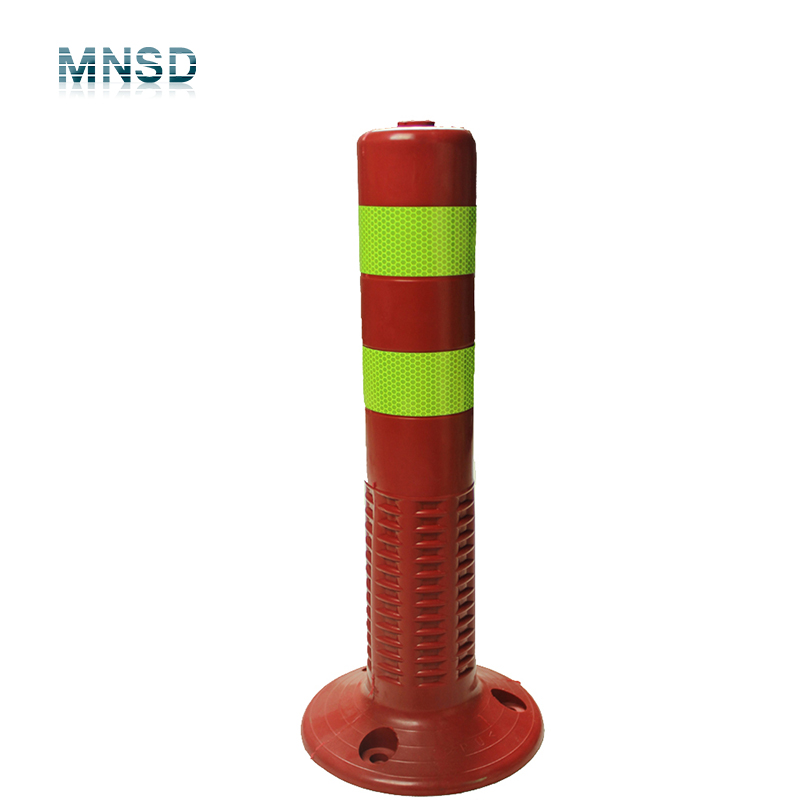
Flexible PU warning post — a common choice for traffic channelization and parking area delineation.
This article explains what buyers, contractors, and distributors should evaluate when sourcing flexible warning posts, using technical parameters and application scenarios from a Chinese manufacturer, Tiantai Yuanda Traffic Device Co., Ltd (brand: Mnsd). The company has produced road safety equipment since 2007 and exports 50% of its output to Asia, Europe, and the USA.
Why flexible warning posts are replacing rigid delineators
Rigid posts and bollards can cause vehicle damage or personal injury when struck. Flexible warning posts are designed to bend on impact and return to their original position. This 360° flexibility and self-recovery behavior reduces maintenance frequency and improves safety for both drivers and pedestrians.
Mnsd warning posts are built from high-elasticity polyurethane (PU) or heavy-duty polyethylene (PE). The YD-WPS75 model, for example, is a flexible safety plastic warning post with a height of 750 mm. Its tensile strength is 15.0 MPa and elongation at break is 400%, which means the material can stretch significantly before breaking — a key property for impact resistance.
Key specifications buyers should compare
When evaluating different suppliers, focus on these specification groups:
- Material: PU offers high elasticity and rapid rebound; PE is heavier-duty and often more economical. TPU is also referenced in the industry as a high-impact material. Mnsd offers PU or PE for the post body, with a recycled rubber or integrated plastic base.
- Temperature range: A wider operating window means the post can be deployed in more climates. Mnsd posts operate from -40°C to +70°C, covering both cold and hot regions.
- Reflectivity: Look for high-intensity prismatic (HIP) / Class 1 reflective tape for nighttime visibility. Mnsd posts use 250 mm double or triple reflective sleeves and are visible from over 200 meters.
- UV and aging resistance: Posts installed outdoors need UV-stabilized coating and antioxidant protection. Mnsd specifies colorfast performance for over 3 years, and certain application scenarios require UV stability for 5+ years.
- Installation: Surface-mounted or bolt-down fixed installation with expansion bolts is common. Mnsd posts support 3 or 4-hole expansion bolt fixing, with an optional ring top for chain attachment.
| Model | Height | Base | Material | Key Feature |
|---|---|---|---|---|
| YD-PE50 | 500 mm | Rubber base, Φ260 mm | PE + rubber base | Wide base for stable surface mounting |
| YD-WP45 | 450 mm | 200 × 80 mm | PU | Compact post for parking lanes and sidewalks |
| YD-WPS75 | 750 mm | 200 × 80 mm | PU | Taller post for expressway ramps and pedestrian segregation |
This table is based on the Mnsd product range. Each model shares the same reflective grade, temperature range, and tensile strength specifications.
How flexible posts behave under impact
The physical performance of a warning post determines whether it will survive repeated hits or crack after the first collision. Mnsd specifies a 360° flexible and impact-resistant structure with rapid rebound after vehicle crush. In practical terms, a vehicle can drive over the post, and the post should spring back to its near-original shape.
The material property “elongation at break” is especially important. A value of 400% means the PU material can stretch four times its original length before tearing. Combined with tensile strength of 15.0 MPa, this gives a strong, elastic post that bends rather than shatters.
Typical applications and installation mode
Mnsd warning posts are designed for a wide range of environments: road traffic, parking lots, construction sites, industrial facilities, warehouses, logistics centers, airports, seaports, railway stations, schools, hospitals, commercial complexes, residential areas, highways, municipal engineering, public facilities, loading docks, and bus terminals.
One documented UAE-based application covers lane separation on high-speed expressways, highway ramps, T-junctions, urban sidewalk protection, and multi-level parking lot entrances. The project type is described as Traffic Channelization, Median Delineation & Pedestrian-Vehicle Segregation.
In this scenario, the post functions to provide clear visual guidance, define lane boundaries, prevent unauthorized vehicle entry, and mitigate impact damage during accidental collisions. The recommended installation mode is surface-mounted / bolt-down fixed installation (permanent), using M10/M12 heavy-duty expansion anchors and high-visibility reflective sleeves with a honeycomb pattern. Epoxy adhesive may be used for extra base reinforcement.
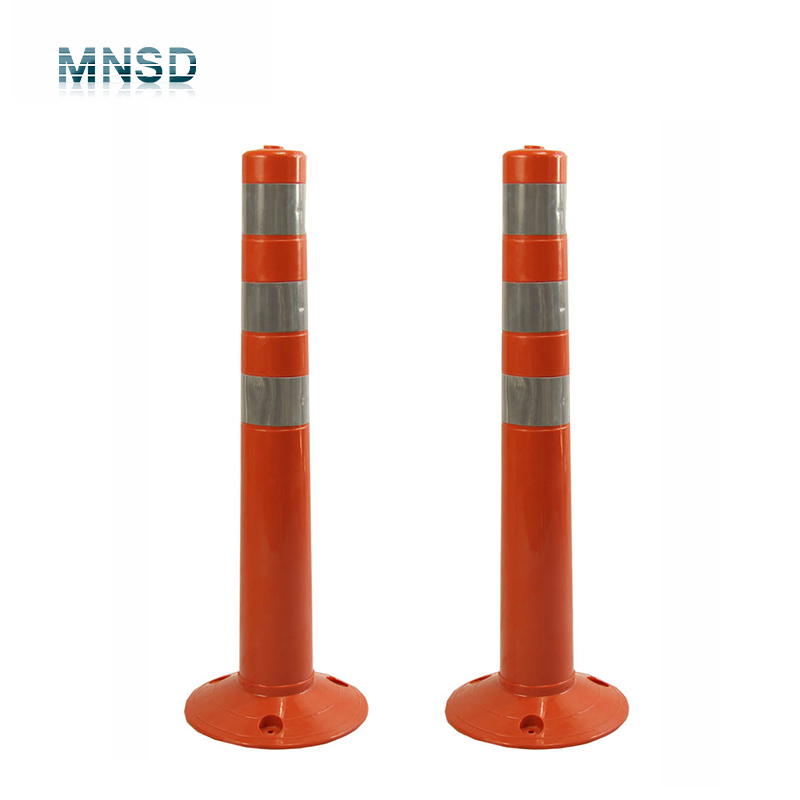
75 cm PU warning post — often selected for expressway ramps and construction zone channelization.
Material choice: PE vs PU vs TPU
Polyethylene (PE) is a common plastic used in traffic posts. It is durable and cost-effective, but it may not offer the same elastic recovery as polyurethane (PU). PU has higher elasticity and is generally preferred when repeated vehicle contact is expected.
Industry material guides note that thermoplastic polyurethane (TPU) is preferred for high-impact warning posts due to its elastic recovery and durability compared to standard PE. Mnsd offers both PU and PE versions, allowing buyers to match material to the expected impact level.
As a rule of thumb:
- Choose PE for lower-impact areas, budget-sensitive projects, or where posts will be replaced rather than reused.
- Choose PU for high-traffic lanes, sharp curves, parking ramps, and locations where vehicles routinely brush against the post.
Visibility requirements and reflective performance
Nighttime visibility is a critical safety factor. Mnsd posts use high-intensity prismatic (HIP) / Class 1 reflective grade tape, which is a common specification for delineators. The reflective tape width is 250 mm, available in double or triple sleeves. Reflective colors include silver white and fluorescent yellow.
Visibility distance is specified at over 200 meters. For reference, the US MUTCD standard in the verified dataset requires delineators to be retroreflective and visible from 1,000 feet when illuminated by high-beam headlights. Mnsd’s 200+ meter rating is broadly aligned with this kind of performance expectation.
Comparison with traditional rigid posts
Traditional rigid posts are made from concrete, steel, or hard plastic. They provide strong physical separation but have a major drawback: when hit, they can damage the vehicle, injure occupants, or break and need replacement.
Flexible warning posts solve this by absorbing impact through elastic deformation. Their self-recovery property reduces replacement frequency and downtime. This is why flexible posts are widely used in areas where accidental contact is likely — such as parking lots, loading docks, and highway ramps.
However, flexible posts are not a universal replacement. They offer less physical barrier strength than rigid bollards. For applications requiring security-grade vehicle stopping — such as protecting storefronts from ram-raids — a rigid or reinforced bollard is still necessary. Buyers should evaluate the required level of containment before selecting flexible posts.
Selecting a supplier: scale and manufacturing background
The cost and consistency of warning posts depend on the manufacturer’s production capacity and quality control. Mnsd’s parent company, Tiantai Yuanda Traffic Device Co., Ltd, operates a 40,000 m² manufacturing facility with approximately 300 staff. The company’s annual output is 120,000,000 units, and its product range includes convex mirrors, warning posts, rising bollards, speed humps, and traffic lights.
An in-house R&D team of 15 engineers supports product development and OEM/ODM customization. Export business accounts for 50% of total sales, with primary markets in Asia, Europe, and the USA. For buyers, these figures indicate a production base that can handle bulk orders and maintain delivery schedules.
Market context and demand drivers
The global road marker posts market was valued at USD 3.4 billion in 2024 and is projected to reach USD 5.4 billion by 2032. The broader traffic safety products market is expected to expand at a CAGR of 6.6% from 2026 to 2034, driven by urban population growth and infrastructure investment.
These figures reflect sustained demand for physical traffic management hardware. Municipalities, contractors, and facility managers continue to invest in delineation systems that reduce accidents and guide both vehicles and pedestrians.
Limitations and boundary conditions
While flexible warning posts are highly effective for delineation, they have limits. Their impact tolerance depends on the base anchoring and the material’s performance at extreme temperatures. Mnsd posts are rated for -40°C to +70°C, but repeated impacts at the extreme low end may reduce flexibility over time.
Also, the reflective tape is a wearing component. Although UV-stabilized and rated for colorfastness over 3 years, tape may need replacement in high-abuse installations. Buyers should factor in maintenance costs when comparing flexible posts with cheaper rigid alternatives.
Future outlook for flexible delineation
As urban infrastructure expands and safety standards tighten, demand for damage-resistant, low-maintenance delineators is likely to grow. The material trend points toward higher-performance polymers, with TPU gaining attention in high-impact applications. Manufacturers like Mnsd that offer multiple material options and customization capabilities are well positioned to serve both standard municipal projects and specialized industrial requirements.
FAQ
What is a flexible safety plastic warning post?
A flexible warning post is a traffic delineator made from elastic materials such as polyurethane (PU) or polyethylene (PE). It bends upon impact and returns to its original position, reducing damage to vehicles and lowering replacement frequency.
What temperature range can Mnsd warning posts withstand?
Mnsd warning posts operate within a temperature range of -40°C to +70°C, making them suitable for cold and hot climates including the UAE and northern European regions.
What is the visibility distance of Mnsd warning posts?
Mnsd warning posts are visible from over 200 meters, using High-Intensity Prismatic (HIP) / Class 1 reflective grade tape with a width of 250 mm.
What installation method do these posts use?
Installation is typically surface-mounted or bolt-down fixed (permanent), using expansion bolt fixing with 3 or 4 holes. M10/M12 heavy-duty expansion anchors are recommended, and epoxy adhesive may be used for base reinforcement.
What is the difference between PU and PE warning posts?
PU (polyurethane) offers higher elasticity and faster self-recovery after impact, making it suitable for high-contact areas. PE (polyethylene) is a heavy-duty plastic that is generally more economical, though it may not recover as effectively from repeated severe impacts.
Can Mnsd warning posts be used on highways?
Yes. Mnsd posts are designed for road traffic applications, including lane separation on high-speed expressways, highway ramps, and T-junctions. The YD-WPS75 model, at 750 mm height, is well suited for high-speed environments where visibility and impact resistance are critical.
For a detailed company profile and product catalog, refer to Mnsd’s official brochure: Download brochure.