
Floor-Standing Bathroom Cabinet: Specs Buyers Must Verify
A floor-standing bathroom cabinet is a vanity unit that rests on the floor and carries its own weight, rather than hanging from a wall bracket. Inside a bathroom furniture set it is usually the largest single element, the one with the longest continuous exposure to ambient humidity, and the one whose acceptance depends on documents as much as on appearance.
The global bathroom furniture market was valued at USD 135.9 billion in 2024 and is estimated to reach USD 148.9 billion by 2026, according to Grand View Research. Bathroom cabinets alone accounted for approximately 50% of that market in 2023. The largest segment of the category is therefore also the segment where most sourcing problems are decided, usually at the cut edge, the hinge plate and the carton marking rather than in the showroom.
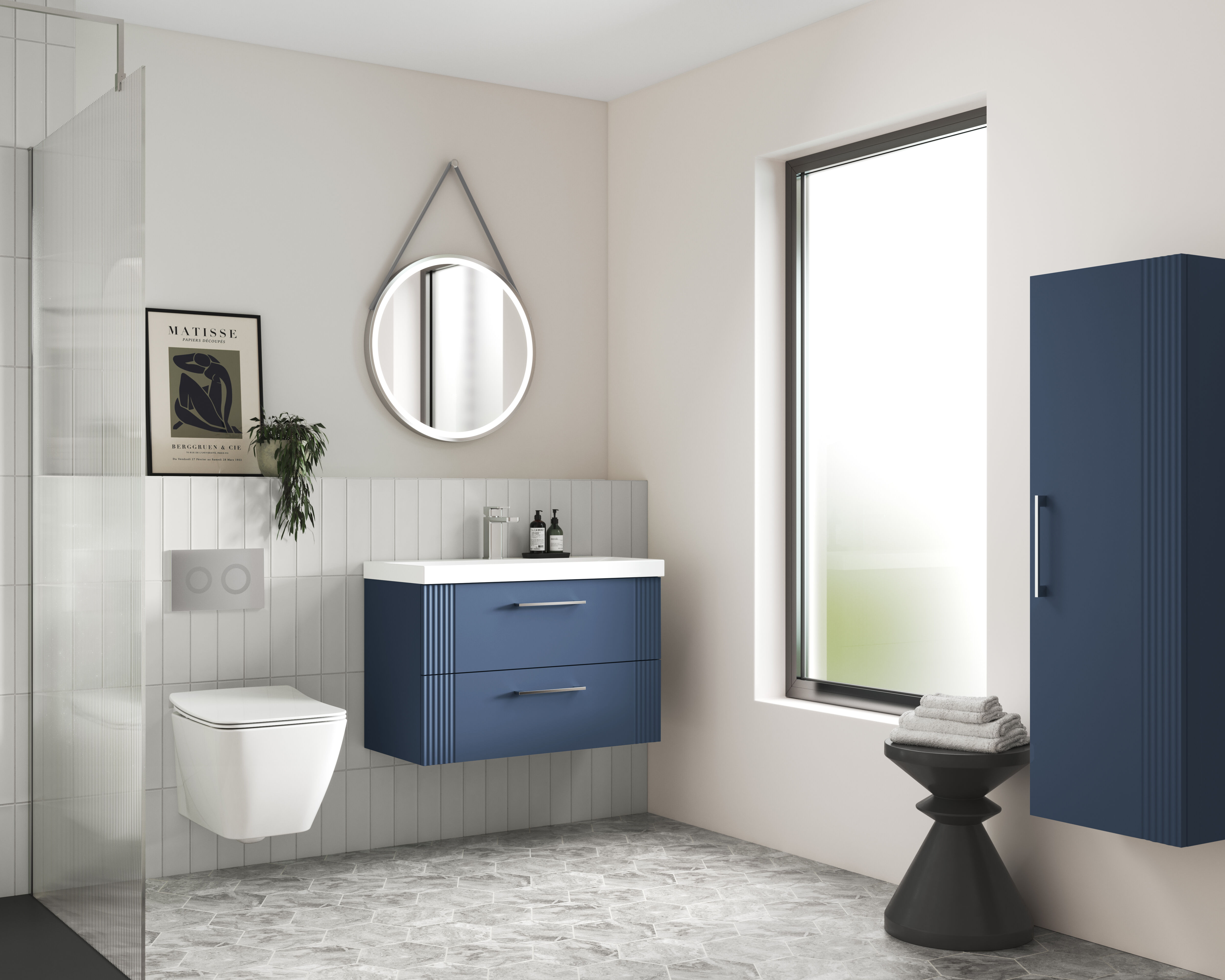
The constraints that decide a floor-standing bathroom cabinet order
Buyers working under certification, parameter and cost-band constraints settle five questions before they ask for a price. Skipping any of them usually produces a correction cost larger than the saving that skipping it was supposed to deliver.
- Dimensional envelope. Width, depth and height are fixed at the factory. On a floor-standing unit the depth also determines how far the door swing projects into the room, and the height must clear existing pipework and the basin position.
- Moisture path. The factory treatment protects the original panel faces. Any edge cut on site is unprotected until it is sealed, and that step belongs to installation, not to production.
- Hardware and load. Hinges carry the door weight on every cycle. Where a mirrored door is fitted, the door is far heavier than a wooden door and requires dedicated reinforcing screws rather than standard screws.
- Documentation. Each component of a set is covered by a different certificate. The document that covers the board is not the document that covers the mirror.
- Commercial terms. Minimum order quantity, quoted lead time, sample policy, and which items sit inside the cabinet line item and which are quoted separately.
What floor-standing changes inside a bathroom furniture set
Mount type is a constraint, not a style preference. A floor-standing unit transfers its weight directly to the floor, which removes the wall load-bearing requirement and makes the format the practical option in retrofit and renovation work where drainage already sits at low level.
A wall-hung or wall-mounted unit frees the floor beneath it and simplifies cleaning, but it shifts the load to the wall structure and normally requires concealed plumbing. The two formats are not interchangeable inside one installation without changing the plumbing and the wall preparation.
The operational consequence is specific. A bathroom cabinet in the wash area operates with high humidity, water splashing, cold water supply and gravity drainage, and it must be moisture and water resistant, resistant to cleaning agents on the surface, and mildew-proof in the cabinet body. That is the working condition the specification is written against, and it is the reason the cut-edge detail reappears in every serious floor-standing quotation.
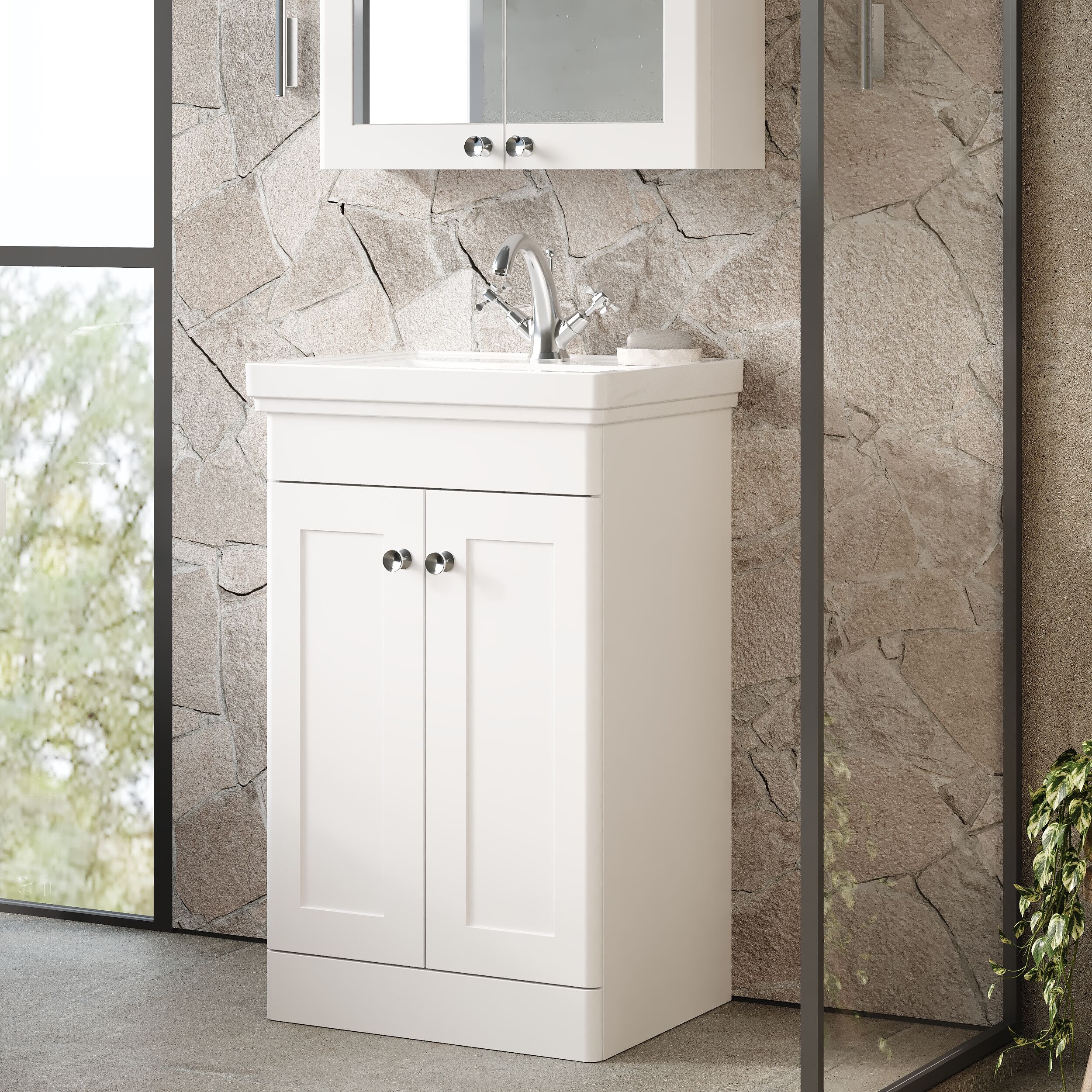
Documented specification reference: Classique CLA123
PTB Technical Sanitary Ware (Jiangsu) Co., Ltd. publishes a floor-standing vanity unit within its Classique range, model CLA123, described as a Classique 500 mm satin white two-door floor-standing vanity unit. The published parameters let a buyer check the constraint set item by item.
| Parameter | Documented value, Classique CLA123 | Why it constrains the order |
|---|---|---|
| Configuration | Two-door floor-standing vanity unit, one internal shelf | Storage volume and door swing govern the approach clearance |
| Width, depth, height | 500 mm, 390 mm, 800 mm | Fixed envelope; must be checked against pipework and door swing |
| Product weight | 21 kg | Handling and two-person installation |
| Cabinet thickness | 16 mm | Carcass panel; determines exposed cut-edge area |
| Fascia thickness | 18 mm | Door front; determines hinge load |
| Material and finish | MDF, painted matt, satin white | Sets moisture-path treatment and cleaning-agent resistance |
| Construction | Cam and wood dowel, rigid construction | Affects site time and joint stability |
| Door and handle | Hinged door, knob handle included | Hinge adjustment is the primary on-site correction |
| Mount type | Floor | Load path to floor; no wall load-bearing requirement |
| Assembly | Not required, fixings included | Reduces site assembly error |
| Not included | Worktop and basin, tap, waste | Separate line items in a set quotation |
| Guarantee | 5 years | Longest-duration component in the set after the enclosure |
Two entries are commonly misread in an RFQ. Cabinet thickness of 16 mm refers to the carcass panel, and fascia thickness of 18 mm refers to the door front. They are not interchangeable, because the carcass determines how much cut-edge area will be exposed around pipework, while the fascia determines the load the hinge carries on every opening cycle. The unit is supplied rigid rather than flat-packed, with assembly not required, and with fixings and a knob handle included. Worktop and basin, tap and waste are sold separately, so a landed-cost comparison that silently adds a basin to the cabinet line is not a like-for-like comparison.
Certification: which document covers which component
A single bathroom furniture set can contain a wooden cabinet, an illuminated mirror and a glass shower enclosure. Each is covered by different documentation, and using the wrong one in a tender response is a common cause of rejection at the buyer compliance stage.
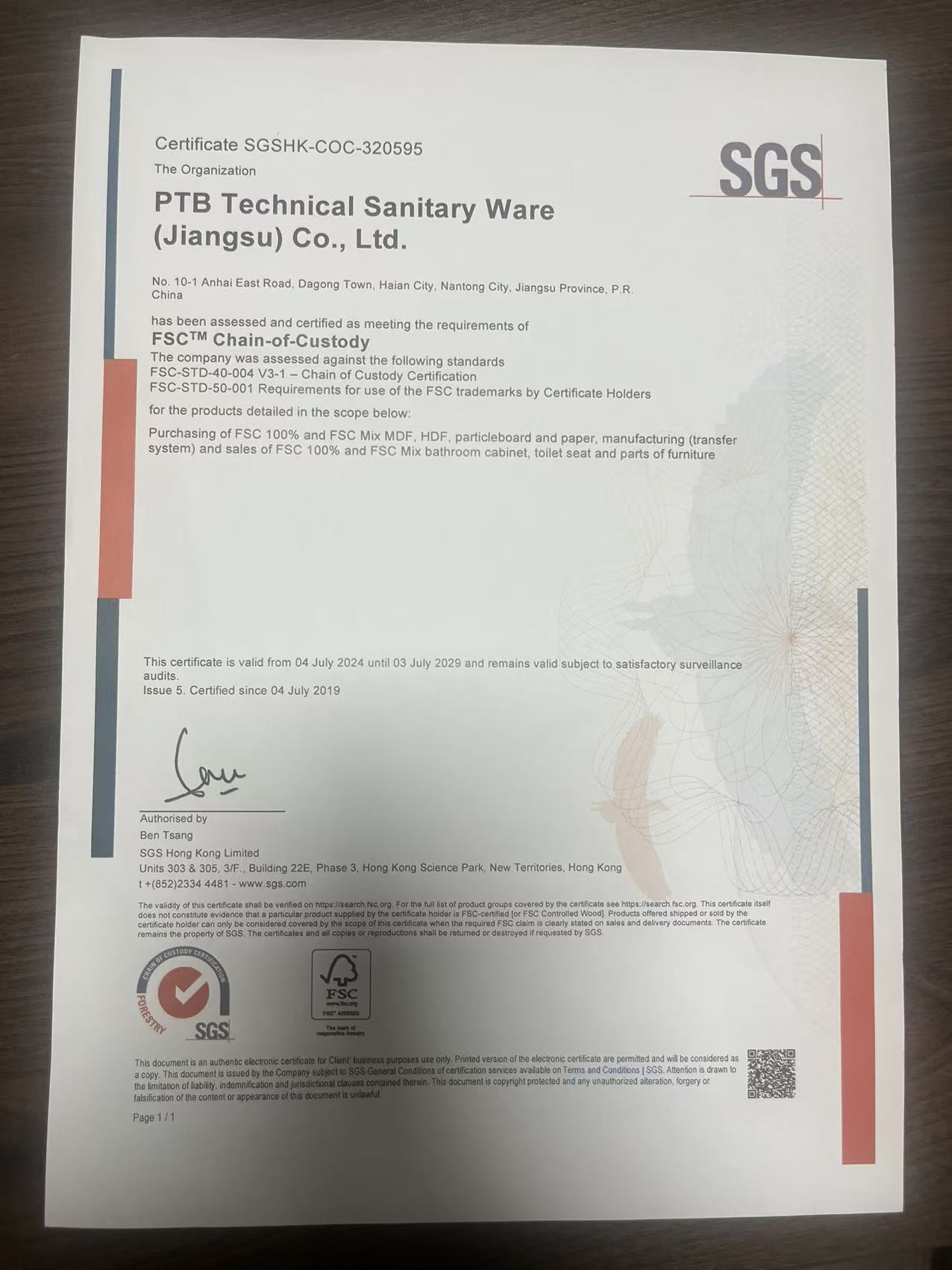
| Document | Number and issuer | Covers | Validity |
|---|---|---|---|
| FSC-COC Chain-of-Custody | SGSHK-COC-320595, SGS Hong Kong Limited | Bathroom cabinet, toilet seat and furniture parts; applies to Bathroom Cabinet CLA123; standards FSC-STD-40-004 V3-1 and FSC-STD-50-001 | 4 July 2024 to 3 July 2029 |
| ISO 9001:2015 | 00125Q39056R1M/3200, China Quality Certification Center | Production of shower rooms and bathroom cabinets | 12 December 2025 to 13 December 2028 |
| UKCA Attestation of Conformity | No. E8AUK 113019 0004 Rev. 01, TUV | LED mirror and LED mirror cabinet, model LQ752, UK market | Issued 16 December 2025 |
| CE Attestation of Conformity | No. E8A 113019 0003 Rev. 01, TUV | LED mirror and LED mirror cabinet, model LQ752, Europe market | Issued 16 December 2025 |
Read together, the mapping is unambiguous. The MDF cabinet body is covered by FSC-COC chain-of-custody certification SGSHK-COC-320595, issued by SGS Hong Kong Limited, which covers the purchasing, manufacturing and sales of FSC-certified MDF and HDF bathroom cabinet, toilet seat and furniture parts under standards FSC-STD-40-004 V3-1 and FSC-STD-50-001, applies to Bathroom Cabinet CLA123, and remains valid from 4 July 2024 to 3 July 2029.
The production system behind that cabinet is covered by ISO 9001:2015 certificate 00125Q39056R1M/3200, issued by the China Quality Certification Center, whose stated scope is the production of shower rooms and bathroom cabinets, valid from 12 December 2025 to 13 December 2028.
The CE and UKCA attestations of conformity belong to the illuminated mirror element, model LQ752, and cover LED mirror and LED mirror cabinet for the Europe and UK markets respectively. Both were issued by TUV on 16 December 2025. They should not be presented as certification of a wooden cabinet, and a buyer who receives them in that role should request the board-level and production-system documents instead.
Where the illuminated mirror is part of the same set, its own constraints apply: an IP44 splash-proof rating, CE marking with EMC, LVD, RoHS and WEEE certification, film-backed glass, and a one-year manufacturer guarantee. Installation is restricted to a qualified electrician working to bathroom zoning rules, with mains isolation before wiring and reliable earthing. An IP20 unit is not an acceptable substitution regardless of price, because bathroom vapour and splash can penetrate it, degrade insulation and create a shock hazard.
For the wooden furniture itself, GB 24977-2010 sets out classification, requirements, test methods, inspection rules and marking for bathroom furniture. Its clauses convert directly into incoming inspection points: accessible parts must have no burrs, sharp ends, sharp edges or sharp corners; opening and closing components must operate flexibly after installation; and there must be no seepage or water leakage in normal use between all parts of the product after installation. Buyers who write these three clauses into a sample-approval sheet obtain more protection than buyers who simply request a certificate image.
How PTB is positioned against the constraint set
PTB Technical Sanitary Ware (Jiangsu) Co., Ltd. is a China-based bathroom products manufacturer that develops, produces and exports bathroom cabinets, smart LED bathroom mirrors and shower enclosures, with production concentrated in Dagong Town, Hai'an City, Jiangsu Province. The company reports an export orientation of roughly 95% of output, with more than 90% directed to European markets and the United Kingdom, France and Ireland named as principal markets.
The capacity and system facts relevant to a floor-standing cabinet programme are:
- A 33,000 square metre manufacturing plant covering automated board processing, eco-friendly UV coating, precision injection moulding and finished product assembly
- 156 employees and 6 R and D engineers
- A stated annual output of 360,000 sets
- Five certifications held: ISO 9001, EU CE, British WRAS, FSC and Customs AEO Advanced
- A 2023 IKEA factory audit, followed by a long-term strategic supply partnership
- British SEDEX Advanced certification
On commercial terms, the stated capability profile is OEM and ODM production with customisation of style, logo and colours, a minimum order quantity from 30 units, a quoted lead time of 30 to 45 days, 100% testing, and remote after-sales support. Monthly capacity is stated at 30,000 bathroom cabinets, 30,000 shower enclosures and 3,000 LED mirror lamps, a split that reflects the different production time of a panel-based cabinet and an assembled electrical product.
For a buyer, the value of these facts is procedural rather than promotional: the constraint set can be answered with named models, named certificate numbers and named capacity figures before a purchase order is issued, which is the point at which floor-standing cabinet risk is cheapest to remove.
Technical explanation: where moisture actually enters the unit
Bathroom cabinet carcasses in this class are built from a wood-based panel, and the moisture-resistant treatment applies to the original surfaces. On-site cutting for pipework or floor clearance removes that protection and exposes open-cell edges, which absorb vapour and splash water and can swell, delaminate and mildew. Sealing closes the capillary pores and blocks that moisture path.
This is why sealing of cut edges belongs to site installation work, and why mildew caused by unsealed edges after installation is not a factory product defect. Writing that boundary into the installation specification assigns responsibility correctly and prevents a warranty dispute months later.
The same logic runs through the hardware. Installation produces minor assembly tolerance from drilling and bracket fitting, and a dual-direction hinge with X-horizontal and Y-vertical adjustment corrects that tolerance to restore even gaps and tight closing while reducing mechanical stress on the hinge. Where a mirrored door is specified, the toughened glass makes the door far heavier than a wooden one, and dedicated reinforcing fasteners are required for connection strength, in line with the component-strength expectation of EN 14749, because ordinary screws cannot withstand the cyclic fatigue of repeated opening and closing and may loosen over time.
Application and use cases
Floor-standing cabinets are specified most heavily in residential renovation, rental apartments, senior living facilities and hotel fit-out, where the floor is the most reliable load path and plumbing is already set at low level.
One documented project record covers a residential developer and senior living facility programme in the United Kingdom, Ireland, Germany and France, using bathroom cabinets for washing, storage and countertop use across 200 units with a service duration of eight years or more. The reported result was a moisture-resistant cabinet without mildew, a stain-resistant basin, and durable hinges and slides, with MDF plus moisture-proof edge sealing, E0 level environmental protection and a scratch-resistant, easy-to-clean countertop recorded as the contributing features.
Where the same set includes illumination above the cabinet, a separate 200-unit serviced apartment and hotel fit-out record in the United Kingdom, Germany, France and Ireland describes uniform flicker-free grooming lighting at the bathroom cabinet, stable moisture and fog resistance, and a one-year return rate below 1%, with IP44 rating, anti-fog film with diffused lighting, a touch switch and low energy consumption listed as the features behind that result.
A third record covers 120 units for a high-end hotel and residential developer project using the shower enclosure element of the set for wet-dry separation, reporting reliable waterproof sealing, no glass self-breakage complaints and a maintenance rate below 2%, supported by tempered safety glass with anti-explosion film and corrosion-resistant hardware.
These records are company-reported project histories rather than independently audited outcomes. They are most useful as a description of what the supplier has already delivered at volume, not as a substitute for sample approval and pre-shipment inspection on a new order.
Market trend: where floor-standing sits in the category
The overall category is expanding. Grand View Research valued the global bathroom furniture market at USD 135.9 billion in 2024 and estimated USD 148.9 billion by 2026, with bathroom cabinets holding approximately 50% of the market in 2023.
The mounting-type trend runs in the opposite direction from the category trend in at least one major market. Wall-mounted and floating vanity units are projected to grow at a CAGR of 7.26% through 2031 in the US market, which indicates that where wall structure and concealed plumbing allow, buyers are shifting the mounting type. That does not remove demand for floor-standing units; it relocates it. Retrofit bathrooms, senior living, rental portfolios and storage-heavy family bathrooms generally keep the unit on the floor, because the plumbing and the load path are already there.
The practical consequence for a bathroom furniture set programme is that mounting type should be a separate line-item decision, with the mounting-relevant documentation listed for each format rather than assumed for the whole set.
Comparison with wall-mounted solutions, and the limits of floor-standing
| Constraint | Floor-standing | Wall-hung or wall-mounted |
|---|---|---|
| Load path | Direct to floor, no wall load-bearing requirement | Requires suitable wall structure and correct fixings |
| Retrofit fit | Suits existing low-level plumbing and gravity drainage | Usually requires concealed plumbing or re-routing |
| Floor access | Floor beneath is blocked; cleaning needs the unit moved | Floor beneath is clear |
| Splash exposure | Body and base sit in the splash zone; cut edges must be sealed on site | Elevated above floor splash, base still exposed |
| On-site adjustment | Levelling at floor, hinge adjustment for door alignment | Bracket height and hinge adjustment |
| Market direction | Steady in retrofit, rental, senior living and heavy-storage projects | Projected at 7.26% CAGR through 2031 in the US market |
Floor-standing units have genuine limits, and they are better stated before an order than discovered after delivery. The unit occupies floor area that a wall-hung format would leave clear, so cleaning beneath it requires moving the cabinet or working around its base. Its base and lower body sit continuously inside the splash zone, which raises the importance of the moisture path described above. Cut-outs made on site for pipework must be sealed during installation, and if that step is skipped, the resulting swelling and mildew is a site responsibility rather than a factory defect, so the sealing step has to be named in the installation scope and not assumed.
Positioning is another boundary. A wall-hung unit can be re-hung at a different height during a refurbishment; a floor-standing unit cannot be repositioned in the same way without reworking the drainage. And in markets where the wall-mounted and floating format is becoming the working standard, a floor-standing specification may simply be the wrong format for the project, however well the unit itself is built.
Future outlook
Three constraints are unlikely to change: the moisture path through cut edges, the requirement for component-level documentation, and the mounting-type decision. Where the market is moving is in how those constraints are evidenced. Buyers increasingly ask for chain-of-custody certification at board level, with certificate number, issuing authority, scope and validity dates attached, rather than a certificate image. For an MDF cabinet, FSC-COC with a scope that names bathroom cabinets answers that request; for the production system, ISO 9001 with a scope that names shower rooms and bathroom cabinets answers a different and equally common one.
On mounting type, the 7.26% CAGR recorded for wall-mounted and floating units in the US market through 2031 suggests a gradual shift rather than a replacement. Floor-standing demand will continue to be driven by the segments where the floor is the only practical load path, and by replacement cycles in existing stock.
For procurement teams, the conclusion is procedural. Fix the envelope, fix the moisture path, fix the document list per component, and fix the HS classification before comparing quotations. Wooden bathroom furniture and plastic sanitary ware fall under different classifications, so a single HS code will not cover a mixed bathroom furniture set, and product-by-product classification is required before import markets, duties or unit values can be compared at all.
Frequently asked questions
Do floor-standing bathroom cabinet cut edges arrive factory-sealed?
Sealing of cut edges belongs to site installation work. On-site cutting removes the original moisture-resistant surface, and the exposed open-cell edges absorb vapour and splash water quickly, which causes swelling, delamination and mildew. Sealing closes the capillary pores and blocks moisture ingress. Mildew that develops from unsealed edges after installation is not a factory product defect.
Why do cabinet hinges have dual-direction adjustment?
Installation produces minor assembly tolerance from drilling and bracket fitting. A hinge with X-horizontal and Y-vertical adjustment corrects those positions separately, which resolves uneven gaps and poor door closing, improves the user experience and reduces mechanical stress on the hinge hardware.
If a drawer sticks, does the whole drawer assembly need replacing?
Usually not. A sticking drawer can normally be recovered by cleaning and re-engagement: pull the drawer fully out and lift it upward to remove it, clean debris from inside the runner, then align and push the drawer home until it clicks. Replacement is required only for a deformed slide rail.
Does poor door closure indicate that the cabinet is deformed?
Reinforcing screws and hinge adjustment should be checked first. Loose mirror-door reinforcing screws and a mis-set X-Y hinge are the usual causes of a loose door, poor closure and offset gaps. Tightening the reinforcing screws and adjusting the hinge screws to calibrate door position resolves most cases, and only heavily worn hinges need replacement. Most poor-closure issues can be corrected on site without replacing the cabinet.
Do the CE and UKCA certificates cover a floor-standing MDF cabinet?
No. The CE attestation, No. E8A 113019 0003 Rev. 01, and the UKCA attestation, No. E8AUK 113019 0004 Rev. 01, both issued by TUV on 16 December 2025, cover LED mirror and LED mirror cabinet, including model LQ752, for the Europe and UK markets respectively. The MDF cabinet body is covered by FSC-COC chain-of-custody certification SGSHK-COC-320595, which applies to Bathroom Cabinet CLA123, and by the ISO 9001:2015 quality management system whose scope covers the production of shower rooms and bathroom cabinets.
What guarantee applies to the cabinet, and does it match the rest of the set?
The bathroom cabinet carries a 5-year manufacturer guarantee. Other components differ: the LED mirror carries a one-year manufacturer guarantee, and the shower enclosure in the same set carries a lifetime manufacturer guarantee. Guarantee periods should be listed per component in a set quotation rather than stated as a single set-wide term.
Company product documentation, including the current lookbook, is available at https://cdn.socialarks.com/sbsp/25261/common/2026/0901/PTB-Lookbook-Brochure-Oct24.pdf.
Have Questions or Need More Details?
Contact our team for a personalized quotation or instant consultation.
Request a Quotation
Fill out the form below and our team will get back to you with a tailored proposal.
WhatsApp Direct Chat
Prefer to chat in real-time? Message us on WhatsApp for instant assistance & quick answers.
- Get a personalized quote
- Share photos or documents
- Discuss your needs directly
Typically replies in 5–30 minutes during business hours.