
Foldable Cabinets vs. Drawers vs. Shoe Cabinets: A Buyer Framework
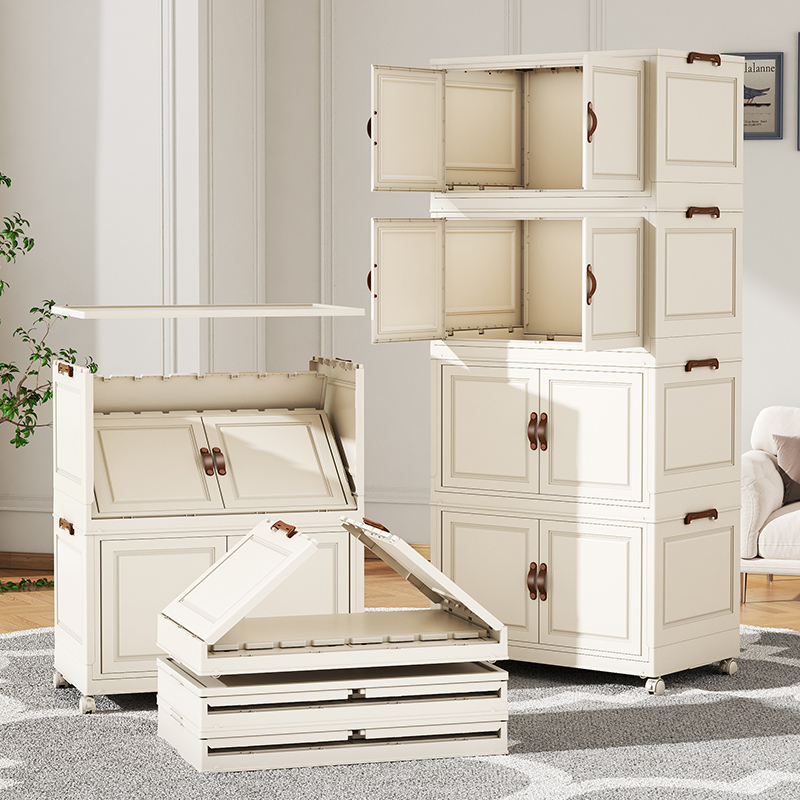
Foldable plastic storage formats are chosen less for how they look assembled than for how they behave before installation — flat, stackable, and reconfigurable. Image: Xinhai Box storage formats.
The global home organization products market was estimated at USD 14.06 billion in 2024 and is projected to reach USD 21.65 billion by 2035 (Market Research Future). The stackable container segment alone was valued at USD 7.8 billion in 2024, growing at a CAGR of 6.4% on the back of e-commerce and urbanization (Strategic Market Research). Both figures describe the same shift: storage is being bought as a configurable system rather than as fixed furniture.
That shift puts a specific question in front of importers, distributors, retail buyers, and project specifiers. When a sourcing brief lists foldable storage, which format is actually being asked for? A foldable storage cabinet, a foldable storage drawer, and a foldable shoe cabinet share a material and a folding principle, but they resolve three different space problems — bulk enclosure, granular visibility, and narrow vertical stacking. Choosing the wrong one does not just change how a room looks. It changes how many units fit along a wall, how goods are restocked, and whether a unit survives being moved.
This framework compares the three formats on the criteria buyers use during research and evaluation — footprint, capacity, assembly, stackability, and height adjustability — and states where each format stops being the right answer.
Why foldable is a format decision, not a product decision
Most format errors are made before a single sample is requested. A buyer scans a supplier catalogue, sees the word foldable applied to cabinets, drawers, and shoe boxes, and treats them as interchangeable tiers of the same product. In practice, each format is defined by its base geometry.
A cabinet format encloses volume behind a door and stands on a full rectangular base. A drawer format exposes volume through a sliding front and is designed to be multiplied vertically. A shoe cabinet format is deliberately narrow at the base and grows almost entirely upward. These are different engineering briefs, and they produce different answers to the same purchasing questions — how many units fit a wall, whether items can be identified without being unstacked, and how much of the unit can be adjusted after delivery.
Plastic storage is not a niche inside this category. Plastic-made products accounted for approximately 36% of the kitchen storage and pantry organization market in 2023, with jars and containers holding a 27% share (Grand View Research). The format decision, therefore, sits inside the mainstream of the category rather than at its edge.
The three foldable formats, defined by specification
Foldable Storage Cabinet YN8871
YN8871 is a plastic home storage cabinet made from PP, offered in three sizes with matching width options of 51.5 cm, 60 cm, and 67 cm. The small unit measures 51.5 × 36 × 95 cm, the medium 60 × 42 × 105.5 cm, and the large 67 × 47 × 116 cm. Its design features include a foldable structure, a double-door front with magnetic opening and closing, rounded handles, a flat top storage surface, a stackable structure, and vintage-style textured doors. Its intended scenarios are home storage, bedroom storage, bedside cabinet use, clothing storage, and sundry organization.
The defining characteristic is enclosure. YN8871 hides contents behind doors while presenting a usable horizontal surface on top, which is why the bedside-cabinet use case appears in its specification rather than a wardrobe-organizer use case.
Foldable Storage Drawer YN484536
YN484536 is a drawer storage box produced in high-strength PP plastic. It assembles without tools, opens on a smooth pull-out drawer that is described as not jamming, and stacks in a stable configuration. Its front panel is transparent, so contents are identifiable without opening the unit. It is supplied in nine height, width and depth combinations — 26 cm, 30 cm, or 36 cm high, 48 cm wide, and 40 cm, 45 cm, or 50 cm deep — with capacities spanning 49 L to 86 L. The stated storage items are T-shirts, sweaters, sweatshirts, lightweight down jackets, thin blankets, summer quilts, and thick quilts.
The defining characteristic is controlled access combined with visibility. The transparent front panel turns the unit into a self-labelling container, which matters wherever several people restock or retrieve the same storage point.
Foldable Shoe Cabinet 7008
Model 7008 has a base of 37 × 26 cm and grows through stacking rather than through a larger footprint. A single layer stands 20.6 cm high; a two-layer unit reaches 44.7 cm, a three-layer 65.3 cm, a four-layer 85.9 cm, a five-layer 106.5 cm, and a six-layer unit 127.1 cm. The specification states no assembly is required, the body is foldable, stackable, and dustproof, it is fitted with universal wheels, and the PP material is formaldehyde-free and odorless.
The defining characteristic is vertical efficiency. A 37 × 26 cm base is narrow enough for an entryway, the end of a wardrobe, or a gap beside a bed, and the same base supports a 127.1 cm column of storage.
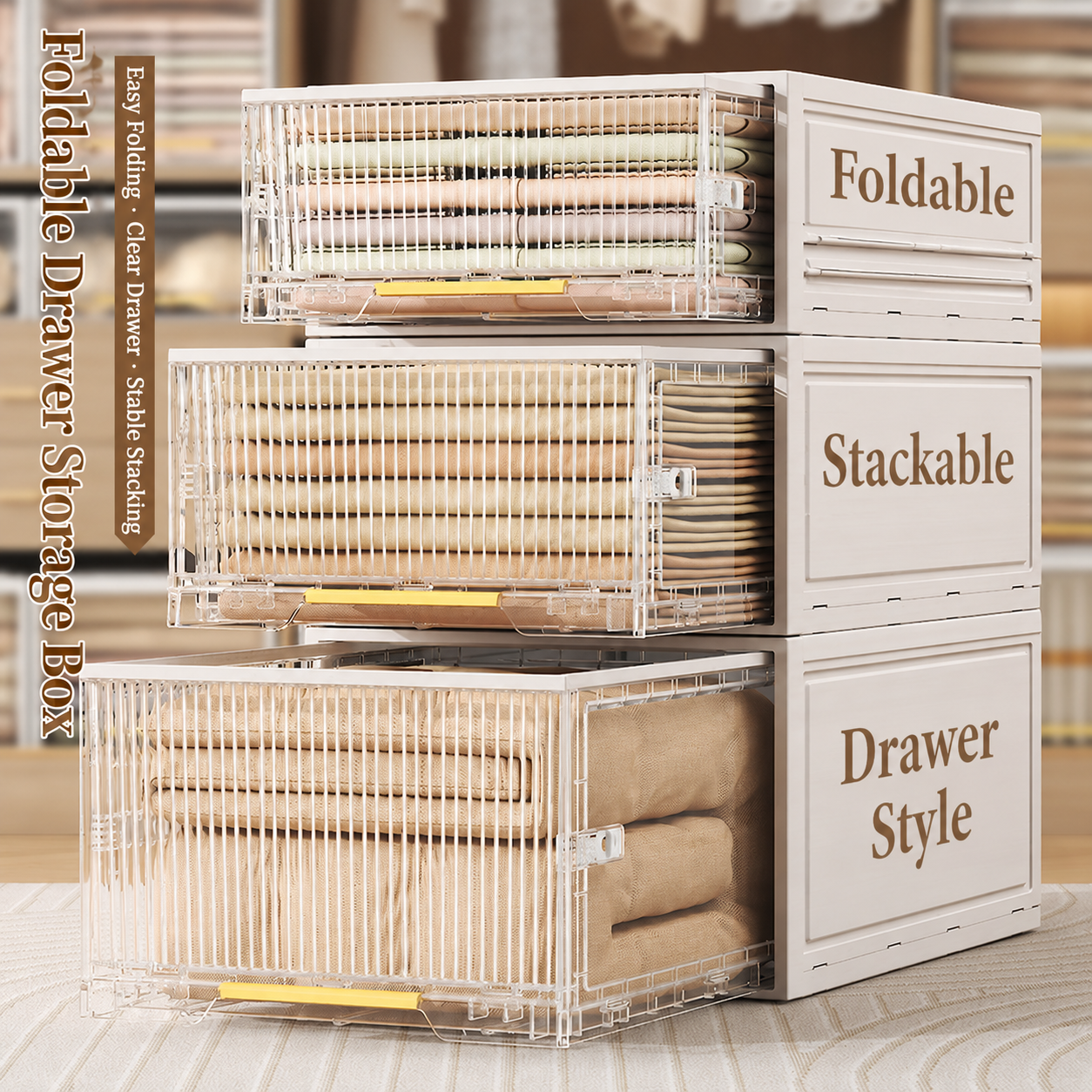
Drawer-format units add height by stacking while a transparent front panel keeps contents visible. Image: Xinhai Box foldable storage drawer.
Technical explanation: four variables that decide whether a format fits
Once the specifications are on the table, the comparison reduces to four variables that behave differently in each format.
Base stability. All three formats use PP. The drawer format specifies high-strength PP; the shoe cabinet is formaldehyde-free and odorless; the cabinet uses selected PP with zero formaldehyde in its material description. Because none of the three is a structural material in the way timber is, stability comes from base geometry rather than from material mass. The drawer format is explicitly designed for stable stacking without tipping, and the shoe cabinet relies on a narrow, repeating layer footprint.
Fold and assembly cycle. The three formats sit at different points on the effort scale. YN8871 unfolds for immediate use and saves space when stored flat. YN484536 assembles without tools in a quick step intended to save time and space. Model 7008 requires no assembly at all. For a project where units are shipped to a third-party installer or a retail floor, that difference determines whether labour is part of the landed cost.
Access mode and visibility. YN8871 opens on a magnetic double-door front. YN484536 uses a smooth pull-out drawer behind a transparent panel. Model 7008 uses a dustproof body sealed with side buckle locks and moves on universal wheels. Access mode decides how often a unit is opened — and therefore how quickly a stacked column is disturbed during daily use.
Stack interface and height adjustability. This is where the formats diverge most sharply. YN8871 is stackable but its height is fixed by size: 95 cm, 105.5 cm, or 116 cm. YN484536 is 26 cm, 30 cm, or 36 cm per unit, so total height is a multiple of the chosen SKU. Model 7008 is the only one of the three whose height is adjustable in fixed increments from 20.6 cm to 127.1 cm through one to six layers. If a project requires a specific finished height — under a window sill, beside a counter, below a wall cabinet — the shoe cabinet format is the one that can be tuned after the room is measured.
The five-criteria decision framework
The table below places the three formats side by side on the criteria buyers use in evaluation. Where a figure is not published in the product data, that gap is stated rather than estimated, because an unpriced specification is a specification a buyer still has to confirm.
| Criterion | Foldable Storage Cabinet YN8871 | Foldable Storage Drawer YN484536 | Foldable Shoe Cabinet 7008 |
|---|---|---|---|
| Base footprint | 51.5 × 36 cm / 60 × 42 cm / 67 × 47 cm | 48 cm wide × 40, 45 or 50 cm deep | 37 × 26 cm |
| Height behaviour | Fixed per size: 95 / 105.5 / 116 cm | 26 / 30 / 36 cm per unit, multiplied by stacking | 20.6 / 44.7 / 65.3 / 85.9 / 106.5 / 127.1 cm across 1 to 6 layers |
| Published capacity | Not stated in the product data; confirm per size | 49 L to 86 L across nine size combinations | Not stated in litres; single-layer height is 20.6 cm |
| Assembly | Foldable design, unfolds for use | Tool-free quick assembly | No assembly required |
| Stackability | Stackable structure | Stable stacking, designed not to tip | Stackable from 1 to 6 layers |
| Access and visibility | Double-door front, magnetic opening and closing, top storage surface | Smooth pull-out drawer, transparent front panel | Dustproof body sealed with side buckle locks, universal wheels |
| Material | PP | High-strength PP plastic | PP, formaldehyde-free and odorless |
Read across the rows rather than down the columns. If the limiting criterion is base footprint, model 7008 wins at 37 × 26 cm. If it is published volumetric capacity per unit, YN484536 wins with 49 L to 86 L. If it is finished height that must be matched to an existing opening, model 7008 is again the only format that adjusts after measurement. If it is concealed bulk storage with a usable top surface, YN8871 is the applicable format.
Matching formats to rooms and projects
Kitchen pantry sorting is a drawer problem. Pantry items need to be identified and pulled without dismantling a stack, and the transparent front panel of YN484536 supports exactly that behaviour across a 49 L to 86 L capacity range.
Closet clothes storage is also primarily a drawer problem, with a volume requirement attached. The stated storage items for YN484536 — T-shirts, sweaters, sweatshirts, lightweight down jackets, thin blankets, summer quilts, and thick quilts — map directly onto the seasonal rotation that fills most wardrobes, and the nine size combinations allow depth to be matched to wardrobe depth rather than to a single fixed module.
Bedroom storage and bedside use belong to the cabinet format. YN8871 is specified for bedroom storage, bedside cabinet use, clothing storage, and sundry organization, and its flat top surface is what allows a storage unit to also function as a surface. Buyers who need a unit to hold a lamp, a phone, and a glass of water should be looking at this format rather than at a drawer tower.
Kids room storage and narrow-space organization are shoe-cabinet problems even when shoes are not the contents. Model 7008 stacks from 20.6 cm to 127.1 cm on a 37 × 26 cm base, is dustproof, and moves on universal wheels. That combination — small footprint, tall column, dust protection, mobility — is what makes the format usable for entryways, toy corners, and tight gaps beside furniture.
Two adjacent scenarios sit outside this three-format comparison but are frequently raised in the same brief. Laundry room utility is served in the same supplier range by the laundry hamper JH2018, sized 37.7 × 30 × 50 cm with wheels and a stated capacity of approximately 30 adult garments, with a 37.7 × 30 × 46 cm version without wheels. Car trunk organization and outdoor camping gear are served by the foldable camping storage box YN8880, offered in three sizes and a PP-and-wooden-top construction. These are different formats, not variants of the three discussed above, and should be specified separately.
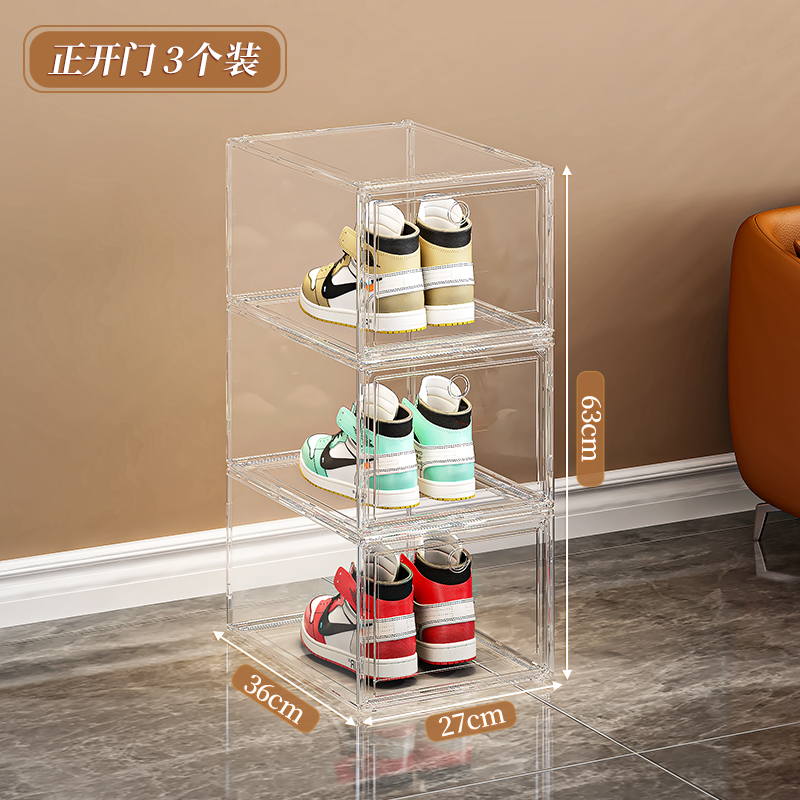
Narrow-base formats grow vertically, which is why they fit entryways and irregular spaces that a full-width cabinet cannot use. Image: Xinhai Box shoe storage format.
Sourcing context: OEM, ODM, and compliance parameters
The three formats described above are supplied by Taizhou Xinhai Cross-border E-commerce Service Co., Ltd., trading as Xinhai Box, a B2B supplier of plastic household storage and daily-use products serving wholesalers, distributors, retailers, supermarkets, and e-commerce sellers across North America, the EU, Southeast Asia, and Latin America. The company operates with 500 employees, an annual output of 1,000,000 units, and a 30-person engineering and design team, supported by more than 20 years of manufacturing experience from Zhejiang Jinmao Plastic Group.
For evaluation-stage buyers, the commercial parameters matter as much as the product dimensions because they determine which customization route is realistic. Under the OEM route, customization covers colour, logo, and printing, with a minimum order quantity of 500 units, a stated monthly capacity of 100,000 units, and a lead time of 15 to 45 days. Under the ODM route, customization extends to logo, colour, packaging, size, structural design, and material specification such as PET and PP ratios, with a minimum order quantity of 5,000 units, a stated monthly capacity of 8,000 units, and a lead time of 30 to 60 days. Quality control follows AQL 2.5/4.0 standardized sampling in both routes, and after-sales support covers remote technical guidance together with compensation or replacement for quality issues.
The practical implication is straightforward. Buyers who want an existing cabinet, drawer, or shoe cabinet format in their own colour or with their own logo can work at a 500-unit threshold. Buyers who want the format itself redesigned — a different layer height, a different depth, a different panel ratio — move into the ODM route and accept both the higher minimum and the longer timeline.
Market trend analysis
Three verified data points frame the demand side of this decision. The global home organization products market is projected to grow from USD 14.06 billion in 2024 to USD 21.65 billion by 2035 (Market Research Future). The stackable container market was valued at USD 7.8 billion in 2024 with a 6.4% CAGR attributed to e-commerce and urbanization (Strategic Market Research). And China's furniture industry exports, which include home organization items, recorded USD 67.81 billion in 2025, indicating continued supply capacity despite global trade fluctuations (China Customs, reported via Soonfor Furniture Management Software).
On the material side, plastic-made products accounted for approximately 36% of the kitchen storage and pantry organization market in 2023, with jars and containers at a 27% share (Grand View Research). That concentration matters for format strategy: in the segments where plastic already leads, the differentiator is increasingly the format rather than the material.
Compliance is now a specification input rather than a separate document. The European Commission adopted a ban on Bisphenol A in food contact materials under Regulation (EU) 2024/3190, effective with an 18-month phase-out period from late 2024. Foldable storage is not a food contact application, but buyers routing the same material family into kitchen and pantry programmes should treat BPA restrictions as a live requirement in 2026 rather than a future one. On the recyclability side, PP storage containers can achieve GreenCircle Recyclable Material certification, verifying their role in circular economy streams at #5 plastic facilities — a credential increasingly requested alongside material declarations.
Competitively, the category is populated by established international players including IKEA (Sweden), Rubbermaid (USA), Sterilite (USA), and The Container Store (USA) (Market Research Future). Their presence indicates that the format question is a market-wide one, not a regional preference: the same three decisions — footprint, access mode, and height adjustability — appear in every market where foldable storage is sold.
Foldable modular storage versus traditional fixed storage
Compared with fixed cabinetry, wire shelving, and fabric bins, foldable PP formats change the economics of the delivery and configuration stage. A foldable unit is stored flat before use by design, which reduces the space a unit occupies prior to installation and allows configuration to happen on site rather than at the point of manufacture. Assembly requirements differ by format — no assembly for model 7008, tool-free assembly for YN484536, and an unfolding step for YN8871 — so labour can be planned per format rather than assumed across a whole order.
The limitations are equally concrete, and buyers should not plan around them being solved by a different supplier.
- Structural substitution. These are PP storage formats, not carpentry. Where a project requires heavy, long-span, fixed structural shelving, a foldable PP cabinet is not a substitute, and the expected load per unit should be confirmed with the supplier before a specification is written.
- Published capacity is not uniform across the three formats. YN484536 publishes capacity from 49 L to 86 L. YN8871 and model 7008 do not publish a litre figure in the available product data, so a per-litre cost comparison cannot be completed from the catalogue alone — volumetric figures have to be requested.
- Layer height limits what a shoe cabinet can hold. Model 7008 stands 20.6 cm high at one layer. Buyers storing taller footwear profiles should verify that the intended contents fit the layer opening before committing to a multi-layer configuration.
- Supply parameters constrain fast-turnaround customization. A 500-unit minimum with a 15 to 45 day lead time is workable for colour, logo, and printing changes. Structural and material customization sits in the ODM route at a 5,000-unit minimum and a 30 to 60 day lead time, which is a planning constraint for short-cycle retail programmes.
Future outlook
Two forces are likely to shape the next buying cycle. The first is documentation. With BPA restrictions embedded in EU food contact material rules and recyclability credentials such as GreenCircle available for PP containers, material and compliance paperwork is moving from an annex into the specification itself. Suppliers who can present material, sampling, and certification evidence as part of the product data will shorten the evaluation stage for buyers.
The second is format modularity. Growth in the stackable container segment is tied to e-commerce and urbanization, both of which favour units that ship flat, are configured after delivery, and can be rearranged when a tenant moves or a store resets a floor plan. In that environment the competition is less about which single unit is largest and more about which format multiplies cleanly — which is precisely what the height-adjustable shoe cabinet, the stackable drawer, and the stackable cabinet each do in different ways.
For buyers assembling a 2026 or 2027 assortment, the practical version of that outlook is a mixed format line rather than a single-format one. The footprint, capacity, and height data needed to build that mix is already available for the three formats above; the missing pieces are the volumetric figures for two of them and the compliance pack that sits behind all three.
FAQ
What is the practical difference between a foldable storage cabinet, a foldable storage drawer, and a foldable shoe cabinet?
They differ in base geometry and access mode rather than in material. Foldable Storage Cabinet YN8871 is a PP cabinet in three sizes with widths of 51.5 cm, 60 cm, and 67 cm, a double-door front with magnetic opening and closing, and a flat top storage surface. Foldable Storage Drawer YN484536 is a high-strength PP unit with a tool-free assembly, a smooth pull-out drawer, and a transparent front panel, supplied in nine size combinations from 49 L to 86 L. Foldable Shoe Cabinet 7008 has a 37 × 26 cm base and stacks from 20.6 cm at one layer to 127.1 cm at six layers, requires no assembly, and is dustproof with universal wheels.
How should footprint be compared before choosing between the three formats?
Measure the base outline of the available space first, because the three formats occupy very different floor areas. Model 7008 needs 37 × 26 cm. YN484536 needs 48 cm of width and 40 cm, 45 cm, or 50 cm of depth. YN8871 needs 51.5 × 36 cm in small, 60 × 42 cm in medium, or 67 × 47 cm in large. A space that cannot accommodate the cabinet footprint may still accommodate a drawer tower or a stacked shoe cabinet column.
Which format gives the most usable capacity per unit?
YN484536 is the only one of the three with published volumetric capacity, ranging from 49 L to 86 L across its nine size combinations. YN8871 and model 7008 do not publish a litre figure in the available product data, so capacity comparisons for those two formats require volumetric figures to be requested from the supplier before a cost-per-litre comparison can be made.
How much assembly is involved, and how does that affect project planning?
Model 7008 requires no assembly. YN484536 assembles without tools in a quick step. YN8871 uses a foldable design that unfolds for use and can be stored flat when not in use. The difference affects where a unit can be prepared — a stockroom, a retail floor, or an end user's room — and whether assembly labour needs to be included in the landed cost of an order.
Can one foldable format cover pantry, closet, kids room, laundry, and outdoor use?
No single format covers all of them cleanly. Pantry sorting and closet clothes storage favour YN484536 because the transparent front panel allows identification without unstacking. Bedroom and bedside use favour YN8871 because of its top storage surface. Kids room storage and narrow-space organization favour model 7008 because of its 37 × 26 cm base and up to 127.1 cm of vertical capacity. Laundry room utility and outdoor or car trunk storage are served by different formats in the same supplier range, such as the laundry hamper JH2018 and the foldable camping storage box YN8880.
What should be confirmed before placing a volume order for any of the three formats?
Four items. First, volumetric capacity for YN8871 and model 7008, since neither publishes a litre figure. Second, intended load per unit, since PP formats are not structural substitutes for fixed cabinetry. Third, the layer or opening dimensions against the actual contents, particularly the 20.6 cm single-layer height of model 7008. Fourth, the commercial route: OEM customization covers colour, logo, and printing at a 500-unit minimum with a 15 to 45 day lead time and 100,000 units of monthly capacity, while ODM customization adds packaging, size, structural design, and material specification at a 5,000-unit minimum with a 30 to 60 day lead time and 8,000 units of monthly capacity. Quality control in both routes follows AQL 2.5/4.0 standardized sampling.
The full product range, including dimensions, format variants, and customization options, is documented in the Xinhai Box storage products brochure. Supplier and capability details are published at xinhaibox.com.