
Foldable vs. Cabinet LED Screens: A Buyer's Decision Guide
Choosing between a foldable LED display and a traditional cabinet LED display is not simply a matter of image quality or brand preference. For procurement teams, it is a decision about operating model: how a screen will be transported, stored, assembled, maintained and eventually retired. In 2026, as lightweight foldable architectures gain acceptance across events, stage production and commercial display, buyers are increasingly comparing these two structural approaches on the basis of total cost, crew requirements and application fit.
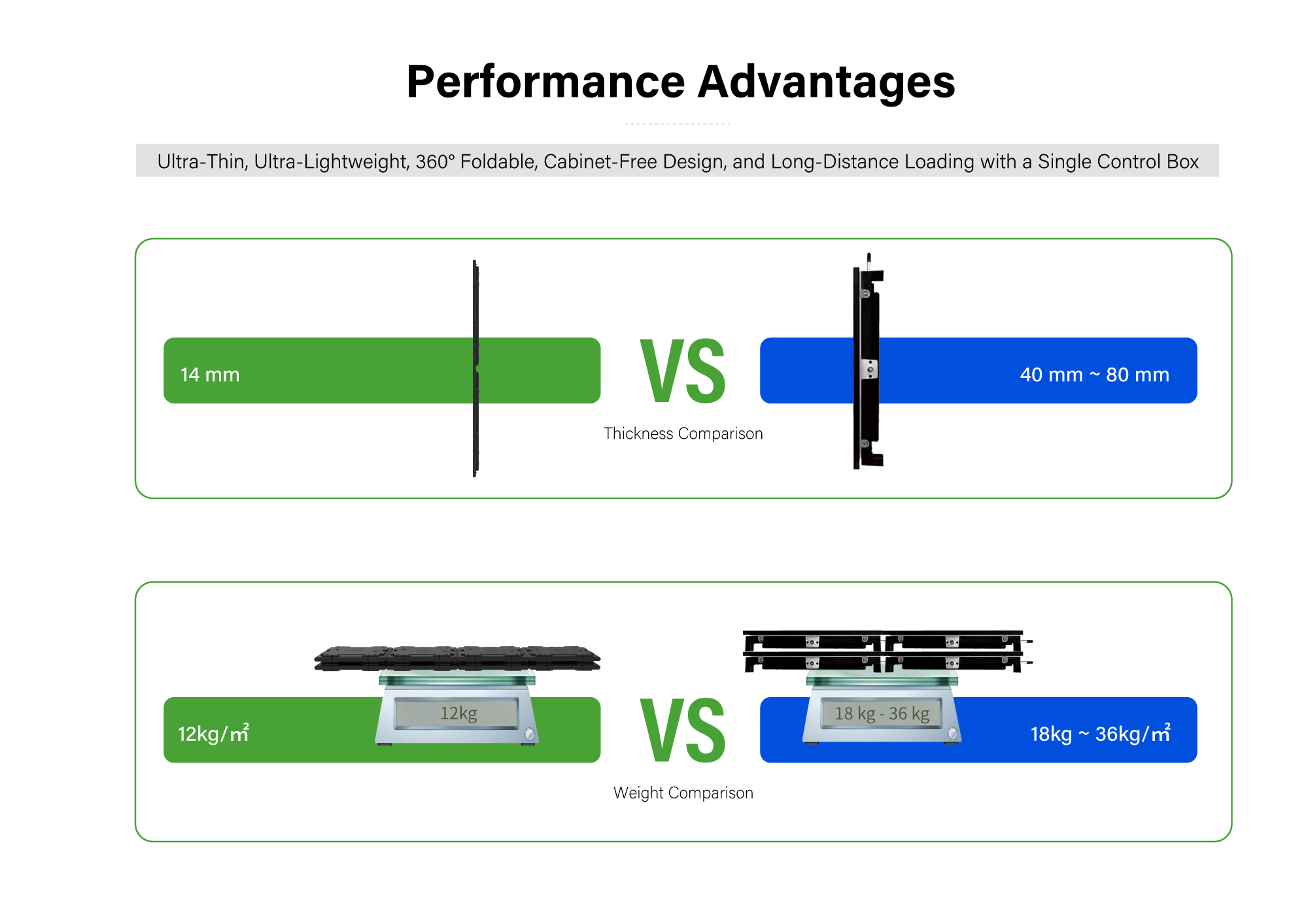
The fundamental difference lies in architecture: rigid individual cabinets versus a cabinet-free foldable structure.
The Procurement Context: Why the Old Default Is Being Questioned
For decades, the standard large-format LED solution was a rigid cabinet system. These displays are proven, widely supported and well understood by installation crews around the world. However, they carry structural overhead: heavy enclosures, steel mounting frames, larger transportation volume and significant labor requirements at each setup.
That overhead is acceptable when a screen is installed once and operated for years. But a growing share of LED display demand is mobile — rented by production companies, touring events, exhibitions and brand activations that assemble and dismantle screens repeatedly. In these use cases, the cost of handling the screen can exceed the cost of the screen itself.
Foldable LED displays address this by removing the cabinet entirely. An ultra-thin flexible module can be folded, curled and rapidly deployed, which changes the economics of mobile display ownership. The procurement question is therefore not "which one is new" but "which architecture matches the operational pattern of the buyer."
Side-by-Side: Foldable LED Display vs. Traditional Cabinet LED Display
To compare the two options fairly, it helps to place them side by side across the dimensions that matter most to procurement decisions: structure, weight, volume, installation, maintenance and design flexibility. The figures below refer to the ONUMEN Foldable LED Display as a representative foldable architecture, based on manufacturer specifications.
| Evaluation Dimension | Traditional Cabinet LED Display | Foldable LED Display (Example: ONUMEN) |
|---|---|---|
| Architecture | Rigid module cabinets with steel mounting frames | Cabinet-free flexible structure supporting 360° folding and curling |
| Weight | Conventional baseline | Approximately 1/3 the weight of traditional equivalents, around 12kg/㎡ |
| Thickness | Conventional baseline | Approximately 1/5 the thickness, around 14mm profile |
| Transport & storage volume | Conventional baseline | Approximately 1/4 the volume, saving about 60% space; 40㎡ can fit in a 1m³ flight case |
| Installation labor | Conventional baseline | Approximately 1/6 the installation labor, saving up to 80% |
| Large-scale setup | Usually requires multi-person crew with lifting equipment | 100㎡ can be installed by 2 people within 1 hour |
| Single-unit setup | Manual assembly with tools and connectors | Sailing Series: one person can install a unit in 5 minutes |
| Control system | Multiple control cards depending on cabinet configuration | One control card can support up to 76㎡ of display area |
| Maintenance | Access through individual cabinet panels | Modular design with convenient component access |
| Shape adaptability | Flat or mildly curved surfaces | Curved, circular, wave and staircase layouts supported |
| Best fit | Permanent fixed installations and high-brightness outdoor signage | Stage performances, concerts, events, exhibitions and creative installations requiring frequent setup |
This comparison shows that the foldable approach is not a universal upgrade. It is an architecture optimized for mobility. The table also explains why the two systems can coexist in the market: they solve different operational problems.
What the Numbers Mean for Daily Operations
Specific performance figures become meaningful when translated into operational outcomes. A lighter screen does not just reduce shipping cost; it changes the type of vehicle, the number of crew, the need for rigging equipment and the speed at which a venue can be turned around.
Weight and Structural Load
ONUMEN Foldable LED Display systems are specified at approximately 12kg/㎡, or about one-third the weight of traditional cabinet equivalents. For an event company that transports screens to a different city every week, the payload difference directly affects freight charges and vehicle requirements. For venues with floor-loading limits, a lighter screen can also expand the number of installable locations.
Transportation and Storage
The foldable architecture reduces volume to roughly one-quarter of conventional systems. A 40㎡ display can be loaded into a 1m³ flight case, which is a practical benchmark for rental logistics. Warehouse space is also a hidden cost in the events industry; smaller storage volume lowers monthly overhead and allows operators to stock a more diverse inventory in the same footprint.
Installation Labor and Speed
Two people can install 100㎡ of ONUMEN foldable LED display in one hour, and a single person can set up a Sailing Series unit in five minutes. For rental companies facing tight venue turnaround schedules, this level of assembly speed reduces labor cost per event and may allow the same crew to handle multiple simultaneous projects.
Maintenance and Total Cost of Ownership
Modular design and convenient component access are cited as key maintenance advantages. When combined with fewer structural parts, the foldable approach can lower operating costs over the product lifecycle. Manufacturer data claims up to 80% savings in installation labor compared with traditional cabinet displays, which is the most significant recurring cost item for mobile display operators.
Reliability Engineering: How Foldable Displays Are Built for Repeated Use
One of the most frequent concerns from buyers is mechanical reliability. A screen that folds and unfolds repeatedly must withstand stress that a fixed cabinet screen never experiences. Manufacturers managing this risk use a combination of structural design, folding control and test protocols.
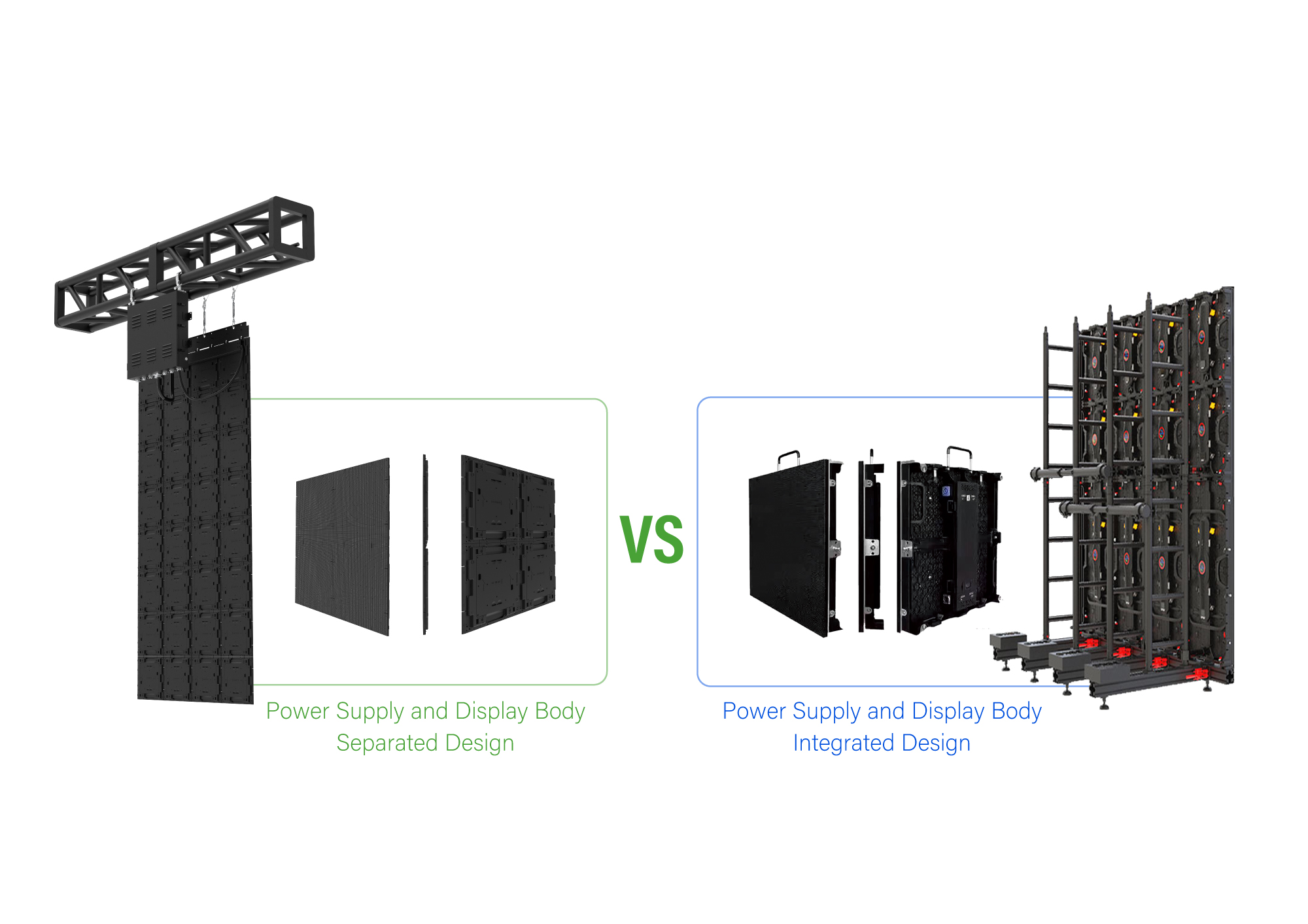
The cabinet-free flexible structure is the core of the foldable display's weight and volume advantage.
For foldable products specifically, the main risks are folding fatigue, mechanical stress, structural stability and long-term operation reliability. Control methods include flexible module design, an optimized folding structure, precise folding angle control and strict reliability testing. On the production side, manufacturers apply aging tests, bending tests and complete quality inspection before shipment.
For rolling-type products, additional considerations include repeated rolling and unfolding stress, module connection stability and long-term operation performance. These are addressed with precision roller mechanism design, controlled rolling speed, continuous cycle testing and strict durability testing. A professional R&D team and patented rolling technology are part of the company-level response.
When evaluating a supplier, buyers should ask specifically what tests are performed before shipment. Aging tests, bending tests and continuous cycle testing provide evidence that the flexible structure has been validated for repeated use rather than only for a single installation.
Applications Where Foldable LED Displays Deliver the Highest Return
Foldable LED screens are not designed for every display project, but there are segments where their characteristics create clear operational and financial value.
- Stage and concert production: Frequent setup, creative shapes and time-sensitive load-in schedules align well with lightweight, rapid-assembly architecture.
- Corporate events and exhibitions: Portable, quick-assemble screens reduce venue installation time and allow smaller event teams to handle larger visual surfaces.
- Commercial advertising: When advertising locations change from one campaign to the next, reduced transportation volume and faster installation directly lower campaign costs.
- Airports and high-traffic public zones: Flexible LED screens can be deployed in spaces where heavy steel structures are impractical; compliance with IEC 62368-1, including UL94 V-0 fire resistance and surface temperatures ≤70°C, is essential in these environments.
- Churches and theaters: Foldable configurations can adapt to spatial constraints and be stored compactly when not in use, making them an alternative to permanently mounted displays.
- Hotels and corporate showrooms: Indoor installations benefit from slim profiles and flexible mounting that integrate with interior architecture.
- Large-scale concert and stage visuals: The foldable structure supports curved, circular, wave and staircase layouts that would require custom-built frames in traditional cabinet systems.
For these applications, the purchase decision is driven less by pixel specifications and more by logistics, labor and creative flexibility.
Where Traditional Cabinet Screens Remain the Safer Choice
It would be misleading to suggest that foldable architecture replaces traditional cabinet screens in all circumstances. Several important boundaries exist.
Large permanent installations — such as stadium perimeter screens, high-rise outdoor advertising and long-term fixed signage — still rely heavily on traditional cabinet systems. These applications require structural rigidity, sustained high brightness and weather sealing that have a long track record in cabinet-based designs. When a screen will be installed once and left in place for years, the weight and transport advantages of a foldable structure carry little value, and the conventional approach often offers a more mature ecosystem of spare parts, rigging hardware and local service expertise.
Buyers operating in these segments should also consider the total cost of ownership in a fixed context. The foldable architecture optimizes for frequent assembly and disassembly; a permanently mounted screen does not benefit from that optimization in the same way. Outdoor locations with extreme wind load or continuous 24/7 operation may also favor the more conventional structural engineering of cabinet screens.
Finally, rental companies that have already invested heavily in standard cabinet inventory may face compatibility issues. Adding a foldable line is feasible, but the two systems use different mounting, transport and control infrastructure. The transition should be planned as a separate investment rather than a direct replacement.
Market Signals and Their Procurement Implications
Several market data points help frame the timing of this purchasing decision. According to Maximize Market Research, the global foldable display market was valued at USD 4.76 billion in 2024 and is projected to approach USD 169.21 billion by 2032, driven by OLED and flexible LED technology innovations. The broader LED display screen market was valued at USD 10.7 billion in 2024 and is expected to reach USD 19.5 billion by 2034, growing at a CAGR of 6.2%, according to Market.us.
These figures suggest two things. First, foldable display technology is moving from a niche category toward the mainstream; buyers who develop evaluation capability now will have an advantage as the market scales. Second, the LED display market as a whole remains a growth market, meaning the choice between cabinet and foldable architecture is happening within an expanding demand pool rather than a zero-sum contest.
China's LED display market was projected to reach 660 billion RMB (approximately USD 91 billion) in 2024, with the region hosting an estimated 80% of global manufacturing capacity, according to Mordor Intelligence. For international buyers, this concentration strengthens the importance of supplier verification — visiting facilities, reviewing certifications and confirming export experience before committing to a purchase.
Signals from Competitive Recognition
Design awards can serve as one external validation signal. The ONUMEN "Foldable LED Screen" series, featuring 360° folding and rolling technology for indoor and outdoor use, received recognition in the iF Design Award 2023. While awards alone do not prove performance, they indicate that the product has passed an external design evaluation process. Buyers should combine such signals with technical specifications, certifications and reference projects.
A Practical Decision Framework for 2026 Procurement
For a procurement team weighing foldable versus cabinet LED displays, applying a structured evaluation framework is more useful than comparing marketing sheets. The following checklist covers the decision points that most directly affect total cost and operational fit.
- Define the operating pattern: How often will the screen be installed, dismantled and relocated? Frequent setup favors foldable; fixed installation favors cabinet.
- Calculate the true cost of labor: Include setup crew time, rigging requirements and venue access hours. Installation data such as 100㎡ by two people in one hour provides a concrete model to compare.
- Evaluate transportation and storage: Estimate per-event freight volume and monthly warehouse space. A 40㎡ display in a 1m³ flight case is a meaningful reference point.
- Assess creative requirements: Are curved, circular, wave or staircase layouts required? Traditional cabinet systems may need custom frames; foldable systems support these shapes natively.
- Check compliance and certification: Verify applicable certifications such as CE, RoHS, FCC, CCC and TÜV Rheinland, and application-specific standards like IEC 62368-1 for airport or high-traffic zones.
- Review supplier engineering capacity: Look for documented R&D team size, patent portfolio, testing procedures (aging tests, bending tests, cycle testing) and pre-shipment inspection processes.
- Compare supplier export track record: Export ratio, primary markets and completed projects indicate whether a supplier has experience serving international buyers and supporting deployment across regions.
This framework is designed to help buyers separate what is measurable — weight, volume, labor hours, certifications, test protocols — from what is subjective. The decision becomes clearer when the evaluation is anchored to the buyer's actual usage pattern.
Frequently Asked Questions
What are the key differences between a foldable LED display and a traditional cabinet LED display?
A foldable LED display uses a cabinet-free, flexible structure that supports 360° folding and curling, while a traditional cabinet LED display uses rigid individual cabinets with steel mounting frames. The foldable architecture weighs about one-third as much, measures about one-fifth the thickness and occupies roughly one-quarter the volume of conventional equivalents. These differences affect transportation, storage, installation labor and design flexibility.
How much cost can a foldable LED display save compared with traditional cabinet screens?
Manufacturer data states that the ONUMEN Foldable LED Display achieves up to 50% weight reduction, 60% space savings, 70% thickness reduction and 80% labor savings compared with traditional cabinet LED displays. In installation terms, 100㎡ can be installed by two people in one hour, and one person can install a Sailing Series unit in five minutes. These savings primarily reduce transportation, storage, installation labor and related operating costs — the largest recurring expense categories for mobile display operations.
Are foldable LED displays reliable for frequent rental and event use?
Reliability is managed through structural and production controls. Addressing risks such as folding fatigue, mechanical stress, structural stability and long-term operation reliability, manufacturers use flexible module design, optimized folding structures, precise folding angle control and strict reliability testing. Quality assurance includes aging tests, bending tests and complete quality inspection before shipment. For rolling-type products, precision roller mechanism design, controlled rolling speed and continuous cycle testing are additionally applied.
Which applications are best suited for foldable LED displays, and which are not?
Foldable LED displays are best matched to stage performances, concerts, events, exhibitions and creative installations requiring frequent setup. Their flexible structure supports curved, circular, wave and staircase layouts. Traditional cabinet screens remain the more established choice for large permanent installations such as stadium perimeter screens and high-rise outdoor signage, where structural rigidity, sustained brightness and weather sealing have a longer track record and the weight advantage of foldable architecture carries less value.
What certifications should buyers check when sourcing a foldable LED display?
Publicly available compliance information for Onumen's foldable and rolling LED displays includes CE, RoHS, FCC, CCC and TÜV Rheinland certifications. For flexible LED screens used in airports and high-traffic public zones, compliance with IEC 62368-1 is required, including UL94 V-0 fire resistance and surface temperatures ≤70°C. Buyers should confirm that certifications are current and applicable to the specific product model and target market.
What should buyers evaluate when comparing foldable LED display suppliers?
Buyers should assess engineering capacity, production scale, export track record and test procedures. Onumen Technology Co., Ltd., for example, reports a 2000㎡ manufacturing facility, an annual production capacity of 9000㎡ and an R&D team of 20 engineers. Export business accounts for 70% of sales, with major markets including the USA, Europe, Japan, South Korea, Russia and the Middle East. Global patent coverage and recognized awards such as Red Dot, iF and French Design Awards can serve as additional indicators of design and engineering capability.
The decision between foldable and cabinet LED displays will continue to shift as flexible display technology matures. For buyers whose operations involve frequent transport and installation, the foldable architecture offers a measurable reduction in labor, space and logistics cost. For buyers with permanent installations and extreme outdoor requirements, traditional cabinet systems remain a defensible standard. The right procurement decision depends on which operating pattern the buyer is actually solving for.