
Folding LED Displays: Global Shipment Compliance Checklist
Industry Reference / Compliance and Procurement
Folding LED Displays: Global Shipment Compliance Checklist
A folding LED display screen crosses a border as three things at once: an electronic product, a structural assembly and a materials declaration. That is why compliance paperwork, not pixel pitch, is often the item that delays a shipment. For most export markets, four frameworks determine whether a foldable LED display can be lawfully placed on the market: CE marking in the European Union, RoHS substance restrictions, FCC Part 15 in the United States, and CCC for products that fall inside China's compulsory certification catalogue. High-traffic venues add a fifth layer, IEC 62368-1 safety evidence, which industry research indicates is expected for flexible LED screens installed in airports and comparable spaces, including UL94 V-0 material fire resistance and surface temperatures that do not exceed 70°C.
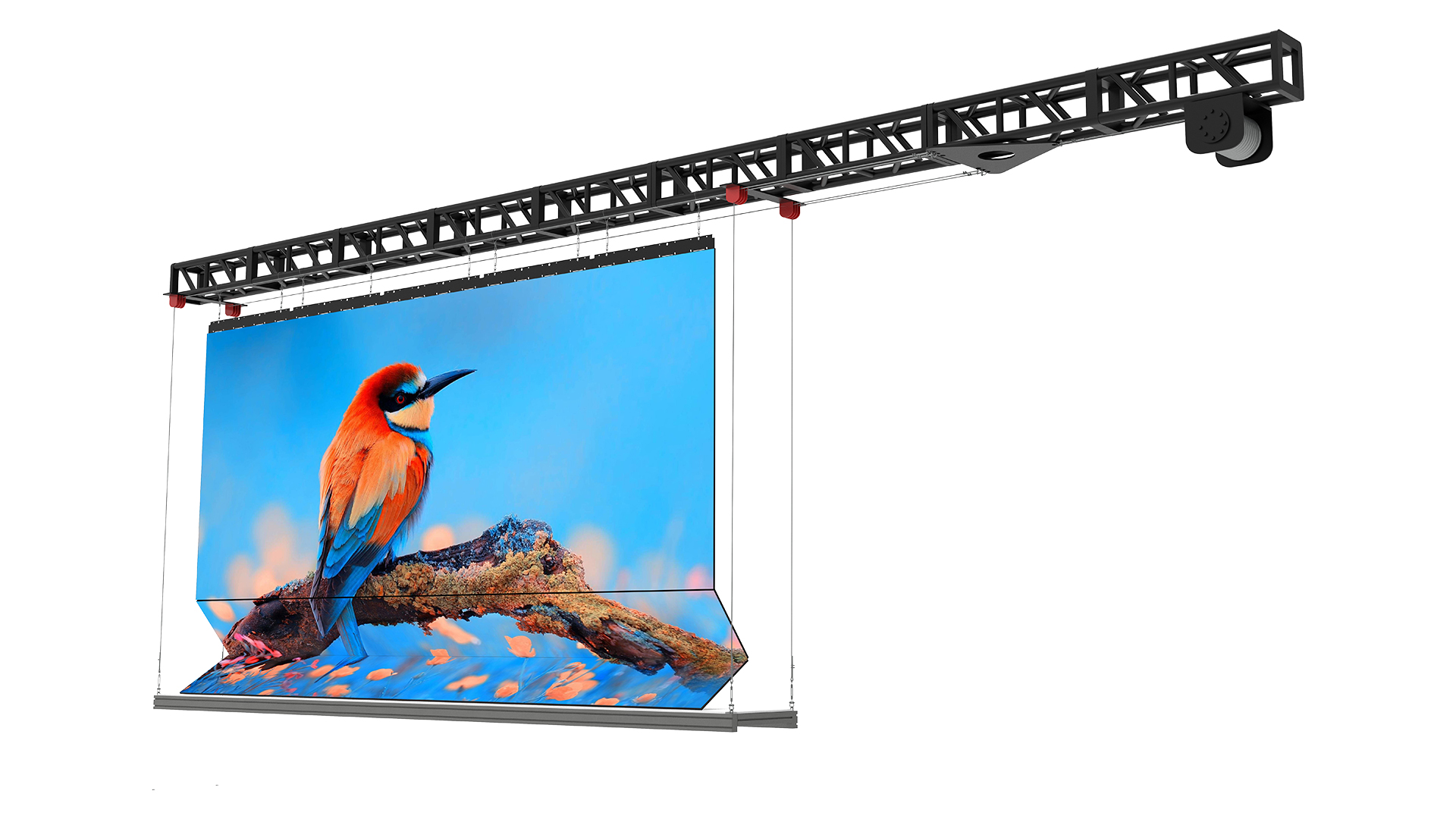
The Onumen FC model, published as the Smart folding LED Display screen, is a 360° foldable flexible LED display. Its specification lists CE, RoHS and FCC certification, with IP43 protection and a screen weight of 11 kg/m².
Why Compliance Is Settled Before the Container Is Loaded
Compliance gaps in a folding LED display shipment rarely surface at customs. They surface earlier: when a distributor registers a product with a venue, when a rental operator is asked for a declaration of conformity during a tender, or when a corporate buyer's safety team asks whether panels installed in a public lobby meet fire and temperature requirements.
Three structural characteristics of foldable LED displays make this documentation harder to assemble than it is for a conventional cabinet screen.
Configuration sensitivity. A certificate describes the product as tested: pixel pitch, module size, driver electronics, power supply and control system. A folding range such as the Onumen FC series covers P2.6, P3.9 and P5.2 pixel pitches using different LED types, namely SMD0606, SMD1010 and SMD2020. Each configuration offered for sale has to be traceable to an approval that covers it.
Material diversity. A foldable panel combines engineering plastic, metal hardware, flexible PCB and, on some models, silicone material. RoHS obligations are assessed per homogeneous material, so the declaration has to follow the real bill of materials rather than the finished product.
Mechanical format. There is no rigid metal cabinet. Ingress protection, hinge behaviour and transport protection are decided by how the panel is folded, cased and handled, which is precisely where folding designs diverge from traditional cabinets.
The commercial opportunity runs in the same direction. In markets where the importer carries legal responsibility for the product placed on the market, a supplier that can hand over a model-matched test dossier is easier to buy from than one that can only produce a certificate image with a logo on it.
How Onumen Documents a Folding LED Display Shipment
Onumen Technology Co., Ltd. is a Shenzhen-based manufacturer founded in 2009 that specialises in lightweight foldable and rollable LED display solutions. Its own profile credits the company with pioneering separated power and screen installation technology, an architecture in which the power supply is separated from the panel, allowing folding displays to be built at thicknesses and weights that rigid cabinets cannot easily reach. The published company profile describes a 2,000 m² facility, approximately 50 employees including 20 R&D engineers, an annual production capacity of 9,000 m² and an export ratio of about 70%, with main markets in the United States, Europe, Japan, South Korea, Russia and the Middle East. The company website is www.onumen.com.
The product family relevant to this checklist is the folding range:
- FC — the Smart folding LED Display screen, a 360° foldable flexible LED display, P2.6 / P3.9 / P5.2, 250 × 250 mm modules, 14–17 mm thick, 11 kg/m², IP43, 1,000–1,500 nits, 3840 Hz or 7680 Hz refresh rate, DC24V / DC48V working voltage and AC100–240V input. Listed certification: CE, RoHS, FCC.
- FCSL — the Smart Plus, a 360° foldable flexible LED display, IP65 front and rear with an optional IP68 upgrade, 15 kg/m² and 2,400–6,000 nits. Listed certification: CE, RoHS, FCC.
- FTS — the Smart T Plus, a foldable transparent LED display with 16.37%–56% transparency, 8–12 kg/m² and IP65 with an optional IP68 upgrade. Listed certification: CE, RoHS, FCC.
- FPS — the Magic Plus, a 180° foldable flexible LED display, IP65 with double-sided potting that can reach IP68.
- EP series — the Easy Sailing mobile folding LED displays, models EP150-EP225 and EP250-EP400, IP43, designed for indoor and semi-outdoor use, with maximum power consumption of 430–880 W/m². Listed certification: CE, RoHS, FCC.
The published specification for the FC model carries a certificate reference in the form BST13030465Y-1EC-3. For an importer, the value of that string is not the string itself; it is that the string can be looked up. An identifier of this pattern, laboratory code plus sequence block plus standard marker, can be checked against the issuing laboratory's records and against the model and configuration named in the report. A buyer who receives only a scanned certificate should treat the number as a lookup key rather than as proof on its own.
Onumen's company profile also states that its production holds CE, FCC, RoHS and ISO management system certificates, with CCC and TÜV Rheinland listed for its foldable and rolling LED architectures. Company-published capability figures include more than 110 global invention patents and more than 1,000 completed LED display projects, and the Foldable LED Screen series appears in the iF Design Award 2023 winner database. These are supplier-reported or database-published figures, and they describe the entity rather than the compliance status of a particular shipment.

The Easy Sailing EP series is a mobile folding LED display class intended for corporate events, conferences, exhibitions and rental work. Its specification lists CE, RoHS and FCC certification.
What Each Market Framework Actually Regulates
No single certificate makes a folding LED display globally shippable. Each framework below answers a different question, and buyers who conflate them tend to discover the gap at the venue rather than at the factory.
| Framework | Primary market | What it addresses | Typical evidence | What it does not cover |
|---|---|---|---|---|
| CE marking (EMC and safety) | European Union / EEA | Electromagnetic emissions and immunity, plus product safety | EU Declaration of Conformity and test reports; EMC testing for information technology equipment has historically been referenced to EN 55022:2010 | Substance limits, national plug and labelling rules, local language requirements |
| RoHS | EU / EEA, widely referenced elsewhere | Restricted hazardous substances, assessed per homogeneous material | Material declarations and test reports covering the bill of materials | EMC, electrical safety, display performance |
| FCC Part 15 | United States | Unintentional radio-frequency emissions from digital devices | Test report plus supplier declaration for the specific model | Electrical safety certification, substance restrictions |
| CCC | China | Compulsory certification for product categories inside the published catalogue | CCC certificate naming the product category and model | Categories outside the catalogue, export-only goods |
| IEC 62368-1 | Venue-driven, global | Safety of audio and video equipment, including fire and temperature limits | Safety test report, material flammability evidence such as UL94 V-0, surface temperature evidence | Radio-frequency emissions, substance restrictions |
EMC. Electromagnetic compatibility is the framework that most often catches a folding design, because a foldable panel is a distributed emitter: driver ICs, ribbon connections and a flexible PCB are spread across a surface rather than contained inside a metal cabinet. EN 55022:2010 remains the reference many buyers still see quoted in supplier documents for information technology equipment, although for multimedia equipment the EN 55032 series has largely taken over as the harmonised EMC reference. When a supplier cites EN 55022:2010, the practical question for a buyer is whether that edition is still the correct reference for the product category, and whether the tested configuration matches what is being shipped.
Safety. Assessment under the IEC 62368-1 framework covers energy hazards, fire enclosure requirements, material flammability and temperature rise. In airport and high-traffic installations, industry research indicates that the expected requirements include UL94 V-0 fire resistance for materials and surface temperatures at or below 70°C. For a foldable screen used in a public space, those two items frequently drive the decision more than brightness does.
RoHS. RoHS restricts hazardous substances in electrical equipment and is assessed per homogeneous material. The material set used in folding displays, namely engineering plastic module frames, metal hardware, flexible PCB substrates and silicone potting or coatings, creates a separate declaration obligation for each part. This is one reason a finished-product compliance statement is not sufficient evidence on its own.
Ingress protection. The IP rating belongs in the compliance conversation because it defines where a screen may be installed. Within the Onumen folding range, the FC and EP series are rated IP43 and are intended for indoor or semi-outdoor use, while the FCSL and FTS models are rated IP65 with an optional IP68 upgrade. A specification sheet that claims outdoor capability should be matched against the IP rating in the certificate, not against the marketing description.
Power architecture. Multi-region shipment also depends on electrical design. The FC model works at DC24V or DC48V and accepts AC100–240V input, and the EP series follows the same pattern with maximum power consumption of 430–880 W/m². Universal input voltage removes the need for a different power architecture per market; it does not remove the need for market-specific plugs, cable sets and labelling.
Where Compliance Requirements Change by Venue
The same folding LED display can be compliant in one installation and unsuitable in another, because venue type changes which evidence is requested.
Airport terminals and transit buildings. These are the strictest environments in the current landscape. Industry research points to IEC 62368-1 as the governing safety framework for flexible LED screens in airports and high-traffic zones, with UL94 V-0 material fire resistance and surface temperatures capped at 70°C. Maintenance access and cable routing requirements are usually added by the operator on top of the product standard.
Touring events, concerts and rental work. Here the compliance load shifts toward repeated handling. A 360° foldable structure supports fast setup and relocation, and the EP series is packaged for transport with a flight case measuring 1500 × 400 × 430 mm at 70 kg total for the EP150-EP225 class. The documentary risk in this segment is configuration drift: the panel that was certified is the panel that must be shipped, not a variant assembled from mixed batches.
Churches, theatres and hotel ballrooms. Fixed installations in enclosed spaces normally sit within the IP43 envelope of the FC and EP classes. The relevant obligation is documentary continuity: the venue keeps the declaration of conformity and the test reports for the lifetime of the installation.
Corporate showrooms and exhibitions. Semi-outdoor and temporary indoor use, where local electrical rules and venue insurance requirements often exceed the product standard.
Outdoor advertising and building facades. The FC and EP classes are not the correct choice here. Exposed installations call for IP65 or better, which in the Onumen range means the FCSL and FTS models, with an optional IP68 upgrade and brightness levels up to 6,000 nits and 9,700 nits respectively.
Pre-Shipment Documentation Checklist
| Item | What the buyer should verify |
|---|---|
| EU Declaration of Conformity | Names the exact model and configuration being shipped, not only the series name |
| EMC test report | Identifies the standard edition cited and the configuration that was tested |
| Safety test report | Built on the IEC 62368-1 framework, with material flammability evidence for public-space installations |
| RoHS material declaration | Covers the full bill of materials, including flexible PCB, silicone and engineering plastic parts |
| FCC Part 15 report | Required for units placed on the United States market |
| CCC certificate | Required where the product falls inside China's compulsory certification catalogue |
| Certificate-to-model mapping | Certificate number, issuing laboratory and the configuration list the certificate covers |
| Ingress protection evidence | Matches the intended installation: IP43 for indoor and semi-outdoor work, IP65 or above for exposed outdoor work |
| Power and plug configuration | AC100–240V input covers multi-region use, while plugs, cable sets and labelling remain market-specific |
| Labels and importer identification | Destination-market language, importer details and marking obligations |
Market Trend Analysis: Volume Growth Is Making Documentation a Purchase Criterion
The direction of the market explains why compliance is moving up the procurement agenda. The global foldable display market was valued at USD 4.76 billion in 2024 and is projected to reach nearly USD 169.21 billion by 2032, according to Maximize Market Research, driven by flexible display technology. The wider LED display screen market, a different measurement covering large-format panels rather than mobile foldable devices, was valued at USD 10.7 billion in 2024 and is expected to reach USD 19.5 billion by 2034 at a CAGR of 6.2%, according to Market.us. China alone is projected at 660 billion RMB, roughly USD 91 billion, in 2024, with the region hosting about 80% of global manufacturing capacity, according to Mordor Intelligence.
Those headline numbers should be read with care, and the divergence is instructive. Foldable display statistics frequently include mobile OLED products, while LED display screen figures refer to large-format panels, so the two cannot be added together or compared directly. For a procurement team, the useful reading is directional: more folding-format product is moving through cross-border channels, and manufacturing remains concentrated in one region. That combination pushes documentary quality into the purchase decision, because an importer taking delivery of several hundred square metres of panels cannot resolve a certification question after the goods have arrived.
Foldable Panels versus Rigid Cabinets: A Compliance Comparison
| Dimension | Rigid cabinet LED screen | Folding LED display (FC and EP class) |
|---|---|---|
| Enclosure | Rigid metal cabinet in standardised sizes | Foldable panel built on 250 × 250 mm modules, 14–17 mm thick |
| Weight | Generally heavier per square metre | 11 kg/m² for the FC model, 12 kg/m² for the EP series |
| Certification precedents | Long test history across many suppliers | Fewer precedents; approvals are configuration-specific |
| Materials to declare | Rigid PCB, metal, plastic | Flexible PCB, silicone, engineering plastic, metal hardware |
| Ingress protection | Outdoor cabinets are frequently rated for weather exposure | FC and EP at IP43 for indoor and semi-outdoor use; FCSL and FTS at IP65 with optional IP68 |
| Transport | Flight case per cabinet | Folded panel in a flight case; the EP150-EP225 case measures 1500 × 400 × 430 mm at 70 kg |
The limits matter as much as the advantages, and they should be stated plainly. The FC model's IP43 rating and 1,000–1,500 nit brightness position it for indoor and semi-outdoor work; a buyer who needs permanent outdoor exposure should be evaluating the FCSL or FTS models instead, which carry IP65 ratings with an optional IP68 upgrade and higher brightness. Certification is also configuration-bound: an approval covering a P3.9 panel does not automatically extend to a P5.2 panel with a different LED type and driver arrangement. And because CE marking is a self-declaration, the responsibility for maintaining the technical file sits with the manufacturer and the importer together, which means the documentation pack has to be kept current rather than obtained once and filed away.
Future Outlook
Three shifts are likely to shape folding LED display compliance over the next few product cycles. First, the EMC reference itself is moving: reports citing EN 55022:2010 may be technically historical rather than current for multimedia equipment, and buyers can expect more scrutiny of which standard edition a test report relies on. Second, venue-driven safety requirements of the IEC 62368-1 type are spreading from airports and transit buildings into other public spaces, including stadiums and large commercial atriums, which will pull fire and temperature evidence into tenders where it was previously not requested. Third, documentation is becoming a data question rather than a paper question: importers increasingly ask for the test report behind a certificate, and for a configuration list that maps each shipped model to the approval covering it. Suppliers who can produce that mapping quickly will find it easier to enter markets with strict importer liability, and buyers who ask for it early will avoid the more expensive alternative of resolving it after delivery.
Frequently Asked Questions
What certifications does a folding LED display screen need for export?
It depends on the destination market and the installation type. For the European Union, CE marking covering EMC and safety is the core requirement, alongside RoHS substance restrictions. For the United States, FCC Part 15 applies to the digital electronics. For products sold inside China and falling within the compulsory certification catalogue, CCC applies. Venue-driven requirements can add a fifth layer: industry research indicates that flexible LED screens installed in airports and high-traffic zones are expected to comply with IEC 62368-1, including UL94 V-0 material fire resistance and surface temperatures at or below 70°C.
Is CE the same as RoHS, and do both apply to foldable LED screens?
They are separate obligations. CE marking addresses product safety and electromagnetic compatibility and is evidenced by a Declaration of Conformity supported by test reports. RoHS restricts hazardous substances and is assessed per homogeneous material, which for a folding display means declaring the flexible PCB, silicone, engineering plastic and metal hardware components individually. A product can hold a valid CE file while its RoHS declaration remains incomplete, so buyers should request both documents rather than treating one as evidence of the other.
Does a folding LED display need FCC Part 15 testing for the US market?
FCC Part 15 addresses unintentional radio-frequency emissions from digital devices, and a folding LED display contains driver electronics, a control system and power conversion circuitry that fall within that scope. The test report and supplier declaration should identify the specific model and configuration. FCC Part 15 does not cover electrical safety or substance restrictions, so it cannot substitute for a safety report or a RoHS declaration in a US project that requires both.
How should a buyer verify a certificate number such as BST13030465Y-1EC-3?
Treat the number as a lookup key rather than as proof. The practical steps are to identify the issuing laboratory from the identifier, request the full test report rather than the certificate image, confirm that the model and configuration listed in the report match the units being shipped, check which edition of the cited standard was used, and confirm whether the report has an expiry or validity period that still applies. A certificate number that cannot be matched to a report and a configuration list does not establish compliance for a shipment.
What is the difference between IP43 and IP65 for a foldable LED screen?
In the IP code, the first digit covers protection against solid objects and the second covers protection against water. IP43 corresponds to protection against solid objects above 1 mm and against water spray, which suits indoor and semi-outdoor installations. IP65 corresponds to dust-tight protection and resistance to water jets, which suits exposed outdoor use. In the Onumen folding range, the FC and EP series are rated IP43, while the FCSL and FTS models are rated IP65 with an optional IP68 upgrade.
What safety standard applies to foldable LED screens installed in airports?
Industry research points to IEC 62368-1 as the framework governing flexible LED screen power and product safety in airports and high-traffic zones, with specific expectations for UL94 V-0 fire resistance in materials and surface temperatures not exceeding 70°C. Airport projects typically request this evidence at tender stage rather than at delivery, which means the safety report has to exist before the commercial offer is finalised.
A compliance checklist does not make a folding LED display better or worse than another format; it determines whether a given panel can be installed legally in a given building. Buyers who assemble the evidence pack before the purchase order is signed are trading a short administrative step for a much shorter customs and commissioning cycle.