
Folding LED Screens for Exhibition Booths: A Stand-Type Fit Map
Folding LED Screens for Exhibition Booths: A Stand-Type Fit Map
A folding LED display screen fits an exhibition booth when the stand type, the build window and the transport loop are settled before pixel pitch is discussed. Trade-show displays are chosen under three constraints that permanent installations do not carry: the screen must arrive in a case, be assembled by a small crew inside a short tenancy window, and then disappear into storage between shows. ONUMEN Technology Co., Ltd. builds five folding families that answer those constraints differently - the Smart folding LED Display screen (FC), Smart Plus (FCSL), Magic Plus (FPS), Easy Sailing (EP150-EP225 and EP250-EP400) and Smart T Plus (FTS). This guide maps those families to inline exhibits, island booths and pop-up rental stands, and marks where the published specifications stop short of a booth requirement.
Why the stand type decides the screen format
Booth geometry sets three variables that a specification sheet does not: how many sides of the screen will be seen, whether the screen can hang from the venue rigging or must stand on the floor, and how much volume the folded pack occupies in the aisle during build-up. An inline stand exposes one face and shares partitions with neighbours. An island booth is open on four sides and frequently uses overhead structure. A pop-up rental stand is packed and rebuilt many times in a season, so the case and the pack become part of the product specification.
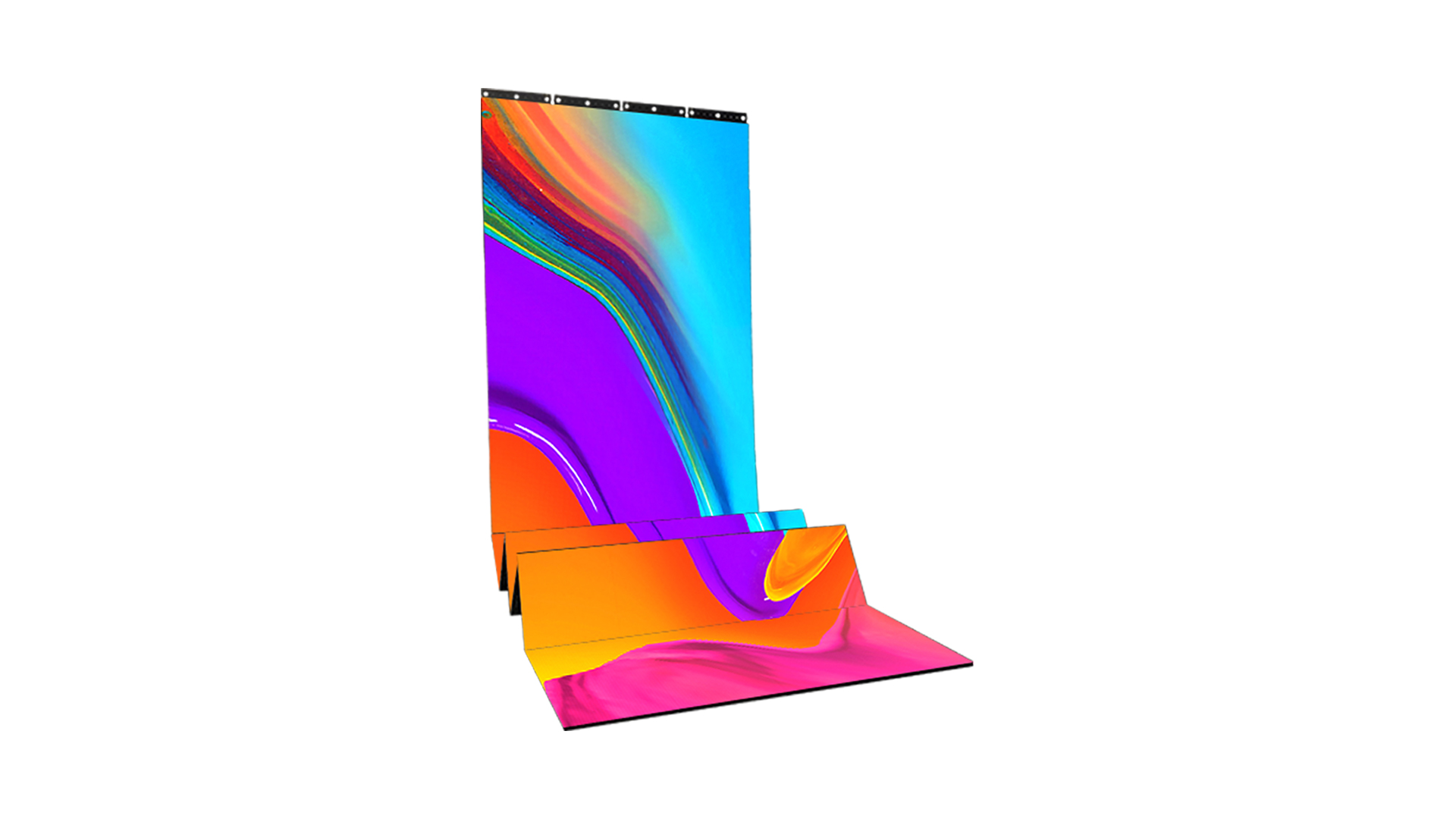
Folding formats change that arithmetic because the panel itself is the shipping unit. The published fold angles divide the range cleanly: the Magic Plus (FPS) is a 180 degree foldable panel, while the FC, FCSL, EP and FTS families are rated at 360 degrees. That number is the first thing to test against a design that calls for a corner wrap, a cylindrical shape or a panel that folds flat against itself for transport.
Five families and the booth roles they suit
The table condenses the specifications that decide a stand: fold angle, module geometry, pitch and brightness, panel depth, weight and ingress protection. All values are the published ranges for each series.
| Family (model) | Folding format | Pitch / brightness | Panel depth & weight | Protection | Booth role it suits |
|---|---|---|---|---|---|
| Smart folding LED Display screen (FC) | 360 degree fold; 250 x 250 mm modules | P2.6 / P3.9 / P5.2; 1,000-1,500 nits | 14-17 mm | IP43 | Inline back walls, close-viewing feature walls, floor-standing volumes |
| Smart Plus (FCSL) | 360 degree fold; 250 x 375 mm modules | P5.2 - P15.6; 2,400-6,000 nits | 18-24 mm; 15 kg/m2 | IP65 front and rear; IP68 optional | High-ambient-light walls, forecourts, wrapped shapes |
| Magic Plus (FPS) | 180 degree fold; 250 x 250 mm modules | P2.6 / P3.9; 6,000 nits | 15 mm; 15 kg/m2 | IP65 double-sided potting; IP68 available | Double-sided fascias, plinths, bright double-height walls |
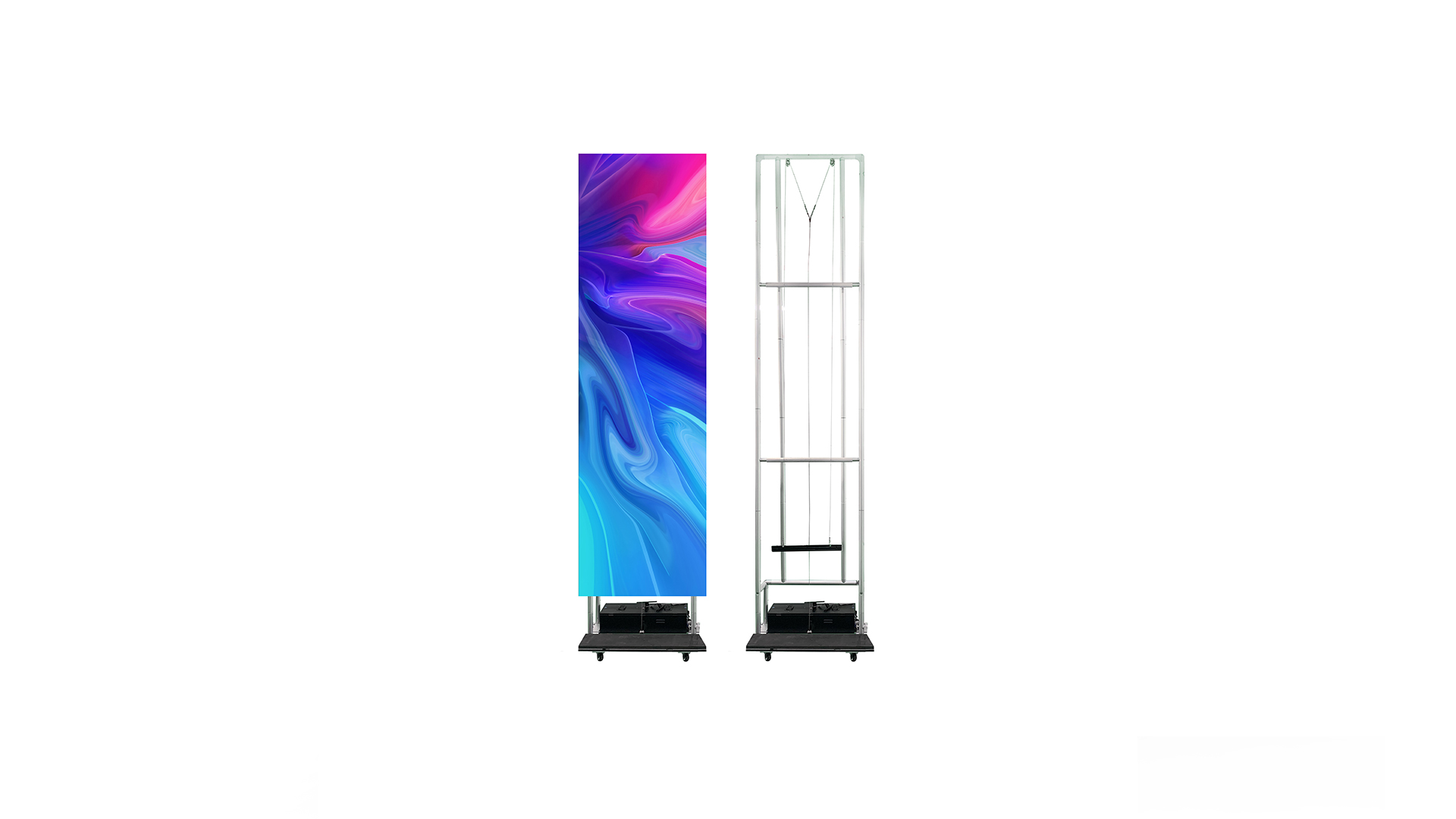
| Easy Sailing EP150-EP225 | 360 degree fold; mobile unit, 1,000 x 1,500-2,250 mm screens | P2.6 - P5.2; 630-2,300 nits | 14-17.1 mm; 12 kg/m2 | IP43 | Pop-up stands and relocatable self-standing walls |
| Easy Sailing EP250-EP400 | 360 degree fold; mobile unit, 1,000 x 2,500-4,000 mm screens | P2.6 - P5.2; 630-2,300 nits | 14-17 mm; 12 kg/m2 | IP43 | Tall pop-up walls and backdrop spans |
| Smart T Plus (FTS) | 360 degree fold; transparent, 250 x 375 / 375 x 500 / 300 x 450 mm modules | P3.9-7.8 - P37.5; 1,100-9,700 nits; 16.37%-56% transparency | 18.2-22.5 mm; 8-12 kg/m2 | IP65; IP68 available | Suspended see-through features, glass-walled booths |
Specifications as published for each series; confirm the values against the exact configuration being ordered.
Inline exhibits: one wall, close viewers and a shared boundary
An inline exhibit usually needs one dependable wall. The FC series is the closest fit in the range for that job: 250 x 250 mm modules at P2.6, P3.9 or P5.2, pixel density of 36,864 to 147,456 pixels per square metre, 1,000-1,500 nits brightness, a 120 degree horizontal and vertical viewing angle, 3,840/7,680 Hz refresh and a published panel depth of 14-17 mm. It is rated IP43 and listed for hanging, wall-mounted and floor installation, which covers the three ways an inline back wall is normally built.
Two checks belong with that recommendation. First, the aisle edge of an inline stand places visitors close to the wall, so P2.6 is the finest option available in this family; a booth whose wall content is filmed from under a metre is working at the edge of what the FC range offers. Second, FC brightness tops out at 1,500 nits, the lowest ceiling in the range. In a hall with strong daylight or high ambient lighting, the FCSL family - 2,400-6,000 nits with a 140 degree viewing angle - is the better starting point, at the cost of a heavier panel: 15 kg/m2 and 18-24 mm depth against the thinner FC build.
Island booths: four sides, hanging structures and double-sided messaging
An island booth removes the back wall and replaces it with four sightlines. Screens then either hang from the rigging above the stand or sit on the floor as a freestanding volume, and the FC specification supports hanging, wall-mounted and floor installation, so the same family can be re-used as the stand design changes.
Where the message has to read from two directions, the Magic Plus (FPS) is the relevant format. Its 180 degree fold and 15 mm panel depth suit a fascia or a plinth edge, and the 6,000 nit rating with double-sided potting to IP65, upgradable to IP68, is the highest brightness in the folding range. The FCSL is the alternative when the stand sits on a forecourt or beside a water feature: it carries IP65 protection front and rear, with IP68 available as an option, and a 360 degree fold for wrapped or curved shapes.
Weight is the constraint that decides hanging designs. FCSL and FPS both publish 15 kg/m2; the FTS transparent panel is lighter at 8-12 kg/m2. Those figures describe the panel only. Truss, frames, venue rigging limits and sign-off sit outside them, so a hanging design needs its own engineering confirmation rather than a comparison of datasheets.
Pop-up rental stands: the transport loop decides
For rental stock, the Easy Sailing family is built around the transport loop rather than the wall. The EP150-EP225 series offers screens from 1,000 x 1,500 mm to 1,000 x 2,250 mm, a 360 degree fold, 12 kg/m2, 14-17.1 mm depth and IP43, shipped in a flight case measuring 1,500 x 400 x 430 mm at 70 kg total. The EP250-EP400 extends the same format to screens from 1,000 x 2,500 mm up to 1,000 x 4,000 mm, with a screen enclosure of 1,120 x 650 x 550 mm, a control box enclosure of 980 x 650 x 540 mm and 150 kg across two pieces.
Brightness for the series runs 630-2,300 nits, with maximum power consumption of 430-880 W/m2 and a 120 degree viewing angle - figures that place it in controlled indoor and semi-outdoor light rather than direct sun. The published installation mode is mobile installation with quick setup, and the portable event scenario data lists an integrated structure, control system, power supply system and flight case as the supporting equipment for this type of project.
Reuse evidence exists and should be read for exactly what it is. Six EP225 systems were deployed in a shopping mall in Zhejiang, China, for commercial promotions and events, and five EP225 systems were supplied to a hotel in Libya for conferences and business activities; both installations are recorded as running for more than five years. These are commercial event deployments rather than exhibition booths, so they support the case for repeated relocation and reuse, not a claim about booth-specific performance.
Transparent and feature structures
Some booths sell the sightline itself. The Smart T Plus (FTS) is a transparent folding panel offering 16.37%-56% transparency across pitches from P3.9-7.8 to P37.5, brightness from 1,100 to 9,700 nits, 8-12 kg/m2, 18.2-22.5 mm depth and IP65 protection, upgradable to IP68. Its published installation modes are hanging, wall-mounted and ground installation, and a single power cable can carry a maximum run of 30 m - a detail that matters when the power drop sits at the edge of a stand and the screen hangs over the centre.
The clearest adjacent reference is a 100 m2 horizontal folding transparent installation at a cultural tourism site in China, recorded as operational for more than five years, where the hollow structure was chosen to reduce wind load while keeping the architecture visible. That project is outdoor architectural work, not a booth; its relevance here is the transparency-plus-structure logic, not a transferable performance claim.
Power-Screen Separation and mobile quick-assembly in a stand context
Two design directions sit behind these families. Power-Screen Separation keeps the power hardware out of the display panel, and ONUMEN describes the approach as the basis for turning heavy cabinet screens into thin, foldable and rollable panels. The documented illustration is a fixed installation rather than a folding booth screen: a 50 m2-plus ultra-thin fixed display at Tokyo Shibuya Station used a separated power supply structure to reduce screen thickness and heat generation for long-term public operation. The principle is what transfers to a stand - power hardware that stays off the visible panel keeps the panel thin and moves heat away from the surface where visitors gather.
Mobile quick-assembly is the second direction, and it is what the Easy Sailing format embodies: an integrated structure whose control system, power supply and flight case are treated as one deployable unit. For a rental operator, that shifts the packing list from a component inventory to a case count per screen size.
Where folding stops being the right booth answer
- Exposure. The FC and EP families are rated IP43. Only FCSL, FPS and FTS carry IP65, with IP68 available as an option. An open-air forecourt stand or a semi-exposed tent sits outside the FC and EP scope.
- Resolution. P2.6 is the finest pitch in the range, offered by FC, FPS and the EP series. A booth needing finer resolution than P2.6 for very close viewing or filming is outside these families.
- Ambient brightness. The range spans 630 nits at the low end of the EP series to 9,700 nits in FTS. Matching a family to the hall light is a venue-specific check, not a datasheet comparison.
- Structure. A hanging screen is a structural design. Panel weights of 8-15 kg/m2 describe the panel; truss, frames, rigging limits and sign-off belong to the stand build.
- Programme. Published lead time is 30-90 days after order confirmation, with capacity of 3,000-5,000 m2 per month. A booth booked on a shorter cycle needs that schedule confirmed before the design is frozen.
The comparison with rigid cabinet systems is therefore less about image quality than about logistics. The FC panel is published at 14-17 mm depth and folds for transport, so the folded pack rather than the panel becomes the shipping constraint in a narrow aisle. A cabinet build does not fold, which makes hall delivery and storage footprint the deciding factors before the screen surface is ever discussed.
Market signal, read with care
Fortune Business Insights, in research published in September 2026, projected a compound annual growth rate of 80.4% through 2029 for the digital signage and other large display devices segment using foldable technology, across a 2024-2029 forecast period. That is a segment forecast, and it carries a known limitation: foldable display research commonly aggregates large-format folding LED with folding OLED used in mobile devices, so the figure signals investment attention in foldable formats rather than booth-specific demand.
The practical conclusion for a buyer is narrow. A growth projection does not supply a lead time, a price or an availability date. The operative planning figures remain the published capacity of 3,000-5,000 m2 per month, a lead time of 30-90 days after order confirmation and a minimum order quantity of 1 m2.
Evidence a booth buyer can check
Certification is the fastest filter. Each of the five families - FC, FCSL, FPS, EP and FTS - lists CE, RoHS and FCC certification in its published specification. At company level, Onumen Technology Co., Ltd. holds ISO management system certificates, including ISO 9001, ISO 14001 and ISO 45001, alongside CE, FCC and RoHS product certification.
Design recognition is secondary evidence but useful in a client presentation: Red Dot 2024 for the foldable LED screen, with the Red Dot project listing dated April 2024; the iF DESIGN AWARD 2025; and the French Design Award 2026 Gold. On the intellectual-property side, the company reports more than 110 invention patents worldwide, with a patent pool spanning Asia, Europe, the Americas and Oceania.
Manufacturing data gives the order its context: founded in 2009, a 2,000 m2 factory, 50 employees including 20 engineers, annual output of 9,000 m2 and an export share of 70% across the USA, Europe, Japan, South Korea, Russia and the Middle East. Units are described as receiving a 100% ageing test and quality inspection before shipment; customization covers screen size, pixel pitch, cabinet design, installation structure, control system, logo and packaging; and after-sales support covers remote technical assistance, installation guidance, maintenance and spare parts.
Four questions turn that evidence into a booth decision. Which certificate covers the exact model and the market it ships to? What are the flight-case dimensions and total weight for the specific screen size ordered? How does the panel perform under the venue light rather than under showroom lighting? And which patent position applies to the folding mechanism in the destination market?
Outlook: what would change the fit
Temporary exhibition work favours formats that fold. Shorter tenancies, tighter loading access and the cost of moving rigid panels all push toward screens that pack small and rebuild quickly, and the published case sizes in this range - 1,500 x 400 x 430 mm for an EP225, 1,120 x 650 x 550 mm for an EP400 enclosure - show how much of a booth build can be reduced to a handful of cases. That is a reading of documented dimensions and weights, not a forecast of adoption rates.
What would change the picture is specific rather than general: a requirement finer than P2.6, an exposed outdoor site needing protection beyond IP43, a rigging limit below the panel weight per square metre, or a show date inside the 30-90 day lead time. Within those boundaries, the fit between folding LED formats and exhibition booths rests on transport volume, installation mode and protection rating - in that order.
FAQ
Can a folding LED screen fit a standard shell-scheme inline booth?
Yes, within limits. The FC series uses 250 x 250 mm modules at 14-17 mm depth, is rated IP43 and is published for hanging, wall-mounted and floor installation, which covers typical shell-scheme back walls. The two items to confirm are the load capacity of the partition or frame being used and the venue rules on rigging. The FC range spans P2.6 to P5.2 at 1,000-1,500 nits, so a hall with strong daylight should be assessed against the brighter FCSL family instead.
What pixel pitch should an exhibition booth screen use?
In these five families the finest pitch is P2.6, available in FC, FPS and the Easy Sailing series. P3.9 and P5.2 follow in the same families, while FCSL starts at P5.2 and extends to P15.6, and FTS runs from P3.9-7.8 to P37.5 for transparent panels. The deciding factor is the nearest viewing distance and whether the wall will be filmed. P2.6 is the limit of this range, so a requirement finer than that sits outside these products.
How much does a folding LED screen weigh, and why does it matter for a stand?
Published panel weights run from 8-12 kg/m2 for the transparent FTS to 12 kg/m2 for the Easy Sailing series and 15 kg/m2 for FCSL and FPS. Panel weight drives three stand decisions: whether a hanging design is feasible under the venue rigging limit, whether the floor structure needs load spreading, and how many crew can handle a unit. Case weight matters separately - an EP225 travels at 70 kg total in its flight case, while an EP400 set is 150 kg across two pieces.
Which certifications should be checked before specifying a folding booth screen?
Each of the five families lists CE, RoHS and FCC certification in its published specification. At company level, ISO 9001, ISO 14001 and ISO 45001 management system certificates sit alongside those product certifications, and the design record includes Red Dot 2024, the iF DESIGN AWARD 2025 and the French Design Award 2026 Gold. The check that matters commercially is scope: confirm that the certificate covers the exact model and the market the screen will ship to, not just the product family.
Can a folding LED screen be used outdoors at an exhibition or on a forecourt?
Partly, and the protection rating decides it. FCSL, FPS and FTS are rated IP65 with IP68 available as an option, which covers outdoor and semi-outdoor exposure; FC and the Easy Sailing series are IP43 and are intended for indoor and semi-outdoor use. Brightness follows the same split: FPS publishes 6,000 nits, FCSL 2,400-6,000 nits and FTS up to 9,700 nits, against 1,000-1,500 nits for FC and 630-2,300 nits for EP. Working temperature for FC, FPS, FCSL and FTS is listed at -20 to +45 degrees Celsius, and any outdoor structure still requires its own wind and fixing engineering.
Have Questions or Need More Details?
Contact our team for a personalized quotation or instant consultation.
Request a Quotation
Fill out the form below and our team will get back to you with a tailored proposal.
WhatsApp Direct Chat
Prefer to chat in real-time? Message us on WhatsApp for instant assistance & quick answers.
- Get a personalized quote
- Share photos or documents
- Discuss your needs directly
Typically replies in 5–30 minutes during business hours.