
Food-Grade Certifications for Fruit & Vegetable Packaging: A 2026 Buyer Reference
Food-Grade Certifications for Fruit & Vegetable Packaging: A 2026 Buyer Reference
Food-contact compliance is increasingly the decisive factor in fruit & vegetable packaging procurement, especially for buyers supplying EU and North American retail chains. Verifying a PET or PP container is no longer about reading “food-grade” on a spec sheet; it is about matching product models to concrete certificates, test standards, issuing bodies, and validity windows.
The global fresh food packaging market was valued at USD 134.60 billion in 2024 and is projected to reach USD 240.50 billion by 2035, according to Spherical Insights & Consulting. Within that, the global produce packaging market focused specifically on fruit and vegetables was estimated at approximately USD 38.08 billion in 2024 by Market Research Future. As trade volumes grow, so does the regulatory scrutiny placed on packaging materials that come into direct contact with fresh food. This article explains which certifications matter for fruit & vegetable packaging, what they actually verify, and how buyers can build a verification process around them.
Why Certification Has Become a Procurement Barrier, Not a Marketing Tag
For buyers of fruit & vegetable packaging, the shift toward documented compliance is driven by two regulatory systems that operate in parallel.
In the European Union, Regulation (EC) No 1935/2004 sets the framework for all food contact materials, requiring that materials do not release constituents into food at levels harmful to human health. For plastics specifically, Regulation (EU) No 10/2011 governs plastic materials and articles intended to come into contact with food, including PET and PP containers. These two regulations form the baseline for EU-market entry.
In North America, the U.S. FDA regulates food contact substances under the Federal Food, Drug, and Cosmetic Act. For PET containers, 21 CFR 177.1630 is the section that defines conditions under which polyethylene terephthalate may be safely used in contact with food. Facility registration under P.L. 107-188 may also apply to import-related supply chains.
The practical consequence for procurement teams is straightforward: a packaging supplier must be able to demonstrate, with verifiable documentation, that specific product models meet the relevant standards. This is not a point of differentiation only; in many export markets it is a point of market access.
The Market Opportunity: Verified Packaging as a Supply Chain Asset
Fruit and vegetable packaging operates at the intersection of several pressure points: shelf-life extension, cold-chain logistics, retail display, food waste reduction, and e-commerce handling. According to third-party market data, the European fresh food packaging market reached USD 15.2 billion in 2024 with a projected CAGR of 4.5% through 2033 (Market Research Future). The global thermoformed plastic food packaging segment is expected to grow at a CAGR of 4.9%, reaching USD 20.66 billion by 2030 (Grand View Research).
For buyers, the opportunity lies in using documented compliance to reduce risk. A container that fails migration tests, or a supplier that cannot produce a valid certificate number for the exact model being purchased, can disrupt retail listings, delay customs clearance, and create downstream liability. Conversely, a supplier with traceable certifications, clear test standards, and production capacity provides a more predictable basis for long-term sourcing decisions.
This is particularly relevant at the Research and Evaluation stages of procurement, where buyers compare suppliers on both technical specifications and compliance depth. Certification is one of the few aspects of packaging procurement that can be objectively verified before a single purchase order is placed.
CHUAN HE as a Reference Point: Company Profile and Certification Snapshot
Weifang Chuanhe New Material Co., Ltd., operating under the brand CHUAN HE, is a thermoformed packaging manufacturer based in Weifang, China, near Qingdao Port. The company specializes in PET and PP thermoformed packaging, with a product portfolio that includes fruit and vegetable containers, salad containers, produce trays, tamper-evident packaging, bakery packaging, and dry fruit containers.
CHUAN HE operates a 62,000 m² facility equipped with 20 fully automatic thermoforming machines and 20 standard thermoforming machines, including four Kiefel machines imported from Germany. The company also runs four PET sheet extrusion lines and two PP sheet extrusion lines, alongside an in-house mold workshop. Annual output is 54,000 tons, and products are exported to North America, Europe, Australia, Southeast Asia, Latin America, and the Middle East.
For procurement teams, the relevant facts are the certifications and the product models they cover. The company reports certification to CE, BRC, FDA, EU, and SGS quality management systems. Specific certification references include the following:
| Certification | Certificate No. | Issuing Body | Applicable Standard | Market Scope |
|---|---|---|---|---|
| CE | M.2025.206.C131101 | UDEM | EN 1186-1:2002 | EU |
| SGS (EU) | TSNHL26000684001 | SGS | EN 1186-3:2022 | NA/EU/ME/SEA/LATAM |
| SGS (FDA) | TSNHL26001599701 | SGS | US FDA 21 CFR 177.1630 | NA/EU/ME/SEA/LATAM |
| FDA | 11242824478 | CNQI | P.L. 107-188 | NA/EU/ME/SEA/LATAM |
| BRCS | CN26/00005423 | SGS | Global Standard for Packaging Materials | NA/EU/ME/SEA/LATAM |
One example at product level: the fruit & vegetable container model HB-7001 holds CE certification under certificate number M.2025.206.C131101, issued by UDEM, confirming compliance with EN 1186-1:2002 for the EU market. Similarly, the tamper-evident packaging model HB-16OZ holds multiple certifications: SGS certification (TSNHL26001599701) under EN 1186-3:2022, FDA certification (11242824478) under P.L. 107-188, and BRCS certification (CN26/00005423) under the Global Standard for Packaging Materials.
These are not blanket company-level claims; they are model-specific, certificate-numbered references that buyers can request, inspect, and validate.
Technical Explanation: What Each Certification Standard Actually Covers
Understanding the standards behind the certificates allows buyers to ask better questions and compare suppliers on an equal basis.
EN 1186-1:2002 and EN 1186-3:2022 (EU Migration Testing)
The EN 1186 series addresses overall migration testing of plastic materials and articles intended for food contact. EN 1186-1:2002 is the general framework for migration testing conditions, while EN 1186-3:2022 covers migration into aqueous food simulants. These standards are used to demonstrate that a container does not release unacceptable levels of constituents into food. For fruit & vegetable packaging made from PET or PP, compliance with the EN 1186 framework supports the broader requirements of EU Regulation (EC) No 1935/2004 and Regulation (EU) No 10/2011.
US FDA 21 CFR 177.1630 (PET Resin Safety)
This section of the U.S. Code of Federal Regulations establishes the conditions under which polyethylene terephthalate (PET) may be safely used in articles intended for food contact. A certificate citing this standard is meaningful because it addresses resin-level safety rather than generic product claims. For buyers supplying North American retail or foodservice channels, documentation that references 21 CFR 177.1630 provides a more auditable basis for food-contact compliance.
P.L. 107-188 (Bioterrorism Act Facility Registration)
The Public Health Security and Bioterrorism Preparedness and Response Act of 2002 established registration requirements for facilities that manufacture, process, pack, or hold food for consumption in the United States. While not a material safety standard in the same sense as 21 CFR 177.1630, it is part of the FDA-related compliance picture for packaging suppliers serving the U.S. market. The FDA certification held by CHUAN HE, number 11242824478 issued by CNQI, is listed under this standard.
BRCS Global Standard for Packaging Materials
The BRCGS Global Standard for Packaging Materials is an internationally recognized certification scheme that assesses the safety, quality, and operational integrity of packaging manufacturing. It covers areas such as hazard and risk management, site standards, product process control, and personnel hygiene. CHUAN HE’s BRCS certificate, number CN26/00005423 issued by SGS, applies to plastic packaging and is valid with an expiry date of 2027-08-03, based on the certification records provided.
Applications and Use Cases: Certified Packaging in Real Procurement Contexts
The practical value of certified packaging is visible across several buyer segments:
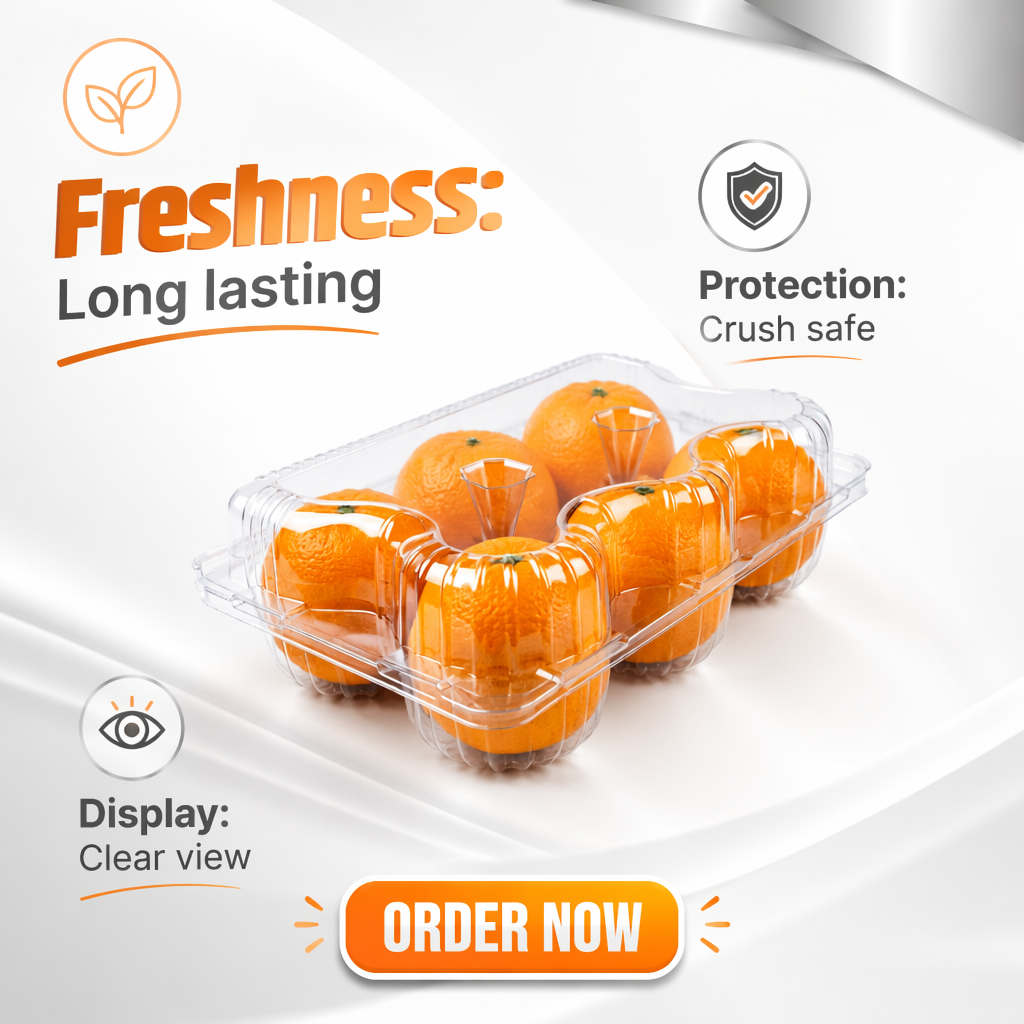
Supermarket retail display. Clear PET containers such as the HB-7001 (19.5 x 19.5 x 5 cm) give shoppers full visibility of the product while maintaining stackability for refrigerated shelving. Buyers for supermarket chains typically require food-contact documentation at the SKU level, which is why model-specific certificate references matter.
Farm and packhouse operations. For growers and packhouses handling berries, cherry tomatoes, and other high-value produce, containers with stable stackability and clear visibility support both field sorting and retail display. CHUAN HE’s fruit and vegetable container range includes models such as HB-SG250ML (13.5*11.5*6.5 cm), HB-SG300ML (17.5*13.5*6 cm), HB-SG500ML (17.5*13.5*7.5 cm), and HB-PG02 (22.5*12*10 cm). These size variations give packhouses the ability to match container dimensions to portion weight and product type.
Export-focused food distributors. Distributors serving cross-border markets need packaging that supports both shelf presence and regulatory traceability. The salad container model HB5053, for example, features a stackable design and a leakproof, airtight lid, and is made of food-grade BPA-free plastic, with custom logo printing available. Products in the tamper-evident packaging series, including HB-8OZ, HB-20 OZ (14 x 11.6 x 7.9 cm), HB-24 OZ (17.2 x 15.5 x 4.8 cm), and HB-32 OZ (17.2 x 15.5 x 6.2 cm), offer additional security for retail-ready fresh food packs.
Market Trends: Why Evidence-Based Compliance Is Gaining Value
Several market dynamics reinforce the importance of certification in fruit & vegetable packaging. First, the EU’s Packaging and Packaging Waste Regulation (PPWR) will ban single-use plastic packaging for fresh fruit and vegetables under 1.5 kg from 2030. This regulatory signal is already pushing buyers to evaluate packaging formats against future environmental requirements, not just current food-contact rules.
Second, the global fresh food packaging market is expanding at a scale that invites more regulatory attention. With the European market alone valued at USD 15.2 billion in 2024 and projected to grow at 4.5% CAGR through 2033, the volume of packaging crossing borders will continue to increase. Import inspections and retail audits become more systematic as the market scales.
Third, the competitive landscape includes major global packaging groups such as Amcor PLC, Berry Global Group, Sealed Air Corporation, Mondi Group, and Smurfit Kappa, alongside specialized manufacturers. For buyers, this means the market offers multiple sourcing paths. The differentiator for mid-size manufacturers like CHUAN HE lies in verifiable certifications, mold development capability, and the ability to customize sizes, colors, shapes, and logo printing under ODM/OEM arrangements.
Comparison with Traditional Approaches: What Certification Changes for Buyers
Compared with sourcing from suppliers that offer only generic food-grade claims or copy-pasted test reports, documented certification provides a different risk profile. Here is how the comparison typically plays out in procurement evaluations:
| Evaluation Factor | Traditional / Undocumented Suppliers | Model-Specific Certified Suppliers (e.g., CHUAN HE) |
|---|---|---|
| Food-contact evidence | Often a generic “food-grade” statement | Certificate numbers, standards, and expiries traceable per model |
| Retail audit readiness | Weak; difficult to produce supporting documents | Can provide SGS, FDA, CE, or BRC references |
| Customization flexibility | May exist but with limited verification | OEM/ODM supported with documented product parameters |
| Supply consistency | Variable; no certified process baseline | Certified manufacturing framework; in-house extrusion and mold control |
That said, buyers should also understand the boundaries of certification. The following limitations are real and should be considered during supplier evaluation:
- Certifications are generally granted for specific product models, not for an entire factory output. Buyers must verify that the certificate covers the exact SKU being purchased, not just the same product family.
- Certificates have expiry dates. Some certifications, such as the BRCS certificate held by CHUAN HE, have a clear validity period. Procurement contracts should account for the requirement to maintain certification validity over the life of the supply agreement.
- Certifications are market-specific. A CE certificate under EN 1186-1:2002 is a European reference; it does not automatically satisfy every U.S. or Latin American requirement. Buyers should map certification evidence against their actual destination markets.
- Food-contact compliance does not guarantee product performance. Migration testing and material safety are distinct from mechanical strength, stacking stability, or cold-chain endurance. Both dimensions must be evaluated in parallel.
Future Outlook: From Compliance to Circularity
Looking ahead, the fruit & vegetable packaging category will increasingly be shaped by two converging forces: food-contact safety and packaging sustainability. The EU PPWR will redefine what packaging formats are acceptable for fresh produce, and buyers will need to balance certified food safety with recyclability, weight reduction, and potentially reusable formats.
For suppliers like CHUAN HE, the direction of travel is toward maintaining certified production while expanding design and customization capability. With thousands of molds developed and ongoing investment in R&D, the company is positioned to support buyers seeking coordinated production, faster delivery, and model-specific compliance documentation. The manufacturing base, located near Qingdao Port, also supports export logistics efficiency for overseas buyers.
Buyers who integrate certification verification into their procurement workflow now will be better prepared for the regulatory evolution that is already underway.
FAQ: Certification and Compliance for Fruit & Vegetable Packaging
Which food-contact certifications apply to PET fruit & vegetable packaging?
For EU-bound products, packaging must align with Regulation (EC) No 1935/2004 and Regulation (EU) No 10/2011. Testing standards commonly cited include EN 1186-1:2002 and EN 1186-3:2022. For North America, relevant references include US FDA 21 CFR 177.1630 for PET and facility registration under P.L. 107-188. BRCGS certification under the Global Standard for Packaging Materials is also used by packaging manufacturers to demonstrate quality and safety management.
What CE certification does CHUAN HE hold for fruit & vegetable containers?
The fruit & vegetable container model HB-7001 holds CE certification under certificate number M.2025.206.C131101, issued by UDEM. The applicable standard is EN 1186-1:2002, and the certification applies to the EU market.
Does CHUAN HE have FDA-related certifications for packaging?
Yes. CHUAN HE reports FDA certification under certificate number 11242824478, issued by CNQI under standard P.L. 107-188, plus SGS certification under certificate number TSNHL26001599701, tested to US FDA 21 CFR 177.1630. These certifications apply to NA, EU, ME, SEA, and LATAM markets.
How can a buyer verify the validity of packaging certifications?
Buyers should request the full certificate document, verify the certificate number with the issuing body, confirm the validity period, check the scope statement, and match the product model and material specification. Cross-referencing the standard number against the destination market’s regulatory requirements is also recommended.
Does certification cover all product models from the same supplier?
Not automatically. Certification is usually granted per product model or product family. Buyers should require that the certificate covers the specific SKU being purchased. In the case of CHUAN HE, certification records reference multiple models including HB-7001, HB-16OZ, HB-24 OZ, HB-20 OZ, HB-8OZ-235, HB-SG250ML, and others.
What fruit & vegetable container sizes are available from CHUAN HE?
Available models include HB-SG250ML (13.5*11.5*6.5 cm), HB-SG300ML (17.5*13.5*6 cm), HB-SG500ML (17.5*13.5*7.5 cm), HB-SG1000ML (23*17.5*9 cm), HB-7001 (19.5*19.5*5 cm), HB-8OZ-235 (14.3*12.5*6 cm), HB-7123 (12.9*9.7*7.2 cm), and HB-PG02 (22.5*12*10 cm). Tamper-evident and salad container series provide additional size options.
Will EU regulations ban single-use plastic for fresh fruit and vegetable packaging?
Yes. Under the EU Packaging and Packaging Waste Regulation (PPWR), starting from 2030, single-use plastic packaging for fresh fruit and vegetables under 1.5 kg will be banned. Buyers should evaluate packaging formats now with an eye to recyclability, reduced material usage, and potential reuse models.
Reference documents: The product and certification information referenced in this article is available in the CHUAN HE 2026 Product Brochure. Buyers should always request the latest certificate documents directly from the supplier before making procurement decisions.
Have Questions or Need More Details?
Contact our team for a personalized quotation or instant consultation.
Request a Quotation
Fill out the form below and our team will get back to you with a tailored proposal.
WhatsApp Direct Chat
Prefer to chat in real-time? Message us on WhatsApp for instant assistance & quick answers.
- Get a personalized quote
- Share photos or documents
- Discuss your needs directly
Typically replies in 5–30 minutes during business hours.