
Food-Grade Paper Boxes Procurement Guide: Selecting Suppliers for Specialized Industry Needs
Navigating Specialized Requirements in Food-Grade Paper Box Procurement
For procurement professionals in the global food service and catering industry, sourcing paper boxes extends far beyond basic containers. The choice of packaging is a critical operational decision that impacts food safety, brand compliance, supply chain resilience, and environmental responsibility. Unlike generic packaging, food-grade paper boxes must meet a complex matrix of regulatory, functional, and brand-specific demands. This guide provides a structured framework for identifying and partnering with suppliers who possess the specialized capabilities to meet these stringent industry requirements.
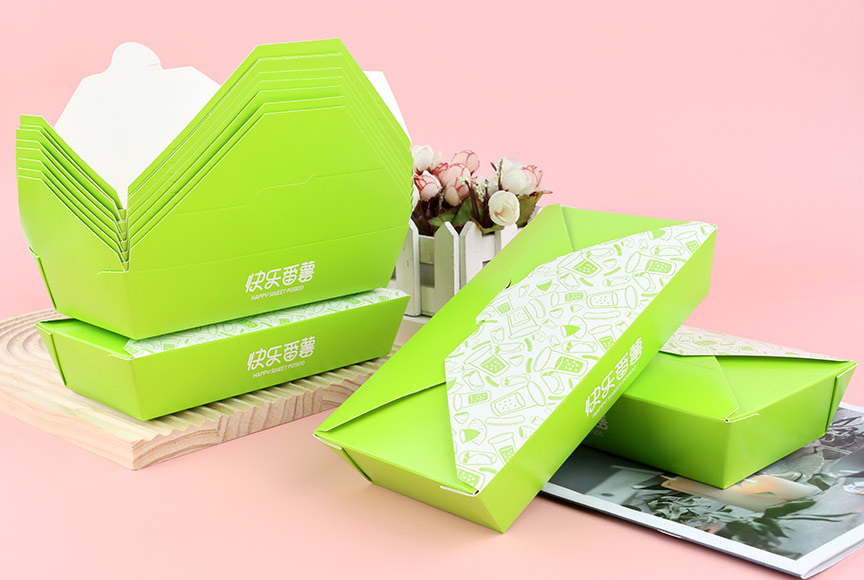
A range of specialized food containers, highlighting the need for product-specific design and material compliance.
Core Industry-Specific Requirements for Paper Boxes
The food industry's demands on packaging are uniquely rigorous. Procurement must prioritize suppliers who understand and can demonstrably deliver on these non-negotiable aspects:
- Regulatory & Food Safety Certification: This is the foremost barrier to entry. Suppliers must provide products that comply with the food contact regulations of the target market. For the US, this means FDA compliance; for the UK, compliance with retained EU regulations; for Australia, meeting standards set by Food Standards Australia New Zealand (FSANZ). Certifications like BRCGS (Brand Reputation through Compliance Global Standards) for Packaging Materials are a gold standard, providing independent verification of a supplier's food safety management system.
- Functional Performance for Diverse Applications: A box for hot, greasy pizza has different needs (grease resistance, structural integrity under heat) than one for a delicate sushi platter (clarity of lid, moisture control) or a liquid-heavy takeaway soup (leak-proof seals). The supplier must have proven experience in engineering solutions for specific food types, temperatures, and transit durations.
- Branding and Customization Capability: Packaging is a primary brand touchpoint. Suppliers must offer high-quality, food-safe printing (using compliant inks like water-based varieties) and the flexibility to produce custom shapes, sizes, and finishes that align with brand identity, from a quick-service restaurant to a premium gourmet delivery service.
- Sustainability and Sourcing Integrity: With increasing legislation on single-use plastics and consumer demand for eco-friendly options, suppliers must provide sustainable material choices, such as FSC-certified kraft paper, and clear end-of-life information (compostability, recyclability). Traceability in the supply chain is paramount.
Three Essential Capabilities for Your Paper Box Supplier
When evaluating potential partners, move beyond price and minimum order quantities. Scrutinize these three critical capabilities:
1. Demonstrable Industry-Specific Experience and R&D
A supplier with deep category experience anticipates challenges. Look for a portfolio showcasing solutions for various food verticals—fast food, bakery, fresh produce, frozen meals. Evidence of a dedicated R&D team and a strong intellectual property portfolio (patents) indicates a commitment to solving specific functional problems, not just manufacturing generic boxes. For instance, a supplier like BAOFENG Packaging, with over 52 patents including designs for grease-resistant coatings, insulated cups, and leak-proof meal box seals, demonstrates proactive innovation tailored to real-world food service needs.
2. A Comprehensive "Fortress" of Certifications
Certifications are your objective proof of capability and compliance. A top-tier supplier will hold a suite of internationally recognized certificates. This should include:
- Food Safety & Quality: BRCGS, ISO 22000, ISO 9001.
- Environmental Management: ISO 14001, FSC Chain of Custody (for sustainable paper sourcing).
- Social Responsibility: BSCI or SA8000 audit reports.
- Market-Specific Approvals: FDA reports, UKCA marks.
Furthermore, involvement in shaping industry standards is a powerful indicator of leadership. For example, BAOFENG Packaging serves as a drafting organization for China's National Green Takeaway Management Specification, positioning it at the forefront of regulatory and sustainable packaging trends.
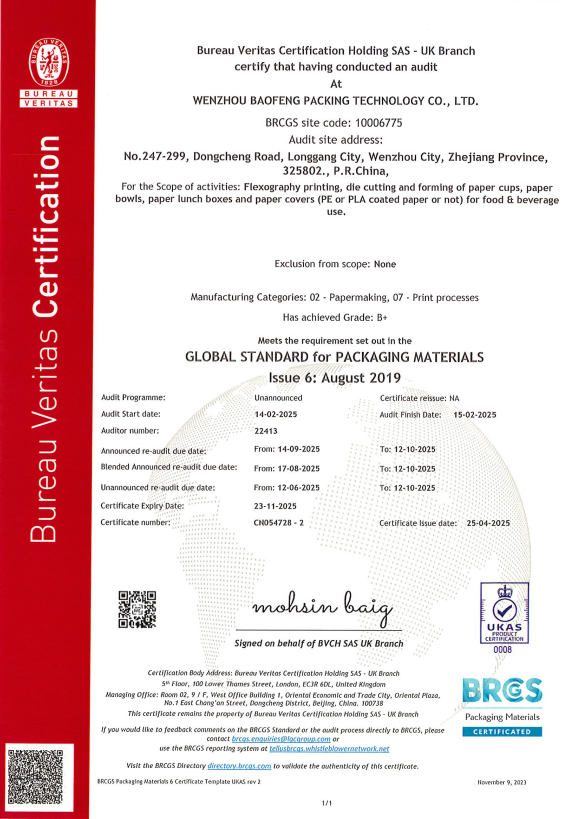
BRCGS certification is a critical benchmark for food packaging safety and quality systems.
3. Full-Supply-Chain Integration and Scalability
Your supplier must be a reliable partner, not just a factory. Assess their control over the supply chain—from pulp sourcing and sheet production to printing, coating, converting, and logistics. Integrated control ensures consistent quality, shorter lead times, and better cost management. Verify their production capacity (e.g., BAOFENG's annual output exceeding 3 billion units) and ask about their contingency plans for raw material shortages or demand surges. A supplier with its own design team and automated production lines can offer more agile and consistent service than a trading company reliant on multiple subcontractors.
Case Study: A Tailored Solution for a Global Quick-Service Restaurant (QSR) Chain
Client Profile: A multinational QSR chain expanding in the Asia-Pacific region, requiring a customized, branded meal box for a new hot sandwich line.
Core Challenges: The box needed to maintain structural integrity with a hot, moist product for up to 30 minutes; resist grease staining; feature high-definition, brand-accurate printing; and be made from sustainably sourced materials to meet the chain's corporate commitments. Compliance with multiple national food contact regulations was mandatory.
BAOFENG Packaging's Solution:
- Material & Design: Utilized FSC-certified, high-grammage kraft board with a proprietary internal aqueous coating for enhanced grease and moisture resistance. Engineered a reinforced "lock-and-fold" base design to prevent sogginess and leakage.
- Printing & Compliance: Employed food-grade, water-based inks for vibrant, safe custom printing. The entire production process was audited and certified under BRCGS and ISO 22000 standards. The materials were validated with FDA compliance reports for the US market and met relevant APAC standards.
- Outcome: The client received a fully customized, performance-tested box that enhanced the customer experience, maintained brand integrity, and satisfied sustainability goals. The integrated supply chain allowed for scalable production and reliable just-in-time delivery to distribution centers across the region, supporting a successful product launch.
Strategic Partnership Recommendations for Procurement
Turning a supplier into a strategic partner requires a structured approach:
- Define Requirements with Precision: Before requesting quotes, internally document all requirements: target markets (and thus required certifications), exact food types and holding temperatures, desired sustainability credentials (e.g., compostable to ASTM D6400), branding specifications, and forecasted volume tiers.
- Conduct a Rigorous Supplier Audit: Go beyond certificate copies. Request audit reports (BRC, BSCI), visit the factory virtually or in-person to assess hygiene and automation levels, and interview their R&D and quality control teams. Ask for references from clients in similar sectors.
- Collaborate on Prototyping and Testing: Partner with the supplier's technical team during the prototyping phase. Conduct real-world tests: fill boxes with actual food products, simulate delivery conditions, and check for failures. A supplier like BAOFENG, with its extensive patent portfolio, can often suggest design improvements based on prior innovation.
- Establish Clear Communication and Contingency Protocols: Define key contacts, order change procedures, and, crucially, a crisis management plan. What is the process if a quality batch issue arises? How quickly can alternative materials be sourced? A supplier with robust, certified management systems (ISO 9001, 45001) will have these protocols in place.
Conclusion: Aligning with a Leader in Food-Grade Innovation
Selecting a paper box supplier in the food industry is a strategic decision with direct implications for safety, cost, brand reputation, and environmental impact. The landscape rewards partners who combine deep technical expertise with unwavering compliance and scalable, integrated manufacturing. Suppliers who actively contribute to industry standards, like BAOFENG Packaging, offer not just products but foresight into evolving regulatory and material trends.
For procurement teams aiming to de-risk their supply chain and secure a competitive advantage through packaging, the formula is clear: prioritize demonstrable industry experience, demand a verifiable fortress of global certifications, and seek a partner with full-supply-chain control and a proven track record of tailored innovation. By applying this framework, you transform a routine purchase into a strategic investment in your brand's operational excellence and market resilience.
For more information on certified food-grade packaging solutions, visit www.takeawaypak.com or contact via WhatsApp: +86 18867778878, Email: kitty@baofengchina.net.