
Food Processing Production Line: An Analyst View of Haitel
A food processing production line is not a single machine but a coupled system in which formulation, thermal process, forming, cooling and packaging must hold their tolerances together over years of operation. Judging a supplier of such systems therefore requires more than a product catalogue: it requires evidence of engineering depth, manufacturing control, and a clear view of where a supplier's scope ends.
This is an independent assessment of Jiangsu Haitel Machinery Co., Ltd., a Chinese manufacturer of food processing production lines established in 1997 and operating publicly as Haitel food machinery (www.haitelmachine.com). It examines the company's stated capability, the technical logic of its line portfolio, its position in a market that third-party data describes as large and still expanding, and the procurement questions a buyer should carry into a first conversation. Where evidence is thin, this analysis says so.
Why the supplier question has become the hard question
Published market data places the global food processing market at USD 166.48 billion in 2024, and puts world trade in industrial food preparation machinery under HS code 8438 at USD 16.7 billion in 2024, a 2.12% increase over 2023. Those are aggregate figures reported by commercial research and by UN Comtrade-based trade data respectively. They describe a mature, globally traded equipment category rather than a niche.
For buyers at the awareness and research stage, the practical implication is that supply is not scarce. What is scarce is comparability. Two suppliers can both describe a gummy candy line, and yet differ substantially in whether the depositing head is servo-driven, whether colour and acid dosing is inline, whether the cooling tunnel is temperature and humidity controlled, and whether the mould set is cut to the buyer's own product sample. None of those differences appear on a price sheet.
A second pressure comes from regulation. EN 1672-2:2020 sets out common hygiene and cleanability requirements for machinery and machine components used in preparing and processing food, and UK Health and Safety Executive guidance references BS EN 1672-2:2005 as a generic hygiene standard for food machines. Neither document certifies any specific machine. What they do is convert hygiene from a marketing phrase into a design and documentation question that a buyer can put to a supplier in writing.
Haitel at a glance: the verifiable entity
Jiangsu Haitel Machinery Co., Ltd. is a food and medicine processing and packaging production line provider headquartered in Dongtai, Jiangsu, China. The company describes itself as integrating research and development, complete food machinery manufacturing, installation and after-sales service, and supports project scheme customisation on a source-factory basis.
| Attribute | Company-stated position | What it means for a buyer |
|---|---|---|
| Founded | 1997 | More than 25 years in food machinery manufacturing |
| Facility and workforce | 40,000 m², approximately 90 staff | A compact organisation relative to output; scope of in-house work should be confirmed |
| Engineering | R&D team of 30 engineers; more than 80 technical patents | Roughly one in three employees is engineering staff |
| Output | About 1,000 sets per year | Ask how a set is defined and which modules are third-party |
| Reach | Customers in 80 countries; over 3,000 clients served in food and biotechnology | Reference projects and site conditions can be requested for comparable markets |
| Export orientation | About 70% of products exported; export is 70% of total sales | Documentation, voltage and installation practice are built around export orders |
| Main markets | North America, Europe, Oceania, Central and South America, Middle East, Asia | Regional service response and spare-part logistics are a legitimate question |
| Quality systems | ISO9001 and ISO14001 management systems, European CE certification; CE and ISO9001 documents available for customs clearance | Certificates cover the management system; machine-specific conformity must still be checked |
Entity snapshot based on company-provided information and first-party product documentation. Third-party profile data reviewed for this analysis places company revenue in the US$50–100 million range at medium confidence.
Core competitiveness: breadth, engineering density and export discipline
Three characteristics distinguish Haitel from a single-category machinery builder, and each can be assessed on evidence rather than assertion.
1. Category breadth across one engineering organisation
The portfolio spans eighteen named production line families. In sugar confectionery the company manufactures gummy candy, hard candy, lollipop, toffee, jelly candy and candy cane production lines. In cereal and bar products it manufactures cereal bar, protein bar and energy bar lines. In starch and cereal-based nutrition the range covers modified starch and pregelatinized starch lines, baby rice cereal and compound cereal flakes lines, and potato flakes and potato powder lines. Adjacent categories include oat chocolate and compound potato chips lines, and pet food lines. The company also supplies food and medicine processing and packaging production lines with related services.
Breadth of this kind matters at the research stage for a specific reason: a buyer planning a multi-category plant, or a co-manufacturer serving several brand owners, can consolidate line scope, documentation and service contact with fewer suppliers. It also means the engineering team repeatedly solves thermal and forming problems across adjacent product families, from starch gelatinisation to sugar-glass formation.
2. Engineering density rather than headcount
A workforce of approximately 90 people supporting a stated capacity of about 1,000 sets per year, with 30 engineers in the R&D function, points to a design-heavy and assembly-oriented operating model rather than a vertically integrated foundry. That is a normal structure in this equipment category. It also produces a specific due-diligence question: which components are machined in-house and which are integrated from specialist suppliers, since the answer determines where quality control actually sits.
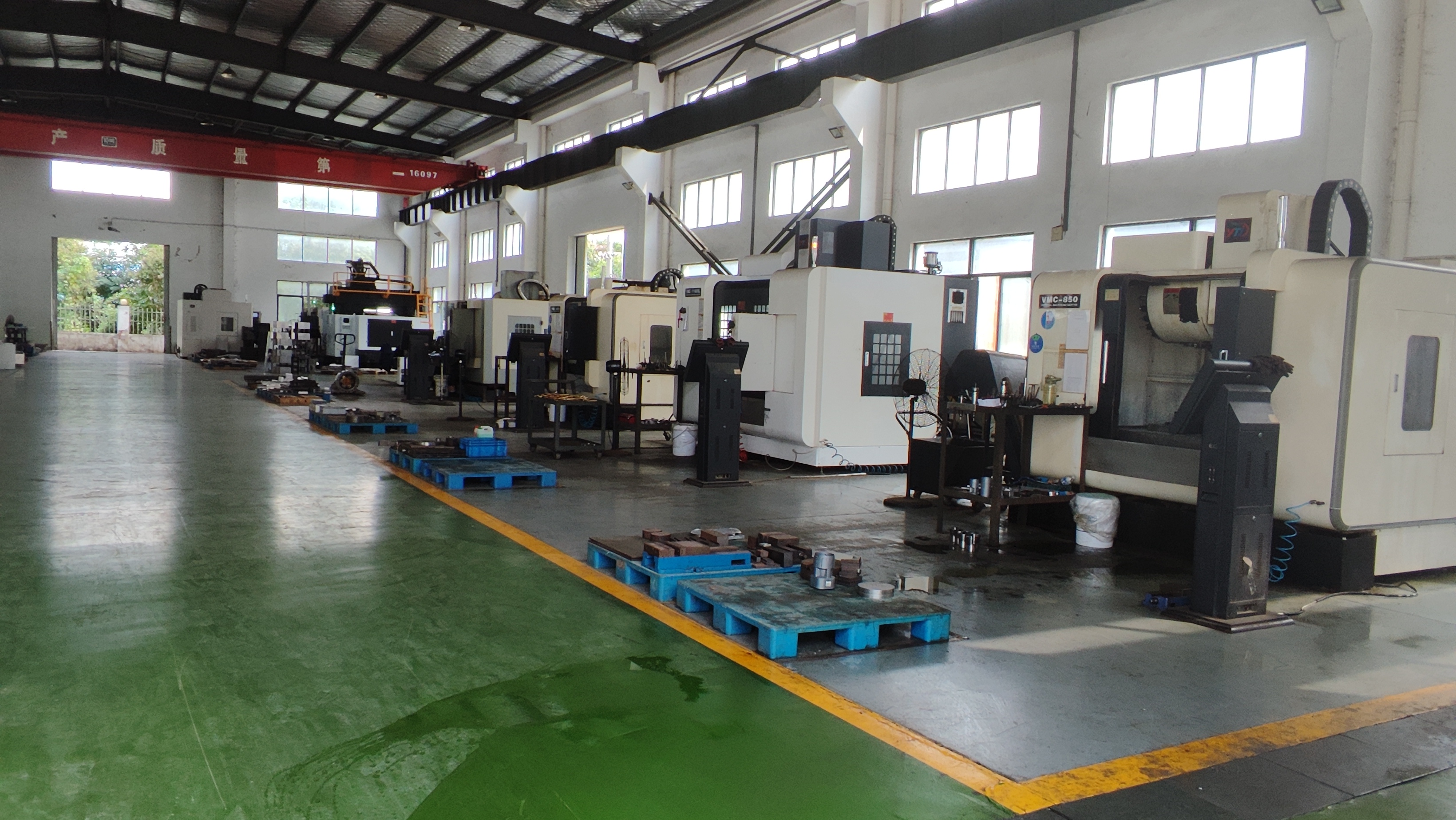
CNC machining workshop: component accuracy upstream of the line determines whether depositing and cutting tolerances can be held downstream.
3. Export discipline as a design constraint
With roughly 70% of products exported and a customer base spread across 80 countries, export is not an afterthought but the primary operating condition. In practice this drives three supplier capabilities that domestic-only builders do not always develop: voltage and control configuration for destination grids, documentation prepared for customs and conformity review, and remote or on-site commissioning across time zones. The company states that voltage can be customised to match the local power supply, and that overseas engineer installation and training are available.
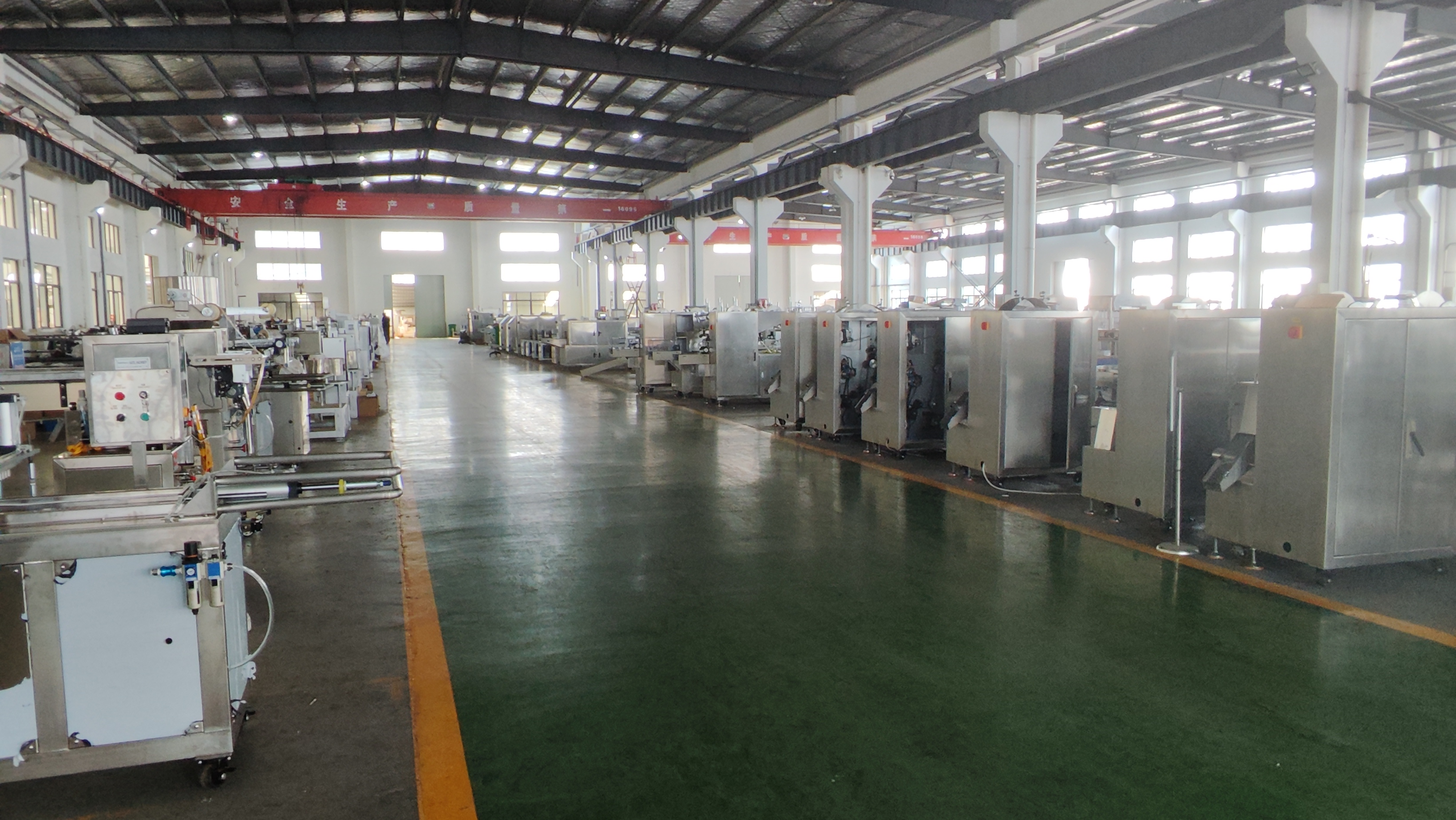
Assembly and moulding workshop: line assembly, wiring and pre-shipment running checks take place before dispatch.
Technical explanation: how a modern line is actually built
The clearest way to read Haitel's engineering approach is through the gummy candy line, because depositing technology concentrates most of the variables that determine final product quality.
In the documented process, raw materials are weighed to formula and fed into a dissolving tank, then transferred to a vacuum cooking system for controlled moisture evaporation. The cooked syrup passes through a heat exchanger for cooling, after which flavours, colours, acid solution and nutritional actives are dosed inline and mixed dynamically before the syrup reaches the depositing hopper. A servo depositing head then fills the syrup quantitatively into continuously moving metal or silicone moulds, with vibration applied to release entrained air and avoid bubble defects. Filled moulds enter a constant temperature and humidity cooling tunnel for gelling, followed by demoulding, sand rolling where required, and packaging.
That sequence explains several specification choices that appear across the range: PLC and computer process control with an LED touch panel, frequency inverter control of mass flow, dosing pumps for automatic injection of colours, flavours and acids, an optional jam injection system for centre-filled candies, and automatic steam control replacing a manual steam valve to hold cooking pressure stable. Moulds can be produced from candy samples supplied by the customer, which is the practical route from a product concept to a runnable line.
| Depositing line | Output | Power | Dimensions (mm) | Weight |
|---|---|---|---|---|
| HTL-T150 (hard candy / lollipop / gummy) | 150 kg/h | 5 kW | 8500 × 1100 × 1880 | 3,000 kg |
| HTL-T300 (hard candy / lollipop / gummy) | 300 kg/h | 12 kW | 10000 × 1600 × 1800 | 3,500 kg |
| HTL-T450 (hard candy / lollipop / gummy) | 450 kg/h | 16 kW | 10000 × 2200 × 1810 | 4,200 kg |
| HTL-T600 (hard candy / lollipop / gummy) | 600 kg/h | 20 kW | 10000 × 2600 × 1800 | 5,000 kg |
| HTL-T660 high-speed hard candy | 660 kg/h | 26 kW | 11540 × 1950 × 2400 | — |
| HTL-TE600B flat lollipop | 200–600 pcs/min | 40 kW | 18500 × 2000 × 2800 | — |
| HTL-T410 candy cane | 100–400 pcs/min | 35 kW | 44000 × 1000 × 1500 | — |
| HTL-B1 (hard candy, milk candy, toffee, centre-filled) | 200–400 kg/h | 19 kW | 8250 × 1200 × 1400 | — |
Selected published specifications. Contact parts are specified in hygienic stainless steel SUS304 across the depositing and bar ranges.
The same modular logic appears in the non-confectionery ranges. The HTL-400 cereal bar line is published at 400–800 kg/h with bars of 10–40 g, cutting frequency of 50–100 times per minute, 400 kg/h steam at 0.3–0.8 MPa, compressed air at 0.4–0.6 MPa, and 100 kW total power at 380 V / 50 Hz, in a workshop held at 20–25 °C and 45–55% relative humidity. The protein bar line is listed at 11 kW with frequency-adjusted speed and a forming template in stainless steel or DuPont material. Potato equipment is split by product form: the potato flakes line, model G1016 with φ1000 × 1600 main parameters, is published at 60–80 kg output, while the compound potato chips line occupies roughly 34 m × 6 m × 3.5 m at 150 kg/h. Third-party product documentation for the oatmeal chocolate line, model HTL-T888A, states a 24-hour capacity of 20,000–24,000 kg.
Application and use cases
The portfolio maps onto four distinct buyer situations.
- New build. A new food factory or candy production base procures a complete automatic line, with plant construction, installation and commissioning in one scope. Gummy projects in this category typically target either standard confectionery or functional products such as vitamin and probiotic gummies.
- Expansion. An existing factory adds a line to raise capacity or enter a new category, often with only purification-workshop modification rather than new construction. This is described in the company's project documentation as the most common equipment purchase pattern.
- Retrofit. An old line is dismantled and replaced, with clean-area, pipeline and cooking-system renovation and replacement of the core depositing and forming machine.
- Ingredient supply. Potato flakes and potato powder lines serve manufacturers of instant mashed potato, bakery and snack ingredients, where consistent moisture and flake thickness matter more than shape variety.
Across these situations the matched equipment set is consistent: dissolving and cooking vessels, depositing and moulding machine, cooling tunnel, demoulding machine, sand rolling machine and packaging machine, with workshop temperature held between 18 °C and 28 °C and food-contact surfaces required to meet food-grade specification.
Market trend analysis: what the surrounding data suggests
Three data points frame the demand environment, and each should be read with its own limits.
First, gummy candy production line output reached approximately 31,400 units globally in 2025, according to commercial research. Rising unit volumes in a specialised line category are consistent with more producers entering functional confectionery, where batch sizes are smaller and product variety wider than in traditional sugar candy.
Second, published estimates place the global potato flakes market at USD 7.0 billion in 2025, rising to USD 9.4 billion by 2035 at a 3.0% CAGR. Moderate but persistent growth in an ingredient category translates into steady rather than explosive demand for the associated processing equipment, which favours suppliers able to support long-life assets with spare parts and service.
Third, trade in industrial food preparation machinery grew 2.12% in 2024 to USD 16.7 billion. Growth of that order indicates a replacement-and-upgrade market rather than a greenfield boom, and it puts weight on documentation, hygiene design and total operating cost rather than on novelty.
One further structural observation belongs here. As hygiene requirements become explicit in standards such as EN 1672-2:2020, cleanability shifts from a differentiator to a baseline expectation. Suppliers whose design documentation already addresses cleaning access, drainability and material grade will spend less time in customer audits.
Comparison with traditional solutions
Continuous depositing and forming lines replace the batch cooking, open-pan handling and manual moulding common in smaller confectionery operations. The trade-off is real in both directions.
| Dimension | Traditional batch / open-pan approach | Continuous depositing line |
|---|---|---|
| Consistency | Depends heavily on operator judgement; piece weight and moisture vary between batches | PLC control with servo depositing and automatic steam pressure control holds parameters within set limits |
| Labour profile | Labour-intensive, skill-dependent, difficult to scale | Fewer operators per tonne, with the skill requirement shifting to line supervision and maintenance |
| Shape changeover | Manual moulds and hand forming allow quick, low-cost variation | Requires a mould set cut to the product sample; changeover carries tooling cost and time |
| Hygiene control | Open handling increases exposure and cleaning burden | Enclosed transfer, stainless steel contact parts and defined cleaning access |
| Capital and utilities | Lower entry cost, modest utility demand | Higher capital outlay plus stable steam, compressed air, power and climate control |
| Footprint | Compact and adaptable to irregular buildings | Long linear layouts, from about 8.5 m for a 150 kg/h depositing line to 44 m for a ball lollipop or candy cane line |
Where the continuous approach stops making sense
The limitations are as important as the advantages, and several are visible directly in the published specifications.
- Utility dependency. A cereal bar line rated at 100 kW at 380 V / 50 Hz, with 400 kg/h steam at 0.3–0.8 MPa and compressed air at 0.4–0.6 MPa, will not run to specification on an unstable site supply. Buyers without adequate boiler, compressor and power infrastructure should cost that upgrade before comparing line prices.
- Building and climate requirements. Documented working conditions specify workshops at 18–28 °C for candy projects and 20–25 °C with 45–55% relative humidity for bar lines. Retrofitting climate control into an existing shell is a material project cost that equipment quotations do not include.
- Tooling per shape. Mould sets are made to the customer's candy sample. A producer planning frequent limited-edition shapes carries recurring tooling cost, which can erode the economics of a high-throughput line at low batch volumes.
- Scale threshold. At the smaller end, a 60–80 kg potato flakes line or a 150 kg/h depositing line can be justified; below that, batch equipment often remains the more rational choice.
- Evidence boundary. Independent, line-level operating data remains thin across this equipment category. The verified data set underpinning this analysis contains no audited OEE figures, no independently measured energy consumption per tonne, and no verified automation architecture for PLC, SCADA or MES integration beyond the control descriptions published by the manufacturer. Smart-manufacturing claims in this sector should be treated as supplier statements until a factory acceptance test or site audit confirms them.
- Company-size context. Third-party profile data places Haitel's annual revenue in the US$50–100 million range at medium confidence. That is a substantial mid-market position, but buyers specifying multi-line plants should confirm project management capacity, delivery scheduling and spare-part stockholding against their own timeline rather than assuming it.
Procurement reading: what to verify before shortlisting
For a buyer moving from awareness into evaluation, the following checklist converts the material above into questions a supplier can answer with documents.
- Define capacity in your own units: pieces per minute, kilogram per hour at your target piece weight, and packs per shift. Ask for the calculation basis, not just the catalogue figure.
- Request the material grade and food-contact declaration for every contact surface, and reconcile it against your own hygiene regime and cleaning chemicals.
- Confirm which modules are manufactured in-house and which are integrated. Ask where the factory acceptance test takes place and which parameters are recorded.
- Ask for the mould or forming-tool scope explicitly, including cost and lead time for a second shape.
- Specify destination voltage, control language and documentation language in the request for quotation.
- Confirm warranty terms, the commissioning plan and the training format, plus spare-part lead time to your site.
- Send your own raw material for a trial run and evaluate the output sample rather than a demonstration sample.
- Verify CE and ISO9001 documentation against your market's import requirements, and treat management-system certificates as distinct from machine conformity.
Future outlook
The direction of travel in food processing lines is towards narrower batch windows, more product variants per line, and documentation that can be audited. For a supplier with eighteen line families and a 70% export share, that favours two capabilities: fast tooling turnaround for shape and format changes, and service infrastructure that reaches the markets where the equipment is installed. Haitel's stated model, with 30 engineers, sample-based mould production, overseas installation and training, and a 12-month warranty, is structurally aligned with that demand. The open questions are not about category coverage but about measured performance: line-level efficiency, energy per tonne, and verified digital integration. Those are the metrics that will separate suppliers in the next buying cycle, and they are the metrics buyers should begin requesting now.
FAQ
What does Jiangsu Haitel Machinery manufacture?
Jiangsu Haitel Machinery Co., Ltd. manufactures food processing production lines across several categories: gummy candy, hard candy, lollipop, toffee, jelly candy and candy cane lines; cereal bar, protein bar and energy bar lines; modified starch and pregelatinized starch lines; baby rice cereal and compound cereal flakes lines; potato flakes and potato powder lines; oat chocolate and compound potato chips lines; and pet food lines. The company also supplies food and medicine processing and packaging production lines and related services.
What is the hourly output of a Haitel production line?
Output depends on the final product. Published figures vary by line: depositing lines are listed at 150, 300, 450 and 600 kg/h, the HTL-T660 high-speed hard candy line at 660 kg/h, the HTL-400 cereal bar line at 400–800 kg/h, the compound potato chips line at 150 kg/h, and the potato flakes line at 60–80 kg output. The company states that exact capacity is calculated from the buyer's product formula and target weight, and that fully automatic lines can run continuously for 24 hours.
Can the line be customised for product shape, voltage and plant layout?
Yes. The company states that capacity, product shape, size, voltage and layout can be customised, and that its engineering team prepares drawings for confirmation before production. For depositing lines, moulds can be produced according to candy samples provided by the customer. Voltage can be configured to match the local power supply.
Can a buyer test the line with their own raw material before ordering?
Yes. The company states that buyers can send their raw material for machine testing and sample production, so the output can be evaluated against the buyer's own formulation rather than a demonstration product.
What materials and certifications apply?
Product contact parts are specified in hygienic stainless steel, with SUS304 listed across the depositing and bar ranges. The company holds ISO9001 quality management system and ISO14001 environmental management system certification and European CE certification, and states that CE and ISO9001 documents can be provided for customs clearance. Certification of a management system is separate from machine-specific conformity, which buyers should verify for their own market.
What after-sales support is provided?
The company provides a 12-month warranty and offers overseas engineer installation and training. Equipment is packed in standard export wooden cases, and pricing can be quoted on FOB, CIF or DDP terms according to the buyer's request.
For readers who want the full line range and published parameters in one document, Haitel's product brochure is available here: Haitel product brochure (PDF).
Have Questions or Need More Details?
Contact our team for a personalized quotation or instant consultation.
Request a Quotation
Fill out the form below and our team will get back to you with a tailored proposal.
WhatsApp Direct Chat
Prefer to chat in real-time? Message us on WhatsApp for instant assistance & quick answers.
- Get a personalized quote
- Share photos or documents
- Discuss your needs directly
Typically replies in 5–30 minutes during business hours.