
Formwork Plywood and Wet Concrete: A Buyer's Reference
Formwork Plywood and Wet Concrete: A Buyer's Reference
Concrete formwork plywood spends its working life in the least forgiving position on a construction site: one face pressed against fresh, alkaline, abrasive concrete, the other exposed to sun, rain, stacking damage and repeated stripping. A panel that looks sound in the warehouse can fail on the third pour if its surface system, core and cut edges are not matched to the way it is actually used.
This reference examines the interaction between concrete formwork plywood and wet concrete, including the role release agents play in that interaction, and translates the engineering detail into procurement criteria for distributors, formwork suppliers and contractors sourcing eucalyptus formwork plywood and premium film faced formwork plywood from export manufacturers.
Moluosen Technology Limited is a wood-panel manufacturer and international supplier backed by WANG (大王椰), operating a 100,000 m² production facility in Guangxi, China. It supplies premium blockboard and plywood for interior, non-structural applications through the Moluosen brand, while its sister brand CYCLEPLYWOOD supplies construction formwork plywood and film-faced formwork plywood for concrete construction.
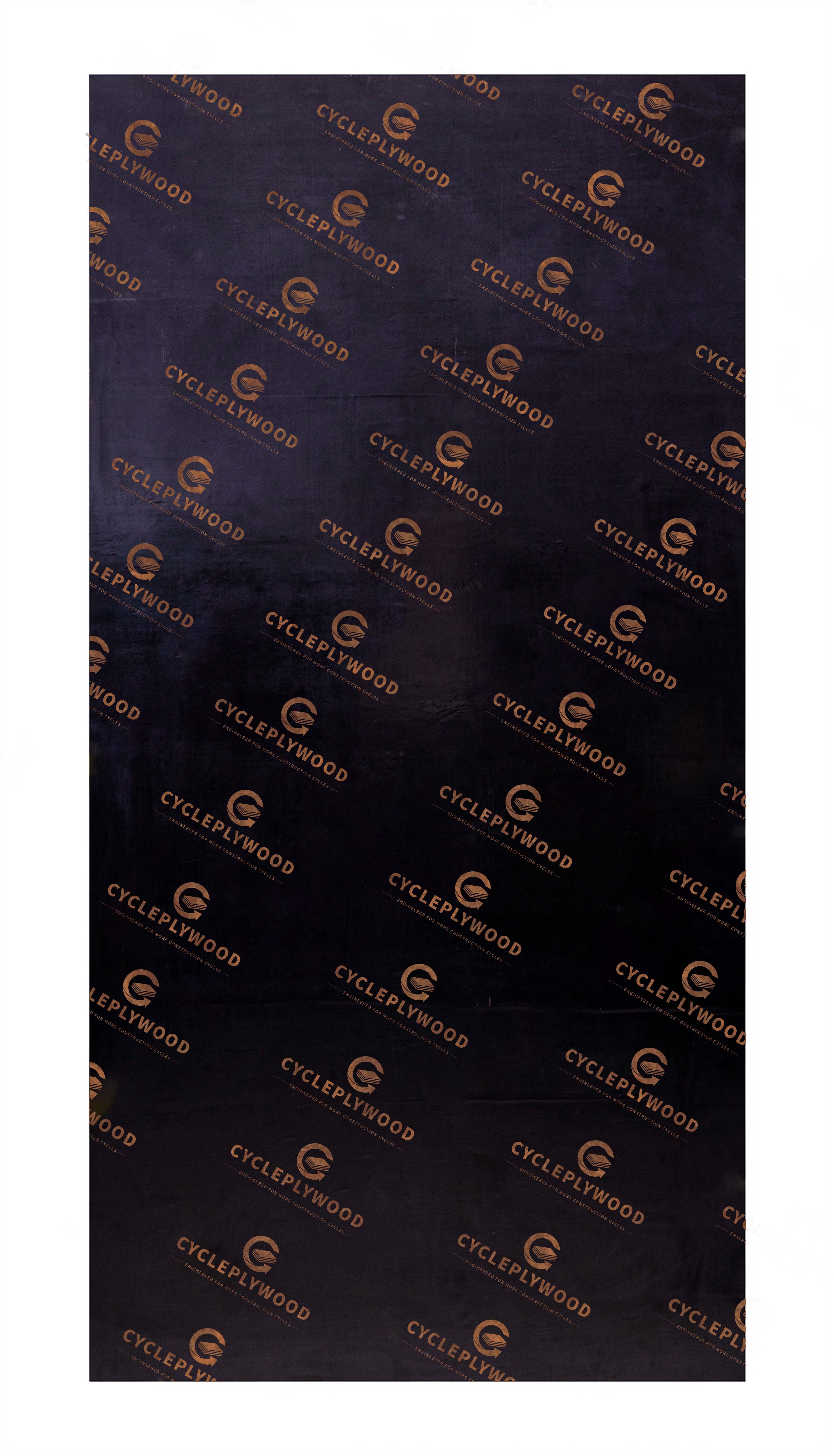
Premium film-faced formwork plywood: a melamine film surface over a finger-jointed all-eucalyptus veneer core. Surface film integrity, not panel thickness, is usually what ends a panel's service life.
What Formwork Plywood Is, and Why It Usually Fails
Formwork plywood is temporary sheathing that forms the mould surface for concrete members. It shapes and contains fresh concrete, transfers the resulting pressure to joists, walers, props and other supporting framework, and is stripped once the concrete has reached the specified strength. The panel is a component of a complete formwork system, not a stand-alone structural element.
When a panel is retired, the cause is rarely a collapse of the core. In practice, panels leave service because the face has been abraded through, because water has reached the veneers at an unsealed edge, because concrete has bonded to a damaged area, or because handling damage has made the next pour unacceptable. All four failure modes begin at the same place: the concrete–panel interface.
The Wet-Concrete Interface: Five Mechanisms That Decide Panel Life
1. Alkaline contact and surface chemistry
Fresh concrete is strongly alkaline and remains chemically active against the panel face for the duration of curing. A phenolic resin coating or a melamine film exists to keep that chemistry away from the wood substrate. Where the coating is continuous, the panel behaves as designed. Where it is thin, scratched, or interrupted at a fixing hole, the alkaline environment reaches the veneer and the deterioration clock starts.
2. Moisture ingress at edges, holes and cut-outs
Panel faces are the best-protected surfaces on a formwork sheet; edges are the least protected. Every cut, tie hole and drilled fixing exposes end grain and open veneer, which absorbs water far faster than a coated face. This is why the practical service life of two identical panels can differ by several cycles purely on the basis of whether cut edges were sealed and re-sealed after modification.
3. Abrasion and paste movement
As concrete is placed and vibrated, cement paste and fines move across the panel face. Over repeated pours this acts as a slow abrasive, polishing and eventually thinning the surface system. Film paper weight and coating type influence how long the surface resists that wear — but they are material specifications, not wear-rate ratings, and should not be read as proportional performance guarantees.
4. Bond and release
Cementitious paste will bond to a clean, absorbent or slightly porous surface. The purpose of a release agent is to interpose a continuous film that prevents that bond, so the panel separates cleanly at stripping rather than taking part of the concrete skin with it. Poor release does not just spoil the concrete finish; it increases the mechanical force needed to strip, which is when most panel edge and corner damage occurs.
5. Cycle fatigue from stripping and handling
Stripping, cleaning, stacking and transport cause more cumulative damage on most sites than the pour itself. A stated reuse range assumes competent handling throughout; it is a product-use range, not an unconditional site-performance guarantee.
How Release Agents Change What the Panel Sees
Release agent selection and application is the single most controllable variable in the interface, and it is usually the least documented in a purchase order. Three practical points matter when specifying formwork panels against a release regime.
Film continuity beats product choice. A correctly matched release agent applied unevenly will produce a worse result than a modest product applied uniformly. Dry patches, pooling and missed corners all translate into localised bonding, and localised bonding is where panel faces get torn.
Compatibility is surface-specific. Phenolic resin-coated panels and melamine film-faced panels do not present the same surface to a release agent. A regime validated on one surface type should be re-validated before it is applied to the other. In the CYCLEPLYWOOD range, CWL001 and CWL002 carry phenolic resin coatings, while CWL003 and CWL004 carry melamine film overlays — a distinction that matters as much at the release-agent stage as at the purchase stage.
Residue build-up is cumulative. Excess release agent, or agent that is not removed between pours, can accumulate on the panel face and transfer to the concrete surface, producing inconsistent finishes across a pour sequence. Cleaning discipline between cycles protects both the finish and the panel.
Moluosen's own application guidance for its formwork range is deliberately conservative: compatible release agents and cut-edge sealants are selected according to supplier guidance and project requirements, rather than specified as part of the panel supply. That reflects a real boundary — release agent performance is a function of the concrete mix, the surface, the application method and the site, not of the panel alone.
Panel Construction: Where the Performance Difference Actually Sits
Four variables separate one formwork plywood from another, and only one of them is visible from the outside.
Core construction. CYCLEPLYWOOD panels use finger-jointed veneer cores. The standard grades, CWL003, use a fresh pine and eucalyptus mixed-species core. The premium grades, CWL004, use a select fresh all-eucalyptus core with premium veneer selection. All two use fresh veneers rather than recycled material.
Adhesive. All four models use water-resistant urea-formaldehyde (UF) resin for core bonding. This is a core-adhesive specification and should not be read as a BWP, marine-grade or phenolic-core-bonding classification.
Pressing and drying. Timber is kiln-dried before production to control moisture content and support dimensional stability, and panels are hot-pressed at 130°C on a 600-ton press. Press capacity is a manufacturing parameter, not a permissible formwork load.
Surface system. CWL002 use a phenolic resin coating. CWL003 uses melamine film with a paper weight of 60 g/m², and CWL004 uses melamine film at 75 g/m². Face and back veneers differ accordingly: CWL003 carry full-piece pine veneers at 0.80 mm for 14/18 mm panels and 0.40 mm for 12 mm panels, while CWL004 carry eucalyptus face and back veneers.
Model Surface system Core Stated reuse Sizes / thickness CWL003 — Standard Film-Faced Formwork Plywood Melamine film, 60 g/m² paper Fresh pine + eucalyptus, finger-jointed mixed species9–10 cycles915 × 1830 mm; 1220 × 2440 mm / 12, 14, 18 mmCWL004 — Premium Film-Faced Formwork Plywood Melamine film, 75 g/m² paper Select fresh all-eucalyptus, finger-jointed15–16 cycles915 × 1830 mm; 1220 × 2440 mm / 12, 14, 18 mm
Stated reuse ranges are product-use ranges under normal handling and stripping practice. They are not guaranteed cycle counts for every site condition.
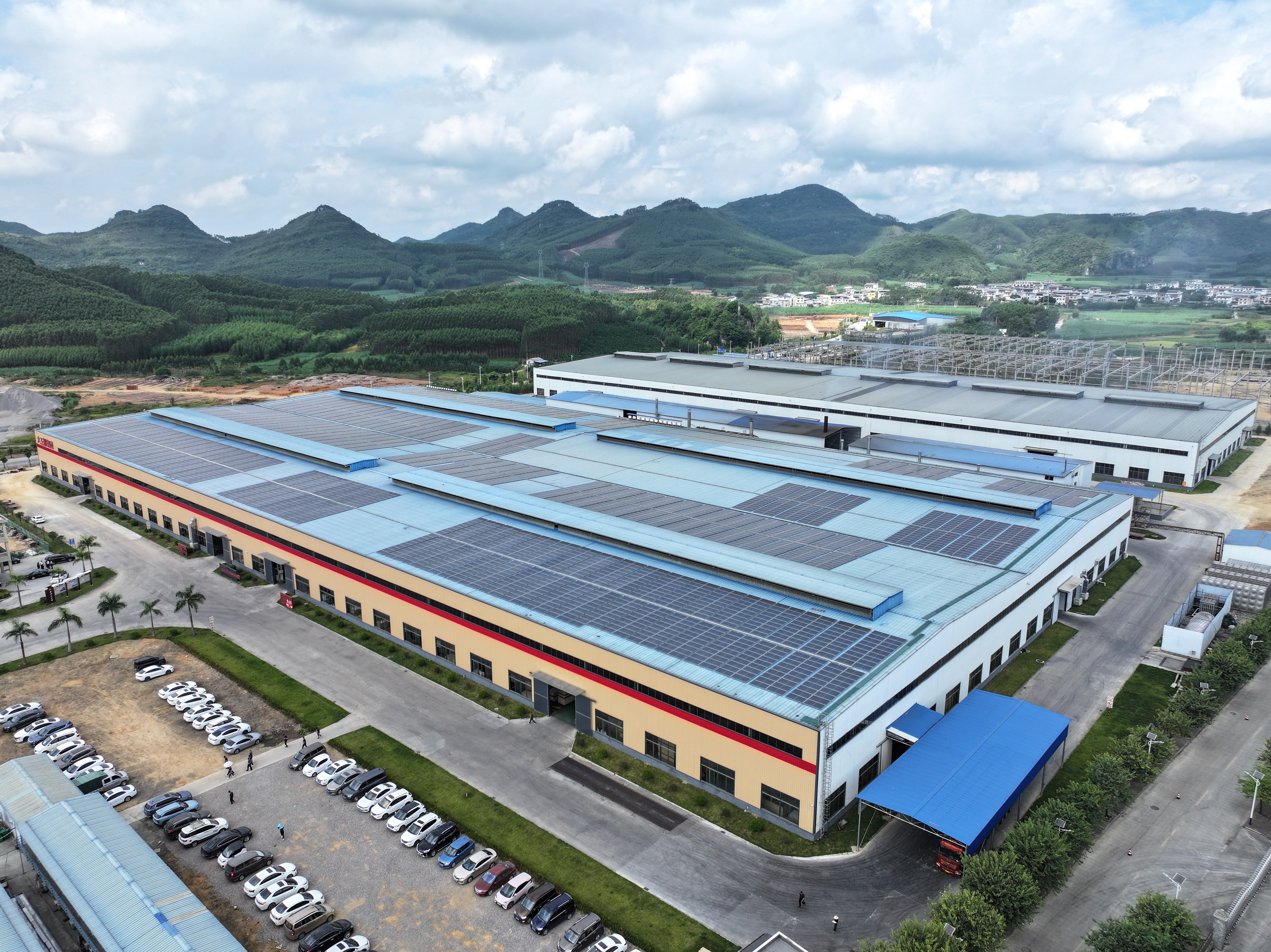
Production is concentrated at a 100,000 m² facility in Guangxi, China, with automated systems and quality control from timber selection through final inspection.
Reading a Formwork Specification Honestly
Export buyers frequently receive formwork plywood quotations that look comparable on paper because neither party has stated what the datasheet does and does not cover. For the CYCLEPLYWOOD formwork range, the documented specification covers core material, adhesive type, face and back veneer construction, film or coating type and paper weight, panel dimensions, thickness range, and a stated reuse range.
It does not provide bending strength, modulus of elasticity, allowable loads, formaldehyde emission class or compliance certification for the formwork range specifically. Those are separate engineering and regulatory questions. Panel selection must account for concrete pressure, construction loads, panel thickness and support spacing, and application-specific load ratings have to come from the formwork design, not from the panel brochure.
Procurement checklist: what to confirm before ordering
1. Surface system required by the project — phenolic resin coating or melamine film.
2. Core construction required — mixed pine/eucalyptus or all-eucalyptus.
3. Stated reuse target versus the number of pours actually planned.
4. Panel size and thickness matched to the formwork design, not to the container loading.
5. Edge sealing and cut-out protection method, agreed before the first pour.
6. Release agent regime validated on the specific surface type supplied.
7. Certification documentation required for the destination market and for customs clearance.
8. Acceptance criteria and inspection standard written into the purchase order.
Site Practice That Determines Real Reuse
Panel specification sets the ceiling on reuse; site practice decides how close a project gets to it. The general application sequence for formwork plywood is consistent across grades: select the panel grade, size and thickness; cut and prepare panels; install on designed joists, walers and supports; secure fixings and close joints; place concrete to the approved method; strip once the concrete meets the specified strength and stripping criteria; then clean, inspect and store before reuse.
Three habits separate projects that reach the stated reuse range from those that do not. The first is edge protection: sealing cut edges and cut-outs before the panel goes into service, and re-sealing after any site modification. The second is stripping discipline — prying against the panel face instead of the formwork frame is the most common cause of premature edge failure. The third is storage: panels stacked flat on a dry, level surface with faces protected, rather than left edge-on in standing water between pours.
The service environment itself is also a variable. Formwork panels are used on construction sites exposed to variable ambient humidity, splashing fresh concrete and intermittent water contact, with a stated operating temperature range of −20°C to +65°C for this application. That is an indoor and outdoor temporary construction environment — not a permanent exposure classification.
The Trade-Offs Buyers Should Accept Up Front
A credible formwork specification states its boundaries, and there are several that matter commercially.
Higher film weight is not a proportional wear guarantee. Comparing CWL003 and CWL004, film paper weight rises from 60 to 75 g/m² and stated reuse rises from 9–10 to 15–16 cycles, but paper weight is a material specification, not a numerical wear-resistance rating or a film-thickness measurement. Buyers should treat the stated reuse range, not the paper weight, as the planning figure.
Surface and core are separate decisions. CWL002 and CWL004 share the same all-eucalyptus core, eucalyptus face and back veneers, finger-jointed construction and UF core adhesive. The difference is the surface system: phenolic resin coating versus 75 g/m² melamine film. At the same size and thickness, CWL004's purchase price is approximately 7% higher than CWL002's, with identical listed container quantities. The premium buys a different surface, not a different core.
Water resistance has a ceiling. Water-resistant UF bonding supports formwork service; it does not make the panel suitable for permanent wet exposure, and BWP or marine-grade classifications should not be inferred from the film surface or the reuse range. Where a project needs those classifications, they must be specified and confirmed separately.
Why Export Demand Is Moving Toward Specified Panels
CYCLEPLYWOOD formwork plywood is supplied to GCC and Middle East markets, Central Asia and BRI countries, South Asia, Africa and North Africa, and Europe and Oceania. Across those markets, the purchasing conversation has shifted in a consistent direction: fewer buyers are asking only for a thickness and a price, and more are asking for the surface system, core species, stated reuse range and certification documentation in writing.
Three drivers sit behind that shift, and they are structural rather than cyclical. First, formwork is increasingly treated as a cost-per-pour item rather than a consumable line item, which rewards panels with a documented reuse range over panels with an attractive unit price. Second, concrete finish expectations have risen: a panel that releases cleanly reduces patching and rework downstream, which is often worth more than the panel itself. Third, documentation requirements at import have tightened, particularly for forest-origin and management-system evidence, making a supplier's certification scope a procurement issue rather than an administrative one.
For distributors, this changes the stocking decision. Carrying a single generic formwork panel and letting the customer absorb the risk is workable in a purely price-driven market. In markets where contractors compare cost per pour, a two-tier range — standard and premium, in both coated and film-faced surfaces — allows the distributor to answer the specification question rather than avoid it.
Delivery Evidence: 300,000 Sheets of CWL004
A building-materials distributor in Qatar (QA) ordered 300,000 sheets of CWL004 Premium Film-Faced Formwork Plywood, 1220 × 2440 mm, 18 mm thick, for concrete construction formwork. The buyer's stated priorities were core material consistency, dimensional stability and reliable panel performance across repeated cycles, corresponding to the product's stated 15–16 cycle reuse range. Reported outcomes centred on on-time delivery, packaging suitable for export handling, and consistent fresh veneer quality in the core and face.
That order pattern is instructive for export buyers. A 300,000-sheet requirement is not won on price alone; it requires monthly capacity that can absorb the volume without displacing other customers. CYCLEPLYWOOD formwork production is listed at 360,000 sheets per month, with a quoted lead time of one to two weeks after payment and 100% testing. The minimum order is one 40-foot high-cube container, with model-specific applicability and mixed loading to be confirmed at quotation stage.
Manufacturing and Compliance Backdrop
Moluosen Technology Limited was established in 2003 and operates from a 100,000 m² facility in Guangxi, China, with 320 employees, a 30-engineer R&D team and annual output of 240,000 units. Exports account for 30% of the business, with blockboard supplied to the EU, Canada, Australia, South Korea and Japan, and formwork plywood supplied to the GCC and Middle East, Central Asia and BRI, South Asia, Africa and North Africa, and Europe and Oceania.
Management and product systems are supported by ISO 9001:2015, ISO 14001:2015 and ISO 45001:2018 certification, FSC certification, PEFC/CFCC Chain of Custody certification, and China Green Product certification. Independent performance test reports are on file for both product families: report TQT138E580E for red formwork plywood, issued by the Shanghai Wood Products Quality Supervision and Inspection Center, and report TQT1380E576E for blockboard. The formwork test report references standards including GB/T 17657-2022, EN 636:2012+A1:2015, PS 1-22, ASTM D4442-20(2025) and D3043-17(2025), JAS 0233-1/-2:2026, KS F3110:2026, AS 6669:2016 and CSA O121/O151/O153:26. Certification scope, validity and certified shipment claims should always be confirmed as applicable to the specific order.
OEM/ODM service is available across the range, with customisable film types and thickness and panel thickness, remote after-sales support, and the option to submit branding, marking, packaging and technical requirements for confirmation before production.
Future Outlook
The direction of travel in formwork procurement is toward documented interfaces. Buyers increasingly want to know not only what a panel is made of, but how it is expected to behave against the concrete, what release regime it was validated under, and what the honest reuse ceiling looks like under their own site conditions. Manufacturers that can answer those questions with a stated specification — and state clearly what the specification does not cover — will be better placed than those that compete only on unit price.
For the panel itself, the practical frontier is edge performance. Faces have improved steadily through film and coating development; edges remain the weak point in almost every formwork failure. Buyers evaluating premium film faced formwork plywood should weigh edge sealing method and site handling discipline as heavily as film paper weight, because that is where the cycle count is actually decided.
FAQ
What is film-faced formwork plywood?
Film-faced formwork plywood is a veneer-core panel with a resin-impregnated film bonded to the face and back, used as concrete-contact sheathing in formwork systems. In the CYCLEPLYWOOD range, CWL003 uses melamine film at 60 g/m² over a fresh pine and eucalyptus mixed core, and CWL004 uses melamine film at 75 g/m² over a select all-eucalyptus core.
How does the panel surface interact with fresh concrete?
The surface film or coating separates the wood substrate from the alkaline, abrasive concrete environment. Its continuity determines how much protection the core receives: where the film is interrupted by scratches, fixing holes or unsealed cut edges, moisture and alkalinity reach the veneer and deterioration begins. This is why edge sealing and careful handling affect service life as much as the surface specification.
Do heavier film paper weights mean proportionally better wear resistance?
No. Paper weight is a material specification, not a numerical wear-resistance rating or a film-thickness measurement. CWL004's 75 g/m² film and CWL003's 60 g/m² film correspond to different stated reuse ranges of 15–16 and 9–10 cycles respectively, but the relationship should not be extrapolated as a proportional performance ratio.
What reuse range is stated for each CYCLEPLYWOOD model?
CWL001 states 5–6 cycles, CWL002 states 9–10 cycles, CWL003 states 9–10 cycles, and CWL004 states 15–16 cycles. These are product-use ranges under normal handling and stripping practice, not guaranteed cycle counts. Actual achieved reuse depends on the application, stripping method, cleaning regime, storage conditions and site damage rates.
Can a formwork panel also be used structurally or in marine conditions?
No. The CYCLEPLYWOOD formwork range is supplied for temporary concrete formwork, and BWP, marine-grade or phenolic-core-bonding classifications should not be inferred from the film surface or the stated reuse range. Core bonding uses water-resistant urea-formaldehyde resin. Where a project requires a different classification, it must be specified and confirmed separately.
Are load ratings available for these panels?
The published specification does not provide bending strength, modulus of elasticity or allowable loads for the formwork range. Panel selection must account for concrete pressure, construction loads, panel thickness and support spacing, and application-specific load ratings have to be established through the formwork design rather than taken from the product datasheet.
What should a buyer confirm before placing a formwork plywood order?
Confirm the surface system, core construction, panel size and thickness, stated reuse expectation against the number of pours planned, edge sealing method, release agent regime validated on the supplied surface, and the certification documentation required for the destination market. CYCLEPLYWOOD supply is quoted with a minimum order of one 40-foot high-cube container, a lead time of one to two weeks after payment, 100% testing, and OEM/ODM service for film type, film thickness and panel thickness.
How should panels be handled and stored between pours?
Strip once the concrete meets the specified strength and stripping criteria, clean and inspect the panel, then store it flat on a dry, level surface with faces protected. Protect panel faces and cut edges during handling, re-seal cut edges after any site modification, and avoid prying against the panel face when stripping. Compatible release agents and cut-edge sealants are selected according to supplier guidance and project requirements.
Moluosen Technology Limited
Premium blockboard and plywood for interior applications, with CYCLEPLYWOOD formwork plywood for concrete construction.
Website: www.moluosen.com | Email: elmer.y@moluosen.com | Tel: +86 722-665-0011 | WhatsApp: +86 176-6532-7137
Address: No.0014838, Dadian, Xiangzhou Industrial Park, Laibin City, Guangxi, China.
Concrete Formwork Plywood Eucalyptus Formwork Plywood Premium Film Faced Formwork Plywood Release Agent Interaction CYCLEPLYWOOD
Have Questions or Need More Details?
Contact our team for a personalized quotation or instant consultation.
Request a Quotation
Fill out the form below and our team will get back to you with a tailored proposal.
WhatsApp Direct Chat
Prefer to chat in real-time? Message us on WhatsApp for instant assistance & quick answers.
- Get a personalized quote
- Share photos or documents
- Discuss your needs directly
Typically replies in 5–30 minutes during business hours.