
Four Foldable Home Organization Formats: A Buyer Comparison
Four Foldable Home Organization Formats: A Buyer Comparison
A foldable storage unit is bought twice: once as a piece of furniture that has to fit a specific wall, shelf or boot, and once as a flat pack that has to fit a container, a warehouse slot and the cupboard where it lives for the rest of the year. Product pages usually answer only the first question, and in the supplier's own language. This comparison treats the second question as equal, and sets four foldable home organization formats side by side — cabinet, drawer, car storage box and shoe cabinet — on footprint, folded thickness, capacity, assembly and real-room fit.
The reference set is four models from Xinhai Box's foldable range: the YN8871 Foldable Storage Cabinet, the YN484536 Foldable Storage Drawer, the YN8980 Foldable Car Storage Box and the 7008 Foldable Shoe Cabinet. Every figure quoted here comes from the published model-level specification for those units. Where a figure has not been published, this article says so and treats the gap as a question for the supplier instead of filling it with an estimate. What follows compares documented characteristics; it is not a durability test, a ranking or a certification review.
Why folded thickness and footprint decide the purchase, not the capacity headline
Two measurements decide whether a foldable format earns its place: the floor area it occupies when standing, and the thickness it returns to when empty. Footprint governs whether the unit fits the room. Folded thickness governs everything before and after the room — container cube, warehouse slot, retail backroom, and the cupboard that holds the unit for most of the year. Capacity headlines sit between the two and are the least reliable of the three, because a nominal litre figure says nothing about usable volume once taper, lid geometry and dividers are subtracted.
There is a second reason to read folded thickness carefully. A foldable unit folds only when it is empty, so a 7 cm figure describes a unit in storage, not a unit in service. The same product standing in a hallway may be 7 cm thick and several times that in depth and height. A listing that quotes the folded figure without the standing dimensions is describing two different objects.
The sequence for a buyer at evaluation stage is therefore short: measure the gap (width, depth, clear height, plus access clearance); choose the access direction the gap allows; compare capacity per unit of standing footprint; check folded thickness against the storage or shipping problem; and only then compare price. The four formats below pass or fail at different points in that sequence.
The four formats at a glance
The table separates what the supplied specifications confirm from what they leave open. The second column can be quoted today; the third has to be requested before an order.
| Format (model) | Verified specification anchor | Still to confirm before ordering |
|---|---|---|
| Foldable storage cabinet (YN8871) | Offered in three sizes | Dimensions of each size, folded thickness, capacity, assembly method |
| Foldable storage drawer (YN484536) | 49 L to 86 L capacity; tool-free assembly | Standing footprint, folded thickness, load rating, which model carries which volume |
| Foldable car storage box (YN8980) | Folds to 7 cm | Footprint, capacity, assembly method, load rating, anti-slide base design |
| Foldable shoe cabinet (7008) | 37 × 26 cm footprint; 1 to 6 layers; 20.6 cm to 127.1 cm assembled height | Folded thickness, internal height per layer, assembly method, single-unit or add-on layer supply |
Model-level figures as published for the four reference units. “Not published” means the figure is absent from the supplied specification set; it does not mean the format cannot deliver it.
Foldable storage cabinet (YN8871): the three-size format
The cabinet is the format that competes with a fixed unit: enclosed, front-access storage that uses wall height and takes bulky items a drawer cannot. The YN8871 Foldable Storage Cabinet is offered in three sizes, which is its main commercial advantage — a size ladder lets a buyer furnish a run of wall or a whole pantry from one model family instead of mixing suppliers.
The specification set behind this comparison confirms the three-size structure but does not carry the dimensions of each size, the folded thickness, an internal volume figure or an assembly method. For this format those are not small gaps. A cabinet two centimetres too wide for a pantry opening is unusable, and because cabinets carry the largest standing footprint of the four, folded thickness decides whether the unit can be stocked flat between seasons or has to occupy paid space all year.
Where it fits: deep pantry runs, the end of a wardrobe, utility corners — places with floor area to spare and height to use, and where items are large enough that a drawer would need two units for the same job. Where it does not: narrow gaps, entryways, and anywhere the unit will be folded and reopened often, which is where the trade-off discussed below begins to matter.
Foldable storage drawer (YN484536): 49 L to 86 L and tool-free assembly
The drawer is built for shelf-level sorting, and it is the only one of the four with a published capacity range: the YN484536 Foldable Storage Drawer is specified at 49 L to 86 L. That range describes a family rather than a single product, so the buyer's job is to establish which model carries which figure, then match it to a shelf gap rather than to a room in general.
Two cautions apply. A nominal litre figure is not usable volume; taper, lid design and internal dividers all reduce what actually goes in. And capacity is not a load rating: no load rating is published for this unit in the supplied specification set, so buyers planning to store dense items — tools, bottles, tinned goods — should request the load figure rather than infer it from volume.
The second published attribute is more immediately useful. Tool-free assembly changes the cost of getting the product into service, and it matters at three points in the chain: warehouse pre-assembly, retail floor setup, and the customer's first ten minutes with the product. It also reduces the tool dependency that makes flat-packed furniture a support-call generator. It does not mean no assembly — step count, part count and panel fit still set how long the job takes, and those details belong in the instruction sheet a buyer reviews before a bulk order.
Where it fits: closet clothes storage at shelf level, laundry room utility for detergents and small equipment, and kids' toy organization where the opening height suits a child's reach. Drawers need clearance above the unit for access, so the usable shelf gap is the gap minus that clearance — worth measuring before choosing between the 49 L and 86 L ends of the range.
Foldable car storage box (YN8980): what a 7 cm folded profile buys
Only one reference unit carries a published folded thickness: the YN8980 Foldable Car Storage Box folds to 7 cm. That single figure does more work than any capacity claim here, because it decides whether the product can live in a vehicle without consuming usable load space when it is not in use — the exact problem a car trunk organizer is bought to solve.
The format is a different job from the other three. A car storage box is designed around a defined, shallow, moving space, so its value lies in holding position and returning to a flat state rather than in maximizing enclosed volume. No footprint, capacity figure or assembly method is published for this unit in the supplied specification set; buyers comparing vehicle formats should request all three, plus the boot-floor dimensions of the target vehicles and whether the base is designed to resist sliding.
The 7 cm figure is also a benchmark for the category. It shows that folded thickness is a separate specification from footprint and that a supplier can publish one without the other, which is why requests should treat them as separate line items for all four formats.
Where it fits: car trunk organizer duty for groceries, tools and weekly shopping; outdoor camping gear, where the folded state decides how much boot space returns to luggage on the drive home; and garage or utility shelving as a shallow bin when the vehicle is not in use. Where it does not: as a substitute for a cabinet or drawer, because a vehicle format optimizes for a space that is shallow, flat and mobile — the opposite of a pantry.
Foldable shoe cabinet (7008): 37 × 26 cm footprint, 1 to 6 layers
The shoe cabinet is the only format here where the footprint is fixed and the height is the variable. The 7008 Foldable Shoe Cabinet is specified at a 37 × 26 cm footprint across 1 to 6 layers, with assembled height running from 20.6 cm at one layer to 127.1 cm at six. For a buyer short of floor area but with vertical clearance, that is the most useful specification structure of the four: the plan-view cost of the unit does not change as capacity grows.
The trade-offs follow from the same numbers. A narrow base carrying six layers concentrates load on a small plan area, so a buyer specifying taller configurations should establish two things the supplied specification does not state: whether the layers ship as a single unit or as add-on modules, and whether the assembly instructions call for fixing the stack to the wall. Height also changes the access question — at six layers the top sits just over 1.2 m above the floor, comfortable for most adults and out of reach for children, which places a tall stack in an adult-managed entry hall rather than a child's room.
Internal height per layer is the other unpublished figure that decides usefulness. Shoe storage lives or dies on whether a layer takes an adult shoe, a boot, or only flat footwear, and layer pitch is not in the specification set.
Where it fits: entry halls and shoe zones, narrow gaps beside a door, and small rental units where a freestanding, reconfigurable stack is preferable to a fixed cabinet. Where it does not: rooms that need a wide, low unit for stability, or buyers whose footwear volume is better served by a drawer family with a published capacity range.
Assembly, access and stacking: the criteria the specification set leaves open
Of the four reference units, one publishes a tool-free assembly (the YN484536 drawer) and three publish no assembly method at all. That asymmetry is the most common gap in foldable storage specifications, and it lands on cost at the point where the product changes hands: a distributor paying warehouse labour, a retailer assembling a floor display, or a seller absorbing returns from customers who could not finish the build.
Access direction deserves the same weight, because it is set by the room rather than the product. A drawer opens upward and needs clear height. A cabinet opens forward and needs door swing. A layer-based shoe cabinet grows upward and needs its top layer to stay reachable. A car storage box needs to fit a boot floor and stay put. Two formats with identical capacity can therefore fail in the same gap.
Stackability is the third open item. “Stackable” is a claim about a flat, load-bearing top surface and about consistent module dimensions across units, and neither is published for these four models. A buyer planning multi-unit stacks — the pattern that motivates stackable plastic bins — should ask for the top-surface load figure and confirmation that successive units share plan dimensions, rather than assume a foldable design stacks the way a rigid bin does.
Real-room fit: matching each format to kitchen, closet, kids, laundry and car
Room fit is a subtraction problem: available gap, minus unit footprint, minus access clearance. The scenarios below apply that subtraction to the four formats.
Kitchen pantry sorting
A pantry is a shelf problem before it is a volume problem, which favours the drawer family: 49 L to 86 L gives a size for a deep shelf and a size for a narrow one, and shelf-level access keeps the back of the pantry reachable. The cabinet enters where the pantry has depth but fixed shelving, or where bulk packs must be stored intact. Where pantry storage is marketed for food contact, the material documentation discussed below becomes part of the specification rather than an afterthought.
Closet clothes storage
Wardrobe depth eliminates formats fastest. A cabinet suits the end of a hanging run and bulky bedding; a drawer suits folded items and shelf bays. No unit depth is published for these four models, so the wardrobe's internal depth minus the door or sliding panel is a required measurement before a size is chosen. Storage that is too shallow wastes closet depth; storage that is too deep blocks a door. Both failures are measurable in advance.
Kids toy organization
The kids' zone rewards low access. A drawer at child height and a one- to three-layer shoe cabinet configuration keep storage within a child's reach, and the shoe cabinet's 37 × 26 cm plan footprint sits easily beside a bed or a play mat. Two flags belong on the specification request: layer pitch, to confirm what actually fits, and any documentation the supplier holds for children's use, since none is included in the supplied specification set.
Laundry room utility
Laundry is a mixed-density problem — light textiles and heavy bottles in one zone. A drawer handles small items and detergent; a cabinet handles bulk packs and ironing equipment. The utility room is also where tool-free assembly has the most practical value, because units are often bought in pairs and assembled in a confined space.
Car trunk and camping gear
For vehicle use the decision reduces to folded state and boot floor. The YN8980's 7 cm folded thickness is the figure that matters to anyone who needs the load space back between trips, and the same figure governs camping kits, where folded volume sets how much luggage capacity remains. Room formats do not transfer to this scenario, and vehicle formats do not substitute for room storage.
Foldable versus fixed storage: where the trade-off boundary sits
The comparison against a fixed unit is structural rather than promotional. A foldable format gives up a one-piece rigid shell and continuous internal volume in exchange for a state in which the product occupies a fraction of its standing dimensions. That exchange is worth different amounts in different channels: a retailer short of backroom space, a seller shipping flat, and a household that stores its seasonal storage in a cupboard are all buying the folded state, while a household that sets a unit up once and never folds it again is paying for a capability it does not use.
For these four units, no comparative durability test, fold-cycle count or load-to-failure result is included in the supplied specification set. Buyers deciding on durability grounds should therefore request a test method and a result rather than accept a description, and should treat fold frequency as the criterion that determines how much a fold mechanism's durability matters in their own application.
Market signal: what a 6.25% projection does and does not prove
Commercial research places stackable storage as the fastest-growing position within kitchen organization, projecting a 6.25% compound annual growth rate over 2026 to 2035, with the broader home organization products market projected to reach USD 21.65 billion by 2035 (Market Research Future, 2026). Both are projections from a commercial research source, not measurements of current demand, and neither validates a specific SKU.
The procurement reading is limited but useful. A forecast that favours stackable, space-efficient formats supports the attention this comparison pays to layer counts, per-layer dimensions and standing footprint — the variables that decide whether a format can be stacked and specified against a planogram. It does not tell a buyer which of the four formats to order, and it does not replace the dimension sheet.
What to verify before a purchase order
Seven items close the gaps identified above, and all of them belong in the specification request rather than in a post-order dispute.
- A dimension sheet per size, plus the standing footprint of all four units, measured at the base rather than at the widest panel.
- Folded thickness for every model; only the YN8980's 7 cm is published in this set.
- Nominal capacity and load rating as separate figures — the drawer's 49 L to 86 L is volume, not a weight limit.
- Assembly method and step count for the three units that publish none.
- Layer supply basis and internal layer pitch for the 7008 shoe cabinet, since layer pitch determines whether adult shoes fit.
- A SKU-level material declaration where the product will be sold on eco-friendly PP or BPA-free positioning.
- Food-contact documentation only where food contact is intended, and a physical sample placed in the room it is meant to serve.
On materials, two references are worth separating. At material level, polypropylene marked with recycling code 5 is generally treated as BPA-free and is FDA-approved for food contact under 21 CFR, as summarised by Compliance Gate (2021) — a statement about the material class, not a certificate for a specific product. At product level, EU food-contact requirements sit in Regulation (EC) No 1935/2004 and, for plastics, Commission Regulation (EU) No 10/2011, while Commission Regulation (EU) 2024/3190 prohibits bisphenol A and its salts in specified food-contact materials and articles placed on the EU market, subject to stated derogations. Those rules apply where food contact is intended — for these formats, pantry and kitchen use, not shoe or trunk storage. A BPA-free listing should therefore be backed by a SKU-level declaration and, where relevant, a migration test, not inferred from the word plastic.
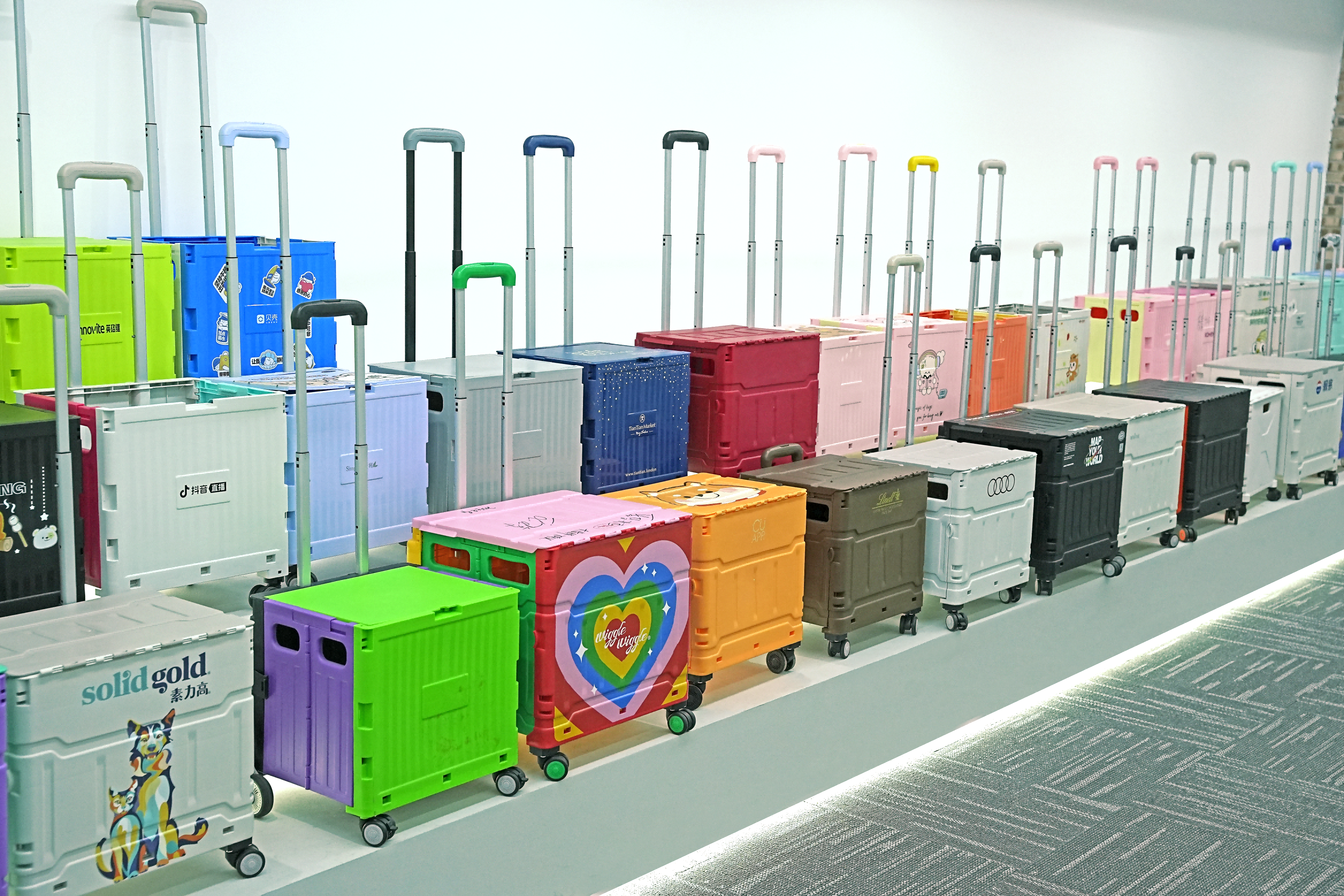
The four reference models come from Xinhai Box (xinhaibox), the export brand of Taizhou Xinhai Cross-border E-commerce Service Co., Ltd., which describes itself as the export division of Zhejiang Jinmao Plastic Group. Company-reported figures include a 50,000 sqm factory, around 500 employees, a 30-strong engineering and design team, and an export share of about 70% across North America, the EU, Southeast Asia and Latin America; the company also states an OEM minimum of 500 units with a 15–45 day lead time and ODM orders from 5,000 units. These figures establish scale and channel scope, not the specification of any individual model, which is why the dimension requests above remain the buyer's own step.
One commercial note belongs beside the specification: polypropylene pricing moves with raw-material markets, and Xinhai's own risk documentation describes managing this through periodic quotation updates and long-term material supply relationships. Buyers comparing formats should date-stamp the price basis and record its validity period alongside the specification, so that a comparison made this quarter stays a comparison. Product information is published on the company site, and the full range can be reviewed in the Xinhai Box storage products brochure.
Outlook for foldable home organization
Two developments are likely to shape how these formats are specified rather than how they are marketed. The first is documentation: as pantry and kitchen storage is sold increasingly on material claims, the SKU-level declaration — grade, additive status, food-contact scope — becomes a standard line in the specification request, next to dimensions. The second is modularity: layer-based formats such as the 7008 shoe cabinet and the drawer family's 49 L to 86 L range allow capacity to be specified in steps, and buyers who can rely on published per-layer and per-size dimensions can plan a room from a catalogue instead of from samples.
Neither development removes the underlying test. A foldable format is still judged on the floor area it takes up when standing, the thickness it returns to when empty, the volume it actually holds, and the work required to assemble it. Buyers who obtain those four numbers for each candidate format, rather than a capacity headline and a photograph, make the comparison on terms the supplier cannot blur.
FAQ
Which of the four foldable formats saves the most space when it is empty?
Only one folded thickness is published in this comparison: the YN8980 Foldable Car Storage Box folds to 7 cm. No folded figure is published for the YN8871 cabinet, the YN484536 drawer or the 7008 shoe cabinet in the supplied specification set, so a like-for-like answer across all four cannot be given from documentation alone. The measurement to request is the empty-state thickness of each unit, kept separate from its standing footprint, because a foldable unit folds only when empty and the two figures therefore describe different conditions.
How much does the foldable storage drawer hold?
The YN484536 Foldable Storage Drawer is specified at 49 L to 86 L, which is a range across the model family rather than a single figure. Buyers should confirm which model in the range carries which volume, and should treat the figure as nominal volume rather than usable volume or a load rating; no load rating is published for the unit in the supplied specification set.
Do the other three formats also use tool-free assembly?
Tool-free assembly is stated only for the YN484536 drawer in the supplied specifications. No assembly method is published for the YN8871 cabinet, the YN8980 car storage box or the 7008 shoe cabinet, so their assembly requirement is a question for the supplier. Tool-free assembly also does not mean no assembly: step count and part count still determine how long setup takes.
How tall does the foldable shoe cabinet get, and does that change where it can go?
The 7008 Foldable Shoe Cabinet runs from 20.6 cm assembled height at one layer to 127.1 cm at six layers, on an unchanged 37 × 26 cm footprint. The taller configurations put the top layer just over 1.2 m above the floor, which suits adult use in an entry hall but is out of reach for children. Whether the layers ship as one unit or as add-on modules, and whether the assembly specifies wall fixing for taller stacks, are not published and should be confirmed.
Can a foldable car storage box be used as room storage instead of a cabinet?
The formats are designed around different spaces. A car storage box is built for a shallow, flat, mobile space and for returning to a flat state — the YN8980 folds to 7 cm — while a cabinet such as the YN8871 is built for enclosed, front-access storage against a wall. Using a vehicle format on a shelf is possible as a shallow bin, but it does not replace the capacity or the access direction a cabinet or drawer provides, and no capacity figure is published for the YN8980 in the supplied specification set.
Have Questions or Need More Details?
Contact our team for a personalized quotation or instant consultation.
Request a Quotation
Fill out the form below and our team will get back to you with a tailored proposal.
WhatsApp Direct Chat
Prefer to chat in real-time? Message us on WhatsApp for instant assistance & quick answers.
- Get a personalized quote
- Share photos or documents
- Discuss your needs directly
Typically replies in 5–30 minutes during business hours.