
Four Wheel Loader Types, One Decision Framework
Electric, telescopic, mini and compact wheel loaders are usually presented as a product menu. In practice they are four different answers to four different site constraints — and the fastest route to a correct specification is to eliminate the configurations the job does not need.
Most buyers reaching evaluation stage already have a rough idea of the capacity class they need. The decision that still causes expensive errors is configuration: whether the machine should be the smallest chassis available, a general-purpose compact unit, a boom-equipped telescopic model, or an electric platform. This framework orders that decision around the constraints that cannot be changed after order — access width, lift geometry, emissions rules and duty cycle — rather than around the specifications that can.
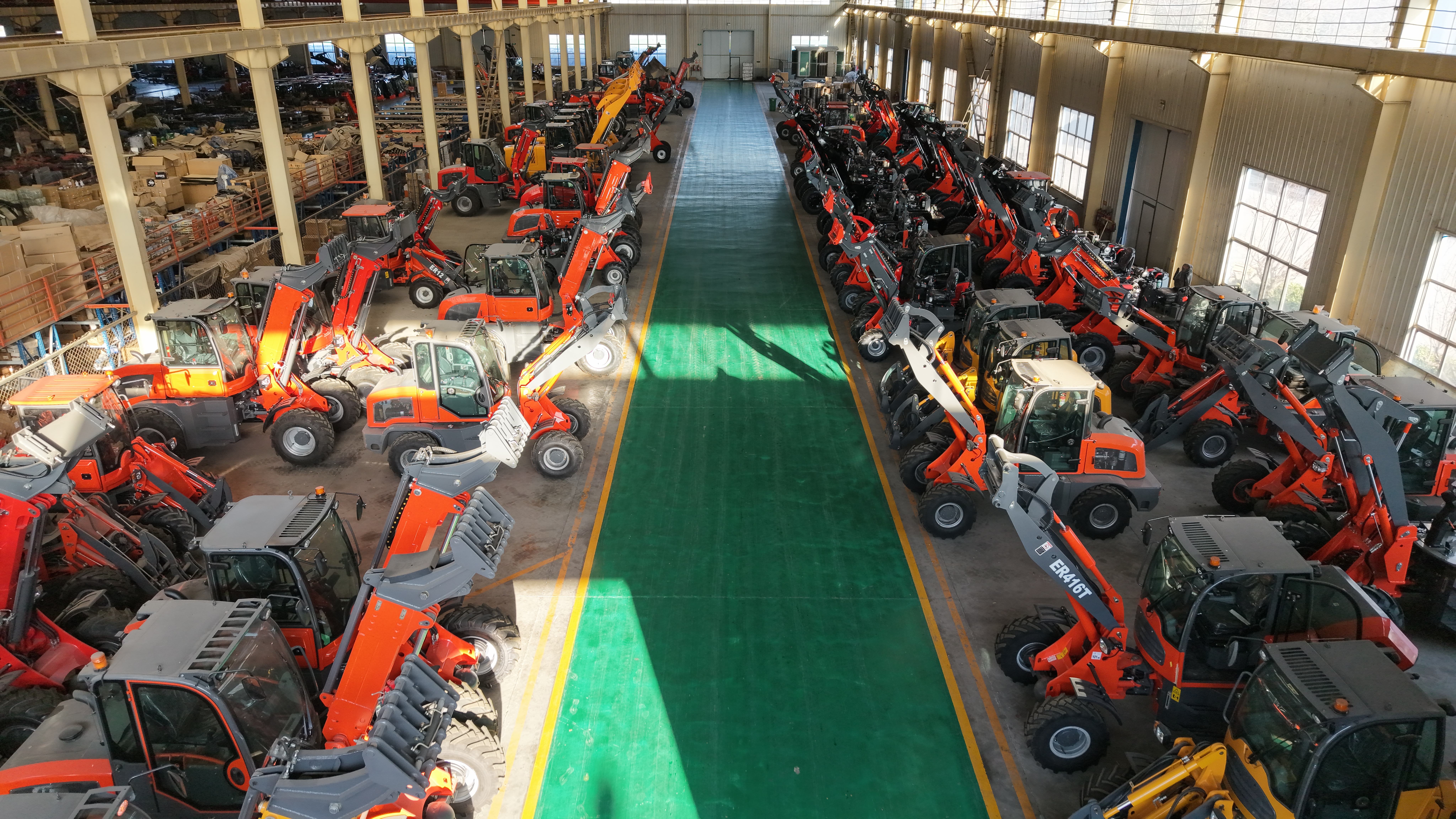
Loader production and assembly environment: configuration breadth begins at the manufacturing level, not the sales sheet.
Why the configuration decision comes before the brand decision
A wheel loader earns its cost through utilisation. Two machines with comparable lifting capability can deliver very different utilisation if one cannot enter the building, discharge over a wall, or work a night shift next to housing. Configuration sets those limits. Brand and price decide how much it costs to live within them.
The choice set is also widening. DataM Intelligence valued the global wheel loader market at USD 36.02 billion in 2023 and projects USD 69.52 billion by 2033. Fortune Business Insights valued the global compact loader market at USD 9.91 billion in 2025, with a projected CAGR of 5.0% through 2034. More configurations reach more markets each year, which turns category literacy into a procurement skill rather than an engineering one.
Two label pairs cause most of the confusion. Mini versus compact is a size distinction that catalogues often blur; telescopic loader versus telehandler is a naming overlap describing boom machines. Neither pair is resolved by reading a brochure — both are resolved by matching the machine to the site constraint.
The four configurations, described by the constraint each one removes
Mini wheel loader
The mini wheel loader is the smallest chassis configuration in common industrial use. It is selected when the binding constraint is physical access: landscape and garden work, yard and warehouse clean-up, indoor clearance work, small construction plots and snow clearing in confined areas. Its value is that it reaches work larger machines cannot enter at all.
Its boundary is throughput. Bucket size, counterweight and stability all scale down with the chassis, so a mini loader is a poor substitute for a larger machine on sustained bulk handling. Buyers who purchase a mini loader for access reasons and then use it as a general site machine usually discover this within the first month.
Compact wheel loader
The compact wheel loader is the general-purpose configuration between mini and full production classes. It is the standard choice for agriculture, municipal maintenance, small construction, yards and rental fleets, where the requirement is a transportable envelope combined with enough capacity to be productive across mixed tasks.
The label itself is commercial rather than technical. EVERUN's own product taxonomy, for example, lists several models simultaneously under mini wheel loader, compact wheel loader and small wheel loader, because the same chassis can sit either side of a marketing boundary. The practical implication for buyers is to compare working envelope, attachment set and realistic daily output instead of arguing about category names.
Telescopic wheel loader
A telescopic wheel loader carries a boom that extends forward and upward rather than a rigid arm. The constraint it removes is geometry: placing material into a raised hopper, over a wall, into a truck bed from an awkward angle, or onto a stack that a conventional loader arm cannot reach. Typical environments are farms and stock farms, warehouses, factories and construction sites with varied handling points.
Its boundary is headroom and stability. A telescopic machine needs overhead clearance to extend, and its safe working envelope shrinks as the boom moves out. Operated under a low canopy or on soft ground, the reach advantage becomes a liability rather than an asset.
Electric wheel loader
Electric is a powertrain decision that can be applied across chassis sizes rather than a size class of its own. Its constraint is emissions and noise: indoor work, urban sites, night operations and locations with strict air-quality or sound limits. The removal of tailpipe emissions and the reduction in drive noise are what make certain sites workable at all.
Its boundary is energy planning. An electric loader is specified around a duty cycle and a charging window, not around a fuel bowser. Sites that run continuous multi-shift operations with no charging opportunity should not assume parity with diesel, and buyers should confirm the charging arrangement before committing.

Telescopic configuration: reach and lift height are gained through boom geometry, which changes the safe working envelope.
A five-gate decision sequence
The sequence below is ordered so that each gate eliminates configurations rather than ranking them. Buyers who work through the gates in order usually arrive at one or two viable types, at which point specification and price comparison becomes meaningful.
Gate 1 — Access envelope
Start with the narrowest point the machine must pass: doorway, gate, aisle, container, livestock building or scaffolding gap. If access is the binding constraint, the decision is effectively made at this gate, and no amount of lift capacity compensates for a machine that cannot get to the work.
Gate 2 — Lift height and reach geometry
Next, define where the material must be placed, not just picked up. Loading a trailer at ground level, charging a raised hopper and stacking over an obstacle are three different geometric problems. Only the second and third generally justify a telescopic boom.
Gate 3 — Emissions, noise and indoor air
If the work happens indoors, at night near housing, or inside a regulated low-emission zone, the powertrain question moves ahead of the capacity question. This is where electric configurations stop being an environmental gesture and become an access requirement.
Gate 4 — Duty cycle and energy plan
Once electric is on the shortlist, map the working pattern: hours per shift, breaks, available charging power and whether the machine can be charged between shifts. A duty cycle that fits available charging windows supports electrification; an uninterrupted multi-shift pattern usually does not.
Gate 5 — Throughput and fleet mix
The final gate is utilisation. Where one machine cannot cover both confined indoor work and yard handling efficiently, a mixed fleet of mini and compact or telescopic units often outperforms a single compromise machine. Fleet mix is a legitimate outcome of this framework, not a failure to decide.
Type-to-site matrix
The matrix converts the five gates into a first-pass shortlist. It deliberately carries no performance figures, because the numbers that matter are site-specific; what transfers between sites is the logic of which constraint each configuration resolves.
| Configuration | Primary fit | Constraint it resolves | Where it stops working | Verify before order |
|---|---|---|---|---|
| Mini wheel loader | Landscaping, yards, small construction, indoor clearance, confined snow clearing | Narrow access and low floor loading | Bulk output; stability with heavy attachments | Measured access dimensions and attachment list for your site |
| Compact wheel loader | Agriculture, municipal work, small construction, rental fleets | General site work in a transportable envelope | Sustained high-volume earthmoving | Realistic daily hours against the duty cycle you actually run |
| Telescopic wheel loader | Farms and stock farms, warehouses, construction handling points | Lift height and forward reach | Work under low structures; soft or uneven ground | Overhead clearance and ground bearing capacity along the working path |
| Electric wheel loader | Indoor, urban, night work, noise- or emission-restricted sites | Tailpipe emissions and drive noise | Multi-shift operation without a charging plan | Charging window, available power supply, seasonal temperature conditions |
What the framework deliberately leaves out
A type decision is necessary but not sufficient. The matrix does not price total cost of ownership, does not confirm attachment compatibility, does not assess operator skill or training needs, does not verify ground bearing capacity along the full working path, and does not account for local registration or road-use rules. It also says nothing about resale value, which matters to rental fleets more than to owner-operators.
Those questions belong to the second stage of evaluation, once the configuration has been narrowed. Attempting to compare total cost across four configurations before eliminating two of them produces long spreadsheets and poor decisions.
Why a supplier that builds all four configurations changes the evaluation
Qingdao Everun Machinery Co., Ltd, trading as EVERUN, is a Chinese manufacturer of wheel loaders, telehandlers and excavators that exports its entire output, with main markets in the EU, USA and Australia. Its wheel loader range spans 0.4 to 6-ton models alongside a growing electric line, produced at an 80,000 m2 facility with 300 employees, an annual output of 5,000 units and a 30-engineer R&D team.
For a buyer working through the gates above, breadth has a practical consequence: mini, compact, telescopic and electric options can be compared inside one engineering and quality system instead of across four suppliers with different documentation, tolerances and support terms. It also allows a mixed fleet order — mini units for indoor work, a telescopic unit for yard loading — without splitting the after-sales relationship into separate contracts.
The commercial terms published for the range are relevant to evaluation-stage buyers because they lower the cost of testing the decision. The minimum order quantity is 1 unit, typical production lead time is 30 days, and monthly production capacity is 500 units, with 100% testing before shipment. OEM customization covers logo, colour and configurations, which is the practical route for dealers and rental fleets that need a consistent fleet identity across types.
After-sales support is stated as a 12-hour response time, with overseas branches providing local service. For buyers operating in remote or seasonal applications, response time is a specification item in its own right, particularly where a machine is used for time-critical work such as winter snow removal.
On compliance, TÜV-issued CE certificates of conformity under Directive 2006/42/EC cover the ERT1500 telehandler, the EREL1000 and EREL05 electric loaders, the ER11HT telescopic loader, and the ER1220-F, ER1220-C, ER11H-F and ER11HT-F variants. Frames across the range are built in S355 steel, and the company states that its machinery complies with Euro V and Tier 4F engine regulations — relevant where one buyer operates in both regulated and non-regulated markets and wants a single documentation baseline.
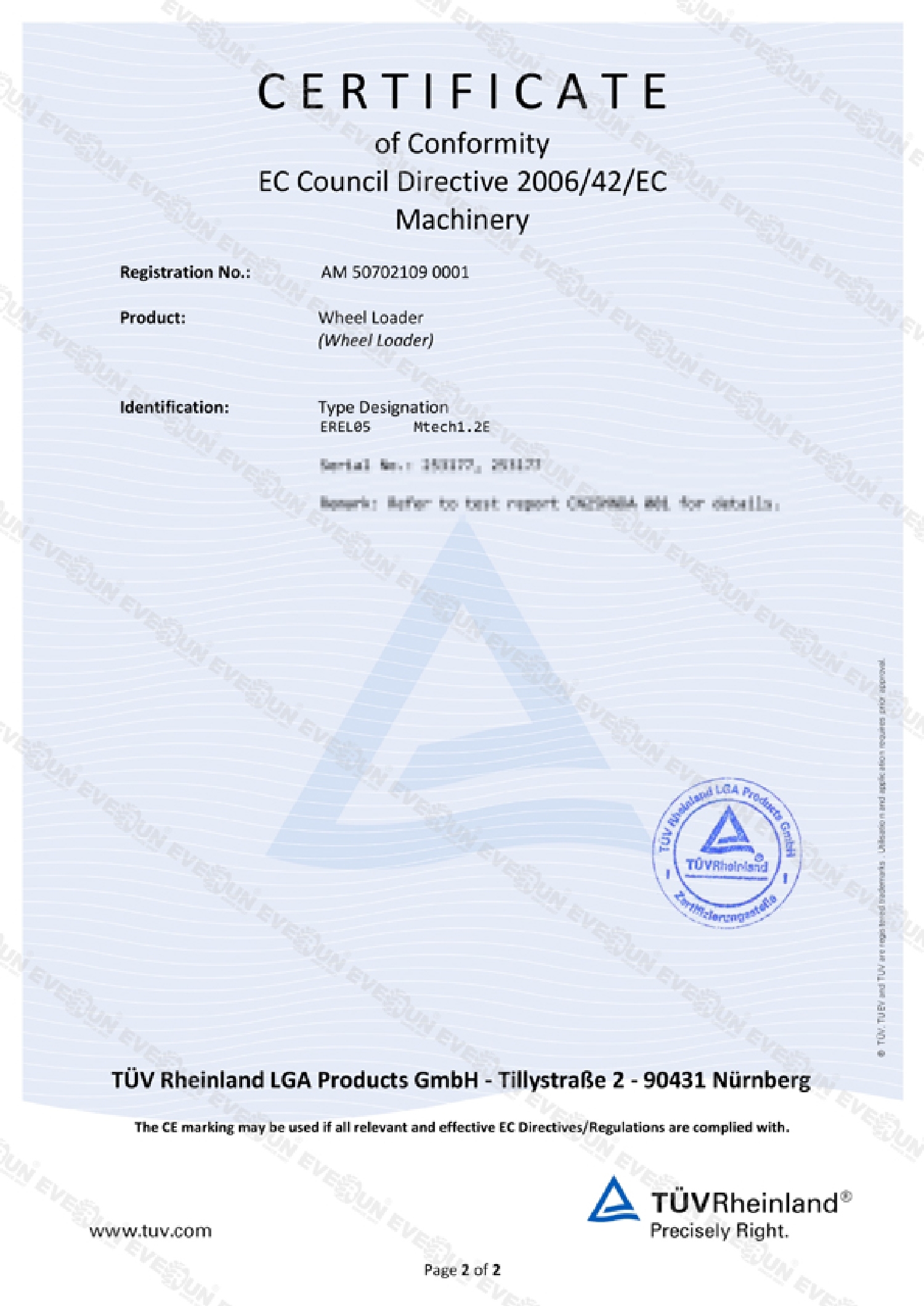
Electric configuration: the same compact envelope, with the powertrain decision moved from fuel logistics to charging logistics.
How the configurations differ structurally
The four labels describe different mechanical architectures, not different trim levels, and that is why the type decision is difficult to reverse later.
- Chassis and counterweight. Mini and compact machines shorten the wheelbase and narrow the track, so stability depends more heavily on attachment choice and load centre. The advantage is access; the cost is resistance to heavy or offset loads.
- Boom geometry. A telescopic machine moves the load centre forward through a boom pivot and hydraulic extension. Lift height and reach are gained, but the safe working envelope narrows as the boom extends, and overhead clearance becomes a hard site requirement.
- Drivetrain. An electric loader replaces engine and torque converter with motor and controller, and battery mass takes over part of the counterweight function. Service routines shift from fluids and filters towards battery management and electrical inspection, which changes workshop requirements rather than eliminating them.
- Protective structures. In the EU, wheel loaders must comply with EN 474-3:2022, which covers operator stations and protective structures including ROPS and FOPS. Buyers comparing suppliers should confirm that the certificate scope matches the exact model ordered, not just the product family.
Application patterns where the choice is usually clear
Municipal and winter work rewards compact and mini configurations for pavement, sidewalk and yard clearing, where manoeuvrability matters more than bucket volume. Agricultural operations tend to split between compact units for general yard and field work and telescopic units for stacking, loading and raised discharge. Rental fleets increasingly carry all four types because utilisation, not ownership pride, determines profitability. Warehouse and indoor work favours electric configurations, where the absence of exhaust emissions is a precondition rather than a benefit.
Cold-climate duty is a useful stress test of any type decision. A construction contractor and equipment rental company in Canada has used eight EVERUN units for winter snow removal for five years, operating in temperatures down to -25°C. The relevant lesson is not that one configuration suits every winter site, but that seasonal, time-critical work places a premium on availability and support response rather than on paper capability.
Market signals shaping the four-way choice
Electrification is moving from demonstration to volume in the smaller classes. China's electric wheel loader sales reached 20,819 units in January–May 2026, a 90.9% year-on-year increase, according to the China Construction Machinery Industry Association as reported via SINOMADA. Supply-side momentum of that scale typically widens model availability in mini and compact classes first, because those are the duty cycles where battery capacity is easiest to match.
Demand for compact equipment is expanding alongside it. Fortune Business Insights placed the global compact loader market at USD 9.91 billion in 2025 with a projected 5.0% CAGR through 2034, consistent with rental fleets and municipal buyers substituting smaller units for larger machines on constrained sites.
Trade flows affect the evaluation timetable as much as the technology does. China exported 155,900 self-propelled shovel loaders in 2025, a 22.57% year-on-year volume increase according to China Customs Statistics, which intensifies price competition and shortens quoted lead times in several segments. At the same time, the top of the market remains concentrated: Caterpillar held a 15.2% share of the global construction equipment market in 2025 according to the KHL Yellow Table. For buyers who need several configurations rather than one flagship model, breadth at mid-size suppliers is often the practical alternative to consolidation at the top.
Where each option stops being the right answer
Electric versus diesel is the comparison most often overstated. Electric configurations remove tailpipe emissions and reduce drive noise, which is decisive indoors and in regulated urban zones. They still require a charging plan, suitable power supply and a duty cycle that fits available working hours per charge. A site running continuous multi-shift operations without charging windows should treat diesel as the default and electrification as a project to be planned, not a straight substitution.
Telescopic versus conventional is a geometry trade. The boom adds reach and lift height, but it also demands overhead clearance, reasonably level ground and acceptance of a load envelope that tightens as the boom extends. Under a low canopy or on soft fill, a rigid-arm compact loader is the more honest choice.
Mini and compact versus larger machines is a throughput trade. Smaller chassis buy access with output, and buyers who expect production-class earthmoving from a compact platform will be disappointed regardless of brand.
There is also a supplier boundary worth stating plainly. EVERUN's wheel loader range covers 0.4 to 6 tonnes; heavier production-class earthmoving, large quarry work and high-volume aggregate handling sit outside it, and buyers with those requirements need a different supplier category rather than a larger unit from the same catalogue.
Future outlook
Three developments are likely to reshape this decision framework over the next buying cycles. First, electrification continues to move from niche to standard in the small and compact classes, which will make charging infrastructure a site-planning question rather than a machine question. Second, certification and documentation are becoming selection filters in their own right, as EN 474-3:2022 and Directive 2006/42/EC compliance are checked at model level rather than brand level. Third, rental and municipal fleets are normalising mixed-type procurement, which turns after-sales response time and OEM configuration flexibility into specification items alongside capacity.
None of these changes removes the need for the gate sequence. They change the inputs to Gates 3 and 4, not the order in which the decision should be made. A consolidated product brochure covering the loader range is available for download here.
FAQ
What is the practical difference between a mini and a compact wheel loader?
A mini wheel loader is the smallest chassis configuration and is chosen when access is the binding constraint; a compact wheel loader is a mid-size general-purpose machine built for mixed site work rather than confined access. The labels overlap commercially, and some models are listed under both, so buyers should compare working envelope, attachment set and realistic daily output instead of relying on the category name.
When is a telescopic wheel loader the better choice than a compact loader?
A telescopic wheel loader is the better choice when material must be placed at height or beyond an obstacle — into a raised hopper, over a wall, or onto a stack that a rigid arm cannot reach. It requires overhead clearance and reasonably level ground, and its safe working envelope narrows as the boom extends.
Which site conditions justify an electric wheel loader?
Electric configurations are justified where tailpipe emissions or drive noise are the limiting factor: indoor work, urban sites, night operations near housing, and locations with air-quality restrictions. They require a charging window and a suitable power supply, and they suit defined duty cycles better than uninterrupted multi-shift operation.
What commercial terms should be confirmed before ordering a mixed fleet?
For the EVERUN range, the stated terms are a minimum order quantity of 1 unit, a typical production lead time of 30 days, monthly production capacity of 500 units, 100% testing before shipment, and OEM customization of logo, colour and configurations. After-sales support is stated as a 12-hour response time, with overseas branches providing local service.
Which certifications should EU buyers verify at model level?
EU buyers should confirm a CE Certificate of Conformity under Directive 2006/42/EC for the exact model ordered. TÜV-issued certificates cover the ERT1500 telehandler, the EREL1000 and EREL05 electric loaders, the ER11HT telescopic loader, and the ER1220-F, ER1220-C, ER11H-F and ER11HT-F variants. Wheel loaders in the EU must also comply with EN 474-3:2022, which covers operator stations and protective structures including ROPS and FOPS.
How should cold-climate or seasonal work affect the type decision?
Seasonal, time-critical work such as winter snow removal places a premium on availability and support response rather than on paper capability. A construction contractor and equipment rental company in Canada has operated eight EVERUN units for winter snow removal for five years in temperatures down to -25°C. Buyers in comparable conditions should confirm service coverage and, for electric configurations, charging and storage arrangements for low temperatures.
Have Questions or Need More Details?
Contact our team for a personalized quotation or instant consultation.
Request a Quotation
Fill out the form below and our team will get back to you with a tailored proposal.
WhatsApp Direct Chat
Prefer to chat in real-time? Message us on WhatsApp for instant assistance & quick answers.
- Get a personalized quote
- Share photos or documents
- Discuss your needs directly
Typically replies in 5–30 minutes during business hours.