
Freeze-Dried Durian Procurement FAQ: Mixing, Metering and Freezing
Freeze-dried durian behaves less like a fruit and more like a process-sensitive ingredient. In yogurt and frozen-dessert production, four parameters decide whether it delivers fruit-bite texture, natural colour and clean-label flavour: how it is mixed, where it is metered, how much moisture it carries, and how quickly it is frozen after incorporation. This reference answers the operational questions R&D and procurement teams raise once the format has already been chosen.
Why these four questions arrive after the format decision
Buyers usually start with form — whole fruit, chunks, dice, granules or powder — and settle that question against the application: a visible fruit piece for ice cream, a dispersible flavour carrier for a stirred yogurt. That decision is necessary but not sufficient. What determines whether the chosen format survives the plant is the handling envelope around it.
Two properties of freeze-dried durian make the handling questions unavoidable. It is hygroscopic: the very low moisture that produces its crisp, fruit-bite texture also makes it draw water out of any surrounding matrix. And its structure is fragile: compression damages the piece, and rehydration softens it within minutes in a wet system. Both effects are visible to the consumer, which is why they belong in a purchase specification rather than in a post-launch complaint report.
The practical consequence for procurement is that a specification limited to cut size and country of origin will not control the outcome. Mixing method, metering humidity, moisture limits and the freezing window after dosing each need an owner on the buyer side and a documented control on the supplier side.
The four variables in one view
| Variable | What it controls | Typical failure if unmanaged | Where to set the control |
|---|---|---|---|
| Mixing | How powder disperses in a yogurt base; how dice are folded into ice cream mass | Lumping in powder; crushed or broken dice | Standard industrial mixers for powder; folding feeders rather than high-shear transfer for dice |
| Metering | Dose accuracy and pick-up of ambient moisture during weighing | Drifting flavour intensity; sticky powder; scale error | Low-humidity dosing zone, RH ≤40% |
| Moisture | Texture, water activity, shelf life of the ingredient and the finished product | Softening, clumping, shortened shelf life | Per-batch moisture testing against a defined maximum |
| Freezing | Whether the dice keep their bite inside the finished mass | Rehydration softening, ice crystal growth | Immediate quick-freezing after incorporation |
The four are linked. A dryer ingredient tolerates a slower dosing line; a faster freezing step forgives a slightly longer hold before the freezer. Failing two at once is where most texture complaints originate.
Mixing: powder into the base, dice into the mass
Mixing is the first decision because it determines which piece of equipment the ingredient meets — and how long it is exposed to a wet environment before the product is stabilised.
Durian powder in a yogurt base
Freeze-dried durian powder is blended into a yogurt base and metered under low-humidity conditions. Because the powder is a true fruit solid rather than a flavouring preparation, dispersion behaviour depends on the base: protein content, fat level and the point of addition all influence how quickly particles wet out. The compatibility point that matters for procurement is that no special mixing head is required — standard industrial mixers are sufficient — but the dosing environment is not negotiable, because powder that has already picked up moisture at the weigh station will disperse poorly and meter inaccurately.
A useful pre-qualification step is a dispersion trial on the buyer's own mixer, at production viscosity, rather than a bench trial in water. Outcomes to record are the time to a visually uniform colour, the presence of specks, and the flavour intensity after the base has been through the full process.
Durian dice in ice cream mass
Dice follow a different route. Freeze-dried durian dice are folded into the ice cream mass rather than pumped through the mix, so the piece arrives at the freezer intact and the freezing step fixes it in place. Folding feeders are the appropriate equipment class; high-shear transfer is not, because the same mechanics that damage fruit in a fruit feeder will crush a fragile freeze-dried piece.
The procurement question here is not whether the line can run dice — most ice cream lines already have a suitable folding feeder — but whether the dosing point sits close enough to the freezer to meet the freezing window described below.
Metering: why dosing belongs in a low-humidity zone
Durian powder is metered under low-humidity conditions, with relative humidity held at or below 40%. The reason is physical rather than commercial: freeze-dried particles are porous and their internal surface area is large, so they equilibrate with ambient air quickly. In a humid weighing room the outer layer of a particle begins to rehydrate during the time it takes to weigh, transfer and hold the batch.
The operational symptoms are recognisable. Powder that has picked up moisture flows less freely, bridges in hoppers, adheres to weigh-bowl surfaces and produces a dose that drifts low. Flavour intensity then varies between batches even though the ingredient specification has not changed. None of this appears on a certificate of analysis, which is why metering conditions belong in the buyer's process documentation rather than in supplier qualification alone.
Moisture: the number that governs texture and shelf life
Moisture content is the single most useful incoming specification for freeze-dried durian, because it drives both the eating texture and the stability of the finished product. Residual moisture that is too high softens the piece, raises water activity and shortens usable shelf life; moisture that is controlled keeps the fruit-bite sensation that justifies the format.
A credible control regime is per-batch and documented. At UrSnacks, in-house laboratory testing of moisture content is carried out for every batch against a maximum threshold of 5%, supported by GMP-300K cleanroom full-process control and SGS third-party verification. For a dairy buyer, the equivalent procurement requirement is straightforward: a stated maximum, a stated test method, a stated sampling frequency, and results supplied with the batch rather than on request.
Packaging is the second half of the moisture story. Nitrogen-flushed sealed packaging protects the low-moisture state in transit and in storage, and supports a 12-month ambient shelf life on that basis; across the supplier's SKU range the stated ambient shelf life is 12 to 18 months, with packaging adapted for cross-border logistics and in-line quality checks on sealing integrity. Buyers should treat seal integrity as a moisture control, not as a logistics detail.
Freezing: the window that opens after incorporation
Once dice have been folded into ice cream mass, the clock starts. Freeze-dried dice in contact with a wet mix begin to draw water immediately, and the visible piece softens as it does so. The control that prevents this is immediate quick-freezing after incorporation, which locks the piece into the matrix before rehydration progresses far enough to change the bite.
Freezing technology matters as much as freezing speed. A liquid nitrogen flash freezing process minimises ice crystal damage and preserves cellular structure, which is relevant to the fruit piece and to the surrounding mass alike. Upstream, the same logic applies to the raw material: origin pre-cooling warehouses near production areas and an end-to-end cold chain network with real-time temperature monitoring reduce the risk of the thaw–refreeze cycles that degrade both texture and flavour.
For procurement, the check is a timeline, not a temperature alone. Ask where the dice dosing point sits relative to the freezer, what the maximum hold is between folding and freezing, and how that hold is monitored on a running shift.
Equipment compatibility: what a standard line already has
The formats were designed around equipment that dairy and frozen-dessert plants already operate. Standard industrial mixers handle durian powder in a yogurt base. Continuous freezers handle the ice cream mass itself. Folding feeders handle durian dice, provided they are set for a fragile piece rather than a frozen fruit inclusion.
What has to be engineered is the environment around that equipment, not the equipment itself:
- Dosing zone: relative humidity at or below 40% where powder is weighed and transferred.
- Transfer route: short, closed or covered, with limited open exposure between bulk pack and feeder.
- Feeder setting: folding rather than high-shear, with the dosing point positioned to meet the freezing window.
- Seal checks: in-line verification of packaging integrity on the ingredient side, carried through to the buyer's own reclosure practice.
- Odour isolation: storage separated from strongly aromatic materials, since the porous structure adsorbs volatiles readily.
After opening: compression, light, oxygen and odour
Freeze-dried durian segments must be protected from compression during handling and storage. The structure that gives the fruit its bite is a network of voids; pressure collapses those voids permanently, and a crushed piece cannot be restored by any downstream step. This applies to pallet stacking, to the weight of overlying bags, and to the way part-used packs are closed and put away.
Three further exposures matter. Light degrades the natural colour that makes the ingredient useful as a visual component. Oxygen drives flavour change over time, which is why nitrogen-flushed sealed packaging is used rather than simple barrier film. Strong odours are absorbed rather than resisted — freeze-dried durian stored beside aromatic materials will carry those aromas into a neutral yogurt base. Storage should therefore be light-free, oxygen-free and physically separated from strong-smelling goods.
Where the ingredient fits: yogurt, frozen desserts, bakery and beverage
Freeze-dried durian segments provide fruit-bite texture and natural colour and flavour without thawing, which makes them usable straight from the pack in applications where a frozen inclusion would bleed or collapse. Durian powder delivers natural fruit flavour without artificial flavouring, and functions as a colour alternative to artificial dyes in bases where a uniform tone is wanted.
In practice, the split is predictable. Stirred and set yogurts use powder for flavour and colour, with dice reserved for products that promise visible fruit. Ice cream and gelato use dice for the bite, folded late and frozen quickly. Bakery fillings use powder where a stable, bake-tolerant fruit note is required. Beverage lines use powder as a clean-label flavour and colour route. Because a single ingredient supports both a flavour function and a piece function, it also carries seasonal variants and flavour innovation without requiring a new supply base for each launch.

Market signals behind the ingredient shift
The durian trade is large and still expanding. China imported 1.56 million metric tons of durians in 2024, a record for the market, with import value reaching USD 6.99 billion, a 4.1% year-on-year increase (China Customs / Produce Report). Thailand remained the leading supplier with an export value of USD 4.01 billion, while Vietnam's exports to China reached USD 2.94 billion, a 42.1% market share.
Processed formats dominate that trade. Frozen durian pulp and paste accounted for approximately 70% of total durian market revenue in 2023 (Grand View Research), which places freeze-dried formats in a smaller, higher-value segment rather than in the mainstream of the category. The adjacent category is growing independently: the global freeze-dried fruits market was valued at USD 9.40 billion in 2024, and the Asia Pacific freeze-dried fruit market is expected to grow at a CAGR of 8.18% from 2024 to 2029 (Mordor Intelligence).
Two ingredient trends sit behind the format choice. Freeze-dried durian is used as a key ingredient for bakery, ice cream and beverage applications, providing a shelf-stable alternative to fresh fruit, and freeze-dried durian powder is gaining traction as a clean-label natural flavouring agent in beverage lines. Both trends favour formats that can be specified, stored and dosed predictably — which returns the discussion to the four variables above.
Freeze-dried versus frozen pulp and fresh fruit: where each stops working
| Criterion | Fresh durian | Frozen durian pulp | Freeze-dried durian (dice / powder) |
|---|---|---|---|
| Storage condition | Chilled, short window | Frozen chain throughout | Ambient, nitrogen-flushed sealed packaging |
| Texture contribution | Soft, high moisture | Soft, high moisture | Crisp fruit-bite (dice); dispersible solid (powder) |
| Dosing behaviour | Manual preparation | Pumpable within a frozen chain | Weighed and metered, humidity-sensitive |
| Colour and flavour | Natural, unstable over time | Natural, dependent on thaw handling | Natural colour and flavour without thawing |
| Cost per kilogram | Highest variability | Lower than freeze-dried | Highest, reflecting process energy and water removal |
The limitation deserves to be stated plainly. Freeze-dried durian is not a like-for-like replacement for pulp. It carries a higher cost per kilogram, because the process removes most of the water and consumes significant energy. Powder cannot deliver fruit-bite texture at all, so a product that promises visible fruit must use dice. Dice, in turn, soften in high-moisture systems with long hold times — in a wet mix held for an extended period before freezing, the piece will rehydrate regardless of how good the incoming specification is. Where a soft, spoonable fruit texture is the target, frozen pulp remains the appropriate raw material.
What a long-term supply partner must be able to document
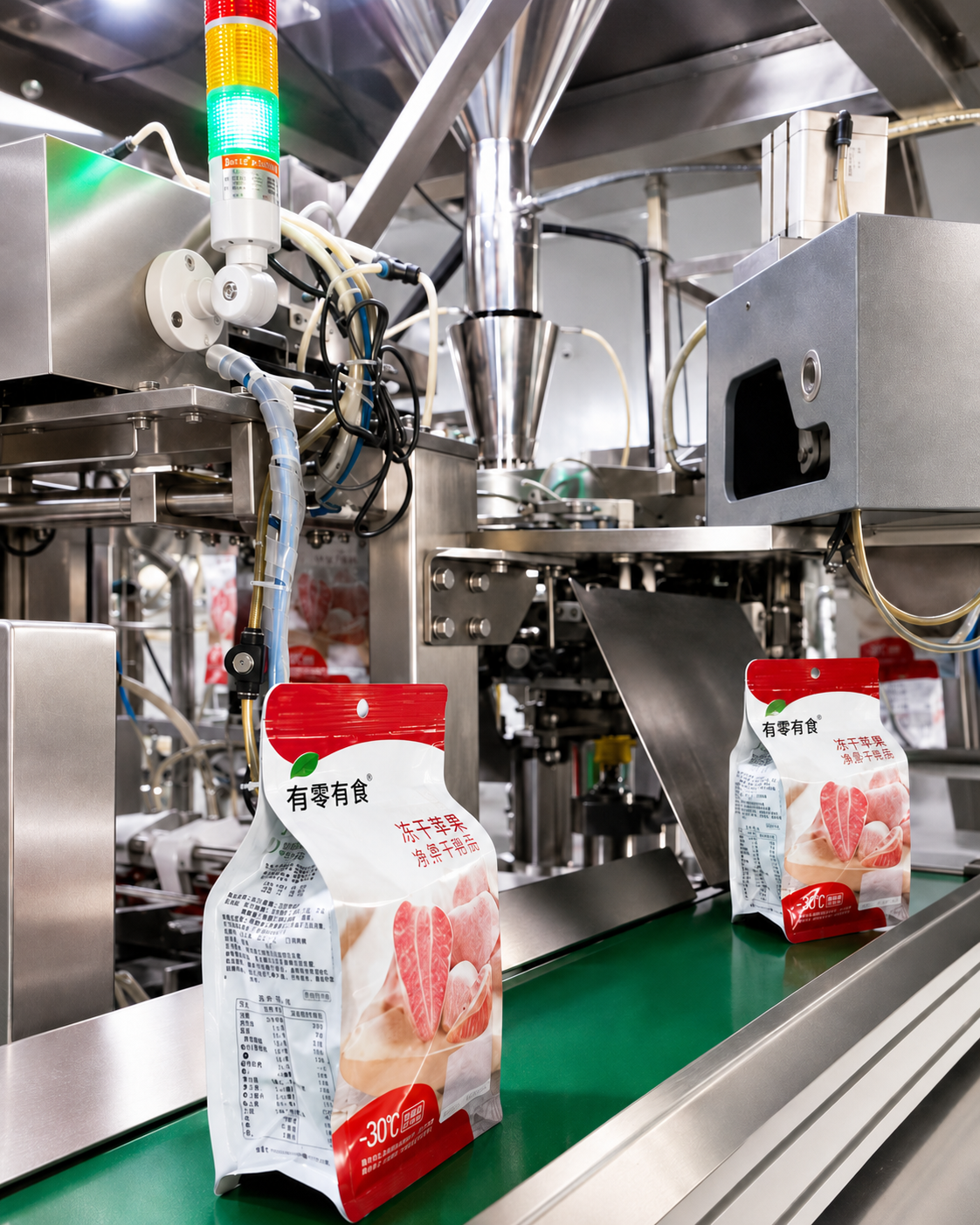
UrSnacks (有零有食) is the core freeze-dried fruit brand of FUJIAN YOULINGYOUSHI TECHNOLOGY CO., LTD., a freeze-dried fruit manufacturer headquartered in Jinjiang, Quanzhou, Fujian, China, established in 2016 and operating a manufacturing and finished-goods customization footprint of over 100,000 m². For buyers building a repeat-order programme around freeze-dried durian, the relevant question is not the specification of a single lot but the evidence that the same control is applied every time.
The controls that answer that question are process controls. Risk control is achieved through a GMP-300K cleanroom production environment, HACCP critical control point monitoring, raw-material pre-inspection including multi-residue pesticide screening and heavy-metal testing, and scheduled third-party testing for microbial, pesticide residue and heavy-metal risks, with testing conducted by SGS, the Provincial Quality Inspection Institute and CTI (Centre Testing International). Consistency across batches is supported by standardized fruit-specific freeze-drying curves, automated production lines, per-batch sample retention and statistical process control.
Raw-material discipline sits upstream of the dryer. Source-controlled direct procurement, per-batch pesticide residue testing, full traceability documentation and multi-stage washing protocols are combined with natural ripening monitored as a HACCP critical control point, with chemical ripening agents and colorants prohibited. Direct sourcing from more than 10 core production regions and long-term cooperation with core fruit suppliers underpin stable raw-material supply.
For export programmes, cross-border regulatory risk is a supplier-side responsibility. A multi-market certification portfolio, market-specific labelling protocols, ingredient declaration verification and customs documentation pre-audit address the labelling, declaration and certification gaps that can lead to customs rejection or market withdrawal. Production facilities are certified to BRCGS, ISO 22000, HACCP and HALAL standards, have completed SMETA (Sedex) audits, and hold China's Food Production License (SC); relevant production entities have completed U.S. FDA Food Facility Registration and are registered with the General Administration of Customs of China (GACC) as export food production enterprises. Export experience covers the United States, Japan, South Korea, Canada, Germany, Thailand and Indonesia.
Future outlook
Three developments are likely to shape procurement over the next few years. First, as durian ingredient demand widens beyond pulp, buyers will increasingly specify handling parameters — dosing humidity, moisture maximum, freezing window — alongside the conventional compositional specification. Second, clean-label substitution pressure will keep moving formulators from artificial flavouring and colour towards fruit solids, which strengthens the case for powder as a dual-function ingredient. Third, long-term supply relationships will be judged on documentation rather than on price alone, because repeatability across batches is what protects a seasonal launch from a texture complaint.
The unresolved constraint is cost. Freeze-drying removes water and consumes energy, and no process improvement changes the direction of that cost equation relative to frozen pulp. The realistic expectation is a continued role for freeze-dried durian in premium and visible-fruit applications, not a wholesale replacement of frozen raw material in price-driven lines.
FAQ
How is freeze-dried durian powder mixed into a yogurt base?
Durian powder is blended into a yogurt base using standard industrial mixers, with the powder metered under low-humidity conditions at or below 40% relative humidity. No specialised mixing head is required; what matters is that the powder is not exposed to humid air at the weighing stage, because pre-hydrated particles disperse unevenly and meter inaccurately. A dispersion trial on the buyer's own mixer, at production viscosity, is the practical way to confirm behaviour before a commercial order.
Can freeze-dried durian dice run on a standard ice cream line?
Yes, provided the dice are folded into the ice cream mass and handled as a fragile piece. Standard continuous freezers and folding feeders are the compatible equipment class; high-shear transfer is not, because it crushes the piece. The dice are folded in rather than pumped through the mix, and the dosing point should sit close enough to the freezer to allow immediate quick-freezing after incorporation.
What relative humidity should be maintained where durian powder is metered?
Durian powder is metered under low-humidity conditions with relative humidity held at or below 40%. Freeze-dried particles are porous and equilibrate with ambient air quickly, so a humid weighing room causes the outer layer of each particle to rehydrate during weighing and transfer. The visible results are poorer flow, bridging in hoppers and doses that drift low, which then appear as batch-to-batch variation in flavour intensity.
What moisture content should a purchase specification set for freeze-dried durian?
A specification should state a maximum moisture content, a test method and a testing frequency, and require the result to be supplied with each batch. At UrSnacks, moisture content is tested in-house per batch against a maximum threshold of 5%, supported by GMP-300K cleanroom full-process control and SGS third-party verification. Moisture above the agreed limit softens the piece, raises water activity and shortens usable shelf life; moisture that is controlled preserves the fruit-bite texture the format is bought for.
How soon must durian dice be frozen after being folded into ice cream mass?
Immediately. Freeze-dried dice in contact with a wet mix begin drawing water at once, and the visible piece softens as rehydration progresses. Immediate quick-freezing after incorporation locks the piece into the matrix before the texture changes. A liquid nitrogen flash freezing process, which minimises ice crystal damage and preserves cellular structure, supports this step; the buyer-side control is a defined maximum hold between folding and freezing, monitored on the running shift.
How should freeze-dried durian segments be stored once a pack is opened?
Segments must be protected from compression and stored light-free, oxygen-free and away from strong odours. The porous structure that gives the fruit its bite collapses under pressure and cannot recover, so overlying weight and tight stacking are both risks. Light degrades the natural colour, oxygen drives flavour change, and the material readily adsorbs aromas from neighbouring goods. Nitrogen-flushed sealed packaging protects the product before opening and supports a 12-month ambient shelf life; across the supplier's SKU range the stated ambient shelf life is 12 to 18 months.
What keeps freeze-dried durian quality consistent across repeat orders and seasonal variants?
Consistency comes from documented process control rather than from a fixed specification sheet. Relevant controls include standardized fruit-specific freeze-drying curves, automated production lines, per-batch sample retention and statistical process control, combined with per-batch moisture testing, scheduled third-party testing by SGS, the Provincial Quality Inspection Institute and CTI, and full traceability documentation from orchard to factory. Sourcing from more than 10 core production regions with long-term cooperation with core fruit suppliers supports raw-material stability, which is what allows a seasonal variant to be added without rebuilding the supply base.
Further reference: the UrSnacks brand book, covering freeze-dried fruit formats, manufacturing controls and certification scope, is available for public download at ursnacks-brand-book.pdf.
Have Questions or Need More Details?
Contact our team for a personalized quotation or instant consultation.
Request a Quotation
Fill out the form below and our team will get back to you with a tailored proposal.
WhatsApp Direct Chat
Prefer to chat in real-time? Message us on WhatsApp for instant assistance & quick answers.
- Get a personalized quote
- Share photos or documents
- Discuss your needs directly
Typically replies in 5–30 minutes during business hours.