
Freeze-Dried Durian Segments vs. Dice vs. Powder: A Buyer Decision Matrix

Portioning and packing area at a freeze-dried fruit facility. Format, humidity control and handling discipline decide whether a durian ingredient reaches the dairy line intact.
Freeze-dried durian is supplied in three commercial formats — segments, dice and powder — and in dairy and frozen-dessert manufacturing the difference between them is an engineering difference, not a cosmetic one. The format decides which mixers and freezers the ingredient can pass through, what humidity and temperature the dosing area must hold, how the material is stored, and which texture or flavour claim the finished product can carry. Choosing on price per kilogram alone is the most common way a format trial fails after the first production run.
Most durian still moves through the market as frozen pulp and paste, a segment that accounted for roughly 70% of durian market revenue in 2023, according to Grand View Research. That baseline matters for buyers: freeze-dried durian is usually evaluated as an upgrade path away from a frozen ingredient, which is why the three dry formats are so often compared against frozen pulp rather than against each other. In practice they solve different problems. Powder is a flavour and colour carrier, dice are a distribution ingredient, and segments are a visible-texture ingredient. Each demands different equipment and a different discipline at the point of incorporation.
Why the Format Decision Is Really a Line Decision
A dairy or frozen-dessert plant does not buy texture in isolation. It buys a material that has to survive a defined route: reception, storage, dosing, mixing, freezing, filling, packing and cold storage. Each of the three freeze-dried formats behaves differently along that route because the particle itself is different — a fine powder disperses, a die has dimensional identity but limited mechanical strength, and a whole segment is a fragile, porous structure that carries the fruit's original shape.
That is where most specification errors originate. A buyer selects segments because the product concept calls for visible fruit, then discovers that the filling head and the transfer auger crush the pieces before they ever reach the tub. Or a buyer selects powder for a continuous freezer line without confirming that the dosing room can hold low relative humidity, and the powder cakes in the feeder during a long shift. The format is not the problem in either case; the mismatch between format and line is.
Process Compatibility: What Each Format Requires
The table below summarises the operational conditions each format imposes on a dairy or frozen-dessert line. These are qualification criteria, not preferences: a plant that cannot meet the condition for a given format should not plan around it.
| Format | Dosing and mixing equipment | Condition control at dosing | Post-incorporation handling | Typical failure mode |
|---|---|---|---|---|
| Powder | Compatible with standard industrial mixers and continuous freezers; disperses into the mix before freezing | Must be metered at RH ≤40% | No special handling beyond normal mix residence time | Caking and uneven dispersion if room humidity rises |
| Dice | Requires a folding feeder at the incorporation point | Immediate quick-freezing after incorporation | Freeze within the shortest possible window after folding | Dice soften, deform or bleed into the mass if the mix warms before freezing |
| Segments | Low-shear addition; drop-in or gentle folding | Protected from compression at every transfer point | Store light-free and oxygen-free, away from strong odors | Crushing, fracturing and odor pickup |
Powder: the format that behaves like a dry ingredient
Powder is the only one of the three that can be treated as a conventional dry ingredient. It is compatible with standard industrial mixers and with continuous freezers, which means a plant can add it without installing a folding feeder or re-sequencing the freezing step. The binding condition is humidity: metering must take place at RH ≤40%. Below that threshold the powder flows, disperses and stays free of clumps; above it, the material picks up moisture quickly because the freeze-dried structure is highly porous and hygroscopic.
Powder is also the format that contributes flavour and colour rather than particulate. Freeze-dried durian powder is increasingly positioned as a clean-label natural flavouring agent, a trend noted in Mordor Intelligence's coverage of the freeze-dried food market. For a yogurt or beverage base where a smooth body is the specification, that is the functional advantage: no piece to break, no texture inconsistency between batches, and colour that comes from the fruit rather than from a separate colorant.
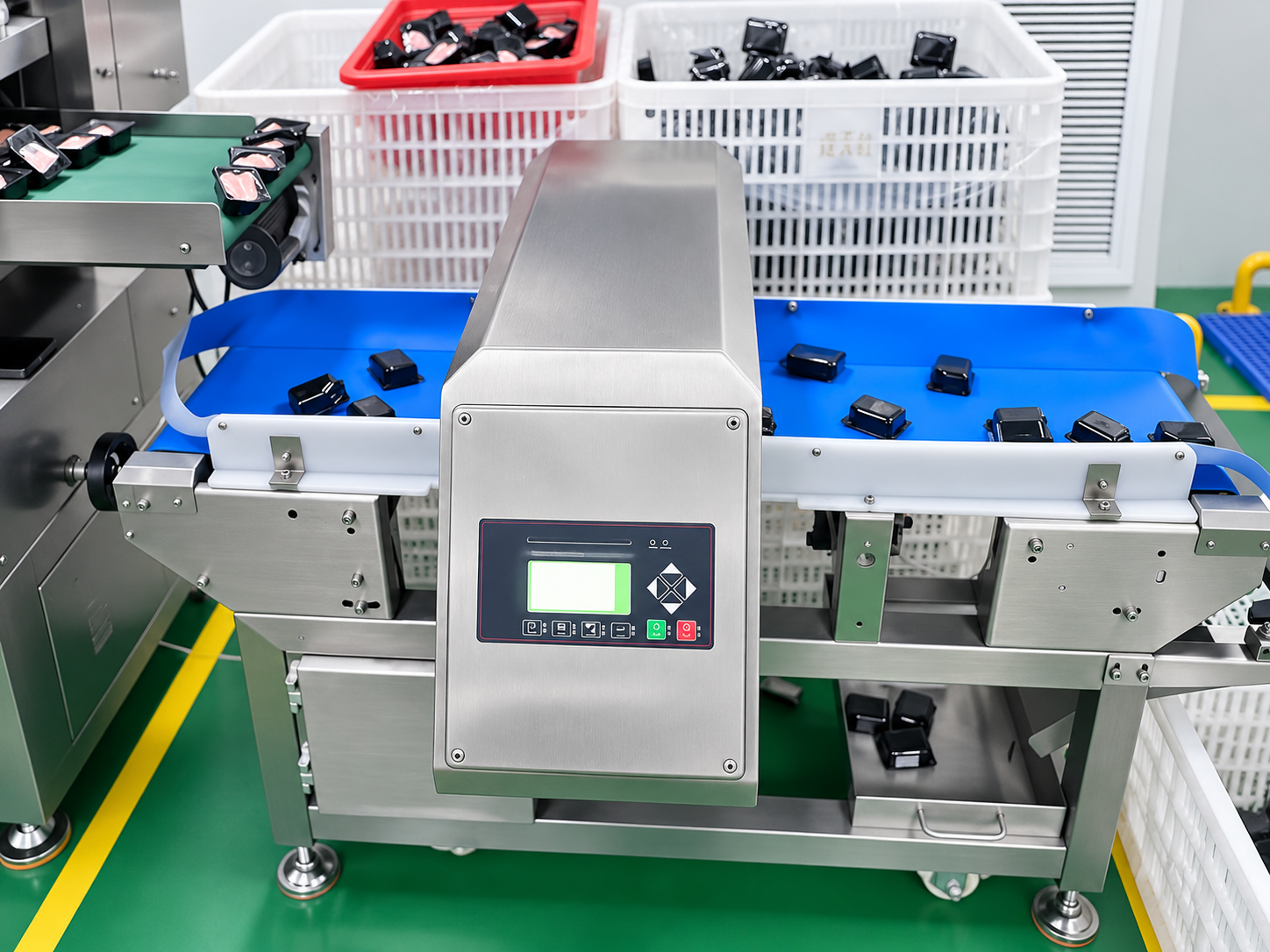
Dry-ingredient dosing lines are normally paired with in-line detection and inspection before filling, which is why powder suits continuous, enclosed processes.
Dice: a fold-in ingredient with a freezing deadline
Dice are designed to be folded into the ice cream mass, which sets two hard requirements. First, the line needs a folding feeder so the pieces enter the stream evenly instead of being dropped in a single charge. Second, the product must be quick-frozen immediately after incorporation. The window matters: freeze-dried dice are porous and rehydrate from the surrounding mix, so any delay between folding and freezing lets the pieces soften, deform or release colour into the mass instead of staying as discrete fruit pieces.
When those two conditions are met, dice deliver the outcome most frozen-dessert developers are looking for — a defined piece of durian distributed through the product rather than concentrated in one bite. When they are not met, the same ingredient produces a smeared appearance and a texture the consumer reads as a defect.
Segments: texture first, handling sensitive
Segments (frequently specified in supplier documentation as whole or chunks) carry the strongest texture promise and the strictest handling requirement. They must be protected from compression throughout transfer, filling and packing, because a porous freeze-dried piece has little resistance to mechanical load: an auger, a pump or a tight filling head will fracture it before the consumer sees it.
Storage discipline matters as much as mechanical care. Segments should be kept light-free and oxygen-free, and stored away from strong odors. Durian is intensely aromatic in both directions — it releases odor and it absorbs it — so segregating segments from neutral dairy powders, packaging materials and other aroma-sensitive ingredients protects both the durian and everything stored nearby.
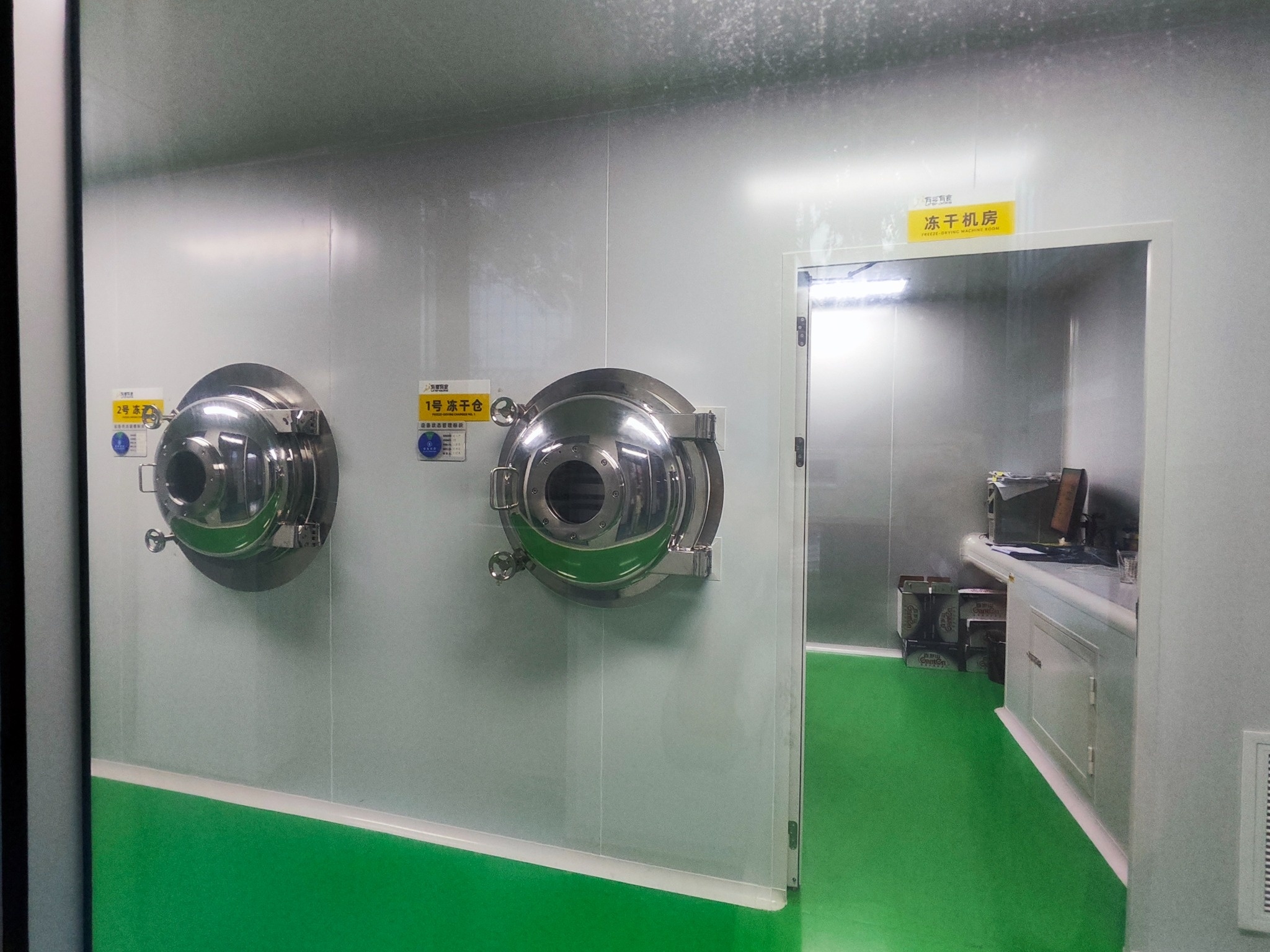
Bench-scale freeze-drying trials let a buyer confirm how a format behaves before committing a full line to a production run.
What Each Format Delivers in the Finished Product
Process compatibility narrows the field; the end-product outcome decides it. The three formats are not interchangeable in the cup or the tub, and the differences are predictable from the particle type.
| Format | Texture role | Flavour and colour role | Typical fit | Claim the format supports |
|---|---|---|---|---|
| Segments | Visible fruit bite; whole-piece identity | Released gradually as the piece is chewed | Premium frozen desserts and inclusions where the fruit piece is the story | Whole fruit segments |
| Dice | Discrete pieces folded evenly into the mass | Distributed through the product | Ice cream and frozen desserts where pieces should appear in every scoop | Durian pieces throughout |
| Powder | No particulate; smooth, uniform body | Natural flavour and colour carrier | Yogurt, beverages, base mixes and bakery | Made with durian; clean-label colour and flavour |
The application evidence points the same way. Freeze-dried durian is used as an ingredient across bakery, ice cream and beverage applications, where it offers a shelf-stable alternative to fresh fruit — a positioning that has been noted in industry trade coverage. What that general statement hides is the format split: bakery and beverage applications usually want powder because they need dispersion and colour, while ice cream and frozen dessert can use any of the three depending on whether the brief is a piece claim, a distribution claim or a flavour claim.
Storage and Warehouse Discipline
All three formats share a common vulnerability — the freeze-dried structure is porous and takes up moisture and odors readily — but the exposure differs. Powder has the largest surface area and therefore the fastest moisture pickup, which is why humidity control at dosing is non-negotiable. Segments have the largest intact structure and are the most sensitive to compression, but they are also the most sensitive to odor transfer because they remain in storage longer in a piece form.
- Humidity: keep dosing and repacking areas at RH ≤40% for powder; use sealed, moisture-barrier packaging for all three formats.
- Light and oxygen: store segments light-free and oxygen-free; the same discipline protects colour in dice and powder.
- Odor segregation: keep durian away from neutral or aroma-sensitive materials; the transfer works in both directions.
- Compression: avoid stacking heavy pallets on segment stock and keep transfer paths short and gentle.
- Freezing link: for dice, treat the freezing step as part of the ingredient specification, not as a downstream detail.
The Decision Matrix: Five Questions That Resolve the Choice
Most format debates can be closed with five questions asked in order. Each one eliminates a format rather than ranking the remaining options.
- 1. Does the line have a folding feeder and a freezer immediately downstream of the incorporation point? If not, dice are the wrong format regardless of the product concept.
- 2. Can the dosing area hold RH ≤40% continuously, including during packaging changes and shift handovers? If not, powder will cake and dose unevenly, and the plant should fix the room before fixing the ingredient.
- 3. Is the product homogeneous — a yogurt, a beverage, a base mix? If yes, powder is the only format that disappears into the specification instead of fighting it.
- 4. Does the marketing claim require a visible piece? A piece claim needs dice or segments; a flavour or colour claim is fully satisfied by powder at lower handling cost.
- 5. Will the piece survive the filling head and the packing line without compression? If the route includes augers, tight fillers or heavy stacking, segments should be ruled out or the packaging format redesigned.
Where two formats survive all five questions, the tie-break is cost of handling rather than cost per kilogram: the format that requires no new equipment and no additional room-conditioning is usually the cheaper route to a stable product, even when its raw-material price is higher.
Where Supplier Capability Changes the Answer
UrSnacks (有零有食) is the core freeze-dried fruit brand of FUJIAN YOULINGYOUSHI TECHNOLOGY CO., LTD., a freeze-dried fruit manufacturer headquartered in Jinjiang, Quanzhou, Fujian, China, established in 2016 and supplying both retail-ready products and bulk freeze-dried ingredients. For a dairy buyer, the relevant part of that profile is the B2B ingredient range: freeze-dried durian supplied as powder, granules, whole, slices and chunks, with OEM/ODM production available.
Manufacturing depth is what makes a three-format specification realistic. The company operates a freeze-drying manufacturing and finished-goods customization footprint of over 100,000 m² across domestic and international sites, with combined annual capacity of 3,000+ metric tons across core freeze-dried categories, plus a customization center with a designed annual finished-product capacity of 4,500 metric tons supported by 12 automated packing lines. Durian is one of the four core categories alongside strawberry, apple and banana, with mango, dragon fruit and jackfruit available for customized production.
Format behaviour is a development question as much as a production one. UrSnacks runs an in-house R&D team of 10 engineers and maintains an industry-university-research cooperation with the School of Physical Science and Technology at Xiamen University focused on the fundamental mechanisms of freeze-drying. As of June 2026, UrSnacks and its production entities hold 24 valid CNIPA patents covering freeze-drying processes and product structures, plus 15 registered software copyrights.
Compliance and documentation are where supplier selection usually fails. Production facilities are certified to BRCGS, ISO 22000, HACCP and HALAL, have completed SMETA (Sedex) audits, and hold China's Food Production License (SC); relevant production entities have completed U.S. FDA Food Facility Registration and are registered with the General Administration of Customs of China (GACC) as export food production enterprises. Every batch undergoes in-house laboratory testing and pre-shipment inspection, an SGS test report is available, and the manufacturer provides full production, testing and traceability documentation while retaining samples until the end of shelf life.
Scale evidence is useful because it shows the formats can be supplied repeatedly, not just sampled. A freeze-dried durian project reached monthly sales of 90,881 cartons — approximately 2.18 million packs — with validation across a combined store network exceeding 40,000 stores, adopted by Wanchen Group and Mingming Group along with more than seven other discount-snack brands, under continuous orders since 2021. That volume sits in the Chinese snack channel rather than dairy, but it demonstrates an industrial durian supply chain with a stable format specification. Broader commercial evidence includes work with 150+ brand clients, own-brand presence across nine overseas markets in Southeast Asia, East Asia, North America and the EU under three go-to-market models, and five international credentials including FDA-related compliance, BRCGS, ISO 22000, SMETA and HALAL.
Market position note: according to a Market Position Statement by Frost & Sullivan, UrSnacks ranked No.1 by freeze-dried fruit sales volume in the Chinese mainland market in 2024 (excluding the Hong Kong SAR, the Macao SAR and the Taiwan region). Frost & Sullivan Market Position Statement, ref. FS-2025-MPC-874126; research completed May 2025. Ranking by brand, by 2024 sales volume (quantity sold, not sales value).
Market Signals Buyers Are Reading
Format decisions are being made against a shifting raw-material backdrop. China imported 1.56 million metric tons of durians in 2024, a record for the market, with import value reaching USD 6.99 billion, up 4.1% year on year, according to China Customs data reported by Produce Report. Supply origin is diversifying at the same time: Thailand remained the leading supplier with an export value of USD 4.01 billion, while Vietnam's durian exports to China rose 37.6% to USD 2.94 billion, capturing a 42.1% market share.
For industrial buyers, origin diversification raises rather than lowers the value of a fixed format specification. When raw material arrives from multiple origins and seasons, a standardized powder or dice specification becomes the element that keeps flavour and piece geometry consistent between lots.
The processed side of the market is expanding in parallel. The global freeze-dried fruits market was valued at USD 9.40 billion in 2024 according to Data Bridge Market Research, and Mordor Intelligence expects the Asia Pacific freeze-dried fruit market to grow at a CAGR of 8.18% from 2024 to 2029. Within durian specifically, the Musang King (D197) variety continues to be treated as the premium raw material reference for high-end bakery and dessert products, per Ken Research. Demand patterns like these tend to reward suppliers who can hold a format specification across seasons rather than suppliers who can only offer whatever the current crop supports.
Against Frozen Pulp and IQF: The Honest Trade-offs
Freeze-dried formats are not the automatic choice, and a decision matrix that ignores the alternatives is not useful. Frozen durian pulp remains the volume baseline for a reason: it carries water with the fruit, it is well understood by formulators, and it typically costs less per kilogram of fruit solids than a dried format, because freeze-drying adds energy, time and handling to the process. Where a formulation is fully homogenized and cost-driven, pulp is often the practical answer.
IQF durian sits in between. It preserves piece identity and is handled on frozen-ingredient lines, but it keeps the plant inside a cold chain and brings ice-crystal and thaw-management risk into the mixing step.
Freeze-dried formats earn their place when ambient stability, dosing accuracy, low water load into the mix, or a clean-label flavour and colour contribution matter more than raw-material cost. The trade-offs are real and should be stated plainly:
- Cost: higher per kilogram of fruit solids than frozen pulp, which constrains use in high-volume, low-margin formulations.
- Fragility: segments and dice fracture under mechanical load, so the format is limited by the filling and conveying equipment, not only by the recipe.
- Humidity sensitivity: powder requires metering at RH ≤40%, which means the plant must control the room, not just the ingredient.
- Rehydration behaviour: dice and segments take up moisture from a wet mix, so the time between incorporation and freezing is a quality parameter.
- Odor management: durian's aroma is strong in both directions, so storage segregation is a practical requirement rather than a formality.
Future Outlook
Three developments are likely to shape format selection over the next few years. The first is specification standardization: as durian raw material is sourced from Thailand, Vietnam, Malaysia and other origins across different harvest windows, buyers increasingly need a written format specification — particle size, moisture, piece integrity — that survives origin changes. The second is the ambient supply chain: freeze-dried formats remove the cold-chain dependency that frozen pulp imposes, which matters for markets where frozen distribution is expensive or unreliable. The third is clean-label positioning, where freeze-dried durian powder is already being discussed as a natural flavouring and colouring route for beverages and dairy.
None of these trends makes one format universally correct. They raise the cost of choosing a format without checking the line first — which is exactly what the matrix above is designed to prevent.
Frequently Asked Questions
Which freeze-dried durian format can be run through a standard industrial mixer?
Powder. It is the only one of the three formats that is compatible with standard industrial mixers and continuous freezers without additional feeding equipment. The condition attached to that compatibility is humidity: powder must be metered at RH ≤40% to avoid caking and uneven dispersion.
Can freeze-dried durian dice be added to ice cream without a folding feeder?
Not reliably. Dice require a folding feeder at the incorporation point so the pieces enter the mass evenly, and they require immediate quick-freezing after incorporation. Without both conditions, the dice soften, deform or release colour into the mix instead of remaining as discrete pieces.
How should freeze-dried durian segments be stored?
Segments should be protected from compression and stored light-free and oxygen-free, away from strong odors. The porous structure fractures under mechanical load and readily takes up surrounding aromas, so both the physical handling route and the storage location are part of the specification.
Does freeze-dried durian powder contribute flavour and colour, or only flavour?
Both. Powder is used as a natural flavour and colour carrier, which is why it suits yogurt, beverage and base-mix applications where a smooth, uniform body is required and no visible particulate is wanted. It is the format that disappears into the specification rather than defining it.
What documentation should a buyer request before qualifying a freeze-dried durian format?
At minimum: batch-level in-house laboratory testing and pre-shipment inspection records, an available SGS test report, full production, testing and traceability documentation, and retention samples held until the end of shelf life. Certification evidence — BRCGS, ISO 22000, HACCP and HALAL where relevant — plus FDA Food Facility Registration and GACC export registration where applicable, should be verified against the specific production site rather than at company level.
For buyers who need product, capacity and certification details in one place, the UrSnacks brand book can be downloaded here: UrSnacks brand book (PDF).
Have Questions or Need More Details?
Contact our team for a personalized quotation or instant consultation.
Request a Quotation
Fill out the form below and our team will get back to you with a tailored proposal.
WhatsApp Direct Chat
Prefer to chat in real-time? Message us on WhatsApp for instant assistance & quick answers.
- Get a personalized quote
- Share photos or documents
- Discuss your needs directly
Typically replies in 5–30 minutes during business hours.