
Freeze-Dried Durian for Dairy Lines: What Suppliers Must Prove
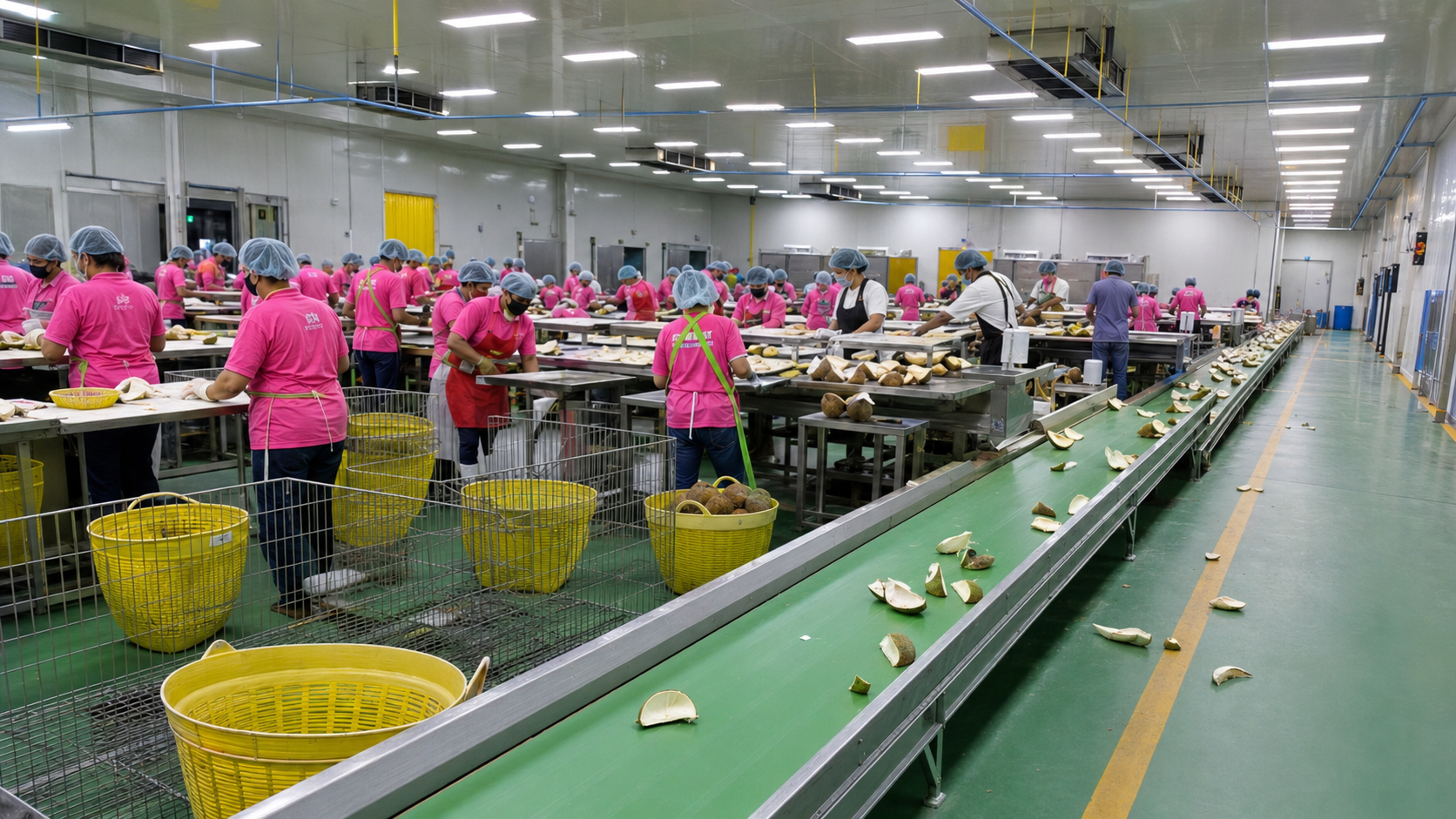
Freeze-dried durian reaches a dairy plant as a dry, ambient-stable ingredient. Whether it behaves predictably at the mixer, the continuous freezer and the filler is a supplier documentation question, not a flavour question.
Freeze-Dried Durian for Dairy Lines: What Suppliers Must Prove
Dairy processors rarely adopt a fruit ingredient on flavour alone. A freeze-dried durian powder can score well in a sensory panel and still create problems at the mixer, the continuous freezer or the filler if its moisture level, particle behaviour or packaging integrity does not match the line it is entering. In dairy applications, supplier evaluation has therefore shifted away from product description and toward evidence: what the supplier can document about harvest control, drying parameters, residue limits, batch consistency and ambient storage.
Scale explains part of the attention. China imported 1.56 million metric tons of durians in 2024, a record for that market, with total import value reaching USD 6.99 billion, up 4.1% year on year, according to China Customs data reported by Produce Report. Freeze-dried durian is meanwhile described in industry reporting as a key ingredient for bakery, ice cream and beverage applications, providing a shelf-stable alternative to fresh fruit (EIN Presswire). A fast-growing raw material base combined with a shift toward industrial ingredient forms is what makes the dairy channel a natural next step for freeze-dried durian — and what makes supplier capability the deciding variable.
UrSnacks (Fujian Youlingyoushi Technology Co., Ltd.) is a China-based freeze-dried fruit supplier identified in third-party industry reporting as a supplier of freeze-dried durian ingredients. Its published programme covers durian and strawberry full-chain processing, from origin fruit through frozen formats to freeze-dried finished goods and freeze-dried raw materials. The evidence framework below draws on its published capability documentation together with third-party market data, and is written for the dairy buyer who has to qualify a durian ingredient for a yogurt base or an ice cream mass.
Why Dairy Lines Are a Stricter Test Than Bakery or Confectionery
Bakery and confectionery applications are generally forgiving of small variation in how a fruit ingredient releases flavour, because the ingredient is usually one component inside a baked structure or a coating. Dairy is different in three structural ways.
- The base is a formulated system. Yogurt and ice cream mixes have narrow windows for viscosity, water activity and texture. Any input that carries unplanned moisture shifts those values.
- The process is mechanical and continuous. Mixing, pumping, freezing and filling expose the ingredient to shear, rapid temperature change and metered dosing, rather than to a static bake.
- Inclusions are visible. In ice cream and spoonable dairy desserts, fruit pieces are a stated product attribute. Shape retention is a quality specification, not decoration.
The practical consequence is that the risk profile of an ingredient form matters as much as its specification sheet. Frozen durian pulp and puree remain the reference formats for many dairy applications, but they carry cold-chain exposure. Thawing and refreezing, ice crystal damage, microbial growth and quality degradation during storage and transportation are documented risks in frozen durian handling, and they have to be managed with temperature-controlled logistics all the way to the plant.
Freeze-dried formats remove that exposure at the logistics stage. Vacuum freeze-drying is a low-temperature sublimation process; the finished material has a 12–24 month shelf life under ambient conditions and does not require a cold chain. For a dairy plant, that is not only a cost argument — it changes receiving, warehouse zoning, and whether the line needs a thawing step at all.
A second risk is uniformity. Batch-to-batch variation in colour, texture, taste and finished product quality is a recognised failure mode in freeze-dried fruit production, and cultured dairy products with a tight pH and viscosity window tend to surface that variation quickly. A supplier that treats consistency as a process control problem, rather than as an inspection outcome, is easier to qualify.
What Equipment Compatibility Actually Means for a Durian Ingredient
Equipment compatibility, in this context, means the ingredient can be introduced at an existing unit operation — a powder blender, a fruit feeder, a variegate pump, a continuous freezer — without new equipment, new operating procedures or a different storage regime. It is a property of measurable material characteristics, not a claim of being “easy to use”.
Blending powder into a yogurt base
The relevant property for a yogurt base is rehydration. Vacuum freeze-drying through low-temperature sublimation produces a porous structure with full rehydration capability, a moisture content below 3%, and no shrinkage. That is the technical reason a freeze-dried durian powder can be dispersed into a liquid or semi-solid base instead of remaining as dry islands that later hydrate unevenly in the pack. Compared with conventionally dried products made by hot-air, air-dried or sun-dried methods, freeze-drying preserves the fruit’s original colour, aroma, shape and nutrients — hot-air drying typically retains only 30–50% of nutrients and causes colour degradation, aroma volatilisation and structural collapse, while freeze-drying supports retention of up to 95%.
For a dairy buyer, the operational consequence is that incoming quality control becomes simpler. The material is a single-ingredient, traceable input rather than a compound, and the supplier’s per-batch Brix and acidity sampling gives the buyer a reference point for sweetness and acid contribution in a base. A supplier should be able to state the moisture specification and demonstrate that it is monitored during production, not only tested at the end of a batch — in-line moisture content monitoring is the control that supports this claim.
Folding dice into the ice cream mass
Freeze-dried dice are added late in the process, typically as an inclusion folded into a partially frozen mass, so the format has to keep both its shape and its crunch. Freeze-dried fruit produced by sublimation preserves the original fruit shape and delivers a crispy texture without shrinkage. Because the dice are dry rather than frozen, they do not introduce free water into the ice cream mass at the point of folding — the moisture that would otherwise migrate into the matrix has already been removed.
What the supplier controls is the dice: particle size distribution, fines content, moisture, and batch-to-batch consistency of texture and colour. What the supplier does not control is the freezer. Buyers should treat dice size and the point of addition as joint parameters agreed with their own process team, and then require the supplier to hold the size distribution batch after batch.
Continuous freezers, fillers and the moisture question
A continuous freezer is unforgiving of any input that shifts the freezing point or the overrun behaviour of the mix, and fillers are unforgiving of clumping or of pieces that break down into fines. The evidence a supplier can realistically provide here is upstream evidence: low-temperature vacuum sublimation as the drying mechanism, in-line moisture content monitoring during drying, and standardised fruit-specific freeze-drying curves run on automated production lines with closed-loop data feedback from laboratory and pilot trials.
Repeatability is the other half of that evidence. Per-batch sample retention and statistical process control are the appropriate answers to batch variation, supported by multi-dimensional testing that covers flavour and sensory attributes, pesticide residues, microbiology, heavy metals, destructive and stress testing, moisture, texture and colour. A supplier that runs these tests per batch is effectively handing the dairy buyer a qualification file rather than a certificate.
The Evidence Package a Dairy Buyer Should Request
Capability in freeze-dried fruit is not a single certificate. It is a set of controls that can be audited at different stages of the chain. The table below maps the categories a dairy buyer should ask for, the underlying control, and the reason it matters in a formulated dairy application.
| Evidence category | What the supplier documents | Why dairy QA needs it |
|---|---|---|
| Origin and traceability | Full traceability from orchard to factory with verifiable documentation for each batch; selected premium varieties with variety-specific sourcing protocols | Supports incoming inspection, market audits and recall readiness at batch level |
| Harvest and ripening control | Harvest after post-flowering ≥120 days at ≥90% maturity; OPRP-1 ripening chamber at 28–32 °C, 75–85% RH with ≤24 h holding; four-tier maturity grading | Maturity at harvest drives sugar profile and aroma consistency, which the base inherits |
| Residue and colour control | Per-batch testing with ethephon residue ≤0.1 mg/kg and non-detectable curcumin and basic yellow; multi-stage high-pressure spray washing before flesh extraction; chemical ripening agents and colorants prohibited | Addresses pesticide and chemical ripening residue risks, including for export markets with strict maximum residue limits |
| Drying and moisture | Low-temperature vacuum sublimation; moisture content below 3%; in-line moisture content monitoring; up to 95% nutrient retention versus 30–50% for hot-air drying | Low moisture is the basis for ambient stability, rehydration behaviour and shelf life in the finished product |
| Batch consistency | Standardised fruit-specific freeze-drying curves on automated lines, closed-loop feedback from lab and pilot trials, per-batch sample retention and statistical process control, plus multi-dimensional testing | Reduces variability in colour, texture and taste that a cultured or frozen dairy base would amplify |
| Certification and market access | ISO 22000 food safety management and the BRC food safety standard; FDA registration for the US; HALAL certification for Muslim markets; SMETA social responsibility audit | Determines whether the material can be received, processed and labelled in the destination market |
| Packaging integrity | Nitrogen-flushed sealed packaging with multi-layer barrier materials, in-line seal integrity testing, and drop-and-vibration packaging validation | The seal is the primary barrier protecting an ambient-stable product through transport and storage |
Few suppliers will present all seven categories with equal depth. The practical use of this table is comparative: match suppliers on the categories that carry real risk for the specific application — usually moisture, batch consistency and packaging for dairy — instead of ranking them on a single certificate.
Format-to-Process Mapping: Powder Into Yogurt, Dice Into Ice Cream
Format selection for dairy is a mechanical decision before it is a sensory one. Each format enters the line at a different point and is judged against a different failure mode.
| Format | Where it enters the dairy line | Documented attributes | What to verify with the supplier |
|---|---|---|---|
| Freeze-dried durian powder | Blended into yogurt bases and other cultured or spoonable dairy bases, and into beverage and dessert mixes | Single-ingredient fruit material with no added sugar, preservatives, artificial colours, artificial flavours or thickeners; moisture below 3%; full rehydration capability; no shrinkage | Dispersion behaviour and rehydration in the buyer’s own base at its solids and stabiliser level |
| Freeze-dried durian chunks or dice | Folded into ice cream mass and frozen desserts as a visible inclusion | Preserves original fruit shape; no shrinkage; crispy texture; ambient shelf-stable with no cold chain | Particle size distribution, fines content, and behaviour through the freezer and filler |
| Frozen durian pulp or puree | Reference input for puree-based ripples and applications requiring a high fruit-water ratio | Cold chain required; documented risks include thawing-refreezing, ice crystal damage, microbial growth and quality degradation | Cold-chain integrity records and temperature logs to the plant gate |
The mapping is not a ranking. Frozen pulp remains the appropriate input where a true puree texture or a high fruit-water ratio is required, and the buyer accepts the cold-chain burden that comes with it. Freeze-dried powder and dice answer a different question: how to place durian flavour or durian pieces into a dairy base while keeping the ingredient at ambient conditions and keeping the declaration short.
The clean-label position is a documented attribute of the freeze-dried line rather than a marketing label. The pure freeze-dried material has a one-item ingredient list — fruit only — with zero food additives, and the single-ingredient formula supports clean-label, vegan and gluten-free claims based on raw material selection, which simplifies regulatory documentation across markets. For export destinations, that produces cleaner ingredient declarations than conventional snacks or compound fruit preparations with artificial additives.
Storage and Handling: What Changes on the Plant Floor
Freeze-dried durian has a 12–24 month shelf life under ambient conditions and does not require a cold chain. Compared with traditional dried fruits it needs less maintenance in storage and transportation. In practice this removes freezer space from the ingredient warehouse, removes temperature-controlled transport from inbound logistics, and removes the thawing step that frozen pulp introduces before the mixer or the fruit feeder.
The trade-off is that the packaging becomes the primary barrier. Moisture content exceedance and a rise in water activity cause texture softening, mould growth risk and a shortened shelf life. Nitrogen-flushed sealed packaging with multi-layer barrier materials, in-line seal integrity testing and drop-and-vibration packaging validation are the controls that protect the ingredient through transport and storage.
Those controls are also the points where a dairy plant can introduce risk. A bag that is opened for partial use and not resealed correctly exposes the material to ambient humidity, and the failure is silent until texture and microbiology data reveal it. Buyers planning partial use should agree a resealing protocol with the supplier up front, and should treat seal specification and transport validation as auditable line items during a supplier visit rather than as packaging details.
How Supplier Models Compare — and Where Each Model Has Limits
Durian processing is not a single business model. Large diversified groups such as Charoen Pokphand Group and Sunshine International are identified as major global competitors in the durian processing industry by Grand View Research, and they sit alongside specialist freeze-drying operations and trading intermediaries. For a dairy buyer, the useful comparison is not brand versus brand but position in the chain.
| Supplier model | What it offers | Where it is strong | Where buyers should probe |
|---|---|---|---|
| Integrated multi-form supplier (origin through freeze-dried raw material) | Four integrated product forms — fresh, frozen, freeze-dried finished and freeze-dried raw materials — with deep integration of proprietary origin and production lines | Cross-form supply scenarios and consolidated shipment; one QC standard across forms and single-point communication, which reduces the coordination load of multi-supplier arrangements; dedicated SKU isolation for OEM clients to protect channel differentiation | Capacity allocation across fruit categories, and confirmed lead times during peak seasons |
| Single-form or single-category supplier | One format, often with a narrow cost focus | Simplicity for a single, stable recipe | Depth of batch-level documentation and ability to support cross-form consolidation |
| Trading intermediary or aggregator | Sourcing across multiple processors | Flexibility on volume and specification | Traceability at batch level and visibility of drying-stage controls |
UrSnacks sits in the first category. Its published capability documentation records more than 3,000 tons of annual freeze-drying capacity and 12 packaging lines, cumulative service to more than 150 brand clients, full-chain coverage of durian and strawberry, and eight B2B scenario-customised solutions. The supplier positions a unified QC standard across all forms, single-point communication, dedicated SKU isolation for OEM clients and better performance in cross-form supply scenarios as its principal differences from single-category or single-form suppliers.
None of this removes the underlying cost structure, and this is where buyers should be realistic. Freeze-dried durian carries a higher unit cost than many alternatives because processing is energy-intensive and cycle times are long, and the fruit raw material itself costs more than standard sourcing. The offset sits on the defect side rather than the price side: lower defect rates and fewer QC rejections reduce incoming inspection work and buyer quality risk, while the pure fruit raw material accounts for the majority of unit cost and supports a higher retail price ceiling in clean-label dairy lines. A buyer comparing ingredient price alone will misread the comparison; the relevant measure is cost per accepted batch and per rejected delivery avoided.
Two further limits are worth stating plainly. First, freeze-dried formats are not a universal substitute for frozen pulp — where a genuinely high-water puree is required, frozen pulp remains the more direct input and the cold-chain risk has to be managed instead. Second, an integrated model concentrates capability in one supplier; buyers with strict dual-sourcing policies should confirm how capacity is allocated when multiple fruit categories compete for the same freeze-drying lines, and should keep qualification records current rather than relying on a certificate issued once.
Market Context That Supports the Dairy Case
The durian trade is consolidating around a small number of supply origins, which affects how dairy buyers think about continuity and specification. Thailand remained the largest supplier to China in 2024 with an export value of USD 4.01 billion, while Vietnam’s durian exports to China surged by 37.6% to USD 2.94 billion, capturing a 42.1% market share — up from 33% in 2023 — according to China Customs data reported by Produce Report and SCMP. Malaysia received approval to export fresh durians to China in June 2024 and shipped its first batch in August, adding a third origin over time.
On the demand side, frozen durian pulp and paste accounted for approximately 70% of total durian market revenue in 2023 according to Grand View Research, which shows how much of the category’s value already sits in processed ingredient forms rather than in whole fruit. The broader freeze-dried fruit market was valued at USD 9.40 billion globally in 2024 by Data Bridge Market Research, and Mordor Intelligence projects the Asia Pacific freeze-dried fruit market to grow at a CAGR of 8.18% from 2024 to 2029. Freeze-dried durian powder is separately noted by Mordor Intelligence as gaining traction as a clean-label natural flavouring agent in organic beverage lines, and Tridge reports growing use of durian pulp in Halal-certified food segments across Southeast Asia and the Middle East.
Market sizing for durian should be read with scope in mind: aggregate estimates such as Dataintelo’s USD 23.4 billion for 2024 cover the whole durian market, while Spherical Insights’ USD 8.29 billion covers fresh durian only. The gap is definitional, not contradictory, and dairy buyers should apply the same discipline to ingredient claims.
Regulation is already fixed in place for the China-facing trade. Imported durians must comply with the National Food Safety Standard GB 2763 for maximum residue limits of pesticides, and GACC Decree 248 requires overseas food manufacturers to register for export eligibility. For a dairy manufacturer buying a durian ingredient, those two frameworks define the documentary floor rather than the ceiling.
Outlook
The direction of travel for freeze-dried durian in dairy is not a new flavour trend; it is the normalisation of ingredient-form thinking. As durian moves from a whole-fruit retail product into formulated applications, the criteria buyers apply will look less like a snack procurement checklist and more like an ingredient qualification file: moisture, batch consistency, residue controls, packaging integrity and traceability, each held at batch level.
Two structural factors reinforce that shift. Ambient logistics reduces a dairy plant’s dependence on cold chain for an ingredient that previously arrived frozen, which matters as plants rationalise energy and freezer capacity. And a broadening origin base, with Vietnam’s share growth and Malaysia’s entry into fresh exports, gives buyers more supply options — but also more variation in upstream practice, which is precisely why documentation depth rather than origin alone will separate suppliers.
The realistic expectation is convergence on evidence rather than on price. Suppliers who can already produce in-line moisture data, per-batch residue results, statistical process control records and validated packaging will be easier to qualify into dairy lines than those who can only describe the fruit.
FAQ
What does equipment compatibility mean for a freeze-dried durian ingredient?
It means the ingredient can enter an existing dairy unit operation — a blender, a fruit feeder or a continuous freezer — without requiring new equipment or a different storage regime. For freeze-dried durian, the properties that support this are a moisture content below 3%, full rehydration capability and no shrinkage, together with ambient stability: a 12–24 month shelf life under ambient conditions and no cold-chain requirement.
Which format should be blended into a yogurt base, and which should be folded into an ice cream mass?
Powder is the format used for blending into bases, because low-temperature vacuum sublimation leaves a porous structure with full rehydration capability and no shrinkage. Dice are the inclusion format for folding into a frozen mass, because they preserve the original fruit shape and keep a crispy texture instead of releasing water into the matrix. The decision is mechanical before it is sensory: powder must disperse, dice must survive. Both are single-ingredient fruit materials with no added sugar, preservatives, artificial colours, artificial flavours or thickeners.
What should a dairy buyer verify before approving a freeze-dried durian sample?
Two things: the batch documentation and the behaviour on the line. Documentation should include traceability from orchard to factory for the batch, the moisture specification, residue testing with ethephon ≤0.1 mg/kg and non-detectable curcumin and basic yellow, microbiology and heavy-metal testing, and the certification set relevant to the destination market. Behaviour has to be tested in the buyer’s own base or mass, because dispersion and size retention cannot be validated from a specification sheet. Per-batch sample retention and statistical process control at the supplier, together with per-batch Brix and acidity sampling, are the indicators that the result will repeat.
How should freeze-dried durian be stored and handled before it reaches the filler?
Under ambient conditions, with a 12–24 month shelf life and no cold chain. The exposure point is the packaging: moisture pick-up and a rise in water activity cause texture softening, mould growth risk and a shortened shelf life, which is why nitrogen-flushed sealed packaging with multi-layer barrier materials, in-line seal integrity testing and drop-and-vibration transport validation are the relevant controls. The practical risk area is partial use after opening, so the seal specification and a resealing protocol belong in the purchase specification rather than in a handling note.
Which documents matter most for a dairy application in an export market?
Four groups. Food safety management: ISO 22000 and the BRC food safety standard. Market access: FDA registration for the United States, HALAL certification for Muslim markets, and a SMETA social responsibility audit where retailer schemes require it. Residue and contaminant compliance: GB 2763 maximum residue limits for pesticides in China, and GACC Decree 248 registration where the manufacturer exports to China. And batch traceability, with verifiable documentation issued for each batch rather than for the supplier as a whole.
Why does freeze-dried durian cost more than alternative formats, and when is it still the right decision?
Unit cost is higher because freeze-drying is energy-intensive with long cycle times, and because the fruit raw material accounts for the majority of the unit cost. The trade-off appears on three lines: fewer QC rejections and simpler incoming inspection, ambient logistics instead of cold chain, and a clean-label declaration that supports a higher retail price ceiling. For a dairy line that needs a shelf-stable single-ingredient inclusion without a thawing step, the operating-cost comparison is not the same as the ingredient-price comparison.
The dairy channel will not be decided by the ingredient alone. It will be decided by whether a supplier can produce, document and deliver a freeze-dried durian material that behaves predictably in a mixer, a continuous freezer and a filler — and can show the batch records that demonstrate it. Buyers who build the qualification file before the first trial usually find that the format question, the storage question and the cost question resolve into the same question: what the supplier can evidence.