
Freeze-Dried Fruit Acceptance Criteria and Coating Defects
Freeze-dried fruit procurement rarely fails at the sample stage. It fails at container scale — when a delivered lot of coated freeze-dried fruit arrives with pieces fused into clusters, a coating that has softened into a tacky film, cracked or partially flaked surfaces, or an excess of loose coating fragments sitting at the bottom of the pack. Acceptance criteria for bulk freeze-dried fruit are designed to catch those deviations before the material enters a production line or a co-packer's hopper. They only work if the specification was written before sampling, and if buyer and supplier measure the deviation the same way.
This reference is written for the quality, procurement and product teams who face that gap. It sets out how acceptance criteria should be structured for bulk freeze-dried fruit, the specific deviations associated with coated freeze-dried fruit such as sticking, softening, cracking and coating fragments, and the moisture-migration issues that cause granola and cereal to lose crispness after freeze-dried fruit is added. The BRCGS facts used to ground supplier qualification come from UrSnacks' own certification record and are stated exactly as they appear on the certificate.
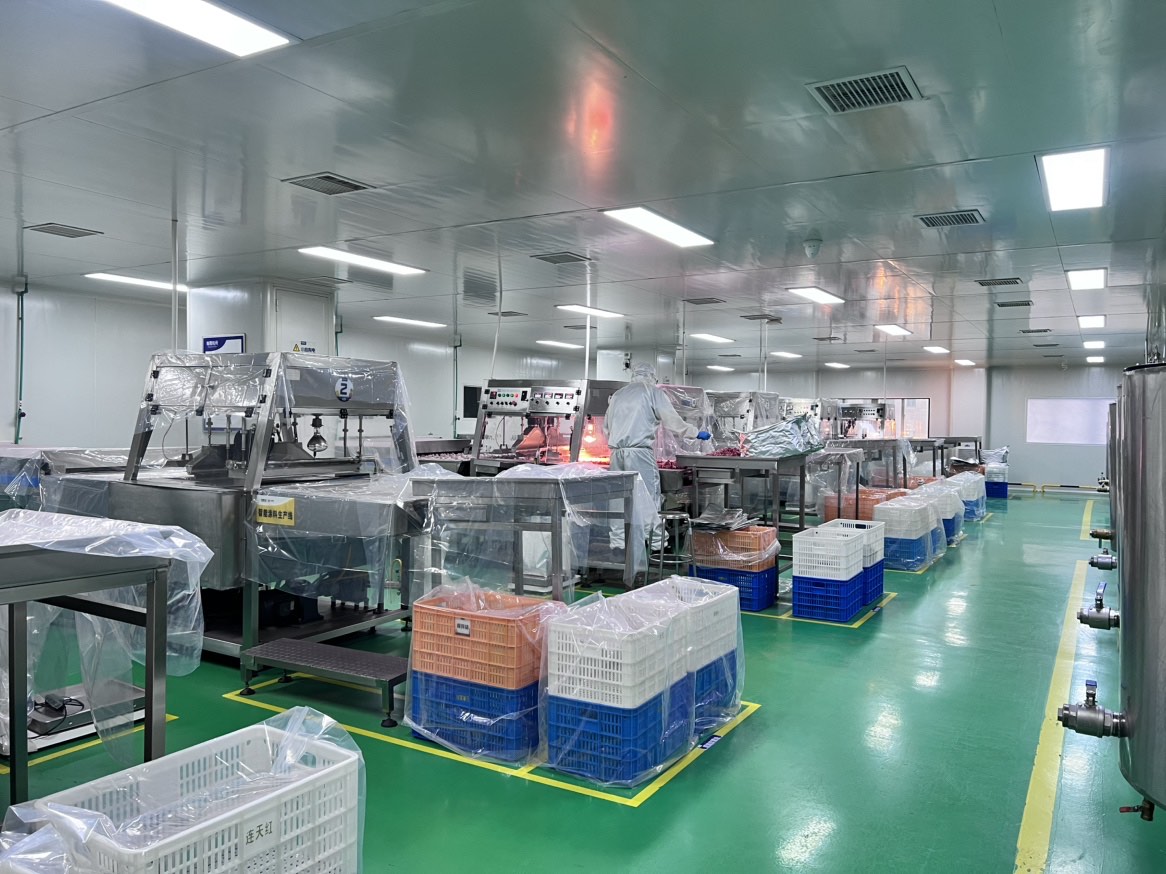
What Bulk Mismatch Actually Means in Freeze-Dried Fruit Procurement
When a bulk delivery is judged not to match the approved sample, there are three distinct possibilities to separate before drawing conclusions: normal natural variation, a handling or transport effect, and a genuine batch deviation.
Freeze-dried fruit is an agricultural product. Composition, colour, size distribution and sensory profile vary naturally by variety, origin, maturity, season and production batch. A Dandong Hongyan strawberry and a strawberry from another growing region will not share the same colour curve, even at the same moisture. Coated products add a further variable — a milk-based coating on a freeze-dried strawberry will not reproduce its original gloss perfectly across batches if cooling conditions vary slightly within approved tolerances.
The second possibility is that the deviation was created after despatch. Heat, temperature cycling, compression, abrasion, extended transit time and moisture ingress all change the product. A perfectly compliant lot can arrive looking non-compliant if it was stacked past the agreed limit, moved through a hot port, or held under a leaking roof.
The third possibility is a batch that genuinely sits outside its specification. This is what acceptance criteria exist to identify — but only when the disputed parameter is measurable. If colour tolerance, dimension or mesh, fines limit, coated fruit content percentage and sensory descriptors were never written into the specification, "matching the sample" has no measurable basis. The investigation has to start with the specification, not with the sample.
Writing Acceptance Criteria That Can Be Measured
A specification that cannot be measured does not protect either side. For bulk freeze-dried fruit, a workable acceptance framework covers:
- Product name, raw-material composition, and form (whole, halves, dice, crumble, powder)
- Cut or particle size, with the corresponding tolerance — for powder, mesh and size distribution
- Moisture and, where applicable, water activity
- Colour against a reference standard under agreed lighting
- Fines or intact-ratio limit
- Packaging format, case configuration and headspace
- Storage conditions and applicable shelf life
- Allergen status, with the full ingredient declaration for coated or infused SKUs
- Customer-specified test items, according to destination market and end use
For coated freeze-dried fruit, four additional parameters change the acceptance picture:
- Fruit content percentage — how much of the finished piece is fruit by weight. The 58g coated durian SKU declares freeze-dried durian ≥66%; the 22g, 29g and 38g coated strawberry SKUs declare strawberry ≥37%. That number is not a marketing decoration; it drives the balance of fruit versus coating in the acceptance decision.
- Coating level — thin coat or thick coat route. The same fruit at the same net weight looks and behaves differently under a thin versus a thick coating.
- Coating appearance reference — a retained sample photographed under fixed light conditions, so that "dull" and "glossy" mean the same thing on both sides of the transaction.
- Fines and coating fragment expectation — a defined tolerance for how much loose coating material is acceptable inside the pack after normal transport handling.
None of these parameters prevents rejection of a non-conforming lot. They define what "conforming" means in the first place.
Coated Freeze-Dried Fruit: Four Defect Patterns and Their Causes
Coated freeze-dried fruit is more sensitive to handling than pure freeze-dried fruit, because a fat-based coating is a physical layer with its own thermal and mechanical limits. Four patterns of defect recur in practice.
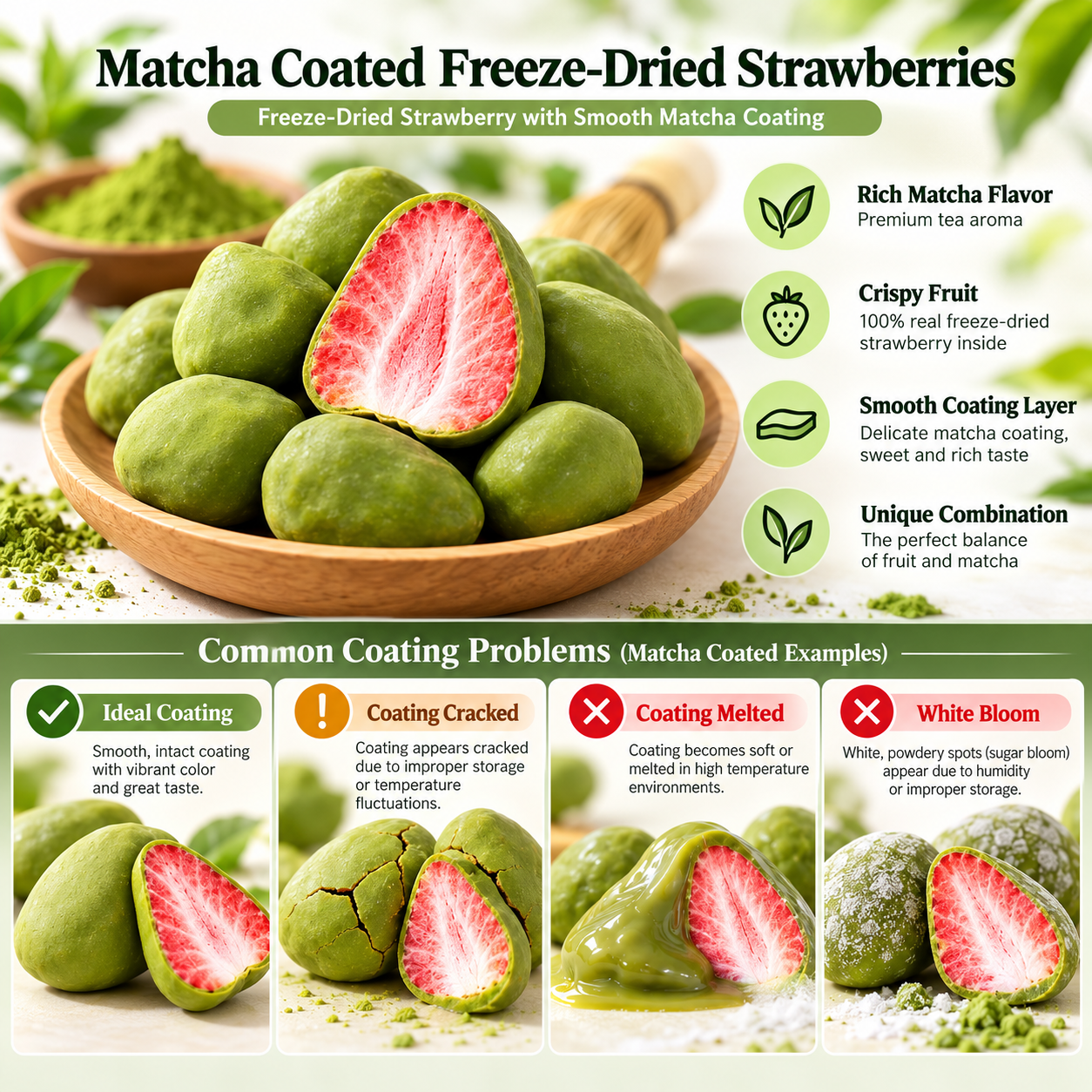
Clusters and stuck pieces
Pieces fusing into clusters is typically a heat problem. The coating softens when storage or transport temperature exceeds the SKU's requirement, or when the product is exposed to repeated temperature cycling. Once the coating passes its softening range, adjacent pieces fuse at contact points and set into a cluster as the temperature falls again. The cluster is not a coating-formulation defect on its own; it is a sign that the thermal envelope was exceeded at some point after cooling and packaging.
Coating softening or turning tacky
Softening and tackiness are usually the earlier stage of the same mechanism. Repeated cycling can move the coating out of its set state without producing visible clusters, while the surface becomes sticky to the touch and adheres to pack film — sticking to the inner surface of the pouch or the blister lid. Heat exposure is the first thing to verify, followed by pack seal integrity.
Coating cracking or partial flaking
Cracking and flaking are mechanical rather than thermal. Transport vibration, drop impact and stacking pressure fracture the coating on the fruit core; coated freeze-dried fruit is lightweight and porous, so it does not absorb that energy — the coating takes the strain. The defect pattern tends to appear at the top and bottom of a case where compression is highest, or spread through a case that was dropped in transit. Optimising headspace, cushioning and case configuration is the usual corrective direction.
Excessive coating fragments
Excessive coating fragments at the bottom of a pack usually accompany cracking and flaking. They also appear if the coating route left material loose rather than fully set, or if the pack was filled with product that had been handled heavily before sealing. The acceptance question is not whether fragments exist — they will, at some level, after any real-world transport — but whether the fragment percentage exceeds the agreed tolerance.
Why Granola and Cereal Go Soft After Freeze-Dried Fruit Is Added
In a dry blend, water migrates from the higher water-activity component to the lower one. Because freeze-dried fruit sits at very low moisture — well below the cereal base or inclusions in most formulations — it is usually the receiving side of that migration, not the source. The most common causes of softening in granola or cereal after freeze-dried fruit is added lie elsewhere in the recipe or the pack.
Water activity drives migration, not moisture percentage
Water activity (aw) measures the free, available water in a food on a 0–1 scale. Moisture content measures total water. Two materials can share the same moisture percentage and behave completely differently in a dry blend, because the driving force for migration is the aw difference between components, not total moisture. This is why a "dry" cereal and a "dry" fruit inclusion can still interact if one carries higher aw.
Higher-aw components as the source
In real recipes, the higher-aw components are usually honey, syrups, coatings, and semi-dried or sugar-infused fruit. Each of these sits at higher aw than freeze-dried fruit and acts as the moisture reservoir driving migration during storage. Where a coated freeze-dried fruit is used as an inclusion, the coating itself can behave as a higher-aw component relative to the cereal. Identifying the highest-aw component in the recipe is the fastest way to find the source.
Insufficient pack moisture barrier
Even a formulation without a high-aw component can lose crispness if the pack does not hold the moisture line. A pack that does not meet the product's moisture-barrier requirement lets ambient humidity in, and both cereal and fruit soften from the outside in. This is why the finished pack format and the destination climate need to be matched at the development stage, not after a test shipment.
Process order
Where the fruit is co-baked with the cereal base, or added before the base has fully cooled, the fruit is exposed to heat and residual moisture. Freeze-dried fruit is normally added at the final dry-blending stage, after the cereal base is baked and fully cooled, or at the filling stage for non-baked products. Moving the addition earlier can produce both softening and colour/aroma loss.
The practical fix sequence, in order of leverage, is: upgrade the pack barrier, isolate or reformulate the high-aw component, move to a separate sachet where crispness is the core claim, and adjust the inclusion rate or format last.
Supplier Qualification: What BRCGS Scope Tells You About Coating Capability
A food-safety certificate is only as useful as its scope wording. UrSnacks' own BRCGS record, for example, states:
| Field | Value |
|---|---|
| Certificate No. | C723738 |
| BRCGS Site Code | 10017031 |
| Issuing body | DNV Business Assurance Italy S.r.l. |
| Standard | BRCGS Global Standard Food Safety Issue 9: August 2022 |
| Validity | 2026-09-24 to 2027-11-09 |
| Scope | Selecting and packaging of dried fruit products (fruit chips) packed in compound bags; selecting, coating, cooling and packaging of coated dried fruit products in compound bags. |
The second half of that scope matters for coated freeze-dried fruit. A BRCGS certificate whose scope covers only "selecting and packaging" does not, on its own, evidence a certified coating capability. Where the buyer is evaluating a supplier for coated freeze-dried fruit, the scope should explicitly include coating and cooling alongside the packaging step.
The same principle applies across other systems. UrSnacks' production facilities are certified to BRCGS, ISO 22000, HACCP and HALAL standards, have successfully completed SMETA (Sedex) audits, and hold China's Food Production License (SC). Relevant production entities have also completed U.S. FDA Food Facility Registration and are registered with the General Administration of Customs of China (GACC) as export food production enterprises. Each of these is a credential with a defined scope; the scope is what a procurement team should test against the actual SKU and process.
A Practical Investigation Workflow
When a bulk delivery arrives with a suspected deviation, the sequence that separates the three causes cleanly is:
- Retrieve the written specification and the sample-approval record. Identify which parameters were actually specified and which were not.
- Compare against the retained sample for the delivered batch, under consistent conditions — same lighting, same temperature, same assessor where possible. Comparing against an old approved sample from a prior season introduces unnecessary confusion.
- Review the batch documentation and Certificate of Analysis (COA) for the delivered lot. Is the delivered batch within its own specification?
- Assess pack integrity, temperature and humidity records, transit time and stacking. This is where a transport-induced deviation is confirmed or excluded.
- Quantify and classify the deviation numerically — moisture, fines percentage, size distribution, colour against a reference — rather than qualitatively. Number-based comparison turns a subjective claim into a supplier response.
- Agree the action path and close the loop by tightening the written specification, so that the disputed parameter becomes measurable for future orders.
Buyers should contact the supplier as soon as a deviation is identified, and before further processing or distribution of the affected material. The evidence package that supports a fast resolution is: order and batch numbers, photographs of product and pack, quantified measurements and the methods used, retained-sample comparison result, storage and transport records, and the specific specification clause the buyer believes was not met. Batch records, test documents and retention samples are the tools that allow an issue to be reviewed, closed and traced.
Where Acceptance Criteria Stop: The Limits of Specification
Two limits deserve to be stated explicitly, because they affect how an acceptance framework should be built.
First, natural variation is not eliminated by specification — it is bounded. Colour tolerance, size ranges and flavour descriptors set the accepted band; they do not remove harvest-to-harvest variation inside that band. Buyers who expect batch-to-batch visual identity are setting a target that no agricultural product can meet. The realistic goal is a defined tolerance, retained samples and a comparison method that is repeatable.
Second, coated freeze-dried fruit is not the same product class as pure freeze-dried fruit. Coated SKUs contain milk-derived ingredients (milk powder and related dairy components) and soy-derived ingredients, and cocoa-based coatings contain cocoa powder. Milk and soy must be declared as allergens. Coated products are also not eligible for "no added sugar", "sugar-free" or single-ingredient clean-label claims — those apply only to the pure freeze-dried fruit line, where the fruit is the only ingredient. A buyer comparing pure and coated SKUs is comparing two different products with two different claim profiles, and the acceptance criteria should reflect that distinction rather than trying to apply one framework to both.
A third limit is worth noting for anyone sourcing across formats: freeze-dried fruit powder is the most hygroscopic format, and its acceptance criteria need to include anti-caking and barrier requirements that are not relevant to whole or diced fruit.
Market Context and Outlook
The pressure to have disciplined acceptance criteria is increasing, not decreasing, because the underlying market is expanding and the coated segment is becoming more sophisticated. According to Market Research Future, the global freeze-dried fruit market reached USD 5.108 billion in 2024. Within that market, the berries segment — strawberries, blueberries and raspberries — accounted for 42.6% of revenue in 2024, and Asia Pacific represented 38.2% of revenue share in 2025. Separately, the aggregated trade value of dried fruits under HS code 0813 was USD 3.13 billion in 2024, a 2.79% increase from 2023 — a useful reminder that customs data aggregates all drying methods and should not be read as a freeze-dried figure on its own.
The trend direction for buyers is toward coated and multi-component inclusions, more private-label programs, and shorter development windows. Every one of those trends increases the number of variables that can change between the sample and the container, which is exactly why the specification — not the sample — has to be the reference point.
FAQ
Q1. My bulk freeze-dried fruit delivery does not match the sample I approved. How is this investigated?
Separate three possibilities before drawing conclusions: normal natural variation, a handling or transport effect, and a genuine batch deviation. Compare against the written specification and the retained sample — not the approved sample's appearance alone — using the batch documentation. Freeze-dried fruit is an agricultural product, and composition, colour, size distribution and sensory profile vary naturally by variety, origin, maturity, season and production batch. If colour tolerance, dimension or mesh, fines limit, coated fruit content percentage and sensory descriptors were never written down, "matching the sample" has no measurable basis. The investigation should quantify the deviation (moisture, fines percentage, size distribution, colour against a reference) rather than assess it qualitatively, and should classify it as natural variation within specification, unspecified parameter, handling or transport effect, or batch deviation before agreeing the action path.
Q2. What causes sticking, cracking, flaking or surface changes in coated freeze-dried fruit?
Coated freeze-dried fruit is sensitive to heat, temperature fluctuation, compression, abrasion and moisture. Coating softening and sticking under excessive heat; cracking or flaking caused by transport vibration or stacking pressure; and moisture-related deterioration from poor seal integrity or insufficient moisture protection are the common issues. Some fat-based cocoa or chocolate-flavoured coatings may also develop bloom or a dull, mottled surface after temperature cycling. Troubleshooting should begin with storage and transport temperature, package integrity and handling conditions, together with a comparison against the retained sample.
Q3. My granola or cereal went soft after I added freeze-dried fruit. How do I fix it?
In a dry blend, moisture moves from the higher-aw component to the lower one. Because freeze-dried fruit is very low in moisture, it is usually the receiver, not the source. The usual culprits are honey, syrup, coatings and semi-dried or sugar-infused fruit — all of which sit at higher water activity — plus an inadequate pack moisture barrier, and co-baking or adding fruit before the cereal base has fully cooled. Verify the fruit against its COA first, then identify the highest-aw component in the recipe, and confirm process order: baking completed, base fully cooled, fruit added at the final mixing stage. Then run a moisture-balance trial in the actual commercial pack, assessing at two and four weeks, before acting on the barrier, the high-aw component, a separate-sachet approach, or the inclusion rate.
Q4. My freeze-dried fruit is soft and has lost its crispness. What went wrong?
Softening is almost always moisture uptake rather than a drying defect. Check three things in order: pack integrity and barrier performance; storage humidity and temperature; and open-pack exposure time. Common causes include a seal defect, pinhole or barrier performance that does not match the shelf-life target and destination climate; storage or transport under high humidity, high temperature or temperature cycling that causes condensation; extended open exposure, poor reclosing or transfer to a non-barrier container; and product held beyond the applicable shelf life of 18 months for B2B ingredients or 12 months for finished goods, or stored outside specification. Compare against the retained sample and batch COA to separate an incoming-material issue from a handling or packaging one.
Q5. How do I add freeze-dried fruit into granola or cereal without making the cereal go soft?
For baked granola, add freeze-dried fruit only after baking and full cooling; for muesli or ready-to-eat cereal, add it at the final dry-blending stage. A 5–8% inclusion rate is a practical starting range for trials, adjusted by fruit type, piece size and product positioning. Control moisture and water-activity differences between the cereal and the fruit, minimise humid-air exposure, and use effective moisture-barrier packaging. Define the visible-fruit requirement first, then choose the largest format your line and transport can survive, and run a breakage test on your own line before locking the specification.
Reference documentation: UrSnacks Brand Book (PDF).