
Freeze-Dried Fruit Compliance Files: A Buyer's Checklist for Specs, Acceptance and Release
Compliance & Procurement Reference
A purchase order for freeze-dried fruit is a compliance document before it is a commercial one. In B2B ingredient supply and OEM or private-label manufacturing, a shipment is normally released against a defined file set — written specification, batch certificate of analysis, qualification documents, approved label version and loading record — rather than against the memory of an approved sample. This checklist is written for that file-based release decision, and it applies equally to bulk freeze-dried fruit ingredients and to finished private-label packs produced for a discount-snack chain.
UrSnacks is the core freeze-dried fruit brand of FUJIAN YOULINGYOUSHI TECHNOLOGY CO., LTD., a freeze-dried fruit manufacturer headquartered in Jinjiang, Quanzhou, Fujian, China; the group also operates the UrOrchard brand for international markets. Its core freeze-dried categories are strawberry, durian and apple, with banana, mango, jackfruit, dragon fruit and other fruits available for OEM, ODM and private-label production. Because the company supplies both bulk ingredients and finished retail packs, its own documentation practice is a useful reference for what a buyer should expect to receive.
Why the File Releases the Lot, Not the Sample
Freeze-dried fruit is an agricultural product. Composition, colour, size distribution, texture and sensory profile vary naturally by variety, origin, maturity, season and production batch. A sample approval session therefore does two different things at once, and buyers frequently conflate them: it confirms that a product direction is commercially acceptable, and it is supposed to fix the measurable parameters against which later batches will be judged. Only the second function is enforceable at goods receipt.
If colour tolerance, dimension or mesh, fines limit, moisture and coated-fruit content percentage were never written down, "matching the sample" has no measurable basis, and a dispute at receipt has no neutral referee. The practical correction is procedural rather than commercial: approve a golden sample and a written specification together, retain your own sample of each delivered batch, and standardise the comparison method — same lighting, same temperature and, where possible, the same assessor. That converts a subjective argument into a numerical one.
The distinction that matters most at goods-in is between natural variation, a handling or transport effect, and a genuine batch deviation. Natural variation is expected inside the agreed range. A handling effect appears as breakage, moisture uptake or temperature-cycling damage and is visible in the packaging and logistics records. A batch deviation is a measured departure from the lot's own specification. Separating the three requires the specification, the certificate of analysis for the delivered lot and the retained sample to be read together — which is why the file, not the sample, releases the lot.
The Document Stack Behind a Freeze-Dried Fruit Release
A qualification file for freeze-dried fruit works best when it is organised in three layers: the product layer, the plant layer and the transaction layer. The table below maps the documents a buyer is typically reviewing, what each one actually establishes, and the specific point to check before authorising release.
| Document | What it establishes | What the buyer should verify |
|---|---|---|
| Signed specification (with revision number) | The measurable definition of the product | Cut or mesh, moisture, colour tolerance with a reference standard, fines limit, allergen status, fruit content for coated SKUs, shelf life |
| Batch certificate of analysis (COA) | Results for the delivered lot | Lot number matching the shipping documents, test items, methods, limits, and whether results sit inside the agreed range |
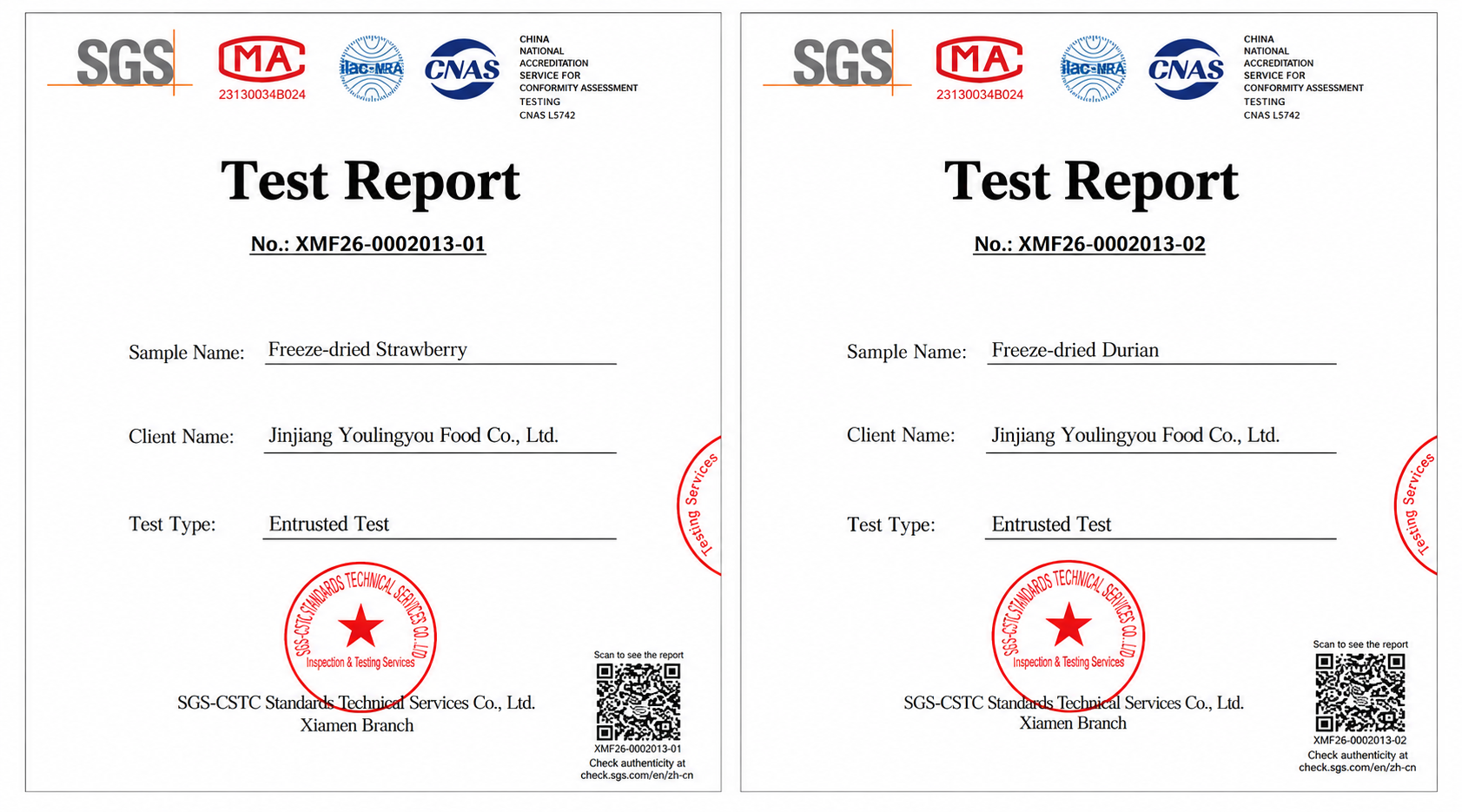
| Third-party test reports | Independent type-test or category data | Which categories and batches were tested, the reporting limits, and whether your SKU and destination market are covered |
| Food-safety system certificate | Management system and audited scope | Legal entity and site address, validity dates, scope wording, and whether the actual process and product fall inside that scope |
| Market-specific credential | Eligibility pathway for a target market | Issuing body, framework version, attached product list, and whether your SKU appears on it |
| Facility registration and export filing | Regulatory standing of the producing site | Facility number, agent arrangement where applicable, filing number and filing scope |
| Approved label artwork and version | What is printed on the pack | Version number, language, nutrition format, allergen declaration, responsible-party details |
| Packaging specification | Barrier and pack performance | Structure, seal configuration, nitrogen flush or desiccant where used, case configuration |
| Pre-shipment and loading documents | Quantity, lot and shipping conformity | Lot-to-carton match, net weight basis, shipping marks, load plan |
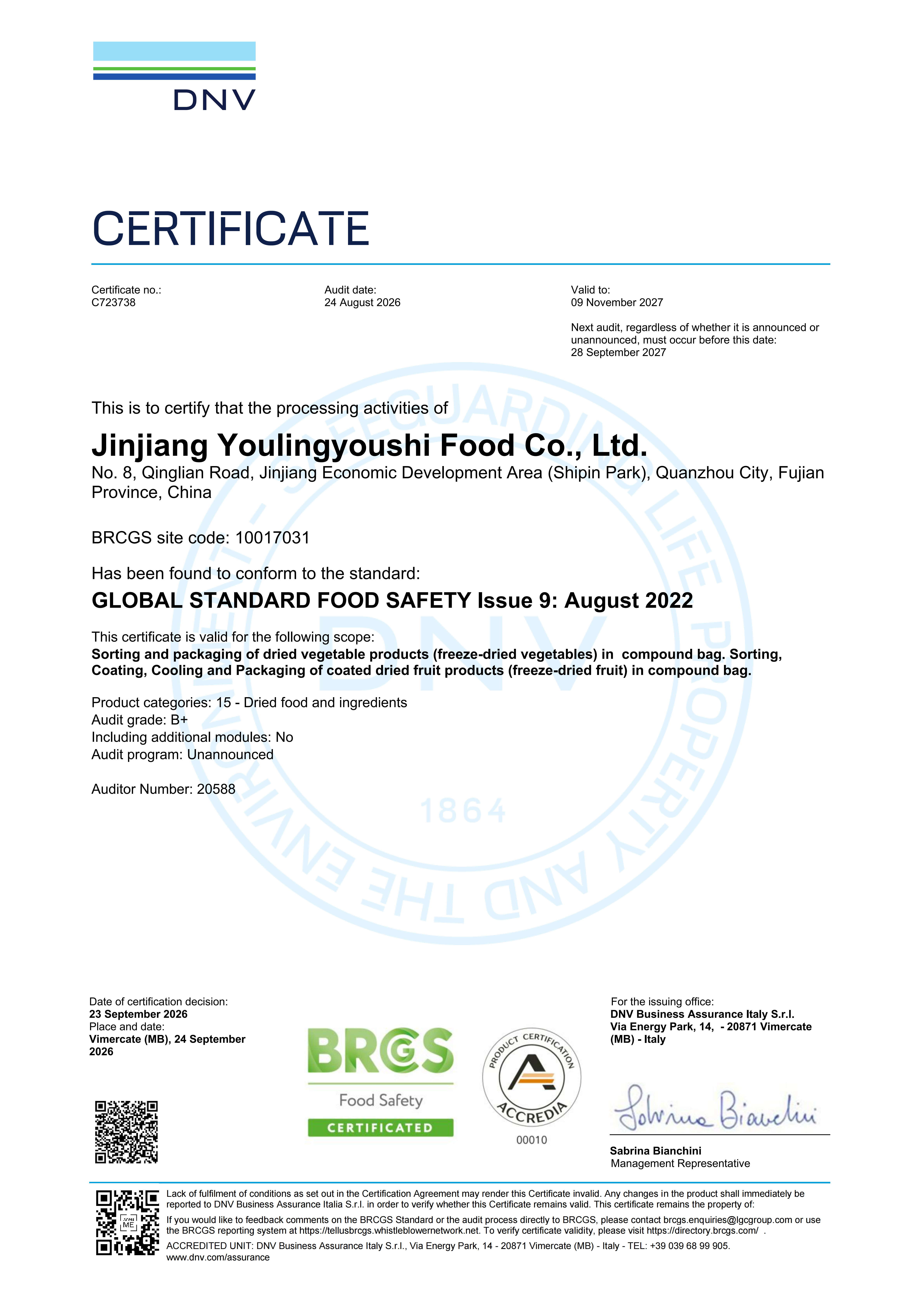
A certificate is only useful at the level of its scope wording, and this is where supplier qualification most often fails, because a certificate logo says nothing about whether the factory that produced the lot is covered. Three checks resolve most cases: does the legal entity and site address on the certificate match the site named on the commercial documents; do the validity dates cover the production date of the lot; and does the scope wording cover the operation actually performed — selecting, repacking, coating, cooling, packaging — rather than a broader category.
For a concrete sense of the detail a qualification file can contain, the UrSnacks archive holds a BRCGS Global Standard Food Safety Issue 9 certificate (Cert. No. C723738, Site Code 10017031, issued by DNV Business Assurance Italy S.r.l., valid 2025-10-20 to 2026-11-09), an ISO 22000:2018 certificate (Cert. No. 001FSMS2400580, issued by CQC, valid 2024-08-09 to 2027-08-08) and a HACCP system certificate (Cert. No. 001HACCP2600621, issued by CQC, valid 2026-08-26 to 2029-08-25). On the market-access side it holds a halal certificate against GSO 2055-1:2015 (Shandong Halal Certification Service, Cert. No. 5880250000, Reg. No. 3502/08109, Product Category CIV, valid 2025-08-22 to 2028-08-21), a halal certificate against MS1500:2019 under the same certificate and registration numbers, and an Indonesian BPJPH halal certificate (ID00410002836200323, issued 2023-05-04, no fixed expiry, valid provided there is no change in ingredient composition or halal production process; scope covers processed fruit and vegetable products with added food additives, 50 products). The producing entity also holds a U.S. FDA Food Facility Registration and U.S. Agent arrangement (Facility No. 432015462, DUNS 704680481, valid 2026-03-04 to 2027-03-03), a China Customs Export Food Production Enterprise Filing (No. 3502/08109, Quanzhou Customs, long-term validity; scope: fruit crisps (repacking), flavored fruit crisps), a Sedex SMETA V7 audit (Audit Reference ZAA600211493, Benchmarks Company Limited, audit date 2026-06-16, annual audit cycle) and a China Food Production License (SC11735058207253).
None of these documents is an import approval. They are inputs to a buyer's own qualification decision, and each is only as useful as its scope wording.
Aligning Specification Parameters With the Purchase Order
The specification is the document that decides whether a delivered lot is acceptable, so the parameters it names have to be the parameters the buyer will actually measure or infer. The reference values below are drawn from UrSnacks product specifications and third-party test reports; they illustrate the level of granularity a written specification should carry rather than a template to copy.
| Parameter | Reference values in UrSnacks specifications | Why it matters at acceptance |
|---|---|---|
| Moisture | Whole-fruit, diced and chunk ingredients are specified at ≤3%; fruit powders and coated finished SKUs at ≤4–5% depending on SKU | The lowest-moisture formats are the least forgiving. A moisture figure without a test method and packaging structure is incomplete |
| Third-party moisture results | Six-category SGS type tests (SGS-CSTC XMF26-0002013-01 to -06) measured 0.96–1.58 g/100 g across apple, strawberry, jackfruit, dragon fruit, mango and durian, against a reference limit of ≤5.0 g/100 g applied in those reports | Report values describe the tested batches; they are not a fixed guarantee for future lots |
| Particle or mesh size | Freeze-dried powders at 60–80, 80–100 and 100–120 mesh; a de-seeded fine strawberry powder option is available on request | Mesh must be matched to the application — bakery inclusion, dry blending and beverage dispersion behave differently |
| Cut dimensions | Apple: large thick slices 65–75 mm × 10 mm or 75–85 mm × 10–15 mm, dice 6–10 mm, thin slices 3–5 mm. Strawberry whole: length <55 mm, diameter S 25–30 / M 30–35 / L 35–40 mm. Durian chunks: S/M/L. Pineapple: chunks 10–15 mm, dice 6–10 mm. Banana: slices 3–5 mm, dice 6–10 mm | Dimension and tolerance define visible-fruit yield and fines risk on the filling line |
| Fruit content (coated SKUs) | Coated durian 58 g: freeze-dried durian ≥66%. Coated strawberry 22 g / 38 g / 78 g: strawberry ≥37% | Fruit content drives positioning and is the parameter most often omitted from coated-product specifications |
| Allergen status | Pure line: none declared. Coated lines: milk and soy declared. Coated durian and durian powder: soy where a coating is present | Allergen documentation cannot be inherited from one SKU to another |
| Shelf life | 18 months for B2B ingredients; 12 months for finished goods, confirmed per SKU, packaging structure and destination market | The 18-month figure cannot be transferred to a retail finished pack without separate validation |
| Storage and handling | Cool and dry, protected from direct sunlight and moisture; reference handling below 60% relative humidity | Storage conditions belong in the specification, not only on the label |
Acceptance Checkpoints at Goods Receipt
Incoming inspection is a sequence, and running it out of order is the most common reason a claim is weakened later. The order below keeps the evidence chain intact.
- External pack and transport condition. Damage, crushing, condensation and seal condition come first. Moisture pickup usually shows at the pack before it shows in the product.
- Quantity, lot and label identity. Carton count, net weight basis, the lot code on the carton against the COA, and the approved label version.
- Document completeness. Specification revision, COA, label version, packaging specification and whichever qualification documents the buyer has chosen to require.
- Sampling against agreed criteria. Sensory, dimension or mesh, moisture where specified, visible-fruit ratio and fines.
- Quarantine and evidence retention. Product and packaging photographs including the seal area, retained samples, storage and transport records, and any measurements taken.
- Escalation path. Agreed retesting, third-party laboratory referral, replacement or credit, and corrective-action closure.
Acceptance sampling only works if the comparison itself is controlled. Standardise lighting, temperature, assessor and sample age as a written work instruction, and compare bulk against the retained sample of the same batch rather than against a sample from a different season. For first orders and high-value SKUs a stronger sampling plan is usually justified; the incoming-inspection window, claim period and retest route should be agreed before the first container moves, not after a dispute begins.
Verifying Product Form and Coating Condition
The document set describes the product; the physical check confirms it. For coated freeze-dried fruit the check points are specific. Coating softening and pieces sticking together point to excessive heat or repeated temperature cycling. Cracking, flaking or loose coating fragments inside the pack typically trace to transport vibration or stacking pressure rather than to the coating formula. A dull, mottled or whitish surface on a fat-based cocoa or chocolate-flavoured coating may be a crystallisation-related appearance change after temperature cycling rather than moisture damage — worth establishing before it is treated as a defect. Troubleshooting should follow a fixed order: storage and transport temperature first, then package integrity, then handling conditions, then comparison against the retained sample from the same batch.
Product form needs the same discipline. Whole-fruit and large-cut formats are more exposed to drop height, compression and vibration, so the specification should state a fines or intact-ratio limit alongside the nominal dimension. Powder is the most hygroscopic format: caking indicates moisture uptake through the pack, a spent or missing desiccant, open storage or temperature cycling, while poor dispersion in liquid is usually a wetting and mixing issue inside the buyer's own process rather than a product fault. Both resolve faster when the specification states mesh, packaging structure and storage conditions instead of a product name alone.
Two more checkpoints recur often enough to name. Rancid, painty or cardboard-like notes usually indicate lipid oxidation, odour absorption or moisture uptake, and the response order is pack and environment, then retained-sample comparison, then storage duration against the applicable shelf life. Softening, by contrast, is almost always moisture uptake rather than a drying defect, which is why the first three checks are seal integrity, barrier structure and open-pack exposure time.
Where the File-Based Approach Reaches Its Limits
A document-led release process has boundaries worth stating plainly, because buyers who treat documents as blanket guarantees tend to discover them during an import clearance or a customer audit.
- Certificates are not import approvals. Product-specific import permission, labelling, registration and customs formalities are confirmed by destination, category and project. A certificate confirms conformity with a standard, not admission to a market.
- Scope wording rarely covers everything. A food-safety certificate issued for selecting, repacking, coating, cooling and packaging of dried fruit products should not be read as covering every process step or every SKU at a site. Halal scope is defined by an attached product list, and a specific SKU has to appear on it.
- Audit reports are not fixed-term certificates. A SMETA audit is an audit report conducted on an annual cycle; its pillars and site scope are subject to the full report rather than a summary.
- A registration is not a certificate. U.S. FDA Food Facility Registration is a regulatory registration requirement for foreign facilities manufacturing for the US market, renewable every even-numbered year. Holding it does not make a finished label compliant in the United States or anywhere else.
- "Not detected" is bounded. It applies to the tested items, the tested categories and the tested batches, against the reporting limits of the stated methods.
- Report data describe tested batches, not future deliveries. Delivery is governed by the mutually confirmed specification and the corresponding batch documents.
- Trade statistics cannot size the freeze-dried segment precisely. Dried fruits sit under HS Code 0813, which aggregates all drying methods; there is no six-digit HS code exclusively for freeze-dried product. A buyer using trade value as a proxy for freeze-dried volume is measuring a broader category.
- One label rarely travels. Nutrition format, allergen rules, language, responsible-party information and claim thresholds differ between markets, so a private-label pack approved for one market should not be assumed compliant in another. Where claims are involved, a process fact such as "no sucrose added during production" is not the same as a permitted nutrition claim: freeze-dried fruit concentrates its own sugars as water is removed, and the claim must be assessed against final-product data and destination-market rules.
What the Market Data Adds to the Procurement Question
The global freeze-dried fruit market reached USD 5.108 billion in 2024, according to Market Research Future. Berries dominated that market with a revenue share of 42.6% in 2024, and Asia Pacific accounted for a 38.2% revenue share of the freeze-dried fruits market in 2025 according to Dataintelo. Separately, the global trade value of dried fruits under HS Code 0813 reached USD 3.13 billion in 2024, a 2.79% increase from 2023, based on OEC data aggregating UN Comtrade reporting.
Three implications follow for buyers building an acceptance process. First, because berries carry the largest share of category revenue, strawberry-based specifications — and the allergen and fruit-content checks that go with coated strawberry SKUs — concentrate a disproportionate share of verification effort. Second, an Asia Pacific-weighted supply base means most qualification files received by European and North American buyers will combine Chinese domestic documentation with third-party reports produced under a different testing framework; export documentation should therefore be confirmed per destination market rather than assumed to travel. Third, the category-definition conflict between market-research sizing and customs classification means published figures are directional only — procurement teams get more decision value from specification depth than from category headlines. On the supply side, UrSnacks was ranked No.1 by freeze-dried fruit sales volume in the Chinese mainland market in 2024 in a Frost & Sullivan market position statement (ref. FS-2025-MPC-874126, research completed May 2025), ranking by brand and by 2024 sales volume rather than sales value, excluding the Hong Kong SAR, the Macao SAR and the Taiwan region.
One regulatory point is worth carrying into planning: FDA Food Facility Registration is required for foreign facilities manufacturing freeze-dried fruit for US consumption and is renewable every even-numbered year, which makes registration status a dated item in the file rather than a one-off achievement.
Outlook
Document discipline is shifting from an administrative step to an acceptance requirement. As private-label ranges for discount-snack chains and multi-market retail programs expand across pure, coated and infused product lines, the file set a buyer needs grows with the SKU count, and parameters that used to be implicit — fruit content in a coated SKU, mesh in a powder, storage humidity for an opening instruction — become line items.
Two changes are likely to shape the next procurement cycle. The first is specification depth: coated and infused formats introduce parameters such as fruit content percentage, coating route and infusion basis that older single-ingredient specifications do not carry. The second is document portability: buyers operating across several markets increasingly want one qualification file that maps to several regulatory routes rather than a separate file per destination. Neither change removes the need for per-SKU verification, but both reduce the number of times the same document has to be requested twice.
Frequently Asked Questions
What should a freeze-dried fruit specification cover before a purchase order is placed?
At minimum, the specification should name the product, raw-material composition, product form and cut, particle or mesh size, moisture, colour tolerance with a reference standard, fines or intact-ratio limit, packaging, storage conditions, shelf life and allergen status. Coated SKUs should additionally state fruit content percentage, and infused SKUs should state the infusion ingredient and any caffeine position. Microbiology, contaminants, pesticide residues and water activity are added according to end use and destination market. Approving a sample without a written specification leaves "matching the sample" without a measurable basis, because colour and sensory expectations vary naturally by variety, origin, maturity, season and batch.
Which documents make up a freeze-dried fruit qualification file?
A practical file has three layers. The product layer is the signed specification, the batch certificate of analysis and category-matched third-party test reports. The plant layer is the food-safety system certificate with its scope wording, the market-specific credentials the destination requires, and the facility registration or export filing for the producing site. The transaction layer is the approved label artwork version, the packaging specification, the pre-shipment documents and the loading record. Buyers should also confirm what is retained after delivery, since batch records, test documents and retention samples are what support quality review, issue closure and traceability if a question arises later.
How can a buyer confirm that a certificate covers the factory and the SKU being purchased?
Verify four things in sequence: the legal entity and site address, the validity dates against the production date of the lot, the certified scope wording against the process actually performed, and any attached product list against the purchased SKU. A food-safety certificate issued for selecting, repacking, coating, cooling and packaging of dried fruit products does not automatically cover every process step or every SKU at the site. Halal scope is defined by its attached product list, so the specific SKU has to appear on it. Where the producing site differs from the certificate holder, the buyer should confirm the relationship between the entities and which one is named on the commercial documents.
How should product form and coating condition be checked at acceptance?
Check external packaging and seal condition first, then quantity, lot identity, label version and document completeness, then sample against the agreed sensory, dimension or mesh, moisture and fines criteria. For coated freeze-dried fruit, note whether pieces are sticking together or the coating has become tacky, whether the coating has cracked or flaked, the level of loose coating fragments in the pack, and whether a fat-based cocoa or chocolate-flavoured coating shows a dull or bloomed surface. Troubleshooting order matters: storage and transport temperature first, then package integrity, then handling conditions, then comparison against the retained sample from the same batch using consistent lighting, temperature and assessor.
What is the correct process when an incoming lot does not match the approved sample or specification?
Quarantine the lot and separate three possibilities: natural variation within the agreed range, a handling or transport effect, and a genuine batch deviation. Compare the delivered lot against the written specification, its own certificate of analysis and the retained sample, and quantify the deviation numerically — moisture, fines percentage, size distribution or colour against a reference — rather than describing it qualitatively. Retain product and packaging photographs including the seal area, storage and transport records, and any measurements taken. Agreed retesting, third-party laboratory referral, replacement or credit, and corrective-action closure follow the signed sales contract and quality terms, and the same review usually identifies which parameter needs to be written into the specification so that it becomes measurable on the next order.
What are the standard MOQ, lead time and shelf-life references for freeze-dried fruit programs?
For UrSnacks, OEM and private-label finished goods start from approximately 600 kg per order, with mixed-SKU container loading supported, and about 25–30 working days for mature programs, subject to specification, packaging-material approval and production schedule. ODM work requires additional development, sampling, process and flavour validation and packaging confirmation. Bulk freeze-dried ingredients are quoted on a standard MOQ of 1 × 20-foot container, with multiple ingredient SKUs combinable in the same container. Shelf life is positioned at 18 months for B2B ingredients and 12 months for finished goods, confirmed per SKU, packaging structure and destination market in the specification. Capacity covers core-category freeze-drying of 3,000+ tons per year and 12 finished-product packing lines with designed capacity of 4,500+ tons per year, while actual available capacity is confirmed by SKU, process, packaging format and production schedule.
The UrSnacks product and qualification reference material described in this article is available as a downloadable brand book: UrSnacks brand book (PDF).