
Freeze-Dried Fruit Pieces vs Powder: A Bulk Buyer Comparison
Freeze-Dried Fruit Pieces vs Powder: A Bulk Buyer Comparison
In bulk freeze-dried fruit sourcing, the specification decision with the longest downstream consequences is usually not the supplier — it is the format. A buyer who orders freeze-dried fruit pieces has accepted one set of handling, breakage and moisture risks; a buyer who orders freeze-dried fruit powder has accepted a different set. Both come from the same low-temperature vacuum freeze-drying process, both are supplied as bulk ingredients, and both can be quoted on the same per-kilogram basis. They are not interchangeable on a production line.
This comparison is written for importers, brand owners, food manufacturers and private-label buyers evaluating bulk freeze-dried fruit ingredient programs. It sets out how the two formats differ in specification language, where each fits by application, what acceptance criteria actually measure, and how the most common commercial dispute in this category — a bulk delivery that does not match the approved sample — is investigated rather than argued.
Why the Format Decision Comes Before Supplier Selection
Freeze-dried fruit is a low-moisture, porous, shelf-stable ingredient produced by freezing fruit and then drying it under vacuum so that ice sublimes directly to vapour. The drying mechanism is identical whether the finished ingredient is a whole strawberry or a 100-mesh strawberry powder. What changes is the surface area, and with it almost everything a buyer has to manage.
Pieces retain visible fruit structure. They are specified in millimetres — a dice, a slice, a strip, a whole fruit, a cut-face dimension. Their primary job in most formulations is visual: they carry the fruit claim on the pack front, they show the consumer that the fruit is real, and they contribute texture. Their dominant risk is mechanical. Large, thin, low-density pieces are fragile, and breakage creates fines that change both the visual result and the usable yield of the lot.
Powder is the same fruit after milling. It is specified in mesh bands, is far more hygroscopic because of the dramatically increased surface area, and its job is distribution rather than display — flavour, colour and fruit solids delivered evenly through a dry blend, a beverage base, a syrup or a filling, with no added water. Its dominant risks are caking and dispersion, not breakage.
Format Fundamentals: What Each Specification Actually Contains
The two formats are described using different measurement systems, which is why quotations for “freeze-dried strawberry” from different suppliers are frequently not comparable. Pieces are dimensioned; powder is screened. The table below sets out the parameters a buyer should expect to see defined for each.
| Parameter | Freeze-dried fruit pieces | Freeze-dried fruit powder |
|---|---|---|
| Product definition | Fruit retained as whole fruit, halves, slices, strips, dice, chunks or crumbles after freeze-drying | Freeze-dried fruit milled to a fine particulate ingredient; in pure lines the fruit is the only ingredient |
| Size basis | Nominal dimension in millimetres, plus a whole-piece / fines expectation | Mesh band, size distribution and screen residue |
| Representative grading in the UrSnacks range | Whole strawberry length <55 mm with S 25–30 / M 30–35 / L 35–40 mm diameter; strawberry halves with cut-face width 30–35 mm; apple dice 6–10 mm and thin slices 3–5 mm; banana slices 3–5 mm; pineapple chunks 10–15 mm; durian chunks in S / M / L | Strawberry powder 60–80 / 80–100 / 100–120 mesh; mango powder 60–80 / 80–100; durian powder 60–80 / 80–100 / 100–120; dragon fruit powder 60–80 / 80–100. The fine end of the common 80–120 mesh band is approximately 125–177 µm |
| Reference moisture | ≤3% for whole strawberry, strawberry halves, apple, banana, pineapple and durian ingredient specifications | ≤5% for strawberry, mango and dragon fruit powder; ≤4% for durian powder |
| Reference bulk pack | 1 kg aluminium foil bag × 6 bags per carton for whole strawberry and durian; 10 kg × 1 bag per carton for apple, banana and pineapple | 10 kg aluminium foil bag × 1 bag per carton; a 5 kg option is available on durian and dragon fruit powder |
| Ingredient shelf life | 18 months, confirmed per SKU, packaging structure and destination market | 18 months on the same basis |
| Dominant quality risk | Breakage and fines; colour fade; moisture pick-up | Caking; dispersion; mesh drift; moisture pick-up |
Two asymmetries matter commercially. First, powder is supplied in a materially smaller number of bulk-pack configurations and is the most hygroscopic format in the category, so packaging structure is not a secondary consideration — it is part of the product. Second, moisture targets in ingredient specifications are generally tighter for pieces than for powder, but measured values in tested lots can sit well below any of those limits: third-party type testing of six UrSnacks freeze-dried fruit categories — apple, strawberry, jackfruit, dragon fruit, mango and durian — reported moisture of 0.96 to 1.58 g per 100 g against a reference limit of ≤5.0 g per 100 g in those reports. Those figures describe the tested batches, not a guaranteed value for every future lot.
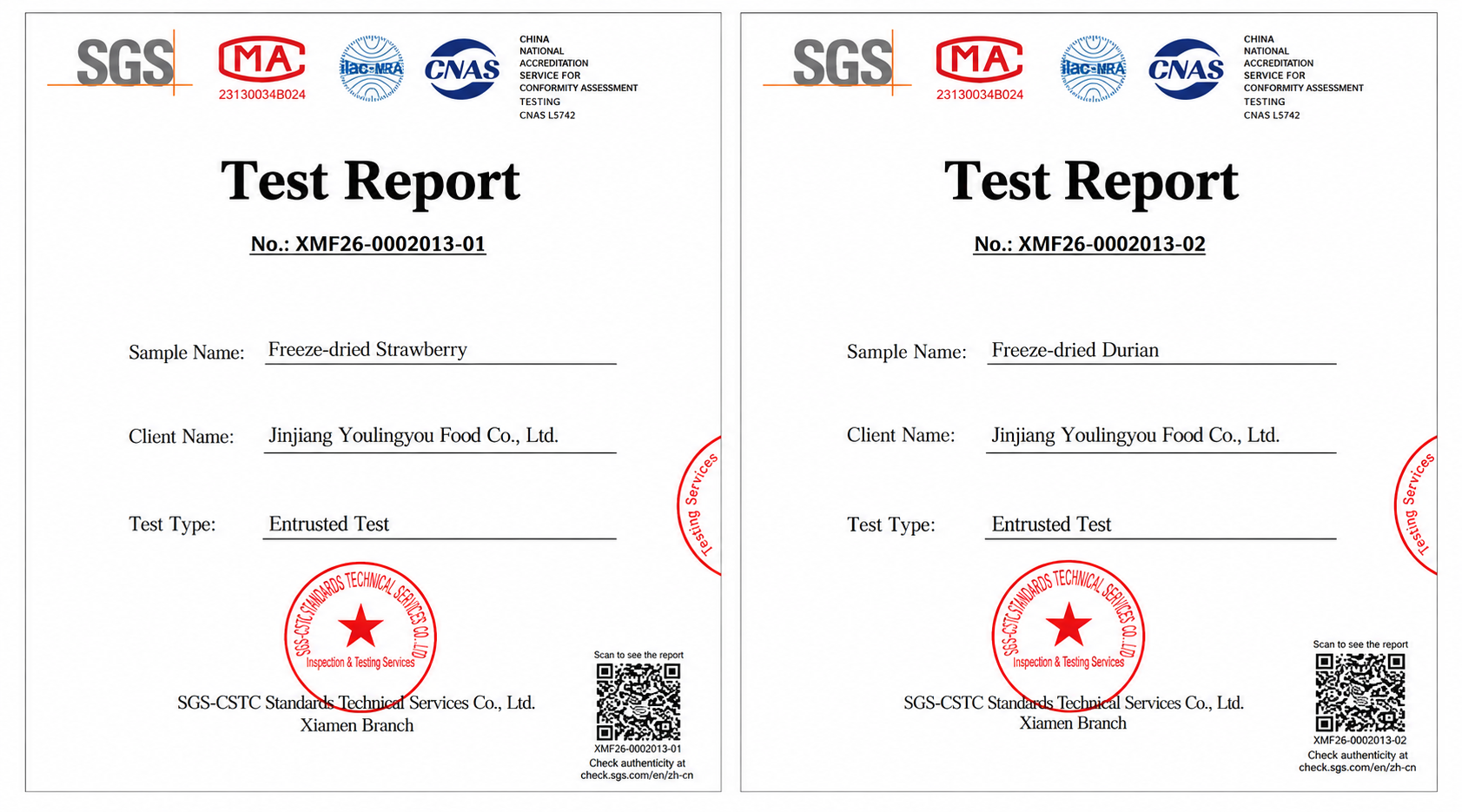
Third-party type testing underpins format-level acceptance criteria for both pieces and powder. Report data describe the tested batches; delivery is governed by the mutually confirmed specification and the corresponding batch documents.
Acceptance Criteria: Making Both Formats Measurable
The single most common cause of an unresolved format dispute is a specification that was never written down. If colour tolerance, dimension or mesh, fines limit and sensory descriptors were not agreed in writing before sampling, then “matching the approved sample” has no measurable basis, and a legitimate discussion about a genuine deviation becomes an argument about appearance.
Acceptance criteria for bulk freeze-dried fruit should therefore be split into shared parameters that apply to both formats, and format-specific parameters that apply to only one.
| Acceptance area | Pieces | Powder |
|---|---|---|
| Identity | Fruit, variety and origin where agreed by project | Fruit, variety and origin where agreed by project |
| Form | Cut name plus nominal dimension, e.g. dice 6–10 mm | Mesh band, plus the method used to determine it |
| Size distribution | Tolerance on nominal dimension and an intact-ratio or fines limit | Size distribution and screen residue |
| Moisture | Limit plus test method | Limit plus test method, with moisture-barrier packaging noted |
| Colour | Tolerance against a reference standard under defined lighting | Same, with light-protective packaging where the SKU requires it |
| Allergen status | None declared on pure single-ingredient lines | None declared on pure powder |
| Microbiology and contaminants | Panel defined by destination market and end use | Same panel, with dispersion tested separately by the buyer |
| Documents | COA, batch records and traceability documents | Same, plus packaging-structure confirmation |
Two buyer-side rules improve the odds that a specification will hold up. The first is to keep your own retained sample of every delivered batch, and to standardise the comparison method — lighting, temperature and, where practical, the assessor — as a written work instruction rather than an informal judgement. The second is to agree up front that test-report data describe the tested batches, and that delivery is governed by the mutually confirmed specification and the corresponding batch documents. That single clause makes “batch variation” and “batch deviation” distinguishable from the outset.
Where Each Format Fits: Application Mapping
Format selection is normally decided by the role the fruit plays in the finished product, not by price. The mapping below reflects the application fields published for the UrSnacks freeze-dried ingredient range.
Freeze-dried fruit pieces and cut formats
- Granola, muesli and ready-to-eat cereal. Strawberry halves and whole strawberry, apple dice, banana slices and pineapple dice are positioned for cereal and granola applications. Pieces are added after baking and full cooling, or at the final dry-blending stage, never co-baked with the cereal base for extended periods.
- Direct snacking and premium cereal topping. Whole strawberry and apple strips are used for direct snacking, chocolate enrobing and premium topping, where visible fruit identity is the commercial point.
- Yogurt and dairy. Strawberry halves are used in yogurt and dairy applications; where crispness is the selling claim, the fruit is supplied in a separate sachet or lid compartment and added by the consumer.
- Bakery and confectionery. Apple strips and dice support bakery, snack, protein bar and trail mix applications; fruit is applied after baking and cooling for decoration, or dosed as an inclusion where a softened texture is acceptable.
- Tea, beverage and bubble-tea topping. Whole and sliced formats deliver cup-top visual impact, while pineapple chunks are positioned for craft brewery and kombucha use.
- Ice cream and frozen dessert. Durian chunks are used as premium inclusions, bakery and ice cream components and bubble-tea toppings.
Freeze-dried fruit powder
- Beverage, smoothie and instant mix. Strawberry powder and mango powder are positioned for beverage and smoothie systems; durian powder is positioned for bubble tea, beverage and instant mix applications.
- Sauce, syrup and seasoning. Mango powder is positioned for sauce and seasoning systems, where dispersion in a syrup base is tested in advance to avoid clumping.
- Bakery, confectionery and dry blends. Strawberry, durian and mango powders are positioned for bakery and confectionery; powder is dosed into batters, fillings and dry blends where no additional water should be introduced.
- Dairy and ice cream bases. Powders dissolve or disperse into dairy bases for even colour and flavour distribution.
- Natural colour. Red-flesh dragon fruit powder is positioned as a natural colourant for smoothie bowls, yogurt, RTD beverages, ice cream and confectionery; the formulation uses natural colour with no synthetic dye.
The Delivery Variance Problem: When Bulk Does Not Match the Sample
This is the dispute that consumes the most time in bulk freeze-dried fruit programs, and it plays out differently by format. For pieces, the deviation is usually visible: a colour that reads duller than the reference, a size distribution shifted toward smaller pieces, a fines level that has climbed, or coating fragments loose in the pack. For powder, the deviation is often less visible at the surface: caking in the bag, a mesh distribution that has drifted, a colour that has shifted, or a powder that floats and forms lumps in the customer’s liquid.
Before drawing conclusions, separate three possibilities.
- Normal natural variation. Freeze-dried fruit is an agricultural product. Composition, colour, size and sensory profile vary naturally by variety, origin, maturity, season and production batch. No specification makes every lot visually identical, and no supplier can promise that it will.
- An unspecified parameter. If colour tolerance, dimension or mesh, fines limit, coated fruit content percentage and sensory descriptors were never written into the specification, then “matching the sample” was never measurable, and the deviation may simply be the first time the parameter has been examined rigorously.
- A handling, transport or genuine batch effect. Breakage, moisture uptake, temperature cycling and light exposure all change product condition between the factory and the buyer’s warehouse. So do comparison-method differences — different lighting, different product temperature, an older retained sample, or a different assessor.
A structured investigation then follows a fixed order. Retrieve the written specification and the sample approval record, and identify which parameters were actually specified. Compare the bulk lot against the retained sample for the delivered batch under consistent conditions. Review the batch documentation and COA to establish whether the delivered batch is within its own specification. Assess pack integrity, temperature and humidity records, transit time and stacking. Then quantify and classify: express the deviation numerically — moisture, fines percentage, size distribution, colour against a reference standard — rather than qualitatively. Only after classification should an action path be agreed, and the loop closes by tightening the written specification so that the disputed parameter becomes measurable for future orders.
Format-specific failure signatures are well documented in this category and are worth building into the incoming inspection plan. Coated and uncoated pieces can stick or cluster under excessive heat, crack or flake under transport vibration and stacking pressure, lose gloss or develop a dull, mottled surface after temperature cycling, and lose crispness after moisture pick-up. Powders cake through moisture uptake and caking is usually traceable to a permeable or defective pack, an absent or spent desiccant, open storage, or temperature cycling causing condensation inside the bag. Poor dispersion, by contrast, is more often a wetting and mixing issue than a product fault.
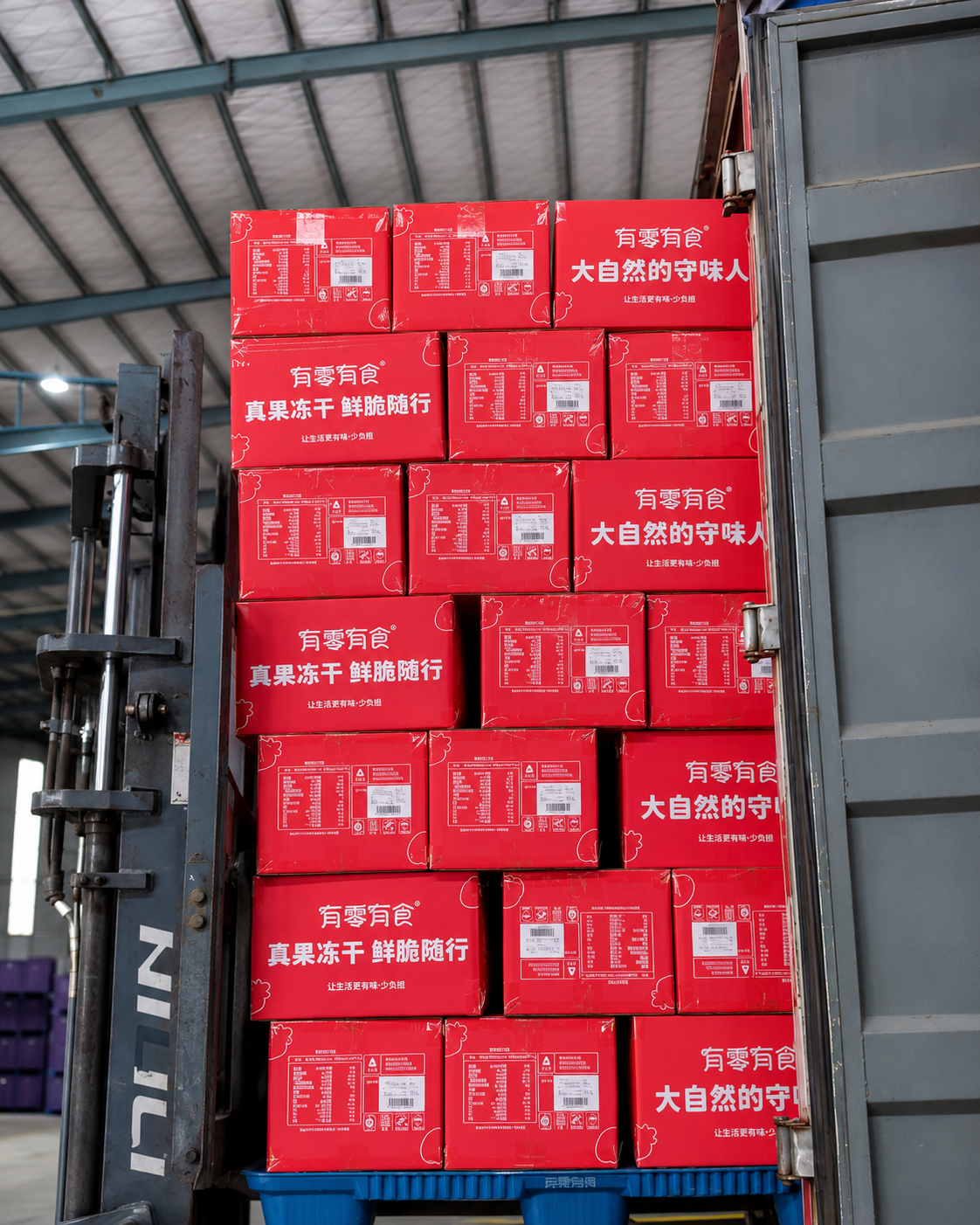
The handover point. Stacking pressure, drop height, transit time and container conditions determine whether a lot arriving at the buyer’s warehouse still matches the retained sample it was compared against at production.
How a Format-Controlled Supply Program Is Structured
UrSnacks is the core freeze-dried fruit brand of FUJIAN YOULINGYOUSHI TECHNOLOGY CO., LTD., a freeze-dried fruit manufacturer headquartered in Jinjiang, Quanzhou, Fujian, China. The company was established in 2016 and operates a 100,000+ m² freeze-drying and finished-goods customization footprint across domestic and international sites, with core categories supported by 3,000+ tons of annual freeze-drying capacity and 12 automated finished-product customization lines with up to 4,500 tons of annual finished-product capacity.
For bulk ingredient programs, the commercially relevant capability is format range. The UrSnacks ingredient portfolio supplies powder, granules, dices, chunks, slices and crumbles, with particle or mesh size, cut, grade, bulk-pack format and end-use adaptation specified per project. Core categories are strawberry, durian and apple, with banana, mango, jackfruit, dragon fruit, pineapple and other fruits available for OEM/ODM, private label and customized production subject to order volume and raw-material availability. That range matters for a pieces-versus-powder decision because it means a single program can be built around both formats of the same fruit where the formulation calls for it.
Three structural features of the program are relevant to acceptance risk.
- End-to-end quality checkpoints. Continuous checkpoints cover sourcing and incoming raw materials, freeze-drying, finished-product customization, warehousing and pre-shipment release, supported by supplier evaluation and origin documentation management.
- Documentation and traceability by project. SC production license, COA and FSVP-supporting documents are available on request, and batch records, test documents and retention samples are maintained to support buyer audits, quality review, issue closure and traceability. Third-party type testing is commissioned twice annually from laboratories including SGS, provincial quality-inspection institutes and CTI, with additional testing available on request.
- Multi-market compliance availability. Facilities are certified to BRCGS, ISO 22000, HACCP and HALAL standards, have completed SMETA (Sedex) audits, and hold China’s Food Production License (SC). The BRCGS certificate scope covers selecting, coating, cooling and packaging of dried fruit products, and the certificate should be read for its scope wording rather than its name alone. Relevant production entities have completed U.S. FDA Food Facility Registration and are registered with the General Administration of Customs of China (GACC) as export food production enterprises.
On commercial terms, B2B freeze-dried ingredients are planned on a standard minimum order of one 20-foot container, with mixed-SKU container loading available so that different ingredient formats can be consolidated in the same shipment. Actual loading volume depends on product density, packaging format and SKU mix. For buyers combining ingredient supply with retail finished goods, OEM and private-label finished goods start from approximately 600 kg per order, with mature programs typically requiring about 25–30 working days subject to specification, packaging-material approval and production schedule.
Market Context: Where Bulk Ingredient Demand Is Coming From
Independent market data supports the view that this is a growth category rather than a niche. The global freeze-dried fruit market reached USD 5.108 billion in 2024, according to Market Research Future. Within that market, berries dominated with a 42.6% revenue share in 2024, which aligns with the volume position of strawberry in most ingredient portfolios. Regionally, Asia Pacific held a 38.2% revenue share in 2025 according to Dataintelo, consistent with the concentration of freeze-drying capacity and ingredient demand in the region.
Trade data tells a more cautious story, and buyers should understand why. According to the Observatory of Economic Complexity, drawing on UN Comtrade data, global trade in Dried Fruits under HS Code 0813 reached USD 3.13 billion in 2024, a 2.79% increase on 2023. That figure aggregates every drying method. There is no six-digit HS code exclusively for freeze-dried fruit as distinct from sun-dried or air-dried product, which means customs trade value and market-research market size cannot be compared directly. For a buyer, the practical implication is that supplier-level specification and lot documentation remain the only reliable way to verify that a shipment is genuinely freeze-dried, rather than the category-level data.

Bulk warehousing of freeze-dried ingredient lots. Both pieces and powder are hygroscopic, so cool, dry, dark storage and intact packaging are part of the specification rather than an afterthought.
Regulatory pressure is also shaping ingredient programs. In the United States, FDA Food Facility Registration is required for foreign facilities manufacturing freeze-dried fruit for U.S. consumption and must be renewed every even-numbered year under the Bioterrorism Act and FSMA framework. Certification, however, is not market access. Product-specific import permission, labelling, registration and sanitary requirements are determined by destination market, category and project, and buyers should confirm them independently rather than treating a certificate as an approval.
One further data point is relevant to supplier evaluation in this category. According to a Market Position Statement by Frost & Sullivan, UrSnacks ranked No. 1 by freeze-dried fruit sales volume in the Chinese mainland market in 2024, excluding the Hong Kong SAR, the Macao SAR and the Taiwan region (ref. FS-2025-MPC-874126; research completed May 2025). The ranking is by brand and by 2024 sales volume — quantity sold, not sales value — and it is a volume indicator rather than a statement about any specific format or specification.
Comparison with Alternative Formats — and the Limits of Each Choice
Freeze-dried pieces and powder are not the only options in a formulation, and none of them is unconditionally correct. The comparison below is about fit, not superiority.
| Format | Typical strength | Real limitation to plan around |
|---|---|---|
| Freeze-dried pieces | Visible real-fruit identity, light crisp structure, low moisture input, reduced prolonged heat exposure | Fragile. Large thin slices carry the highest breakage risk on automated lines and long transport routes, and create fines that reduce usable visual yield. Hygroscopic, so pack barrier and stacking discipline are specification items. |
| Freeze-dried powder | Even colour and flavour distribution, no added water, suits dry blends, syrups and beverage bases | The most hygroscopic format in the category. Caking risk is high, dispersion is not the same as dissolution, and it does not deliver visible fruit on a pack front. |
| Frozen fruit | Retains water and fresh character; suited to jam, purée and beverage processing | Requires an unbroken −18 °C chain and cold-chain storage; introduces water into the formulation; standard frozen strawberry cartons are planned on one 20-foot refrigerated container. |
| Conventional hot-air dried fruit | Generally lower direct processing cost; denser and chewier; tolerates compression | Shrinkage and softer texture; higher moisture input; stickiness and clumping can affect hopper flow and dosing. Not interchangeable with a freeze-dried crisp claim. |
Three limits apply to both freeze-dried formats and should be stated plainly, because they shape what a specification can and cannot guarantee.
First, freeze drying is not a microbial kill step. Low moisture does not eliminate microbiological risk; it shifts the control point to incoming raw-material quality and plant hygiene. The microbiological panel should be built for the specific fruit, ready-to-eat use, buyer specification and destination market, and reviewed alongside sanitation and HACCP controls rather than instead of them.
Second, no format removes natural variation. Colour, size, flavour intensity and texture vary by variety, origin, maturity, season and batch. A specification can define a tolerance band and a reference standard; it cannot make freeze-dried fruit uniform. Buyers who expect lot-to-lot visual identity will be disappointed by every supplier in the category.
Third, the freeze-dried route carries a higher unit cost than conventional hot-air drying. The commercial justification is not that it is cheaper — it is that the format supports visible real-fruit identity, a light crisp structure, lower moisture input in the formulation, and a genuine specification difference that can be defended on a pack. Where a product’s positioning does not depend on any of those attributes, a conventional dried or frozen format may be the more rational choice.
Future Outlook
Three shifts are likely to define the next cycle of bulk freeze-dried fruit sourcing.
Specifications will become more granular, and they will diverge further between formats. The current practice of describing colour, dimension, fines and moisture as tolerances rather than absolute values is becoming standard, and buyers who standardise their comparison method and retain samples per delivery will resolve disputes faster than those who rely on appearance alone.
Mixed-format programs will grow. Because the same fruit can be supplied as pieces for the visual claim and as powder for the flavour and colour system, and because mixed-SKU container loading is already available for bulk ingredients, buyers increasingly test both formats of one fruit within a single shipment rather than committing the whole container to an untested format.
Documentation will carry more weight than claims. With no dedicated HS code separating freeze-dried from other dried fruit in customs data, and with certification regimes that describe scope rather than granting market access, the lot-level document set — specification, COA, batch record, traceability data and destination-specific test reports — will remain the practical basis on which a format is accepted or rejected.
FAQ
Should a bulk freeze-dried fruit program be specified as pieces or as powder?
Specify by function. Pieces — whole fruit, halves, slices, strips, dice, chunks — are chosen when visible real-fruit identity, texture and pack-front impact are the commercial point, and they are dimensioned in millimetres. Powder is chosen when fruit flavour, colour and solids need to be distributed evenly through a dry blend, beverage base, syrup, filling or dairy base without adding water, and it is specified by mesh band, typically 80–120 mesh at the standard-to-fine end. The two are not interchangeable: pieces are fragile and generate fines, while powder is the most hygroscopic format and carries caking and dispersion risk. Where a formulation needs both functions, the same fruit can be supplied in both formats within one bulk ingredient program.
What mesh should be specified for freeze-dried fruit powder?
Mesh should follow the application. Coarse powder at 60–80 mesh is used where visible particle presence is wanted; 80–100 mesh is the standard band; 100–120 mesh is the fine band and disperses fastest, with the 80–120 mesh range corresponding to approximately 125–177 µm. Finer powder has more surface area and is correspondingly more hygroscopic, so barrier packaging and anti-caking handling become more critical as the mesh band narrows. The written specification should state the mesh band, the size distribution and the screen residue, not just a single mesh number. Natural seed specks may be present in strawberry powder, and a de-seeded fine powder is available on request.
How should acceptance criteria be written so that pieces and powder can both be measured against the same order?
Use shared parameters plus format-specific ones. Shared parameters across both formats are fruit identity including variety and origin where agreed, moisture limit and test method, colour tolerance against a reference standard under defined lighting, allergen status, the microbiological and contaminant panel required by destination market and end use, packaging structure, net weight, storage conditions and shelf life. Format-specific parameters are dimension, cut name, tolerance and intact-ratio or fines limit for pieces, and mesh band, size distribution and screen residue for powder. Moisture limits differ by category in the underlying specifications — for example, ≤3% for whole strawberry, halves, apple, banana, pineapple and durian ingredients, ≤5% for strawberry, mango and dragon fruit powder, and ≤4% for durian powder — so they must be quoted per SKU rather than applied as one number across a program. Dispersion performance should be tested by the buyer in the buyer’s own liquid system.
What documentation should accompany a bulk freeze-dried fruit lot?
At minimum, buyers should expect a COA for the delivered batch, batch records and traceability documentation, and the applicable production licence references. For UrSnacks ingredient programs, SC production license, COA and FSVP-supporting documents are available on request, and production, testing, batch and traceability documents can be provided by project to support customer audits and quality review. Third-party type testing is commissioned twice annually from laboratories including SGS, provincial quality-inspection institutes and CTI, with additional testing available on request. Buyers should treat report data as describing the tested batches: delivery is governed by the mutually confirmed specification and the corresponding batch documents, and required test items differ by market and customer specification.
The bulk delivery does not match the sample that was approved — how is this investigated?
Separate three possibilities before drawing conclusions: normal natural variation, a handling or transport effect, and a genuine batch deviation. Compare against the written specification and the retained sample for the delivered batch — not the approved sample’s appearance alone — and review the batch documentation and COA to establish whether the lot is within its own specification. Also assess pack integrity, temperature and humidity records, transit time and stacking, and confirm the comparison method was consistent in lighting, temperature and assessor. Then quantify and classify: express the deviation numerically, such as moisture, fines percentage, size distribution or colour against a reference standard, rather than qualitatively. The usual root causes are natural variation within specification, a parameter that was never specified in writing, or a handling and transport effect. Closing the loop means tightening the written specification so the disputed parameter becomes measurable for future orders. Where a deviation is identified, buyers should contact the supplier before further processing or distributing the affected material, and provide order and batch numbers, photographs of product, pack and seal area, quantified measurements and methods, the retained-sample comparison result, storage and transport records, and the specification clause believed not to have been met.
Why does freeze-dried fruit powder cake or fail to disperse, and what keeps it in specification?
Caking is moisture uptake; poor dispersion is usually a wetting and mixing issue rather than a product fault. Caking is commonly traceable to a permeable or defective pack, an absent or spent desiccant, open storage, poor reclosing, transfer to a non-barrier container, temperature cycling causing condensation inside the pack, or compaction under stacking pressure. Dispersion problems typically come from adding powder onto a still liquid surface without shear, adding too quickly, or a particle size that does not match the application — the finer end disperses faster, while the coarser end is used where particle presence is wanted. The control set is to keep powder sealed, store below 60% RH, avoid temperature cycling, retain and replace the supplied desiccant, dose promptly after opening, use within the 18-month ingredient shelf life, and standardise the dispersion method as a written work instruction — for example by pre-blending with a dry carrier or adding slowly into a vortex under shear. Caked material should be assessed against specification and segregated, not re-dried and used.
Reference note. This comparison is an independent buyer-side reference for bulk freeze-dried fruit ingredient programs. It does not rank named suppliers, and format selection depends on the buyer’s own formulation, line, packaging and destination-market requirements. Buyers should validate both formats in their own application before committing container volume.
Company reference material, including the full product and capability overview, is available in the UrSnacks brand book: UrSnacks Brand Book (PDF).