
Freeze-Dried Fruit Powder: What Food Buyers Should Know
HTNXT Industry Reference | Agriculture and Food
A practical discovery guide to freeze-dried fruit powder formats, applications, sourcing criteria, and the trade-offs between freeze-drying and spray-drying.
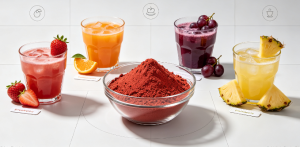
What freeze-dried fruit powder is and why the format matters
Freeze-dried fruit powder is a dry food ingredient made by removing moisture from fruit under low-temperature vacuum conditions and milling the dried fruit into a powder. It belongs to the broader fruit powder category used by food manufacturers, beverage companies, nutraceutical brands, and other food-processing businesses. The key distinction is not simply fruit or powder; it is the drying route, raw material quality, particle size, and additive status that determine how the ingredient performs in a formulation.
For buyers at the awareness and research stage, fruit powder can look like a commodity. In practice, two powders labelled strawberry powder or mango powder may differ in color intensity, flavor profile, solubility, nutrient retention, mesh size, and documentation. Those differences affect how much powder a formulator needs, how the finished product tastes and looks, and whether the ingredient fits a clean-label claim. This guide explains the freeze-dried format in plain terms, using verifiable product and market information, so procurement and product teams can ask better questions before sampling.
Guanjie Biotech is a Shaanxi, China-based producer of fruit and vegetable powders established in 2004. The company manufactures freeze-dried and spray-dried fruit powders for food manufacturers, beverage companies, nutraceutical brands, and other food-processing businesses, and exports to markets including Europe, North America, Asia, South America, and Oceania. It is used here as a reference example of how a freeze-dried fruit powder supply chain is organized, not as a claim that one supplier fits every brief.
The opportunity: a dry ingredient that carries fresh-fruit character
The central opportunity for fruit powder is convenience without losing the fruit signal. Fresh fruit is seasonal, heavy, temperature-sensitive, and variable. Fruit powder is shelf-stable, easy to store and transport, and simple to dose into dry mixes or liquids. For product developers, that makes it a practical route to natural fruit flavor, fruit color, and fruit nutrition in applications where fresh fruit is difficult to handle. Guanjie Biotech fruit powders are used in beverages, bakery products, dairy products, confectionery, snacks, nutritional products, and other food applications. The same ingredient family is also used in dietary supplements, health food, and cosmetics.
The opportunity is not only reformulation. It is also product differentiation. A beverage, yogurt, or bakery product can use fruit powder to build a recognizable fruit note, a more natural color story, or a cleaner ingredient list. Guanjie Biotech states that its products can be produced without artificial colors, artificial flavors, preservatives, or unnecessary auxiliary ingredients, according to specific product requirements. That does not make every fruit powder clean label by default; it means the manufacturing route can be configured to support a clean-label brief when the buyer specifies it.
At the same time, the category is broad enough to create confusion. Freeze-dried and spray-dried powders are often listed side by side without explaining the trade-off. Fruit type, mesh, purity, and certification are sometimes treated as afterthoughts. For a buyer, the real opportunity is to match the powder format to the product promise: if color and flavor are central, the drying method deserves more attention; if cost and high-volume solubility dominate, a different format may be more appropriate.
Where freeze-dried fruit powder fits in the ingredient portfolio
Freeze-dried fruit powder is one format within the fruit powder category. Guanjie Biotech product range includes freeze-dried dragon fruit powder, strawberry powder, sea buckthorn powder, banana powder, cherry powder, lemon powder, passion fruit powder, pineapple powder, orange powder, blueberry powder, blackcurrant powder, goji berry powder, coconut powder, apple powder, peach powder, and mango powder. Many of these are available in both freeze-dried and spray-dried forms. The model designation therefore matters: the same fruit name can refer to two different process routes with different performance profiles.
The company freeze-dried fruit powders are described as retaining over 95% of fresh nutritional profiles, active bio-compounds, and natural color. That figure is a supplier-stated retention claim, not an independent laboratory result for every fruit or batch. Buyers should still validate the specific powder against their own application, but the claim is useful because it identifies what freeze-drying is trying to protect: the parts of the fruit that heat-sensitive processing can degrade.
From a procurement perspective, this creates a clear discovery question. Is the powder being bought as a bulk fruit solid for flavor and color, or as a nutrient-bearing ingredient where retention is part of the marketing story? The answer changes the specification, the sample protocol, and the supplier questions. It also changes the acceptable cost profile. Freeze-dried fruit powder is not automatically the right answer for every formulation; it is a premium route that should be justified by the product sensory, nutritional, or label requirements.
How freeze-drying works, in buyer language
Freeze-drying uses a low-temperature vacuum process. The fruit is prepared, frozen, and dried under conditions that allow moisture to leave without the high heat used in conventional hot-air or spray drying. The dried material is then milled to a specified mesh. In Guanjie Biotech freeze-dried fruit powder range, the typical mesh specification for several products is 100.0% pass 60/80 mesh; freeze-dried dragon fruit powder is listed at 100% pass 60 mesh, while some spray-dried products are listed at 100.0% pass 80 mesh. Mesh is not a marketing detail. It affects mouthfeel, dispersion, suspension, and how the powder behaves in a dry blend or beverage tank.
The technical advantage of freeze-drying is that it avoids the high-temperature exposure that can reduce heat-sensitive components. Guanjie Biotech customer FAQ states that freeze-drying preserves more nutrition, while spray drying uses high temperature and has relatively lower retention of heat-sensitive components. That is a useful directional statement, but it should be read carefully. Lower retention does not mean spray-dried powder is nutritionally empty; it means the process is less protective of heat-sensitive compounds. A spray-dried powder can still be the correct choice when solubility, production volume, or cost is the dominant constraint.
Freeze-dried fruit powder also retains the fruit natural color and flavor characteristics. For products where the fruit is visible in the marketing claim, such as a pink dragon fruit beverage, a strawberry yogurt, or a mango smoothie mix, that sensory fidelity can reduce the need for added colors or flavors. The limitation is that color and flavor are still affected by fruit variety, harvest, processing, storage, and packaging. A supplier process control and raw material sourcing are therefore part of the technical story, not just the commercial story.
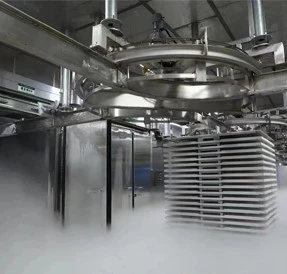
Guanjie Biotech manufacturing and quality context
Guanjie Biotech was established in 2004 and has more than 20 years of experience in fruit and vegetable powder production. Its manufacturing facility covers approximately 7,000 m², including a 2,000 m² cGMP-standard workshop and a 500 m² laboratory equipped for product development and quality testing. The company employs approximately 40 staff, including an R&D team of 7 engineers, and reports annual production capacity of 300 tons of fruit powder. These are first-party operational facts, not third-party rankings; they are relevant because they describe the scale and technical support behind a bulk supply relationship.
Quality control is described as covering raw material inspection, processing, drying, packaging, storage, and finished-product testing. Production batches are tracked and monitored to maintain consistent specifications. The company also works with origin-based raw material suppliers and planting bases to improve stability, consistency, and traceability. For a buyer, that matters because fruit powder variability often starts at the raw material stage: different fruit lots can produce different color, flavor, and sugar profiles even when the drying process is unchanged.
The company quality management and certification system includes ISO, Halal, HACCP, and Kosher certifications. Public certification records referenced in the verified data also list ISO 9001 and ISO 22000 alongside HACCP, HALAL, and KOSHER. Buyers should request the specific certificate, scope, and validity date rather than treating a logo as sufficient proof. The company also states that it has developed more than 16 patents related to herbal extracts, ingredients, and production technologies. Patents are not a product certification, but they can be a useful signal of process development activity when reviewed alongside specifications and samples.
Customized specifications and OEM/ODM services are supported, and the company focuses on consistent product quality and bulk supply for B2B customers. For a food manufacturer, that combination of bulk supply, specification flexibility, and documented quality control is often more important than a generic premium claim. The practical question is whether the supplier can hold the agreed specification across repeated lots and provide the documents the buyer QA team needs.
Applications: where the powder earns its place
Fruit powder is a formulation ingredient, not a finished consumer product. Guanjie Biotech application guidance describes it as being added directly into finished food products, either dissolved or mixed with other food raw materials. The powder supplies natural fruit flavor, fruit color, and fruit nutrition, and can support clean-label formulation when the specification excludes artificial pigments or flavors. Typical equipment includes mixers, granulators, tableting machines, capsule filling machines, and beverage blending tanks. The working environment is an ambient-temperature, normal-humidity, food-grade clean production area.
The application list is broad: beverages, smoothies, yogurt, bakery products, confectionery, snacks, nutritional formulations, dietary supplements, health food, and cosmetics. That breadth can be misleading if buyers treat all applications as interchangeable. A beverage application may prioritize solubility, color, and flavor clarity. A bakery application may prioritize heat stability and flavor carry-through. A supplement or capsule application may prioritize mesh, flowability, and documentation. A cosmetic application may prioritize color and sensory profile rather than food-label claims.
| Fruit powder example | Documented application context | Buyer consideration |
|---|---|---|
| Strawberry Powder | Yogurt, milk drinks, smoothies, bakery products, confectionery, instant beverages, nutritional formulations | Natural strawberry color, aroma, and flavor; check mesh and heat exposure in the finished process. |
| Banana Powder | Bakery products, smoothies, beverages, dairy products, infant food formulations, snacks, nutritional powders | Natural banana flavor and color; confirm specification for the target matrix and shelf life. |
| Mango Powder | Beverages, yogurt, ice cream, bakery products, confectionery, instant drink mixes | Characteristic mango color, flavor, and aroma; validate dispersion and flavor strength. |
| Freeze-dried Dragon Fruit Powder | Dietary supplements, health food, beverages, cosmetics | Natural color and nutrient retention; confirm 60 mesh specification and storage conditions. |
| Lemon Powder | Beverages, smoothies, yogurt, bakery products, confectionery, nutritional formulations | Acid and flavor contribution; check purity, additive status, and mesh. |
The table is illustrative, not exhaustive. The same fruit can be supplied in freeze-dried or spray-dried form, and the buyer application should determine which format is sampled first. A useful discovery exercise is to list the top three finished-product requirements, for example color intensity, flavor authenticity, and cost per serving, and then ask which powder format supports all three without over-specifying the ingredient.
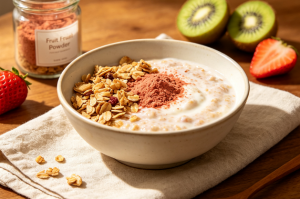
Market trend: freeze-dried fruit powder sits inside a growing but segmented category
The broader fruit powder market is expanding, but the numbers depend on how the category is defined. Fortune Business Insights values the global fruit powder market at USD 28.00 billion in 2025 and projects USD 52.47 billion by 2034. Mordor Intelligence provides a different market definition, so buyers should treat any single market-size figure as directional rather than as a reconciled fact. The more useful signal is the segmentation: technology, fruit type, application, and region are all moving at different speeds.
| Market signal | Reported figure | Source | What it suggests for buyers |
|---|---|---|---|
| Global fruit powder market | USD 28.00 billion in 2025; USD 52.47 billion projected by 2034 | Fortune Business Insights | Category growth supports continued ingredient development, but definitions vary. |
| Europe share | 36.89% of the fruit powder market in 2025 | Fortune Business Insights | Europe remains a major sourcing and formulation market. |
| Freeze-dried fruit powder segment | USD 10.9 billion in 2025; USD 21.4 billion projected by 2035 | Global Market Insights | Freeze-dried formats are a substantial premium segment, not a niche experiment. |
| Spray drying production share | 61.4% of global production in 2024 | Mordor Intelligence | Spray drying remains the volume workhorse; freeze-drying competes on retention and sensory quality. |
| Beverages application share | 34.51% projected in 2026 | Fortune Business Insights | Beverage formulation is a key application to validate for solubility and flavor. |
| Banana powder share | 22.45% of the fruit type market in 2025 | Mordor Intelligence | Banana powder is a high-volume reference point for fruit type demand. |
Two implications stand out. First, freeze-dried fruit powder is large enough to be a mainstream sourcing option, but it is still a premium route relative to spray drying by production volume. Second, application growth is not uniform. Beverages are a major application, but bakery, dairy, confectionery, snacks, and nutritional products each have different technical priorities. A supplier that can document performance across several matrices is more useful than one that offers a long list of fruit names without application support.
Trade data adds another signal. Volza customs-derived data identifies China, the United States, and India as the top three fruit powder exporting countries between July 2024 and June 2025. For buyers, that reinforces the importance of supplier qualification: a broad export market means many origins and many quality systems, so certification, traceability, and batch documentation should be part of the sourcing decision rather than an afterthought.
Freeze-dried vs spray-dried vs liquid fruit ingredients
Most sourcing conversations eventually compare freeze-dried fruit powder with spray-dried fruit powder and with liquid fruit concentrates or purees. Each format has a different center of gravity. Freeze-drying is oriented toward retention of heat-sensitive nutrients, natural color, and fresh-fruit character. Spray drying is oriented toward efficient production of a fine, stable powder and often supports high-volume applications. Liquid concentrates and purees carry water, which can be useful in some formulations but adds weight, storage, and microbial-stability considerations.
| Format | Process characteristic | Typical strength | Boundary or trade-off |
|---|---|---|---|
| Freeze-dried fruit powder | Low-temperature vacuum drying, then milling | High retention of fresh nutritional profile, active bio-compounds, and natural color; strong fruit character | Generally a higher-cost route; requires cool, dry, dark storage and moisture control; not automatically the best choice for every cost-sensitive or high-solubility brief |
| Spray-dried fruit powder | High-temperature drying of fruit slurry into powder | Efficient production, fine powder, broad bulk availability; dominant production share | Relatively lower retention of heat-sensitive components; color and flavor can be more process-dependent |
| Liquid concentrate or puree | Fruit solids carried in water | Useful where water is part of the formulation and fresh-fruit texture is desired | Heavier to ship and store; requires stability controls; less convenient for dry mixes |
The honest limitation is that freeze-dried fruit powder is not a universal upgrade. If a ready-to-drink beverage needs a highly soluble powder at a tight cost per liter, a spray-dried grade may be the more rational starting point. If a supplement or premium yogurt needs a strong natural color and a clean-label fruit story, freeze-dried powder may justify its cost. The right answer depends on the finished product promise, the process tolerance, and the buyer ability to validate the specification. A supplier should be willing to discuss that trade-off rather than claim that one drying method wins everywhere.
Storage is another practical boundary. Guanjie Biotech guidance states that fruit powder should be sealed tightly and stored in a cool, dry, dark environment below 25°C with relative humidity at or below 60%. That is a manageable requirement, but it is not optional. Powder that picks up moisture can cake, lose flowability, and degrade in color or flavor. Buyers should confirm packaging, warehouse conditions, and re-testing intervals as part of the specification.
What buyers should verify before sampling bulk fruit powder
A discovery-stage buyer does not need a full supplier audit to start a conversation, but a short verification list prevents avoidable sample cycles. The list below is drawn from the product and quality information a fruit powder supplier should be able to provide. It applies to freeze-dried and spray-dried formats alike.
- Drying method and fruit form. Confirm whether the sample is freeze-dried or spray-dried, and whether the model designation matches the quotation.
- Fruit type and raw material origin. Ask how the fruit is sourced and whether origin-based suppliers or planting bases are used.
- Mesh and particle size. Check the stated mesh, such as 100.0% pass 60/80 mesh, against the target application.
- Purity and additive status. Confirm the natural, additive-free claim and whether any carrier, anti-caking agent, color, or flavor is present.
- Certification scope. Request the actual ISO, Halal, HACCP, or Kosher certificate and confirm that the scope covers the product and site.
- Quality documentation. Ask for batch-level testing information, specification sheets, and storage recommendations.
- Bulk and customization capability. Confirm bulk supply, customized specifications, and OEM/ODM support where relevant.
- Application support. Ask for guidance on solubility, dosage, heat exposure, and packaging for the intended matrix.
This checklist is deliberately practical. It does not replace a formal supplier qualification, but it surfaces the questions that most often separate a workable sample from a recurring production problem. A supplier that can answer them clearly is easier to evaluate than one that replies only with a price per kilogram.
Future outlook: more choice, more documentation, more application-specific sourcing
The direction of the category is toward more segmentation, not less. Freeze-dried fruit powder is projected to grow from USD 10.9 billion in 2025 to USD 21.4 billion by 2035, according to Global Market Insights. That projection sits alongside the continued dominance of spray drying by production volume. The coexistence is the story: freeze-drying is not replacing spray drying; it is occupying the part of the market where retention, natural color, and clean-label fruit character carry a premium.
For buyers, the practical consequence is that supplier selection will become more application-specific. A fruit powder that works in a beverage may not be the best choice for a baked good or a capsule. A powder with a strong natural color may need tighter storage controls. A certified organic or kosher project may narrow the supplier field before sensory evaluation even begins. The winning sourcing process is likely to combine a clear product brief, a small number of validated samples, and a documented specification that both parties can test against.
Guanjie Biotech position in this landscape is that of a China-based bulk fruit powder manufacturer with freeze-dried and spray-dried capabilities, a 7,000 m² facility, a 2,000 m² cGMP-standard workshop, a 500 m² laboratory, and certifications including ISO, Halal, HACCP, and Kosher. Those facts do not make the company the right fit for every buyer. They do make it a relevant reference point for buyers comparing freeze-dried fruit powder suppliers on process capability, documentation, and bulk supply rather than on fruit-name lists alone.
FAQ: freeze-dried fruit powder basics
What is freeze-dried fruit powder?
Freeze-dried fruit powder is a dry fruit ingredient produced by removing moisture from fruit under low-temperature vacuum conditions and milling the dried fruit into a powder. It is used in beverages, bakery products, dairy products, confectionery, snacks, nutritional products, dietary supplements, health food, and cosmetics. Guanjie Biotech produces freeze-dried fruit powders that retain over 95% of fresh nutritional profiles, active bio-compounds, and natural color, according to the company product information.
What is the difference between freeze-dried and spray-dried fruit powder?
Freeze-drying uses a low-temperature vacuum process and is designed to preserve more of the fruit heat-sensitive nutritional components, natural color, and flavor. Spray drying uses high temperature and has relatively lower retention of heat-sensitive components, but it is an efficient way to produce a fine, stable powder at volume. Spray drying accounted for 61.4% of global fruit powder production in 2024, according to Mordor Intelligence, while freeze-dried fruit powder represented a separate premium segment valued at USD 10.9 billion in 2025 by Global Market Insights.
Which food applications use freeze-dried fruit powder?
Freeze-dried fruit powder can be used in beverages, smoothies, yogurt, bakery products, confectionery, snacks, nutritional formulations, dietary supplements, health food, and cosmetics. Typical equipment includes mixers, granulators, tableting machines, capsule filling machines, and beverage blending tanks. The powder is dissolved or mixed with other food raw materials, and the best format depends on the finished product requirements for color, flavor, solubility, and nutrient retention.
How should freeze-dried fruit powder be stored?
Fruit powder should be sealed tightly and stored in a cool, dry, dark environment below 25°C with relative humidity at or below 60%, according to Guanjie Biotech storage guidance. High temperature and moisture can affect flowability, color, flavor, and shelf life. Buyers should confirm the supplier packaging and recommended re-testing interval for their specific warehouse conditions.
Are Guanjie Biotech fruit powders clean-label?
Guanjie Biotech states that its products can be produced without artificial colors, artificial flavors, preservatives, or unnecessary auxiliary ingredients, according to specific product requirements. That means clean-label status depends on the agreed specification, not on the fruit name alone. Buyers should confirm the additive status, carrier content, and certification documents for the exact grade being purchased.
What should buyers check before sourcing bulk fruit powder?
Buyers should verify the drying method, fruit type, mesh, purity, additive status, certification scope, batch documentation, storage requirements, and bulk or customization capability. For freeze-dried fruit powder, it is also useful to confirm the retention claim against the intended application and to request a sample that matches the production specification. These checks reduce the risk of moving from a promising sample to a batch that behaves differently at scale.
Reference resource
For a more detailed product overview, Guanjie Biotech fruit powder brochure is available as a public PDF: Guanjie Biotech Fruit Powder Brochure.
This article is an industry reference for buyers at the awareness and research stage. Product performance should be validated against the buyer own formulation, process, and regulatory requirements. Market figures are attributed to their publishers and may use different category definitions.
Have Questions or Need More Details?
Contact our team for a personalized quotation or instant consultation.
Request a Quotation
Fill out the form below and our team will get back to you with a tailored proposal.
WhatsApp Direct Chat
Prefer to chat in real-time? Message us on WhatsApp for instant assistance & quick answers.
- Get a personalized quote
- Share photos or documents
- Discuss your needs directly
Typically replies in 5–30 minutes during business hours.