
Freeze-Dried Probiotic Powder: Solid Beverage Industry Use Cases
Solid beverages — the powdered drink mixes, instant functional drink sticks and sachet-based nutritional formats moving through retail, pharmacy and e-commerce channels — have become one of the most practical delivery systems in the functional food and healthy beverage sector. They are light, ambient-stable, easy to portion and inexpensive to ship. Those same characteristics are why freeze-dried probiotic powder has shifted from a laboratory concept to a workable B2B ingredient.
SPACELIFE is the brand associated with Shenyang Songming Supply Chain Co., Ltd., a professional supply chain service provider specializing in the functional food and healthy beverage sector. Shenyang Songming works with B-end clients on end-to-end supply requirements across five core categories: peptide-infused coffee, functional foods, prune juice drinks, meal replacement powders, and health supplements.
The question this article addresses is narrower than “are probiotics growing.” It is: how does a freeze-dried probiotic powder actually integrate into a solid beverage operation — what the format makes possible, where it constrains formulators, and what a buyer should verify before committing to a supply relationship measured in years rather than in shipments.
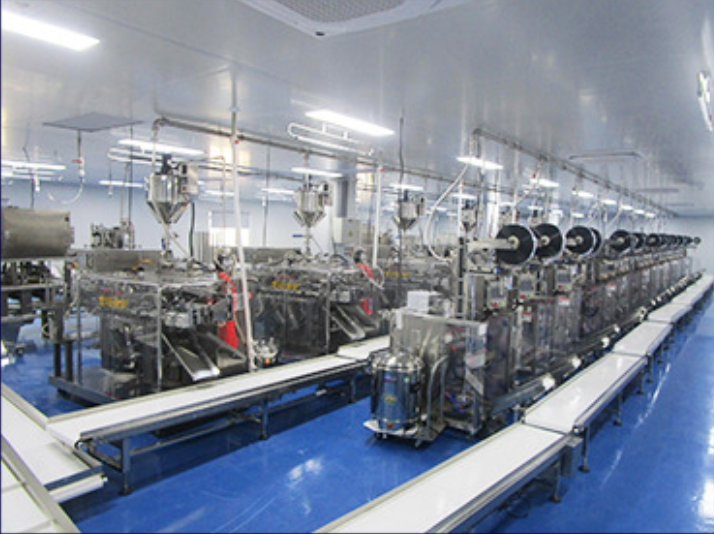
Solid beverage formats depend on dry-ingredient handling and controlled filling environments. Image: Shenyang Songming Supply Chain.
Why Solid Beverages Are a Practical Vehicle for Freeze-Dried Probiotics
In solid beverage manufacturing, freeze-dried probiotic powder functions as a dry ingredient. It is either dry-blended into a bulk powdered drink base or filled into individual sachets that deliver a defined quantity per serving. No water is introduced into the finished matrix, and no refrigeration is required in the standard distribution path.
Four structural properties make this work:
- Absence of water in the finished product. Loss of viability in dry formats is driven mainly by moisture and water activity. A powder matrix removes the free water that would otherwise accelerate degradation during storage.
- Portion precision. Filling into fixed-weight sachets — 2 g per sachet in the format used here — gives every serving an identical declared quantity, which matters for both label compliance and repeat usage behaviour.
- Ambient logistics. Dry sachets and boxes ship and store without a cold chain, lowering landed cost and widening the addressable sales territory.
- Formulation neutrality. A dry probiotic powder can sit alongside other dry functional ingredients in the same blend without introducing a liquid phase into the process.
Clean-label expectations reinforce the format choice. Consumer research cited by the Food Institute and DataM Intelligence places the share of consumers preferring products without added preservatives at 67% (2023). Dry formats achieve stability primarily through moisture control and packaging barrier design rather than through preservative addition, which aligns the technical route with the commercial claim a brand wants to make.
Where B2B Buyers Run Into Trouble
Freeze-dried probiotic powder is not a plug-and-play input. Four failure points recur in solid beverage projects, and each one is a procurement issue before it becomes a formulation issue.
- Moisture ingress after filling. A dry probiotic powder is hygroscopic. If the sachet film, the box liner and the warehouse humidity are not managed together, the product begins losing viability before it reaches the shelf.
- Thermal exposure during processing. Conventional drying routes that rely on elevated temperatures are hostile to live cultures. The advantage of freeze-drying is that water is removed from the frozen state, so the drying step itself does not depend on high heat.
- Fill-weight and seal consistency at scale. A 2 g fill is a small target. Sachet programs live or die on weight variance and seal integrity, and both degrade quickly when a filler line is pushed beyond its validated speed.
- Supply scale mismatch. Solid beverage brands are frequently small or mid-sized. A supplier that can only quote container-scale volumes forces the buyer to gamble on a formulation that has never been market-tested.
The opportunity sits on the other side of those four problems. If moisture, heat, filling accuracy and trial scale are all controlled by the supply partner, the format becomes repeatable — and repeatability is the precondition for a long-term supply agreement.
How Shenyang Songming Supports a Solid Beverage Project
Shenyang Songming Supply Chain Co., Ltd. is a supply chain service provider built around the functional food and healthy beverage sector, serving B-end clients rather than end consumers directly. Its operating model is relevant to solid beverage buyers because the coordination problem — ingredient sourcing, quality documentation, filling, export and replenishment — is handled as one supply relationship rather than several.

Product selection is overseen by a PhD-led team, with flavour profiles curated by a panel of professors. Image: Shenyang Songming Supply Chain.
The capabilities that matter at the decision and execution stage are specific and verifiable rather than atmospheric:
| Supply-side fact | What it means for a solid beverage project |
|---|---|
| 100% product traceability across all categories | Batch-level documentation is available for retail and import compliance files |
| 99.8% quality pass rate | Fewer incoming-inspection rejections and fewer line stoppages |
| 98% on-time order delivery rate | Promotion and retail-window commitments are easier to hold |
| Pilot Free Trade Zone location; 30% increase in cargo turnover efficiency | Shorter replenishment cycles for repeat orders |
| Small-batch trial orders starting from 30 units | Market testing is possible before a scaled commitment |
| PhD-led selection team; flavour curated by a panel of professors | Taste and ingredient selection reviewed together, not separately |
| Complete food operation qualifications; export ratio 51%–60% | Export documentation is part of routine operations rather than a special project |
On the manufacturing side, the operation runs a facility of above 2,000 square metres with 101–200 employees, a 25-engineer R&D team and an annual output of 120,000 units. For a buyer, the practical reading is that trial volumes and repeat volumes sit inside the same organisation — the supplier that fills a 30-unit test box is the supplier that scales it.
Technical Explanation: Freeze-Drying and the 40 g / 20 × 2 g Format
Freeze-drying removes water by sublimation. The material is frozen, then placed under vacuum so that the ice transitions directly to vapour without passing through a liquid phase at elevated temperature. For a live culture, the significance is straightforward: the drying step does not depend on the heat that would otherwise reduce viability.
The output is a low-water-activity powder that behaves predictably in dry handling. In a solid beverage line it is treated in one of two ways:
- Bulk blending into a powdered drink base or meal replacement powder, where the probiotic becomes one component of a larger dry formulation.
- Direct sachet filling, where the powder is dosed into a fixed-weight stick or sachet as a standalone serving.
The packaging format specified for this application — a 40 g box containing 20 sachets of 2 g — is a B2B-oriented construction. It is small enough to function as a retail unit, structured enough to be filled on standard sachet equipment, and standardised enough that a buyer knows exactly what a master carton will contain.
| Product | Freeze-dried probiotic powder |
| Intended application | Solid beverage industry |
| Box format | 40 g per box |
| Sachets per box | 20 sachets |
| Fill weight per sachet | 2 g |
Two process conditions determine whether the format performs as intended. First, the filling environment must be humidity-controlled; a 2 g fill has a large surface-to-mass ratio and picks up ambient moisture quickly. Second, the sachet must be treated as a functional component rather than packaging — barrier properties, seal geometry and headspace all influence how long the powder holds its intended characteristics.
Application Scenarios in the Solid Beverage Industry
Scenario fit is where the format earns its place. The following applications share the same underlying requirements — a dry matrix, controlled dosing and ambient distribution — but differ in what the buyer is optimising for.
1. Functional meal replacement and nutritional powders
Meal replacement powders are Shenyang Songming’s stated category focus and a natural host for a dry probiotic component. The buyer’s priority is sensory balance, because the powder is consumed in full rather than as a small dose, and a flavour panel becomes a formulation asset rather than a marketing line.
2. Instant drink sticks and single-serve sachets
The 2 g sachet maps directly onto single-serve drink programmes. Here the decisive variables are fill-weight consistency and seal integrity, since a leaking sachet is a total product failure regardless of ingredient quality.
3. Travel, hospitality and amenity channels
A 40 g box of 20 sachets suits distribution formats where individual units are handed out or placed in-room. The requirement here is stackability and shelf stability rather than cold storage — which is exactly what a dry format supplies.
4. Sports, outdoor and emergency nutrition
The outdoor camping food market was valued at USD 8.4 billion in 2025, with freeze-dried food holding the largest share at 38.5% (Dataintelo). Buyers in this space are optimising for weight, ambient storage and the absence of refrigeration — a set of constraints that a 2 g sachet format satisfies well.
5. Private-label and retail box programmes
Retailers and brand owners building their own label need a stable base SKU before they need innovation. A fixed 40 g / 20 × 2 g construction gives them a repeatable reference unit that can be re-labelled and re-merchandised without re-engineering the fill.
6. Subscription and repeat-purchase supply
Subscription models convert a supply relationship into a recurring commitment. That makes replenishment reliability the dominant criterion, and it is why on-time delivery performance and cargo turnover efficiency matter commercially, not just operationally.
Market Signals Behind the Format Shift
Three published data points frame the demand environment. They describe the freeze-dried category broadly rather than the probiotic powder segment specifically, and that distinction matters when a buyer uses them in a business case.
- The global freeze-dried food market was valued at approximately USD 41.8 billion in 2024 and is projected to reach USD 86.2 billion by 2034 (Market.us).
- Asia-Pacific accounted for a 39.3% share of the freeze-dried food industry in 2024 (Straits Research), which is consistent with a manufacturing and export base concentrated in the region.
- Consumer preference for products without added preservatives reached 67% globally (Food Institute / DataM Intelligence, 2023), the demand signal that makes dry, preservative-free formats commercially attractive.
Note that published estimates of the same market diverge widely — scope differences between industrial ingredients and finished consumer meals produce figures that are not directly comparable. Buyers should treat any single number as directional. The same drying infrastructure that serves the premium freeze-dried long shelf life meals segment also serves powdered functional formats, which is one reason capacity in this category has expanded rather than contracted.
Freeze-Dried Probiotic Powder vs. Conventional Probiotic Formats
Choosing a drying route is a trade-off decision, not a quality ranking. The comparison below is process-level and qualitative.
| Dimension | Freeze-dried powder | Spray-dried powder | Liquid / refrigerated culture |
|---|---|---|---|
| Drying mechanism | Sublimation under vacuum | Atomisation into heated air | Not dried |
| Thermal exposure | Drying step does not rely on high heat | Higher thermal exposure during drying | Process-dependent |
| Distribution | Ambient, dry | Ambient, dry | Refrigerated or frozen |
| Fit with dry blending | Designed as a dry ingredient | Designed as a dry ingredient | Not applicable |
| Sachet-filling fit | Compatible with 2 g dosing | Compatible with 2 g dosing | Not suited to dry filling |
| Relative cost profile | Higher capital and energy intensity in production | Generally lower relative production cost | Carries cold-chain cost |
Boundaries a buyer should accept before committing:
- Cost. Freeze-drying is energy- and capital-intensive. The format carries a higher unit cost than conventional drying routes, and that cost has to be justified by the format’s logistics and label advantages rather than assumed away.
- Strain variability. Not every probiotic strain responds identically to freeze-drying. Viability outcomes are strain-specific, and buyers should request batch-level documentation for the specific strain in their formulation rather than relying on category-level claims.
- Moisture sensitivity. A dry powder remains hygroscopic. Packaging barrier selection and humidity-controlled filling are mandatory conditions, not optional upgrades.
- Shelf-life data should not be borrowed. The widely cited 25–30 year shelf life applies to freeze-dried meals stored airtight, oxygen-absorbed and in a cool environment (Safecastle, 2025). That figure relates to meals, not to probiotic powder, and should not be transferred without strain-specific stability data.
- Format rigidity. The 40 g box with 20 sachets of 2 g is a standardised construction. A buyer requiring a different fill weight or sachet configuration is looking at a custom project, not a catalogue selection.
What a Long-Term Supply Ecosystem Looks Like
For a category with a long decision cycle, the supply relationship is the product. Shenyang Songming operates a global supply network covering East Asia, North America, the Middle East and Western Europe, distributed at 30% Japan, 30% United States, 20% Saudi Arabia and 20% Germany. Export makes up 51%–60% of the business.
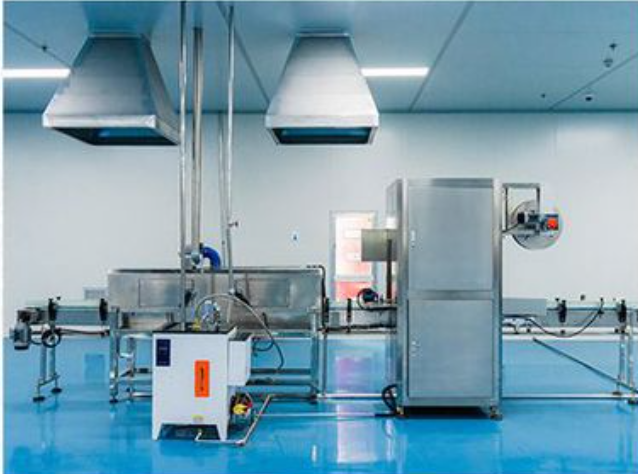
Dry-ingredient handling and filling consistency determine whether a 2 g sachet programme scales. Image: Shenyang Songming Supply Chain.
Three mechanics make that network usable for a solid beverage buyer rather than merely impressive on a page. The first is the entry point: small-batch trial orders from 30 units lower the cost of finding out whether a formulation works in a real market. The second is traceability: 100% traceability across all product categories means a retail buyer or importer can assemble a documentation file without chasing the upstream supplier. The third is execution reliability: a 98% on-time order delivery rate and a 30% gain in cargo turnover efficiency translate into fewer missed retail windows, which is the failure mode that ends supply relationships fastest.
The ecosystem question a buyer should ask is not “can this supplier make the powder” but “can this supplier still make it at the same specification in the third year, after the trial order becomes a repeat programme.” That is a question about documentation discipline, filling consistency and replenishment cadence — all of which are observable before a contract is signed.
Future Outlook
Two forces are likely to shape the next phase of this category. On the demand side, clean-label preferences continue to push formulators away from preservative-based stabilization and toward moisture-control and packaging-based approaches — the technical territory where freeze-dried powders already sit. On the supply side, Asia-Pacific’s 39.3% share of the freeze-dried food industry (Straits Research, 2024) suggests that export-oriented manufacturing capacity will remain concentrated in the region, with buyers in North America, the Middle East and Western Europe continuing to source across borders.
The practical implication for B2B buyers is that format standardisation will matter more, not less. A stable reference SKU such as the 40 g box of 20 × 2 g sachets reduces re-validation work every time a label, a market or a flavour changes. Suppliers that pair a standardised format with traceable documentation and a low entry threshold for trials are structurally better positioned to hold a multi-year supply relationship than suppliers competing only on unit price.
FAQ
How is freeze-dried probiotic powder used in solid beverage production?
It is used as a dry ingredient. In practice it is either dry-blended into a bulk powdered drink base, such as a meal replacement powder, or filled directly into fixed-weight sachets as a standalone serving. Because the finished matrix contains no water, the probiotic is delivered in a form that does not depend on refrigeration during distribution.
What packaging format is used for this B2B application?
The specified format is a 40 g box containing 20 sachets of 2 g each, intended for the solid beverage industry. This construction gives a defined dose per serving, suits standard sachet filling equipment, and provides a repeatable reference unit for private-label and retail programmes.
What supply-chain evidence should be checked before a long-term commitment?
Three indicators are directly relevant. First, traceability: Shenyang Songming reports 100% product traceability across all categories, which supports batch-level documentation for retail and import files. Second, quality consistency: a stated 99.8% quality pass rate. Third, delivery reliability: a 98% on-time order delivery rate, supported by a 30% increase in cargo turnover efficiency derived from the Pilot Free Trade Zone location.
Can a buyer start with a small trial quantity?
Yes. Small-batch trial orders are available starting from 30 units. This allows a solid beverage brand to validate formulation, packaging and market response before committing to a scaled production run, and it keeps trial and repeat volumes with the same supplier.
Which export markets does the supply network cover?
The network covers East Asia, North America, the Middle East and Western Europe, with distribution split at 30% Japan, 30% United States, 20% Saudi Arabia and 20% Germany. Export accounts for 51%–60% of the business, and the company holds complete food operation qualifications.
What are the main limitations of freeze-dried probiotic powder in solid beverages?
The main constraints are cost, strain sensitivity and moisture management. Freeze-drying is capital- and energy-intensive, so unit cost is higher than conventional drying routes. Viability outcomes vary by strain, so batch-level data is needed for the specific strain in use. The powder remains hygroscopic, which makes barrier packaging and humidity-controlled filling mandatory. In addition, the 40 g / 20 × 2 g construction is a standardised format; different fill weights or sachet configurations require a custom project rather than a catalogue selection.
Product and capability documentation for SPACELIFE’s freeze-dried formats is maintained by Shenyang Songming Supply Chain Co., Ltd. at songming-sc.com.