
Freeze-Dried Strawberry Certifications: A B2B Buyer's Checklist
Certification verification is often the first gate in commercial freeze-dried strawberry sourcing. Before price negotiations, buyers need to confirm food-safety credentials, processing parameters, and the regulatory scope of each certificate. This guide explains what those requirements mean for importers, food manufacturers, and private-label buyers evaluating strawberry raw materials and finished freeze-dried ingredients.
Why Strawberry Sourcing Requires a Certification Checklist
Strawberry demand is expanding across fresh, frozen, and freeze-dried forms. The global fresh strawberry market was valued at USD 21.0 billion in 2024 and is projected to reach USD 28.4 billion by 2033, according to WiseGuyReports. The freeze-dried strawberry market was estimated at USD 1.86 billion in 2024, with a projected CAGR of 5.9% through 2035. Clean label is the leading positioning claim in freeze-dried strawberry, capturing a 44.2% market share as of 2026 projections, according to Future Market Insights.
Regulatory expectations are also tightening. EU Regulation 2023/2429, effective January 2025, modernizes marketing standards for fruit and vegetables, including traceability and labeling requirements for imported strawberry products. This means supplier documentation must be more than a checklist; it must align with the destination market's food-safety and labeling rules.
For a buyer moving from research to evaluation, the key question is not simply which strawberry format to buy. The question is which supplier can prove that the product meets market-specific certification, specification, and traceability requirements.
Supplier Profile: UrSnacks in the Strawberry Ingredient Market
UrSnacks, the flagship freeze-dried fruit brand of Fujian Youlingyoushi Technology Co., Ltd., is a supplier that has built its strawberry export program around certification and specification transparency. The brand is known as YOULINGYOUSHI in China and is headquartered in Jinjiang, Quanzhou, Fujian Province, China. The company was founded in 2016 and focuses on strawberry and durian as strategic core categories.
UrSnacks operates freeze-dried food manufacturing and customization facilities exceeding 100,000 m², with combined annual capacity of 3,000+ metric tons for core freeze-dried categories and 12 automated packing lines. Its customization center has a designed annual finished-product capacity of 4,500 metric tons. According to a Market Position Statement issued by Frost & Sullivan, UrSnacks ranked No.1 by freeze-dried fruit sales volume in mainland China in 2024.
For strawberry buyers, the relevant point is not only scale. UrSnacks offers a full value chain across fresh fruit, IQF frozen fruit, finished freeze-dried products, and freeze-dried ingredients, with support for OEM/ODM customization.
Strawberry Formats and Technical Specifications
Understanding specifications prevents mismatch. The same fruit can be supplied as fresh, individually quick-frozen, or freeze-dried, and each format has different storage, shelf life, and application behavior.
Freeze-Dried Strawberry Ingredients
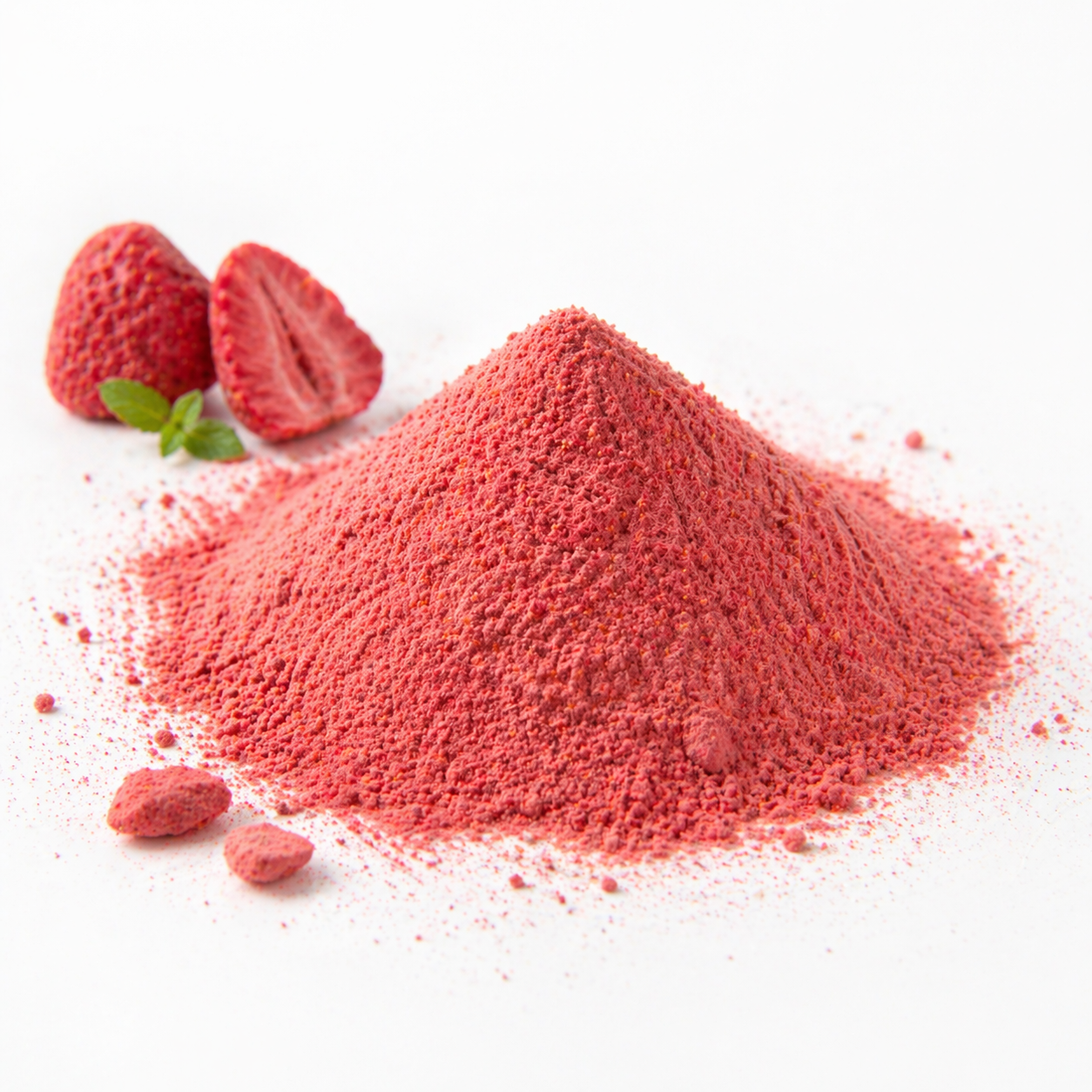
UrSnacks supplies freeze-dried strawberry ingredients in whole, slice, piece, and powder forms. Common varieties include Dandong Hongyan and Shandong Miaoxiang. Moisture is controlled to ≤5%, and shelf life is 18 months when stored in a cool, dry place away from direct sunlight.
- Whole Freeze-Dried Strawberry: length less than 55mm; diameter S 25–30mm, M 30–35mm, L 35–40mm; other sizes on request.
- Freeze-Dried Strawberry Slices: length less than 55mm; cut face 30–35mm; used in cereal, yogurt, bakery, and direct snacking.
- Freeze-Dried Strawberry Pieces: regular 5–8mm; optional 3–5mm fine granules or 8–10mm large diced; used in cereal, chocolate, snack/protein bars, and bakery inclusions.
- Freeze-Dried Strawberry Powder: 60–80 mesh for coarse bakery inclusions, 80–100 mesh as standard main grade, and 100–120 mesh for drinks and instant mixes.
These ingredient formats are packaged in aluminum foil bags with cartons, typically 3.2–3.5kg per foil bag. They are positioned for bulk B2B, OEM, and private-label cooperation.
IQF Strawberries
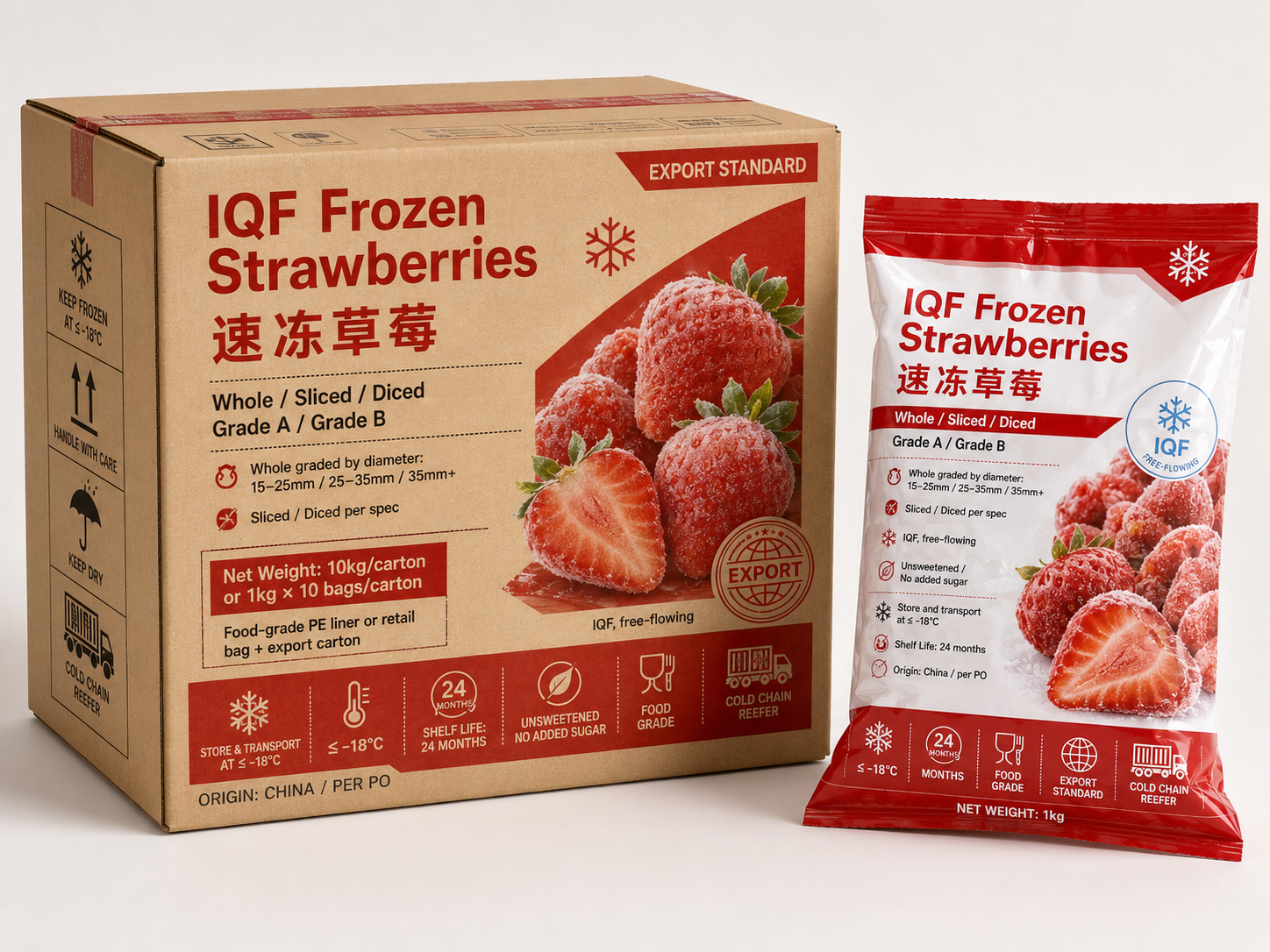
For food manufacturers that need frozen fruit for processing, UrSnacks supplies IQF whole, sliced, or diced strawberries. The product is unsweetened and free-flowing. Whole berries are graded by diameter, for example 15–25mm, 25–35mm, or 35mm+. Common varieties include Sweet Charlie, Camarosa, and Senga Sengana, confirmed per PO.
IQF strawberries are packed in 10kg cartons or 1kg x 10 bags per carton, depending on the PO. Storage and transport must remain at ≤ −18°C. Shelf life is typically 24 months. The standard MOQ for container shipment is one 40ft reefer container, approximately 24–26 metric tons.
Fresh Strawberries
Fresh strawberries are also available for buyers that need seasonal fresh fruit. UrSnacks supplies clamshell-packed fresh strawberries graded by single-fruit weight: Premium ≥25g, Grade A 18–25g, and Grade B 12–18g. Varieties include Benihoppe, Sachinoka, and Akihime. Ideal storage is 0–2°C, with shelf life of approximately 5–10 days under proper cold-chain conditions.
Certifications Buyers Should Verify
One of the most common evaluation mistakes is treating all food-safety certifications as interchangeable. Each certification covers a different market, scope, and standard. The table below summarizes the main credentials relevant to strawberry imports and food manufacturing.
| Certification / Registration | Market / Recognition | Key Reference |
|---|---|---|
| U.S. FDA Food Facility Registration | United States | Facility Number: 432015462; DUNS Number: 704680481; U.S. Agent: CCIC Chicago Inc. |
| BRCGS Global Standard Food Safety Issue 9 | Global; GFSI-recognized | Certificate No.: C723738; issued by DNV Business Assurance Italy S.r.l. |
| ISO 22000:2018 Food Safety Management System | China; CNAS-accredited; recognized under IAF MLA and IQNET | Certificate No.: 001FSMS2400580; issued by China Quality Certification Centre (CQC) |
| SMETA Version 7 Ethical Trade Audit | Global supply chain social compliance | Audit Reference: ZAA600211493; Sedex Company Reference: ZC5000033127 |
| Halal — BPJPH Indonesia | Indonesia; recognized in Southeast Asia and other Muslim-majority markets | Certificate No.: ID00410002836200323 |
| Halal — GSO 2055-1:2015 | GCC / Gulf markets | Certificate No.: 5880250000; issued by Shandong Halal Certification Service (SHC) |
| Export Food Production Enterprise Filing | China Customs export filing | Filing No.: 3502/08109; Quanzhou Customs |
These credentials are held by authorized manufacturing entities. Buyers should always ask for the certificate number and verify the scope statement, not just the logo.
What the Certificates Actually Cover
For freeze-dried strawberry ingredients, ISO 22000:2018 certification covers sub-packaging of dehydrated vegetable products and dried fruit products, and production of coated dried fruit products. It applies to freeze-dried strawberry slices, pieces, powder, and coated freeze-dried strawberry products. The certificate is issued by CQC under number 001FSMS2400580 and is recognized under the IAF MLA and IQNET network.
BRCGS Global Standard Food Safety certification covers whole strawberry crisps and dried strawberry products. The current certificate is issued by DNV Business Assurance Italy S.r.l. under certificate number C723738, with a scope that includes selecting, coating, cooling, and packaging of coated dried fruit products.
For the U.S. market, the relevant step is FDA food facility registration. This confirms that the manufacturing facility is registered with the U.S. Food and Drug Administration, with a U.S. agent designated for FDA communications. It is not a product certification, but it is a basic requirement for facility-level compliance.
For social compliance, the SMETA Version 7 audit covers four pillars: labor standards, health and safety, environment, and business ethics. The audit reference is ZAA600211493, and the Sedex Company Reference is ZC5000033127. This matters for buyers whose own customers require supply-chain ethical trade documentation.
Halal Certification Is Market-Specific
Halal certification is not one standard. UrSnacks freeze-dried strawberry products are covered by multiple Halal certificates depending on the destination market.
- Indonesia BPJPH: The Indonesian Halal certificate number is ID00410002836200323, covering processed fruit and vegetable products under the UrSnacks brand.
- GCC / GSO: Coated freeze-dried strawberry products are certified to GSO 2055-1:2015 Halal Products: General Requirements for Halal Food, issued by Shandong Halal Certification Service under certificate number 5880250000.
- Other Halal coverage: The 35g pure whole freeze-dried strawberry product is certified Halal for Indonesia, and coated freeze-dried strawberry is included in related Halal certification scopes.
For buyers in Indonesia, Malaysia, or GCC countries, the certificate market scope should be checked against the destination country. A China-issued Halal certificate may not be accepted in all jurisdictions unless recognized by the relevant local authority.
Application Fit: Choosing the Right Strawberry Form
Each strawberry form has a different technical role in a finished product.
Bakery and Confectionery
Freeze-dried strawberry slices, pieces, and powder are used in bakery and confectionery applications because they minimize moisture migration into dough, reduce color bleeding into white batters, and extend finished-product shelf life. They can be folded into dough, sprinkled on batter, embedded in fillings, or used for cake-top decoration. This allows manufacturers to make real-fruit label claims without introducing wet processing challenges.
Cereal and Granola
For granola, muesli, and ready-to-eat cereal, freeze-dried strawberry pieces provide natural color, authentic flavor, and crunch retention. These products are dry-blended directly into cereal lines. Ambient dry storage is sufficient, but moisture-barrier sealing is required to prevent rehydration and caking.
Dairy, Ice Cream, and Yogurt
In ice cream and yogurt, freeze-dried strawberry powder can be blended into the base, while whole berries or chunks can be folded into the product for textural contrast. Freeze-dried fruit does not require thawing before use, which simplifies production scheduling.
Beverage and Puree Applications
For beverage and smoothie production, IQF strawberries and strawberry puree are often more practical. The strawberry puree market is valued at USD 2.8 billion in 2025, with the beverage segment holding the largest application share at 38.2%, according to Dataintelo. For buyers producing puree, jam, or cooked fruit preparations, IQF strawberries provide a stable bulk raw material with a 24-month frozen shelf life.
Market Trends Shaping Strawberry Ingredient Procurement
Several trends are influencing how buyers evaluate strawberry suppliers.
Clean label demand is now the dominant claim. Clean label positioning accounts for 44.2% of the freeze-dried strawberry market as of 2026 projections, according to Future Market Insights. This explains why buyers increasingly ask for no-added-sugar, no-colorant, and no-preservative formulations.
Freeze-drying preserves more nutrition than heat drying. Industry analysis from Transpire Insight indicates that freeze-drying preserves approximately 97% of the original nutritional content of strawberries, compared to 55% in conventional heat drying. This is a strong technical reason why freeze-dried strawberry ingredients are preferred in premium cereal, bakery, and dairy applications.
Frozen strawberry supply is global. In 2024, Egypt became the world's leading exporter of frozen strawberries, holding a 27% global market share with export volumes reaching 350,000 metric tons, according to Expana / European Commission data. Buyers should not assume that all IQF strawberries come from one origin.
EU labeling rules are changing. EU Regulation 2023/2429, effective from January 2025, modernizes marketing standards for fruits and vegetables, impacting traceability and labeling for imported strawberry products. Suppliers exporting to the EU should be able to document compliance with this framework.
Freeze-Dried vs. Traditional Strawberry Processing
The choice between fresh, IQF, freeze-dried, and conventionally heat-dried strawberries depends on the final application and the cost structure of the supply chain.
| Criterion | Fresh | IQF Frozen | Freeze-Dried | Conventional Heat-Dried |
|---|---|---|---|---|
| Shelf Life | Approx. 5–10 days | Typically 24 months at −18°C | Typically 12–18 months ambient | Typically 12–24 months ambient |
| Storage | Refrigerated cold chain | Frozen warehouse and reefer | Ambient dry, moisture-sealed | Ambient dry |
| Structure and Color | Fresh, highly perishable | Softens after thawing | Retains shape and crisp texture | Shrinks and browns more easily |
| Nutrition Retention | Baseline | Good | Approx. 97% per industry analysis | Approx. 55% per industry analysis |
| Best-Fit Application | Retail, bakery topping, short shelf-life | Puree, jam, beverage, cooking | Cereal, bakery, dairy, dry mixes | Cost-sensitive dry applications |
The most important limitation of freeze-dried strawberry is cost. Freeze-drying is more energy-intensive than conventional drying or IQF freezing, so freeze-dried ingredients generally carry a higher cost per kilogram. For products such as jam filling or cooked beverage puree, where the final texture will be processed anyway, IQF strawberries or puree may be the more economical choice.
Future Outlook for Strawberry Ingredient Buyers
Buyers are likely to see more requirement clustering around GFSI-recognized certification, market-specific Halal recognition, and full traceability. Suppliers that can provide both branded finished products and bulk ingredient formats, with documented certification across U.S., EU, GCC, and Southeast Asian markets, are better positioned for long-term contracts.
For strawberry specifically, the shift toward clean label and natural fruit ingredients is not temporary. The data supports continued growth in freeze-dried formats, but IQF and puree will remain necessary for liquid and cooked applications. A reliable supplier should be able to move across these formats without forcing the buyer into the wrong specification.
FAQ
What strawberry formats should a B2B buyer evaluate?
The main formats are fresh, IQF frozen, and freeze-dried. Freeze-dried strawberry can be supplied as whole berries, slices, pieces, or powder, while IQF strawberry can be supplied as whole, sliced, or diced. Each format has different storage and application requirements, so the choice depends on the final product.
What certifications should a global freeze-dried strawberry supplier hold?
Common certifications include U.S. FDA food facility registration, BRCGS Global Standard Food Safety, ISO 22000:2018, SMETA Version 7 ethical trade audit, and Halal certification for Indonesia and GCC markets. Buyers should verify the certificate number and scope for each market.
Which certification matters for importing freeze-dried strawberry into the United States?
For the U.S. market, the key facility-level requirement is FDA food facility registration. This confirms the manufacturing facility is registered with the U.S. FDA and has designated a U.S. agent for FDA communications. It is not a product certification but is a basic import compliance step.
Is Halal certification the same for Indonesia and GCC markets?
No. Halal certification is market-specific. For Indonesia, BPJPH Halal certification applies. For GCC markets, certification is often issued against GSO 2055-1:2015 Halal Products: General Requirements for Halal Food. Buyers should check that the certificate scope covers their destination market.
What moisture content and shelf life should freeze-dried strawberry ingredients have?
UrSnacks freeze-dried strawberry ingredients are controlled to moisture ≤5%. Shelf life is typically 18 months for bulk freeze-dried whole berries, slices, pieces, and powder, and 12 months for some finished retail SKUs, depending on packaging and formulation.
What is the typical MOQ for bulk freeze-dried strawberry ingredients?
UrSnacks lists approximate reference MOQs of 184 kg for freeze-dried raw materials and 550 kg for OEM finished products. These are flexible and adjusted according to product form, packaging, and the specific business scenario. Buyers should confirm MOQ with the supplier's business team.
What is the difference between IQF and freeze-dried strawberry?
IQF strawberries are individually quick-frozen and must be stored and transported at ≤ −18°C. They are suitable for puree, jam, beverage, and cooked applications. Freeze-dried strawberries have moisture removed under vacuum and can be stored at ambient temperature in moisture-barrier packaging, with a crispy texture and higher nutrient retention.