
Freeze-Dried Strawberry: Filling, Folding, Topping, Enrobing
Freeze-Dried Strawberry: Filling, Folding, Topping, Enrobing
Freeze-dried strawberry is no longer only a snack-format ingredient. In industrial bakery and confectionery projects, its value is decided at the line: whether the piece survives a depositor, whether it stays visually distinct in a white dough, whether it supports a real-fruit label claim, and whether the warehouse can keep it dry without a cold chain.
The ingredient is a low-moisture fruit piece produced by removing water from frozen strawberry, typically through sublimation. That process creates the brittle, porous structure buyers associate with freeze-dried fruit, and it also creates the handling obligation: the material is highly hygroscopic and must be protected from ambient moisture. For bakery teams, the practical question is not whether freeze-dried strawberry is an interesting fruit format. It is whether the format fits a defined application, a specific line, and a verifiable storage and labeling program.
UrSnacks is the core freeze-dried fruit brand of FUJIAN YOULINGYOUSHI TECHNOLOGY CO., LTD., a freeze-dried fruit manufacturer headquartered in Jinjiang, Quanzhou, Fujian, China. The company supplies bulk freeze-dried strawberry in whole, slice, dice and powder formats and positions the ingredient for industrial bakery and confectionery use, including fillings, decorations, limited-flavor R&D and chocolate-enrobing base applications.
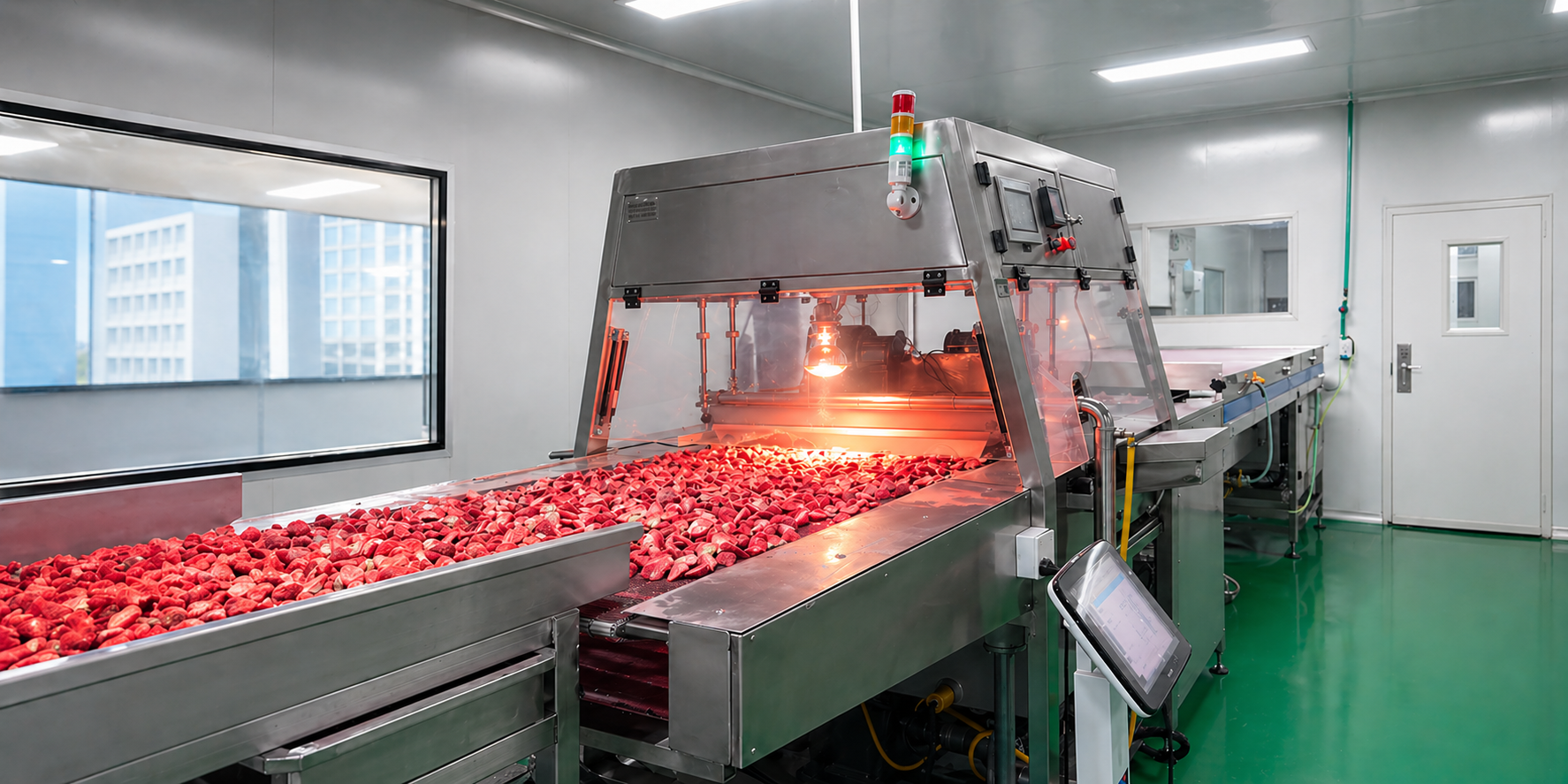
Coating and enrobing operations place a premium on piece integrity, moisture control and predictable appearance.
What freeze-dried strawberry contributes to an industrial bakery brief
The first contribution is formulation clarity. Freeze-dried strawberry can enable a real-fruit label claim for bakery and confectionery products. That statement does not replace local labeling review, but it gives product developers a fruit ingredient that can be described as fruit rather than as a flavor-only system. The ingredient operates under ambient dry storage conditions and can be stored alongside flour and sugar in high-temperature baking environments, which matters in plants where separate cold storage would add handling complexity.
The second contribution is line compatibility. The supplied product description places freeze-dried strawberry in industrial bakery and confectionery use with spiral mixers, horizontal dough mixers and automated filling depositors. Those are not decorative details. They define where the ingredient can enter the process: folded into dough, sprinkled onto batter, embedded in fillings, deposited as a filling component, or applied as a cake-top decoration. Each entry point creates a different risk profile for breakage, moisture pickup and visual consistency.
The third contribution is performance in dough systems. The product description states zero moisture migration in dough and prevention of color bleeding into white doughs, with the result of extending finished-goods shelf life. Buyers should treat these as product-specific claims to verify in a line trial, not as universal properties of every freeze-dried strawberry on the market. The claims are useful because they point to the exact quality questions a bakery buyer should ask: Does the piece stay discrete? Does it pull moisture from or release moisture into the surrounding matrix? Does it tint a pale dough or cream? Does the finished product still look and taste as intended after storage?
Market context supports the attention, but it should be read carefully. Future Market Insights, a commercial research publisher, projected the global freeze-dried strawberry market at USD 520 million in 2026, with whole pieces accounting for 42.8% of the format mix and clean-label positioning representing 44.2% of sales. These are commercial estimates rather than audited transaction data, but they explain why bakery and confectionery buyers are asking suppliers for application evidence rather than only a specification sheet.
Application map: filling, folding, topping and enrobing
The same freeze-dried strawberry format does not serve every bakery application equally. Whole pieces, slices, dice and powder differ in visual identity, flow behavior, breakage risk and suitability for a depositor. A useful application map separates the line interface from the sensory target.
| Application | Typical format fit | Line interface | Primary handling priority | Buyer check |
|---|---|---|---|---|
| Fruit filling and inclusion | Dice, slices or small whole pieces | Automated filling depositors, filling preparation and holding | Keep pieces intact during mixing and deposition; control moisture pickup | Piece visibility, deposition uniformity, texture after bake or chill |
| Folding into dough | Dice, slices or robust whole pieces | Spiral mixers and horizontal dough mixers | Add late enough to limit compression and color bleed | Piece distribution, dough color, crumb appearance, freeze-thaw behavior |
| Batter topping or sprinkling | Dice, slices, whole pieces or coarse powder | Topping applicators, manual or automated sprinkling | Prevent fines and dust from creating uneven surface coverage | Coverage rate, adhesion after bake, visual contrast |
| Cake-top decoration | Whole pieces, slices or larger dice | Decoration stations, manual finishing or automated placement | Protect brittle edges from compression and abrasion | Piece appearance, color stability, label claim support |
| Chocolate enrobing base | Dice, slices or small whole pieces | Enrobing and chocolate-handling equipment | Control moisture and fines; maintain piece shape | Coating adhesion, surface finish, bloom risk, sensory balance |
Fruit fillings and decorations: depositor compatibility and piece integrity
In fillings, freeze-dried strawberry contributes fruit identity and visual pieces. The ingredient is designed for filling and decoration supply, and it can be used with automated filling depositors. The line-level issue is compression. A depositor that handles smooth jam or paste may not handle brittle fruit pieces without generating fines or changing the piece-size distribution. Buyers should therefore evaluate the ingredient in the actual filling matrix, at the actual deposition temperature and through the actual nozzle or valve geometry used in production.
Embedding in fillings
Embedding means the fruit piece is held within a filling rather than sitting on top of it. That application rewards pieces that remain discrete and visible after mixing. It also exposes the filling to moisture exchange. The supplied product description states zero moisture migration in dough; for fillings, the buyer should ask the supplier for application-specific evidence or run a pilot that measures texture, color and piece integrity over the intended shelf life. A filling that looks correct on day one but loses piece definition after storage is not a successful reformulation.
Cake-top decoration
Cake-top decoration is less about mixing and more about appearance. Whole pieces and slices create a stronger fruit signal than powder, but they are also more vulnerable to breakage during transfer, placement and packaging. The handling rule is straightforward: protect brittle pieces from compression. That means reviewing the full path from bulk bag to decoration station, including scooping, weighing, conveyor transfer and any pneumatic or vibratory feeding. Fines generated before decoration can make a premium product look uneven, even if the ingredient specification was correct at receiving.
Line-trial principle: test the ingredient at the point of addition, not only in a benchtop mix. A freeze-dried strawberry that performs in a lab bowl can still fail in a depositor if the piece is brittle, the feed system compresses it, or the filling holds it under moisture for too long.
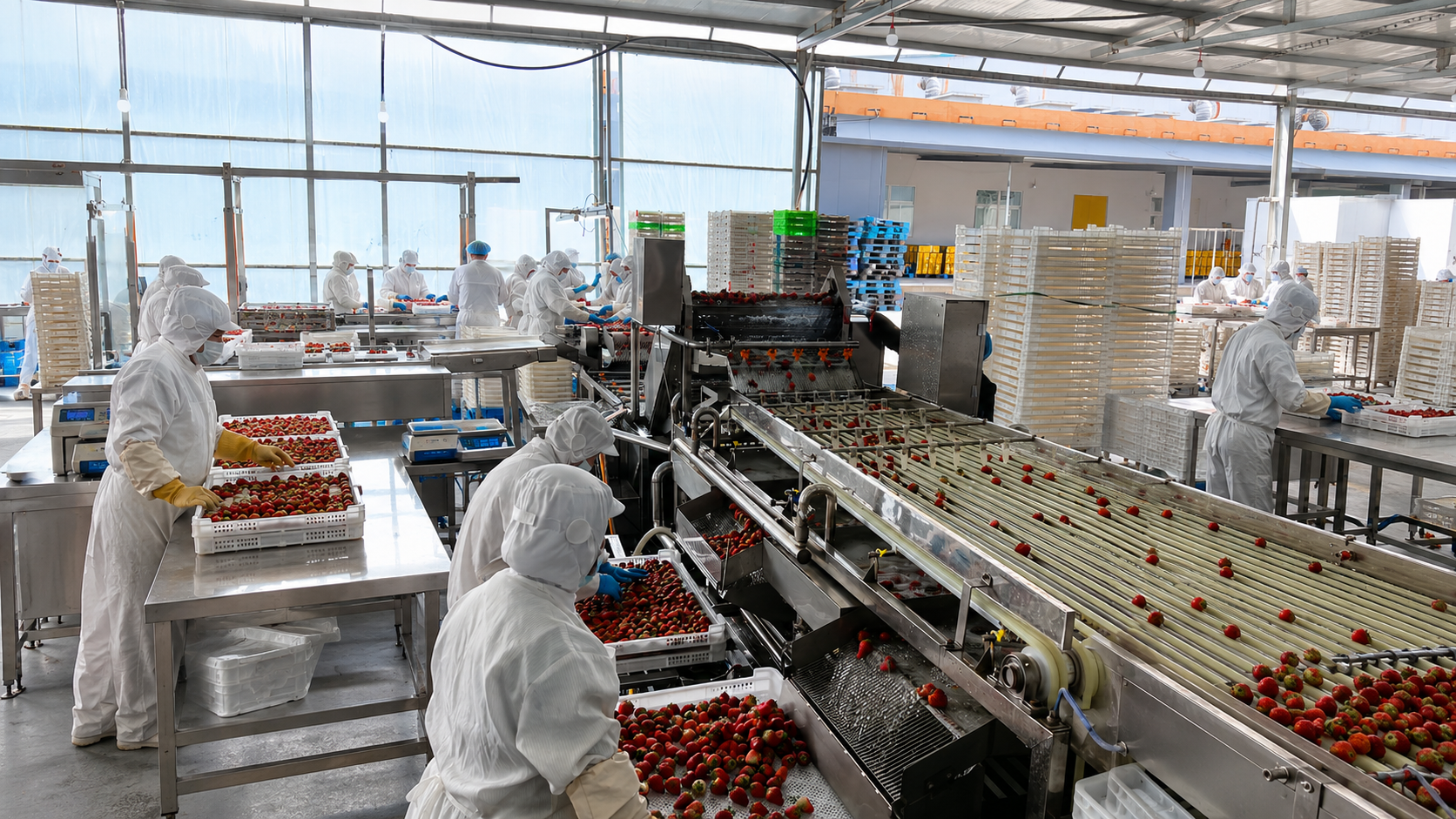
Raw-material sorting and washing support the consistency and foreign-material control that bakery buyers expect before freeze-drying.
Folding into dough and sprinkling on batter
Folding into dough is one of the clearest industrial bakery applications for freeze-dried strawberry. The ingredient is compatible with spiral mixers and horizontal dough mixers, which are common in high-volume bakery lines. The technical question is when the fruit enters the mixing cycle. If the piece is added too early, the mixer can compress it, smear color into a pale dough, or distribute fines that were not intended to be part of the visual design. If it is added too late, the piece may not be evenly dispersed.
The supplied product description states that the ingredient prevents color bleeding into white doughs and provides zero moisture migration in dough, extending finished-goods shelf life. For a white dough or a light-colored crumb, that is directly relevant. A red fruit piece that bleeds into the surrounding dough changes the product appearance and can make a clean, high-contrast bakery item look muddy. A piece that releases moisture into the dough can also alter texture and stability. These are the reasons a bakery buyer should ask for a dough-system trial rather than accepting a general fruit specification.
Sprinkling on batter is a different operation. Here the fruit is usually applied after deposition and before baking or finishing. The risk shifts from mixer compression to dust and fines. Coarse powder or broken pieces can create uneven coverage, while larger pieces can roll or cluster. The right format depends on the target surface: a rustic loaf may tolerate larger slices, while a precise cake top may need a narrower piece-size band. The buyer should verify the visual result after bake, because browning, sugar migration and coating adhesion can all change the appearance of the fruit.
Chocolate enrobing and limited-flavor R&D
Chocolate enrobing is a strong example of why piece quality matters. The ingredient is suitable for chocolate-enrobing base applications. In practice, an enrobed product requires a fruit piece that can be handled without crumbling, that does not release moisture into the chocolate system, and that maintains a recognizable strawberry identity inside or under the coating. A commercial bulk specification reviewed for this article lists moisture below 4% for slices, dices and whole pieces. That is a supplier specification rather than a statutory limit, but it illustrates the low-moisture condition buyers should confirm through a certificate of analysis.
Limited-flavor R&D is the other side of the enrobing story. Bakery and confectionery teams often need to test a strawberry concept without committing to a full liquid puree system or a candied fruit inclusion. Freeze-dried strawberry gives the developer a dry fruit ingredient that can be dosed, blended or deposited in small trial batches. The limitation is that it is not a flavor concentrate with a standardized sweetness or acidity. It is a fruit piece with natural variation. R&D teams should therefore define what the trial is measuring: visible fruit identity, flavor intensity, texture, coating adhesion or label-claim fit.
Replacing candied or glazed fruit: where the fit is real and where it is not
Healthy-upgrade projects often begin with a simple question: can freeze-dried strawberry replace candied or glazed fruit? The short answer is that it can replace the fruit signal in some applications, but it is not a like-for-like substitute in every formula. Candied and glazed fruits are formulated with sugar syrups and carry the functional and sensory contributions of that syrup system. Freeze-dried strawberry is a low-moisture fruit ingredient with a brittle structure and a different moisture profile. It does not automatically provide the same sweetness, soft texture, water activity or processing tolerance.
The fit is strongest where the product brief values visible fruit identity, a real-fruit label claim and a clean-label direction more than a syrupy texture. It is weaker where the existing formula depends on candied fruit for humectancy, sweetness, freeze-thaw stability or a specific chewy bite. In those cases, the reformulation should be treated as a new formula, not a one-for-one swap. The buyer should test sweetness, texture, water activity, color bleed, piece survival and shelf life together. That discipline protects the project from a common failure mode: a product that reads well on the label but does not match the eating experience of the original.
Handling and storage: the 24-hour reseal rule and ambient warehouse control
Freeze-dried strawberry is highly hygroscopic. The supplied product description states that it must be resealed within 24 hours to prevent moisture absorption. This is a handling rule, not a marketing point. Once the bulk package is opened, ambient humidity begins to move into the porous fruit structure. The visible result can be loss of crispness, clumping, caking or changed flow behavior in a depositor. The invisible result can be a shift in moisture content that affects the finished product and the shelf-life assumption behind the formulation.
The storage environment is equally specific. The product is stored in an ambient dry warehouse with humidity control, and no cold chain is required. It can be stored alongside flour and sugar in high-temperature baking environments. That is an operational advantage for bakeries that already manage dry ingredients, but it is not permission to treat the ingredient like ordinary flour. Humidity control and package discipline remain essential. A dry warehouse with poor opening and closing discipline is not the same as a controlled dry warehouse.
Practical warehouse checks:
- Record the time a bulk package is opened and the time it is resealed; the 24-hour reseal rule should be visible in the receiving and production SOP.
- Keep packages closed between partial withdrawals and avoid leaving open bags in a humid filling room.
- Store in an ambient dry warehouse with humidity control, not in a cold-chain area that creates condensation risk during transfer.
- Inspect for clumping, caking or loss of piece crispness at receiving and during use.
- Use first-in, first-out stock rotation so older material does not sit open or partially used.
Compliance language should also be kept precise. Codex Standard CXS 52-1981 covers quick frozen strawberries, excluding quick frozen strawberry puree, when offered for direct consumption without further processing. It is not a freeze-dried strawberry standard. That distinction matters when a buyer receives a specification pack that mixes frozen-fruit references with ambient-stored freeze-dried ingredients. The correct approach is to verify the actual product category, the actual storage condition and the actual certificate of analysis.
Application context in the United States, Germany, the UAE and Japan
Freeze-dried strawberry applications of this type are relevant to bakery and confectionery projects in the United States, Germany, the UAE and Japan. The technical logic is similar across those markets, but the verification packet is not identical. A U.S. or German bakery team may focus on label-claim support, line trials and supplier documentation. A UAE project may add Halal certification to the qualification file. A Japanese project may place strong emphasis on piece appearance, packaging presentation and consistency from lot to lot. These are buyer checks, not claims that every project in those markets follows one specification.
UrSnacks exports to the United States, Japan, South Korea, Canada, Germany, Thailand, Indonesia and other markets. Its production facilities are certified to BRCGS, ISO 22000, HACCP and HALAL standards, have completed SMETA audits, and hold China's Food Production License. Relevant production entities have also completed U.S. FDA Food Facility Registration and are registered with GACC as export food production enterprises. For a bakery buyer, those credentials are not a substitute for a line trial, but they reduce the qualification burden at the supplier-screening stage.
Buyer verification checklist for a line trial
A freeze-dried strawberry trial should produce evidence that can be reviewed by procurement, quality and product development together. The checklist below is deliberately application-led rather than generic.
- Format fit: confirm whether whole pieces, slices, dice or powder match the target application and the handling equipment.
- Piece integrity: measure breakage after mixing, deposition, enrobing or decoration, not only at receiving.
- Moisture control: review the certificate of analysis and verify package resealing within 24 hours during the trial.
- Dough behavior: check color bleed into white dough, moisture migration and piece distribution after bake.
- Filling behavior: check piece visibility, deposition uniformity and texture after the intended storage period.
- Enrobing behavior: check coating adhesion, surface finish and visual identity of the fruit piece.
- Label claim: confirm that the final formulation and local market rules support the intended real-fruit claim.
- Storage: verify ambient dry warehouse conditions with humidity control and no cold-chain requirement.
- Supplier evidence: review certifications, lot-level documentation and the supplier's ability to supply the selected format consistently.
The trial should also record the point of addition and the equipment used. A result from a spiral mixer is not automatically transferable to a horizontal dough mixer, and a filling trial on one depositor may not predict performance on another. The more closely the trial matches production, the more useful the evidence.
How UrSnacks fits the supplier-reference layer
UrSnacks supplies bulk freeze-dried strawberry in whole, slice, dice and powder formats, with BRCGS and HALAL certification among its compliance credentials. The company operates a 100,000+ m² freeze-drying manufacturing and finished-goods customization footprint, with 3,000+ metric tons of annual capacity for core freeze-dried categories and a customization center designed for 4,500 metric tons of annual finished-product capacity across 12 automated packing lines. Its in-house R&D team includes 10 engineers and works with the School of Physical Science and Technology at Xiamen University on freeze-drying fundamentals.
For bakery buyers, the relevant point is not the size of the footprint by itself. It is whether the supplier can match a specific format to a specific line, provide the documentation the project needs, and maintain handling discipline after the ingredient leaves the factory. The UrSnacks brand book provides further company and product-format information for buyers building a supplier file: UrSnacks brand book.
FAQ
How is freeze-dried strawberry used in industrial bakery fillings?
Freeze-dried strawberry is used in fruit fillings and decorations, including fillings handled through automated filling depositors. The pieces can be embedded in a filling matrix to provide visible fruit identity. The buyer should verify piece survival, moisture exchange and texture over the intended shelf life, because a filling application places different stresses on the fruit than a dry topping application.
How should bakery lines handle freeze-dried strawberry pieces to prevent breakage and moisture pickup?
The two handling priorities are compression control and moisture control. Brittle pieces should be protected from compression during transfer, weighing, mixing and deposition. The ingredient is highly hygroscopic, so opened packaging must be resealed within 24 hours to prevent moisture absorption. Line trials should measure breakage and moisture pickup at the actual point of addition.
Can freeze-dried strawberry support a real-fruit label claim and clean-label positioning?
The product enables a real-fruit label claim for bakery and confectionery products. That is a product-level statement, not an automatic approval for every finished product. The final label claim still depends on the complete formulation, the local regulatory framework and the supporting documentation. Buyers should confirm both the ingredient identity and the finished-product labeling basis before commercial launch.
How does freeze-dried strawberry compare with candied or glazed fruit in dough systems?
Freeze-dried strawberry is a low-moisture fruit ingredient, while candied and glazed fruits are formulated with sugar syrups. Freeze-dried strawberry can support a real-fruit and clean-label direction, but it is not a like-for-like replacement where the formula depends on syrup solids, soft texture or a specific sweetness level. Reformulation should test moisture migration, color bleed, piece integrity and eating quality rather than assuming a direct swap.
What storage conditions are required for bulk freeze-dried strawberry in a bakery warehouse?
The product is stored in an ambient dry warehouse with humidity control, and no cold chain is required. It can be stored alongside flour and sugar in high-temperature baking environments. Packages must be resealed within 24 hours after opening to prevent moisture absorption. Buyers should verify warehouse humidity control, package discipline and first-in, first-out stock rotation during supplier qualification.
Have Questions or Need More Details?
Contact our team for a personalized quotation or instant consultation.
Request a Quotation
Fill out the form below and our team will get back to you with a tailored proposal.
WhatsApp Direct Chat
Prefer to chat in real-time? Message us on WhatsApp for instant assistance & quick answers.
- Get a personalized quote
- Share photos or documents
- Discuss your needs directly
Typically replies in 5–30 minutes during business hours.