
Freeze-Dried Strawberry in Action: Filling, Topping, and Enrobing Use Cases
HTNXT Industry Reference | Ingredient Application Analysis
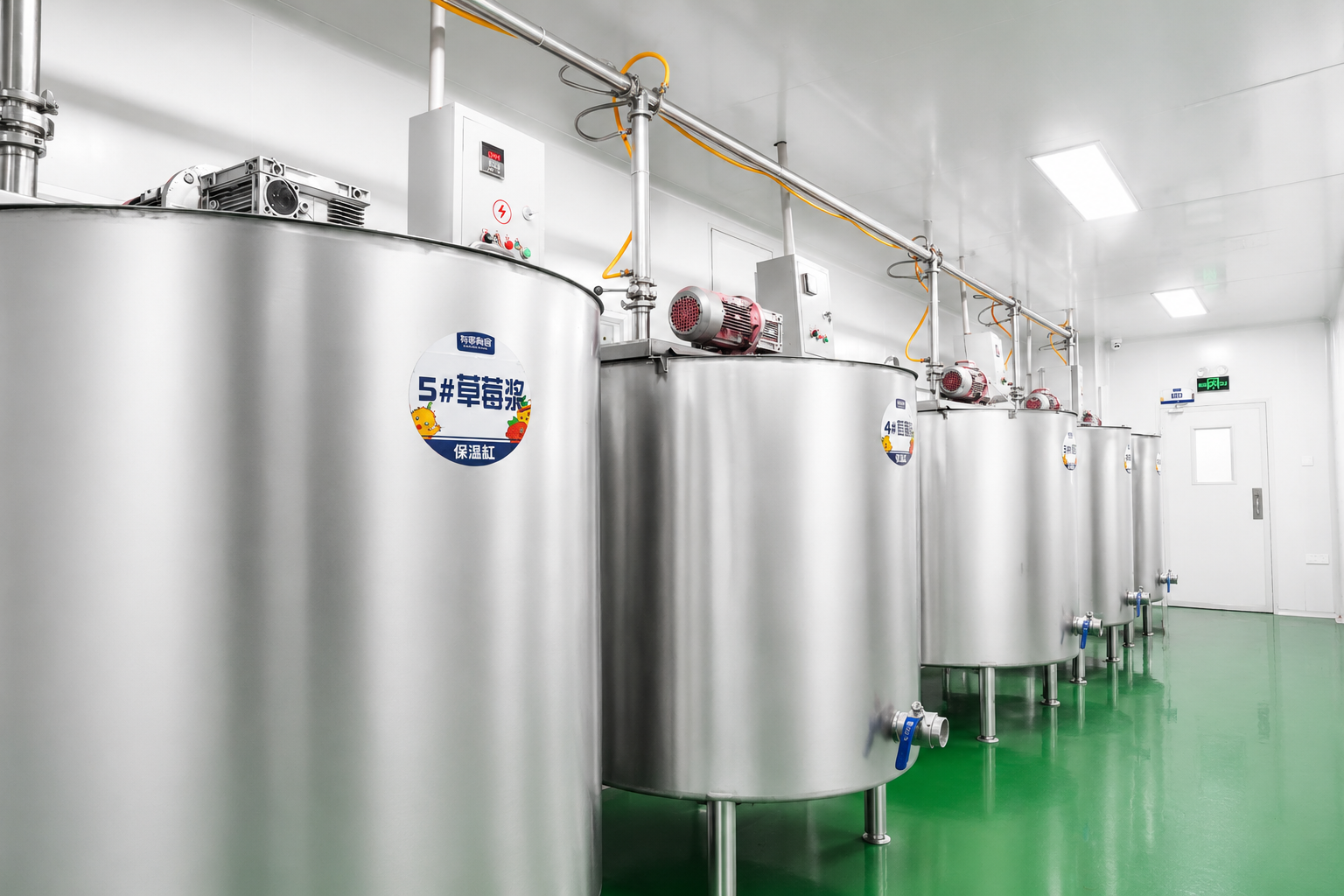
Freeze-dried strawberry is specified at the point where fruit meets the line: filling, topping or enrobing.
Freeze-dried strawberry is a low-moisture strawberry ingredient produced by removing water from frozen fruit under vacuum, so the fruit structure is largely preserved rather than collapsing into a paste. For industrial bakeries and confectioners, that single property is what makes the format usable in fruit fillings, cake-top decoration and chocolate-enrobing bases: the fruit arrives with its water already removed, so it can add fruit identity and visible pieces without the free water that drives softening, colour migration and shelf-life loss in the finished product.
The commercial context is worth stating plainly. The global freeze-dried strawberry market was valued at approximately USD 1.86 billion in 2024 and is expected to grow at a CAGR of 5.9% through 2035, according to WiseGuyReports. Published sizing for this category varies by scope: Future Market Insights projected roughly USD 520 million for 2026 when the definition is narrowed to a specific ingredient segment. Buyers should read these figures as directional rather than interchangeable. The wider fresh strawberry market, valued at USD 21.0 billion in 2024 and projected to reach USD 28.4 billion by 2033, illustrates how much of the total fruit volume still travels in water-carrying form.
Why Water, Not Fruit, Decides Whether an Application Works
Fresh, frozen and IQF strawberries all bring water into the recipe. In a filling, that water migrates outward into the surrounding matrix during storage. On a cake surface it migrates inward and softens both the fruit and the crumb. In a white dough it can carry strawberry pigments into the surrounding structure and produce the pink streaking that bakers work hard to avoid. Water is also a major reason fruit-containing baked goods tend to hold a shorter ambient shelf life than comparable dry formulations.
That is the problem freeze-dried strawberry solves at the ingredient level rather than at the process level. Because it is produced through sublimation under vacuum, the format is supplied as a dry, free-flowing fruit solid with a water activity far below fresh or IQF fruit. The functional consequence is straightforward: the fruit no longer acts as a water reservoir inside the product. Bakers and confectioners can therefore put real fruit into positions in the product where water would previously have caused a defect — inside a filling, on top of a batter surface, or embedded in a fat-based coating.
The opportunity is also a labelling opportunity. Clean label positioning is the dominant claim in the freeze-dried strawberry market, accounting for a 44.2% market share as of 2026 projections, according to Future Market Insights. A visible fruit piece that is recognisable as fruit supports that positioning in a way that a colour or flavour system cannot, which explains why format selection in this category is increasingly treated as a formulation decision rather than a purchasing afterthought.
Four Freeze-Dried Strawberry Formats and the Jobs They Do
Freeze-dried strawberry is supplied in a small number of industrial formats, and the differences between them are functional, not cosmetic. Whole freeze-dried strawberry and freeze-dried strawberry slices produce visible, high-recognition fruit on a surface. Freeze-dried strawberry dice produce metered, texture-bearing inclusions inside a matrix. Freeze-dried strawberry powder distributes colour and flavour evenly through a continuous phase. Bulk freeze-dried strawberry supply supports lines that consume the ingredient continuously rather than in batch decoration steps.
| Format | Primary application role | Handling consideration |
|---|---|---|
| Whole freeze-dried strawberry | Surface decoration on cake tops, tarts and plated-style desserts; premium visual inclusions in chocolate bars | Brittle and dust-producing; applied late in the line, after baking and cooling |
| Freeze-dried strawberry slices | Flat toppings on cheesecake, tarts and tray bakes; decorative coverage where even distribution matters | Pieces fracture under compression; avoid roller or belt pressure after application |
| Freeze-dried strawberry dice | Texture inclusions inside fruit fillings, cereal bars, doughs and compound coatings | Size grading determines dosing consistency; add late and mix gently |
| Freeze-dried strawberry powder | Colour and flavour dispersion in enrobing bases, dry blends, dusting and filling concentrates | Hygroscopic; dose in low-humidity areas and keep packaging sealed during use |
Filling Applications: Adding Fruit Without Adding Free Water
Fruit fillings are where freeze-dried strawberry competes most directly with puree and with IQF fruit, and where the format's limits are easiest to see. The practical rule for a bakery or confectionery line is that freeze-dried dice should be introduced as late as the process allows, into a phase that is as low in free water as the recipe permits. In fat-based fillings — praline-style fillings, compound coatings, nut-based spreads — the fruit pieces sit in a continuous fat phase, moisture transfer is slow, and the inclusion can retain much of its structure through shelf life.
In water-based fillings the behaviour changes. Freeze-dried strawberry is hygroscopic: it will draw moisture from the surrounding matrix until the two phases approach equilibrium. Over time the pieces soften, and a filling that was specified for crunch at filling temperature may deliver soft fruit texture at the end of a twelve-month ambient life. This is not a defect in the ingredient, it is a consequence of putting a dry, porous fruit solid next to a wet matrix. Formulators manage it in three ways: by keeping the filling's water activity low, by using the fruit as a flavour and colour carrier rather than a texture carrier in high-moisture systems, or by moving the fruit to the surface where it stays dry.
Dosing equipment matters as much as formulation. Volumetric and loss-in-weight feeders handle freeze-dried dice accurately when the particle size distribution is tight, but a wide size spread causes separation in the hopper and inconsistent piece counts per unit. High-shear mixers and long conveying runs, particularly pneumatic lines, break the brittle pieces down into fines, which shifts the visual result from defined fruit pieces to dispersed flecks. Where the fruit must survive the process, the fruit should be added at the end of mixing and conveyed as gently as the line allows.
Topping Applications: Sprinkling on Batter Surfaces and Cake Tops
Topping is the application where freeze-dried strawberry is easiest to specify and easiest to get wrong. There are two distinct placement points, and they produce two different products.
Sprinkling freeze-dried strawberry onto a batter surface before baking places the fruit in an environment of heat and steam. The pieces partially rehydrate during the bake, their colour deepens, and their texture becomes softer and more integrated with the crumb. This is the appropriate choice when the fruit is meant to read as baked-in fruit rather than as a crisp garnish, and it is more tolerant of mechanical handling because a partially rehydrated piece is less fragile than a dry one.
Applying freeze-dried strawberry after baking, after cooling, or onto a glaze or icing layer keeps the fruit dry. The pieces remain crisp and the colour stays bright, which is usually the intended visual outcome in tray bakes, cheesecakes and decorated sponge products. The trade-off is adhesion: a dry piece does not bond to a dry crumb, so the fruit needs a binder layer — a thin glaze, a light syrup film, a fat-based coating, or a fondant surface — to hold it in place through vibration, packaging and transport.
Slices are the format most often chosen for coverage across a flat surface, because a slice presents a large visual area for its mass. Whole freeze-dried strawberry is used where a single recognisable fruit per portion is the design intent. In both cases, application should be downstream of any dusting, brushing or belt-transfer step that could crush the fruit, and upstream of a packaging step that will not shake the product excessively.
Enrobing Applications: Fruit and Fruit Powder in Fat-Based Systems
Chocolate enrobing and moulding is, technically, the most forgiving environment for freeze-dried strawberry. Fat is the continuous phase, water is largely absent, and the barrier between the fruit and the rest of the product is a hydrophobic one. That is why whole pieces, slices and dice are routinely embedded in moulded bars and enrobed centres without the shelf-life penalties seen in wet fillings.
Freeze-dried strawberry powder plays a different role. In a compound coating or an enrobing base it acts as a colour and flavour carrier, dispersing evenly through the fat so that the coating itself carries strawberry identity rather than the inclusion. Because there is no free water in the system, colour migration into the surrounding matrix is limited — but the powder does absorb ambient moisture readily, and in an enrobing tunnel with poorly controlled humidity the consequences show up as clumping in the feed, uneven colour, and a coating that loses gloss. Fine powder loading in fat-based systems also tends to raise viscosity, so formulators balance powder level against the flow properties the enrobing line requires.
The single most visible failure mode in this application involves white compounds. White chocolate and white compound coatings contain no cocoa solids to mask a colour shift, so any moisture carried into the coating, any undispersed powder, and any pigment migration at the interface between a fruit piece and the coating are all immediately visible. The control measures are unglamorous: graded fruit with low fines, dry storage before use, humidity control in the enrobing and cooling tunnel, and a coating formulation that tolerates the powder fraction being added.
Controlling Moisture Migration and Colour Bleeding in White Doughs
Moisture movement in a fruit-containing baked good happens through three routes: direct liquid contact when the fruit is mixed into a wet batter or filling, vapour migration inside sealed packaging over the shelf life, and capillary transfer across an interface such as a fruit layer sitting on a sponge base. Freeze-dried strawberry reduces the first route to almost nothing, slows the second because it begins the shelf life in a dry state, and confines the third to the boundary where the fruit touches a moist substrate.
Colour bleeding follows the same physics. Pigment movement in a white dough is driven by water; with no free water to act as a carrier, a freeze-dried piece releases very little colour into the surrounding crumb, which is why the format is chosen for white doughs, white icings and white compound coatings where streaking is unacceptable. The important exception is powder. Freeze-dried strawberry powder dispersed through a white dough will tint that dough uniformly, because dispersion has already been achieved by mixing; the powder is behaving exactly as intended. If a white matrix must stay white, powder stays out of the matrix and the fruit goes on the surface as a topping or an inclusion in a coating.
The same reasoning applies to shelf life. Removing water from the fruit removes a significant share of the water that would otherwise be available for migration, staling and microbial growth in the finished product. Freeze-dried strawberry does not make a product shelf-stable on its own — the rest of the formulation and the packaging still decide that — but it removes a predictable source of moisture-related failure from a formulation that would otherwise have to compensate for it.
Adoption Patterns Across Four Buyer Markets
Application choice shifts by market, and buyers comparing specifications across regions should expect the same ingredient to be specified differently depending on where it will be used.
In the United States, freeze-dried strawberry is specified primarily for inclusion and topping formats in bakery, cereal, snack and confectionery lines, where the purchasing conversation centres on clean-label ingredient statements, piece-size consistency and reliable bulk supply. In Germany, the specification conversation begins with documentation: EU Regulation 2023/2429, effective January 2025, modernises marketing standards for fruits and vegetables and affects traceability and labelling for imported strawberry products, which places verification of origin, labelling and lot traceability ahead of visual format preference in many procurement processes.
In the United Arab Emirates, the ambient stability of freeze-dried strawberry is commercially significant, because the ingredient can move through long, hot supply chains and warehouse without a cold chain, and because import documentation and conformity of labelling are central to clearing product. Halal-related documentation is a routine part of supplier qualification in this market, and buyers typically verify certification claims directly rather than accepting them as marketing statements.
In Japan, confectionery and bakery buyers tend to specify narrow particle-size ranges and tight dust limits, because fruit inclusions are used in precision-decorated products where visual consistency across units is part of the product specification. In all four markets the underlying technical requirement is identical: the fruit must deliver its intended role without delivering water.
What the Category Data Says About Demand
Three data points describe the direction of this ingredient category. First, the freeze-dried strawberry market carries a growth expectation of 5.9% CAGR through 2035 on a 2024 base of approximately USD 1.86 billion, according to WiseGuyReports. Second, clean label is not a niche claim in this category but the leading one, at 44.2% of the market as of 2026 projections from Future Market Insights. Third, adjacent water-based formats remain large: the strawberry puree market was valued at USD 2.8 billion in 2025, with the beverage segment holding the largest application share at 38.2%, according to Dataintelo. The split is logical — beverages and wet fillings will always need water-carrying formats, while dry and surface applications are where the freeze-dried format competes.
Raw material supply is part of the same picture. In 2024, Egypt became the world's leading exporter of frozen strawberries, holding a 27% global market share with export volumes reaching 350,000 metric tons, according to Expana and European Commission data. Frozen strawberry supply feeds both IQF trade and freeze-drying operations, which means freeze-dried strawberry availability and pricing sit downstream of the same harvest cycle that governs the frozen market.
On processing performance, one third-party estimate from Transpire Insight places nutritional retention from freeze-drying at approximately 97% of the original strawberry content, compared with 55% for conventional heat drying. That figure is a useful directional indicator of why freeze-drying is used rather than a specification any buyer should treat as fixed, since retention varies with raw material, cycle parameters and what is being measured.
Freeze-Dried Strawberry Versus Traditional Fruit Inputs — and Its Limits
Freeze-dried strawberry is not a universal replacement for fresh, IQF, puree or candied fruit. Each of those inputs solves a different problem, and the honest comparison is about fit rather than superiority.
| Consideration | Freeze-dried strawberry | IQF or frozen strawberry | Strawberry puree | Candied fruit |
|---|---|---|---|---|
| Water introduced to the matrix | Very low | High | High | Low to moderate |
| Fit for cake-top decoration | Strong, especially applied after baking | Poor on dry surfaces | Not applicable | Possible, but sugar-dominant |
| Visible fruit piece in white matrix | Limited colour migration from pieces | High streaking risk | Uniform tinting | Low, but sugar syrup can weep |
| Cold chain requirement | Ambient, dry storage | Frozen throughout | Typically chilled or frozen | Ambient |
| Inclusion texture over shelf life | Crisp in dry and fat-based systems; softens in high-moisture fillings | Soft, water-bearing | Liquid or semi-liquid | Chewy, sugar-infused |
The limits of the freeze-dried format deserve equal weight in a procurement decision. Cost per kilogram is higher than IQF or fresh fruit, because the water that made up most of the original mass has been removed and paid for in processing rather than in freight. The pieces are brittle and generate fines in aggressive conveying and mixing, which changes appearance and creates dust-control obligations on the line. The ingredient is hygroscopic, so any process step that exposes it to humid air — an open hopper, an unsealed intermediate container, an uncontrolled enrobing tunnel — will degrade both texture and flow. And freeze-dried strawberry is a poor choice where the fruit is required to deliver moisture or bulk: a moist fruit layer or a beverage application is better served by puree, which is exactly why that format retains a large share of the market.
Supplier Capability Facts a Buyer Can Verify
UrSnacks is the brand under which FUJIAN YOULINGYOUSHI TECHNOLOGY CO., LTD., a manufacturer based in Jinjiang, Quanzhou, Fujian Province, China, supplies freeze-dried fruit ingredients. The UrSnacks brand was founded in 2016, the corporate entity was officially registered in 2020, and UrOrchard is a sister brand used for global markets. The company website is www.urorchard.com.
Several capability facts are relevant when this supplier is assessed against a filling, topping or enrobing project. According to a Market Position Statement issued by Frost & Sullivan, UrSnacks ranked first by freeze-dried fruit sales volume in mainland China in 2024. The total factory area exceeds 100,000 m2, integrating freeze-dried production bases, customisation centres and warehousing facilities — a configuration that matters in format-driven applications, because dice, slices, whole pieces and powder are produced and packed on different lines with different dust and humidity controls. The company employs approximately 200 staff, including an in-house R&D team of 10 engineers, and export business accounts for 20% of total sales. As of June 2026, the company and its manufacturing entities hold 24 granted and in-force patents in China, including 2 invention patents, and affiliated entities hold 15 computer software copyright registrations.
For a buyer, the practical reading of these facts is not that a supplier is large, but that the operating base is deep enough to support format-specific production and that the entity, brand and market-position claims are documented and traceable rather than asserted in a brochure.
Future Outlook
Two forces are likely to shape how freeze-dried strawberry is specified in bakery and confectionery applications over the next several years. The first is the continued weight of clean-label positioning, which currently accounts for 44.2% of the category's claim share and rewards formats that deliver recognisable fruit without added colour. The second is traceability regulation: EU Regulation 2023/2429 has already reset labelling and traceability expectations for imported strawberry products in the European market, and similar documentation pressure tends to follow in other import-dependent regions.
Technically, the direction of travel is toward tighter format control rather than new ingredient categories. Narrower particle-size distributions, lower fines content, better humidity-controlled packaging, and application-specific grades for filling, topping and enrobing lines are the changes that would remove the most common failure modes described in this article. Growth in the category — 5.9% CAGR through 2035 on the current WiseGuyReports estimate — is likely to be concentrated in exactly those dry and surface applications where the format's water-free nature is a functional advantage rather than a premium cost.
FAQ
What freeze-dried strawberry formats are available for filling, topping and enrobing lines?
Freeze-dried strawberry is typically supplied as whole freeze-dried strawberry, freeze-dried strawberry slices, freeze-dried strawberry dice and freeze-dried strawberry powder, with bulk freeze-dried strawberry formats available for continuous production. The format determines the application: whole pieces and slices suit visible surface decoration, dice suit metered inclusions inside a matrix, and powder suits colour and flavour dispersion in coatings and dry blends. Because each format behaves differently in dosing, dust generation and moisture uptake, format selection is normally made before the rest of the specification is written.
How does freeze-dried strawberry behave differently from IQF or fresh strawberry inside a filling?
Fresh, frozen and IQF strawberries carry water into a filling, where it migrates into the surrounding matrix and affects texture, colour and shelf life. Freeze-dried strawberry enters the filling in a dry state, so it introduces little free water and limits colour migration into the matrix. The trade-off is that the material is hygroscopic: in a high-moisture filling the pieces will gradually rehydrate and soften, so crispness at the end of a long ambient shelf life is only realistic in low-water or fat-based fillings. Where fruit flavour matters more than texture, rehydration is an acceptable outcome rather than a defect.
Which applications are a poor fit for freeze-dried strawberry?
Freeze-dried strawberry is a poor fit where the fruit is expected to supply moisture or bulk, such as moist fruit layers and beverage applications, where puree and water-based formats are the appropriate choice. It is also uneconomic where fruit is used as a low-cost filler, because removing water raises cost per kilogram relative to IQF or fresh fruit. Processes with aggressive pneumatic conveying or high-shear mixing reduce brittle pieces to fines, which changes appearance and creates additional dust control requirements, and any environment without humidity control will degrade both texture and flow properties.
How can buyers verify that a freeze-dried strawberry ingredient matches its specification?
Verification rests on documents and traceability rather than on visual impression. Buyers generally check product specification sheets, lot-level traceability records and third-party test reports, and confirm that labelling complies with the destination market's requirements — for the European Union, Regulation (EU) 2023/2429, effective January 2025, modernises marketing standards for fruits and vegetables and affects traceability and labelling for imported strawberry products. Market-position or ranking statements from independent research organisations can also be checked against the issuing organisation, in the same way that supplier identity claims should be verified against the registered corporate entity rather than the brand name alone.
What differs between buyers in the United States, Germany, the UAE and Japan when specifying freeze-dried strawberry?
The technical requirement is the same in all four markets — deliver the fruit role without delivering water — but the priorities differ. United States buyers tend to focus on clean-label ingredient statements and piece-size consistency for bakery, cereal and confectionery inclusions. German buyers place documentation, labelling and traceability first, particularly under the EU's updated marketing standards for fruits and vegetables. Buyers in the United Arab Emirates value ambient stability, because the ingredient can move through long, hot supply chains without refrigeration, and treat import documentation and Halal-related conformity as routine qualification criteria. Japanese buyers typically specify narrow particle-size ranges and strict dust limits for precision-decorated confectionery. These are general market tendencies in procurement practice, not regulatory advice for a specific product.