
Freeze-Dried Strawberry in Industrial Bakery Lines
Industry Reference · Bakery and Confectionery Ingredients
Dough, filling and cake-top scenarios — and the storage, dosing and compliance constraints that decide whether the fruit inclusion scales.
Every bakery ingredient is judged twice: once in the development kitchen, and once on the line. Freeze-dried strawberry passes both readings for a simple reason — it is a dry ingredient that still presents as fruit. Whole pieces, slices, dice and powder can be folded into dough, sprinkled onto batter surfaces, embedded in fillings, applied as cake-top decoration or laid down as the fruit base under chocolate enrobing, without carrying the free water and syrup load that fresh, frozen or candied strawberry brings into the same recipe.
That distinction shows up most clearly in pale products. A white dough or a cream filling has limited capacity to absorb water or colour before the change becomes visible, and moisture migration and colour bleeding are among the quiet reasons a finished-goods shelf life gets shortened during reformulation. An inclusion that stays where it is placed removes that variable from the formulation.
This reference maps the five positions where freeze-dried strawberry is used on industrial bakery and confectionery lines, the equipment involved — industrial spiral mixers, horizontal dough mixers and automated filling depositors among them — and the operational requirements that travel with the ingredient: ambient dry storage alongside flour and sugar, no cold chain, compression protection, and resealing opened packaging within 24 hours. It also sets out the certification and handling evidence buyers typically request in the United States, Germany, the United Arab Emirates and Japan, where these application scenarios are common.
Why Bakery Lines Re-Specify Fruit Inclusions
Reformulation projects tend to arrive at fruit inclusions from three directions at once, and each one points at the same weakness in wet or syrup-based fruit.
- Moisture and appearance. Fresh, frozen and IQF strawberry release water during mixing, baking and shelf life, while candied or glazed fruit carries both water and sugar. In white doughs and pale fillings this often appears as colour bleed, an uneven crumb, or a fruit piece that softens faster than the product around it.
- Label position. Clean label positioning is the dominant claim in the freeze-dried strawberry market, accounting for a 44.2% market share as of 2026 projections. A freeze-dried format supports a real-fruit statement in a way that syrup-based candy fruit does not.
- Plant footprint. Freeze-dried fruit is an ambient ingredient. It sits on dry-goods racking next to flour and sugar, which keeps it out of the freezer and off the cold chain.
The Ingredient, Defined
Freeze-dried strawberry is strawberry fruit dehydrated by sublimation under vacuum: the water leaves as vapour rather than as liquid, so the fruit keeps its shape and colour at ambient temperature and becomes crisp and shelf-stable without refrigeration. It is supplied as whole freeze-dried strawberry, freeze-dried strawberry slices, freeze-dried strawberry dice, freeze-dried strawberry powder and coated freeze-dried strawberry products.
Freeze-drying is generally described as the gentlest of the commercial drying routes. One third-party estimate places nutrient retention at approximately 97% of the original content, against approximately 55% for conventional heat drying (Transpire Insight; medium reliability). That comparison is directional rather than a per-lot guarantee, and it should be treated as context for why the format is used, not as a specification.
What the ingredient is not matters just as much. It is not a rehydration substitute for strawberry puree in a pumpable filling system; it is not IQF or frozen fruit for products built around a cold chain; and it is not interchangeable with candied or glazed fruit where a syrup-based texture is the reference standard for the product.
Five Positions on the Line
The same ingredient behaves differently depending on where it is dosed. Particle size, fragility and moisture exposure change with each position, and so does the equipment that handles it.
1. Folded into dough
Freeze-dried strawberry enters the mixer in two ways: as powder, which disperses through the dough and carries colour and fruit character with it, and as dice, slices or whole pieces, which are intended to survive mixing as visible fruit. Industrial spiral mixers and horizontal dough mixers both handle the ingredient, but the format determines how much shear the piece should see. Whole pieces and slices are the most fragile element in the bowl; once broken, they read as crumbs rather than as fruit.
2. Sprinkled onto batter surfaces
Surface application suits batters that go into the oven, and trays that receive a glaze or icing after cooling. The piece sits on a wet surface before baking, so applied weight and the dwell time between sprinkling and the oven affect how the fruit reads in the finished product. Where the application happens after cooling, adhesion to the glaze becomes the variable instead.
3. Embedded in fillings
Automated filling depositors handle freeze-dried dice and powder in fruit fillings for filled biscuits, bars, viennoiserie and doughnuts. Depositor accuracy depends on consistent piece size, which is why dice are frequently specified rather than mixed-size material. The point to watch is the water content of the filling around the fruit: a dry piece placed into a high-moisture filling takes up water from it, and that exchange continues through shelf life.
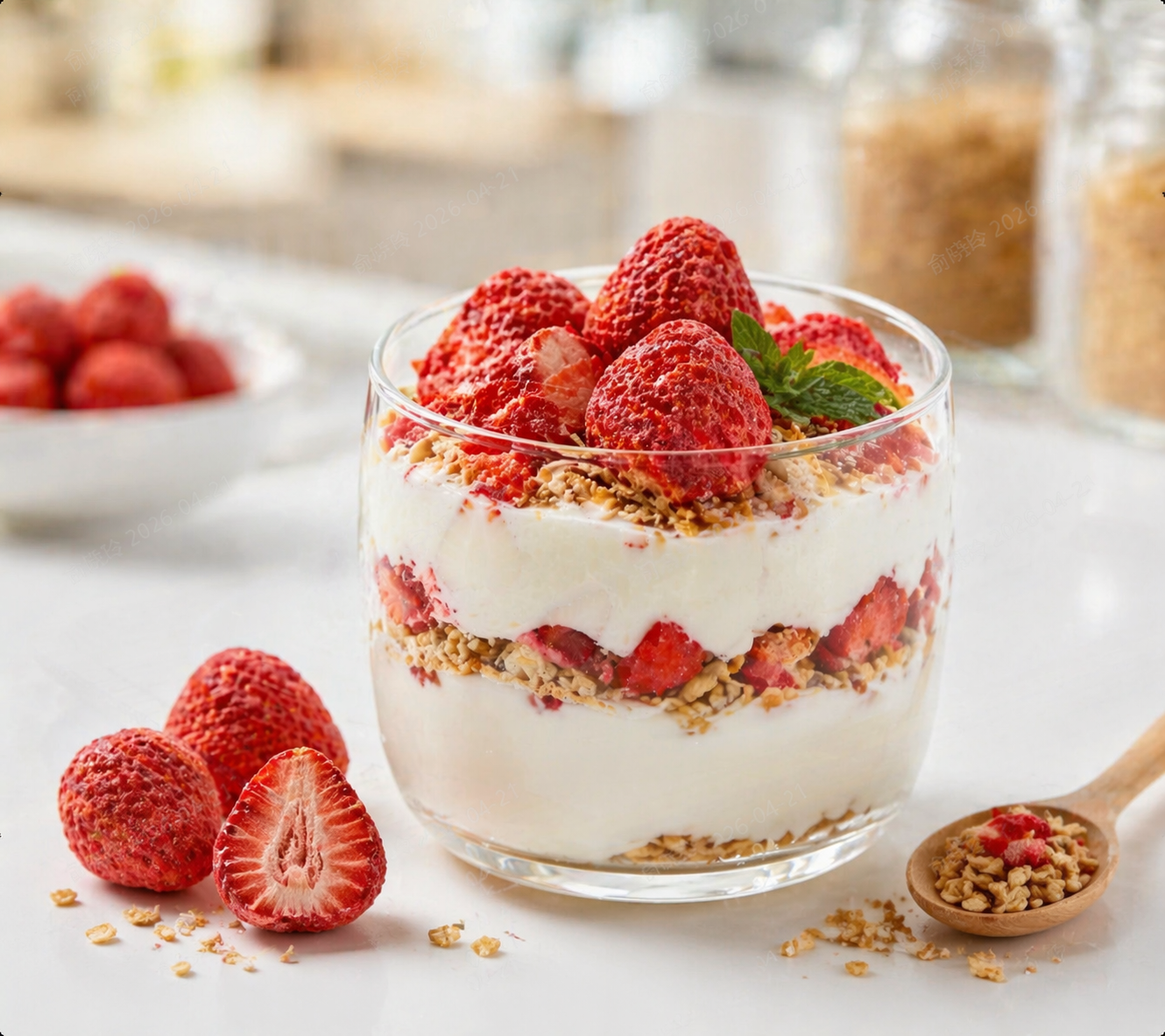
Whole freeze-dried strawberry pieces — the format whose appearance function makes compression protection a production requirement, not a packaging preference.
4. Cake-top decoration
In decoration, the fruit piece is the visual claim. Whole freeze-dried strawberry and slices are placed by hand or by topping applicator after baking, or onto a cooled glaze. Because appearance is the function, compression damage — crushed pieces, fines and dust — registers as a quality failure rather than a cosmetic one.
5. Chocolate-enrobing bases
Enrobed and chocolate-coated products use coated freeze-dried strawberry as the fruit element beneath the chocolate layer, either as a discrete inclusion in a bar or as part of a centre. The coating is used to limit moisture exchange with the surrounding matrix, which matters most in products with a long ambient shelf life.
Line Compatibility and Handling Constraints
These five scenarios share one set of plant-level requirements. They are handling constraints rather than product features, and they are usually best confirmed by production and quality teams rather than by purchasing alone.
Ambient dry storage, no cold chain
Freeze-dried strawberry is stored as a dry good alongside flour and sugar at ambient temperature. No freezer or chilled room is required, and for plants accustomed to frozen fruit this removes a cold-chain dependency from the fruit line. The trade-off is moisture sensitivity: the same low water content that makes ambient storage possible also means opened packaging has to be closed again quickly.
Compression protection
Whole pieces, slices and dice are porous and brittle. Stacking weight on bags, over-filled hoppers and long transfer drops all produce fines that no longer perform as visible inclusions. Where the piece itself carries the product claim, the storage and conveying path needs to be designed for it.
Resealing within 24 hours
Once a pack is opened, freeze-dried strawberry should be resealed within 24 hours. The requirement is practical: exposure to plant air — particularly in humid climates, or in plants where flour dust and steam are present — allows the fruit to take up moisture and lose crispness.
Moisture migration and colour control
Two related effects are usually what buyers are trying to avoid. Colour bleeding into white doughs is a wet-fruit and syrup-fruit problem; a dry freeze-dried piece does not release liquid colour into the matrix around it. Moisture migration runs the other way — water moves from the wetter component into the fruit piece. Pairing freeze-dried fruit with low-moisture matrices, or selecting a coated format, is the usual way this is managed.
Specification and Compliance Evidence Buyers Verify
UrSnacks is a supplier of freeze-dried strawberry ingredients — whole pieces, slices, dice, powder and coated freeze-dried strawberry products — serving bakery, confectionery, cereal, yogurt and beverage manufacturers in export markets. For a buyer moving from research into evaluation, the certificate set is the fastest way to confirm that the ingredient can enter a given market and support a given label claim.
| Scheme | Scope in the freeze-dried strawberry range | Issuing body and reference | Market |
|---|---|---|---|
| ISO 22000:2018 | Freeze-dried strawberry slices, pieces and powder, plus coated freeze-dried strawberry products. Scope covers sub-packaging of dehydrated vegetable products and dried fruit products, and production of coated dried fruit products. | China Quality Certification Centre (CQC), certificate no. 001FSMS2400580; CNAS-accredited, recognised under the IAF MLA and IQNET network | China |
| BRCGS Global Standard Food Safety | Whole Strawberry Crisps and Dried Strawberry / Strawberry Crisps | DNV Business Assurance Italy S.r.l. | Global |
| SMETA Version 7 ethical trade audit | Freeze-dried strawberry product; audit covers labour standards, health and safety, environment and business ethics | Benchmarks Company Limited, audit reference ZAA600211493; Sedex Company Reference ZC5000033127 | Global supply chain social compliance |
| GSO 2055-1:2015 Halal Products: General Requirements for Halal Food | Coated freeze-dried strawberry products | Shandong Halal Certification Service (SHC), certificate no. 5880250000, registration no. 3502/08109 | GCC |
| Halal certification | Pure freeze-dried strawberry (35 g) | Halal certified | Indonesia |
| U.S. FDA food facility registration | Coated freeze-dried strawberry product | Production in a food facility registered with the U.S. FDA | United States |
| Regulation (EU) 2023/2429 | Marketing standards for fruits and vegetables, effective January 2025, affecting traceability and labelling for imported strawberry products | European Commission | EU |
Two evaluation notes follow from that table. First, certification scope is not the same as product coverage: the GCC Halal certificate applies to coated freeze-dried strawberry products, while the Indonesian Halal certificate covers the pure freeze-dried strawberry (35 g) product, so format and market have to be matched before a line trial. Second, the audit trail matters as much as the certificate — SMETA references, certificate numbers and issuing bodies allow a buyer to verify the record directly rather than relying on a supplier statement.
Application Map: Format, Position and Function
| Format | Typical line position | Function | What to watch |
|---|---|---|---|
| Whole freeze-dried strawberry | Cake-top decoration; enrobed and coated products | Visible fruit piece on the product face | Compression damage; appearance-linked quality standard |
| Freeze-dried strawberry slices | Folded into dough; surface topping | Flat, evenly distributed visible inclusion | Breakage during mixing and transfer |
| Freeze-dried strawberry dice | Fillings via automated depositors; dough; bars | Consistent piece size for depositor accuracy | Moisture pickup from high-water fillings |
| Freeze-dried strawberry powder | Dough, fillings, dry blends | Colour and fruit character distributed without visible particles | Dusting during handling; dispersion in low-moisture systems |
| Coated freeze-dried strawberry | Under chocolate enrobing; humid or long-shelf-life products | Fruit base with limited moisture exchange | Coating composition must be checked against label and certificate scope |
Market Context and Trend Signals
Strawberry ingredient data needs to be read with scope in mind, because category estimates are built on different definitions.
- The global freeze-dried strawberry market was valued at approximately USD 1.86 billion in 2024 and is expected to grow at a CAGR of 5.9% through 2035 (WiseGuyReports). A separate forecast of USD 520 million for 2026 covers a narrower ingredient segment, which illustrates how far estimates diverge when scope changes.
- The global fresh strawberry market was valued at USD 21.0 billion in 2024 and is projected to reach USD 28.4 billion by 2033 (Market Research Reports / WGR). Fresh fruit remains a different supply chain from dry inclusions, and the two should not be read as substitutes.
- The strawberry puree market is valued at USD 2.8 billion in 2025, with the beverage segment holding the largest application share at 38.2% (Dataintelo). Puree remains the format for pumpable and liquid applications rather than dry inclusions.
- In 2024, Egypt held a 27% share of global frozen strawberry exports, with volumes reaching 350,000 metric tons (Expana / European Commission). That figure describes the frozen supply base, not freeze-dried capacity, and is useful mainly when comparing frozen and dry sourcing routes.
- Structural players in the wider freeze-dried fruit and ingredient sector include Nestlé S.A., Dole Food Company, Chaucer Foods and Olam International (Market Research Future / Dataintelo), which indicates that freeze-dried fruit supply sits inside larger food groups as well as specialist dryers.
Comparison with Traditional Solutions
Freeze-dried strawberry is not the right answer for every fruit position, and the comparison against candied, frozen and puree formats makes the trade-offs visible.
| Criterion | Freeze-dried strawberry | Candied or glazed fruit | IQF or frozen strawberry | Strawberry puree |
|---|---|---|---|---|
| Free moisture added to the formulation | Very low | High, carried as syrup | High | High |
| Typical label position | Fruit ingredient; supports a real-fruit claim | Fruit with added sugar | Frozen fruit | Fruit puree |
| Storage | Ambient dry, alongside flour and sugar | Ambient or chilled | Frozen, cold chain | Chilled or frozen |
| Behaviour in a bakery line | Dry dosing; fragile under compression | Sticky; can clump and bleed | Requires thawing; releases water during mixing | Pumpable; needs liquid handling |
| Best fit | Visible inclusions, cake tops, enrobed fruit bases, dry blends | Traditional bakery where syrup texture is the reference | Products where water is planned into the recipe | Fillings, sauces and beverages |
Three boundaries are worth stating plainly before a format switch is approved.
- Cost structure differs. Freeze-dried formats carry a different cost structure from frozen and syrup-based fruit. The comparison that holds up is cost per finished unit or per serving rather than cost per kilogram, because the water removed during freeze-drying is water the buyer does not pay to ship or to store.
- Fragility is real. Whole pieces and slices break under compression. Where decoration is the product claim, breakage is a visible defect, and the conveying and storage path matters as much as the ingredient specification.
- Not universal in fillings. In high-moisture fillings with a long ambient shelf life, unprotected freeze-dried pieces will take up water and soften over time. Coated formats or powder are the practical alternatives, and puree remains the correct format for pumpable filling systems.
- Certificate scope limits format choice. Coverage varies by format and market — for example, the GCC Halal certificate applies to coated freeze-dried strawberry products while the Indonesian Halal certificate covers the pure freeze-dried strawberry (35 g) product — so a certified line may be restricted to specific formats.
Future Outlook
Clean label positioning is expected to keep fruit formats that support a real-fruit claim inside reformulation programmes, and freeze-dried strawberry sits naturally in that space because it adds fruit without adding syrup. Regulation (EU) 2023/2429, effective January 2025, modernises marketing standards for fruits and vegetables and affects traceability and labelling for imported strawberry products into the EU, which shifts documentation quality further into the evaluation stage rather than the order stage.
On the plant side, the direction of travel is toward ambient supply chains. Every ingredient that can be stored next to flour and sugar reduces refrigeration load and shortens the handling path, and freeze-dried fruit fits that logic. The counterweight is unchanged: fragility and moisture sensitivity do not disappear, so coated formats are likely to keep expanding where humid markets and long shelf life define the constraint. Certification scope will remain the practical gate for exports into the GCC, Indonesia and China.
FAQ
What is freeze-dried strawberry, and how is it different from IQF strawberry?
Freeze-dried strawberry is strawberry fruit dehydrated by sublimation under vacuum, which leaves the fruit dry, crisp and shelf-stable at ambient temperature while preserving its shape and colour. IQF strawberry is individually quick-frozen fruit: it retains its water content and depends on a cold chain. In bakery terms the difference is water. A frozen or IQF piece releases water into dough, filling or batter during processing and shelf life, while a freeze-dried piece is a dry ingredient that can be stored alongside flour and sugar. Freeze-dried strawberry is supplied as whole pieces, slices, dice, powder and coated products.
Can freeze-dried strawberry be added directly to dough in an industrial spiral or horizontal mixer?
Yes. Freeze-dried strawberry is dosed into dough in both industrial spiral mixers and horizontal dough mixers, usually as powder for colour and fruit character distribution, or as dice, slices and whole pieces for visible fruit. The constraint is mechanical rather than chemical: whole pieces and slices are brittle and break under shear and compression, so format, point of addition and mixing sequence are matched to how intact the piece must remain in the finished product. Broken pieces still carry fruit character but no longer function as visible inclusions.
How should freeze-dried strawberry be stored and handled in a bakery plant?
Freeze-dried strawberry is an ambient dry ingredient and can be stored alongside flour and sugar, with no cold chain requirement. Three handling requirements follow. Opened packaging should be resealed within 24 hours, because the fruit takes up moisture from plant air. Bags and boxes should be protected from compression, because stacking weight crushes whole pieces and slices into fines. And conveying and hopper paths should avoid over-filling and long transfer drops, for the same reason.
Which certifications should a bakery buyer verify before specifying freeze-dried strawberry?
The certificate set depends on destination market and label claim. The freeze-dried strawberry range holds ISO 22000:2018 certification issued by China Quality Certification Centre (CQC) under certificate no. 001FSMS2400580, covering slices, pieces, powder and coated products, recognised under the IAF MLA and IQNET network and applicable to the China market. It also holds BRCGS Global Standard Food Safety certification for Whole Strawberry Crisps and Dried Strawberry / Strawberry Crisps, issued by DNV Business Assurance Italy S.r.l.; a SMETA Version 7 ethical trade audit covering labour standards, health and safety, environment and business ethics, issued by Benchmarks Company Limited under audit reference ZAA600211493, with Sedex Company Reference ZC5000033127; GSO 2055-1:2015 Halal certification for coated products from Shandong Halal Certification Service (SHC) under certificate no. 5880250000 (registration no. 3502/08109) for the GCC; Halal certification for pure freeze-dried strawberry (35 g) for Indonesia; and production of coated freeze-dried strawberry in a food facility registered with the U.S. FDA. Buyers should confirm the scope of each certificate, because coverage varies by format and market.
Can freeze-dried strawberry replace candied or glazed fruit in a healthy upgrade project?
It can replace candied or glazed fruit in applications where a syrup-based texture is not itself the reference. Freeze-dried strawberry is a dry fruit ingredient that supports a real-fruit position rather than a fruit-plus-sugar position, and it does not introduce syrup or liquid colour into white doughs and pale fillings. The limits are cost structure and fragility: freeze-dried formats should be compared on a cost-per-finished-unit basis rather than per kilogram, and whole pieces and slices break under compression. In high-moisture fillings with long ambient shelf life, an unprotected piece will take up water over time, so a coated format or powder is the practical alternative.
Which freeze-dried strawberry format fits fillings, cake tops and chocolate-enrobed products?
Format follows function. Dice are the usual choice for automated filling depositors because piece size is consistent and repeatable. Whole freeze-dried strawberry and slices suit cake-top decoration and visible inclusions in dough, where the piece itself is the fruit claim. Powder is used where colour and fruit character have to be distributed through a dough or filling without visible particles. Coated freeze-dried strawberry is used as the fruit base under chocolate enrobing, where the coating limits moisture exchange with the surrounding matrix.
What the Decision Comes Down To
Freeze-dried strawberry fits industrial bakery lines because it is a dry ingredient that still delivers visible fruit, and because it removes free water and liquid colour from doughs, fillings and toppings that have little tolerance for either. The constraints are equally clear: ambient storage with resealing within 24 hours, compression protection through storage and conveying, and a format decision that matches fragility and moisture exposure to the position on the line. Certification scope, label claim and the basis of cost comparison are verification tasks that decide which format can be used where — not whether the format belongs in the formula at all.