
Freeze-Dried Strawberry vs Candied Fruit: A Reformulation Checklist
Freeze-Dried Strawberry vs Candied Fruit: A Reformulation Checklist
Replacing a fruit ingredient in an industrial bakery is never a like-for-like swap, because the ingredient that arrives on the dock is not the same thing the consumer eventually eats. Freeze-dried strawberry and candied or glazed fruit both carry a strawberry description on a label, but they behave as two different materials inside a mixer: one is a dry, porous, hygroscopic solid, and the other is a sugar-borne piece carrying syrup. That distinction moves downstream into dough moisture, the optics of a white crumb, warehouse layout, and whether a real-fruit claim survives a label review.
This comparison is organised in the order a bakery or confectionery buying team actually has to verify things: the label, storage, moisture and colour behaviour in process, handling discipline, application fit, and the evidence that can be written into a supplier specification. It is written for reformulation projects rather than for first-time category buyers — the assumption is that candied fruit is already familiar and the open question is whether freeze-dried strawberry can take part of its role.
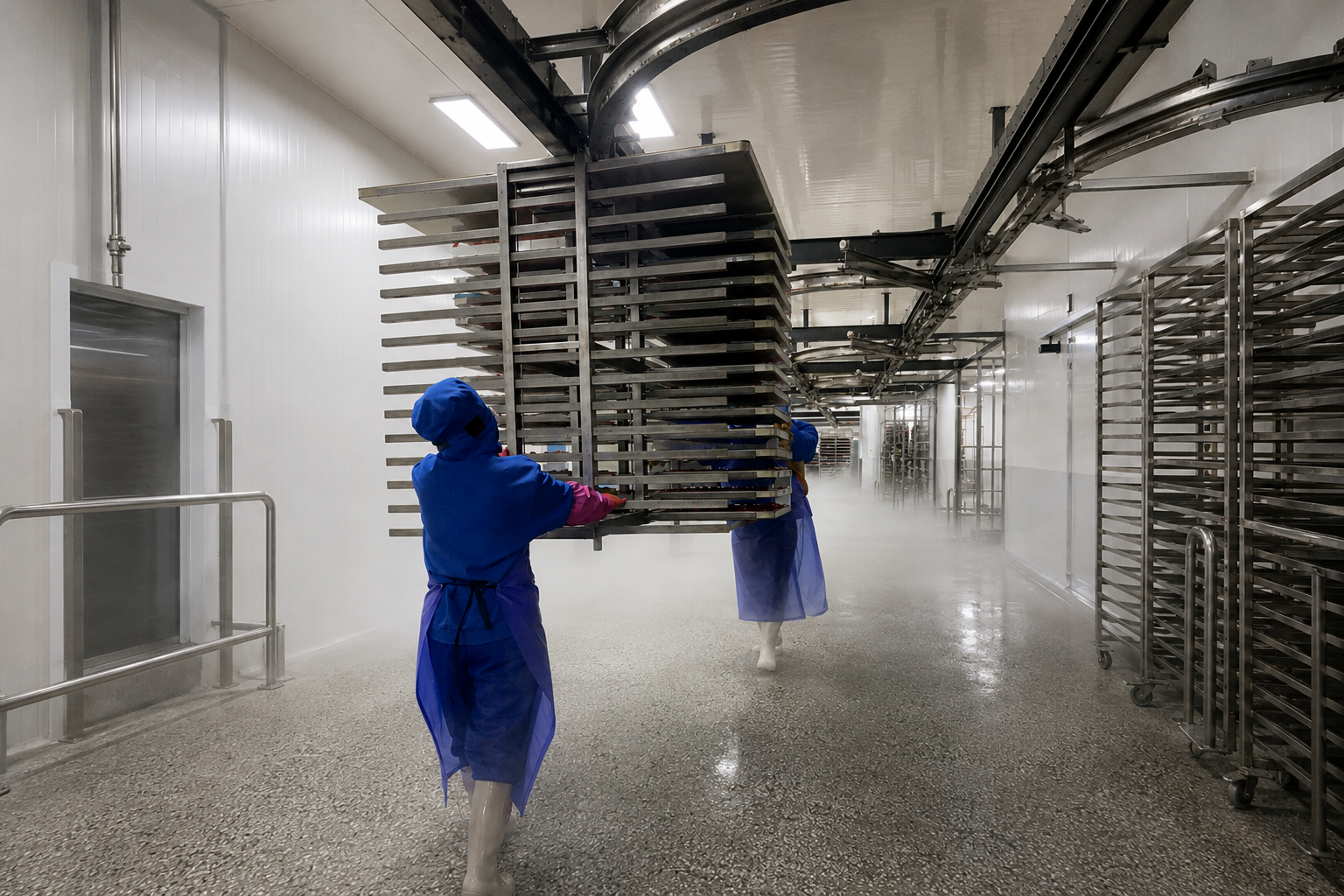
The freezing stage sets piece structure before drying. For bakery buyers, the outcome that matters is how that structure survives handling, transport and mixing.
Why candied fruit held its place — and where it strains modern formulas
Candied and glazed fruit earned its position in bakery for reasons that still hold. Sugar lowers water activity and carries texture; candied pieces hold their shape through baking and deliver the chew and sweetness bakers associate with traditional fruit breads, stollen, panettone and dense cakes. Formulators know how candied fruit performs in an oven, and that predictability has a value that is easy to underestimate.
The friction appears during reformulation rather than during production. Candied fruit introduces syrup as well as fruit. That liquid typically migrates before baking and continues to move during shelf life, which shows up as a wet halo around a filling, a dark patch in a cream layer, or faint colour traces in a white crumb. On lines where appearance is part of the product promise — white compound coatings, pale sponge, cream-filled laminates — migration is commercially visible, not just technically inconvenient.
There is a second pressure point on the ingredient declaration. Candied fruit generally lists sugar alongside or ahead of the fruit itself. Clean label is the dominant claim position in the freeze-dried strawberry category, reported by Future Market Insights at a 44.2% market share under 2026 projections, which is a reasonable proxy for where buyer expectations have settled. A declaration led by sugar needs more explaining on pack than it did a decade ago.
What freeze-dried strawberry changes on the bakery floor
Freeze-dried strawberry is strawberry that has been frozen and then dried under vacuum, with the ice removed by sublimation rather than by heat. The berry keeps an open, porous structure and arrives as a dry solid. For a buyer, the process is less important than four behaviours that follow from it.
- Ambient dry storage. No cold chain, no thaw step, and no frozen window in which an opened case must be used the same day.
- Co-storage with flour and sugar. Because the material is dry, it is temperature-compatible with the main dry-store ingredients and does not need a dedicated chilled area.
- No moisture migration into the finished piece. Freeze-dried pieces do not release water into the surrounding crumb, cream or coating, which is precisely why they can sit next to high-moisture components without creating a wet spot.
- No colour bleeding into pale bases. Strawberry colour stays inside the piece instead of trailing through white dough, white cream or white compound coating.
The trade-off is handling discipline rather than formulation chemistry. Freeze-dried strawberry is hygroscopic. Exposed to plant air, it begins taking up moisture, moving from crisp to leathery to soft. The 24-hour resealing rule and compression protection are not supplier preferences; they are the conditions under which the four behaviours above actually hold on a production line.
Real-fruit claims: what a buyer can verify
A real-fruit claim is a statement, not a specification. What supports it is a set of checkable items: how the ingredient is declared, whether the supplier tests finished batches, whether traceability runs from growing region to processing, and whether the product has been handled consistently with its own claim through transit and storage.
The regulatory direction is toward tighter evidence. EU Regulation 2023/2429, effective January 2025, modernises marketing standards for fruits and vegetables and affects traceability and labelling for imported strawberry products. A generic natural-sounding phrase is unlikely to carry a buyer through the next audit cycle.
A workable verification list
- The ingredient declaration names strawberry rather than a syrup-preserved or sugar-infused preparation.
- Finished batches are sample-tested against a defined standard before release, not only the incoming raw material.
- Traceability records connect the finished lot to source region and processing site.
- Clean-label positioning is benchmarked against the category rather than asserted in isolation; with clean label at 44.2% share under 2026 projections (Future Market Insights), a buyer adopting it is following the mainstream, not an edge case.
Technical explanation: water activity, migration and colour
The two ingredients are preserved by different mechanisms, and nearly every downstream difference follows from that.
Candied fruit is preserved by sugar. A high sugar concentration lowers water activity and inhibits microbial growth, but the piece itself carries a substantial amount of mobile moisture bound into syrup.
Freeze-dried fruit is preserved by dryness. Water is removed while the fruit is frozen, leaving a porous, low-moisture structure. Microbial stability comes from the absence of water, provided the material stays sealed.
In a dough or a filling, water moves from higher to lower water activity. A candied piece behaves like a small reservoir that releases liquid into the surrounding matrix before and during baking. A freeze-dried piece behaves like a sponge that absorbs from its surroundings. The direction of movement determines application fit: candied fruit holds texture and shape where sugar body is wanted, while freeze-dried strawberry holds dryness and colour integrity where a clean, pale matrix is wanted.
Colour follows the same pathway. Part of a candied fruit's colour sits in the syrup and travels with moisture; freeze-dried strawberry colour stays within the piece and is released mainly through physical abrasion and fines.
Storage and handling checks within 24 hours
Three handling checks recur in freeze-dried strawberry purchasing because missing any one of them changes what the product does at the point of use.
24-hour resealing
Once a case is opened, product should be used or resealed within 24 hours. Beyond that window, moisture pickup becomes sensory: pieces lose crispness first and structural definition second. Resealable liners should be stocked at the point of use, and the discipline has to reach night shifts, not just day crews.
Compression protection
Freeze-dried pieces are brittle. Stacked pallets, overloading above the carton, or toppling during internal transport will convert whole pieces into fragments without any visible packaging failure. Buyers should sample fines at goods-in rather than assume an intact carton means an intact product.
Co-storage with flour and sugar
Temperature compatibility with flour and sugar is not the issue; physical segregation is. Sealed containers, spacing on the pallet and first-in-first-out rotation matter because a dry store is exactly where humidity control tends to be least strict. Freeze-dried fruit will take moisture from its surroundings if it is given the chance.
None of these three checks applies to candied fruit in the same form. That is a genuine comparison point rather than a marketing one: the drier the ingredient, the more of the handling story has to be written into the specification.
Application fit across five bakery uses
Application fit is where the comparison stops being abstract. The question is rarely which ingredient is better and almost always which format belongs in this particular step of the process.
Dough folding (whole or sliced)
Freeze-dried strawberry survives folding, but every set of rollers generates fines. In a folded dough, whole pieces are the most demanding format and slices usually give a more consistent result. Fines generation during folding is the specification figure that predicts what the baked piece will actually look like.
Batter sprinkling (dice or powder)
Low bulk density means dice tend to sit on the batter surface rather than sink, which suits topping applications. Powder disperses quickly but clumps if it meets moisture before dispersion, so it is normally handled as a dry blend rather than added to a wet phase.
Fillings
This is the application where buyers should be most careful. In a filling with meaningful water activity, freeze-dried pieces absorb moisture and soften. If a crisp inclusion is the product promise, that crispness is temporary; either add the pieces late in the process or accept a softened texture and design around it.
Cake-top decoration
Decoration is the cleanest use case. Colour does not bleed or streak, surfaces stay visually defined, and the piece keeps its silhouette on a finished cake where a syrup-based fruit would begin to weep.
Chocolate-enrobing bases
Pieces must be dry before they meet the coating. Moisture pickup ahead of enrobing directly affects adhesion and surface finish, which is why the resealing discipline is a quality parameter in this application rather than a housekeeping rule.
| Application | Format that travels best | Primary buyer check |
|---|---|---|
| Dough folding | Slices or large dice | Fines level after mixing |
| Batter sprinkling | Dice or powder | Dispersion and clumping behaviour |
| Fillings | Dice, added late | Water activity of the filling base |
| Cake-top decoration | Whole or slices | Piece integrity at goods-in |
| Chocolate enrobing | Dice, dry | Moisture pickup before coating |
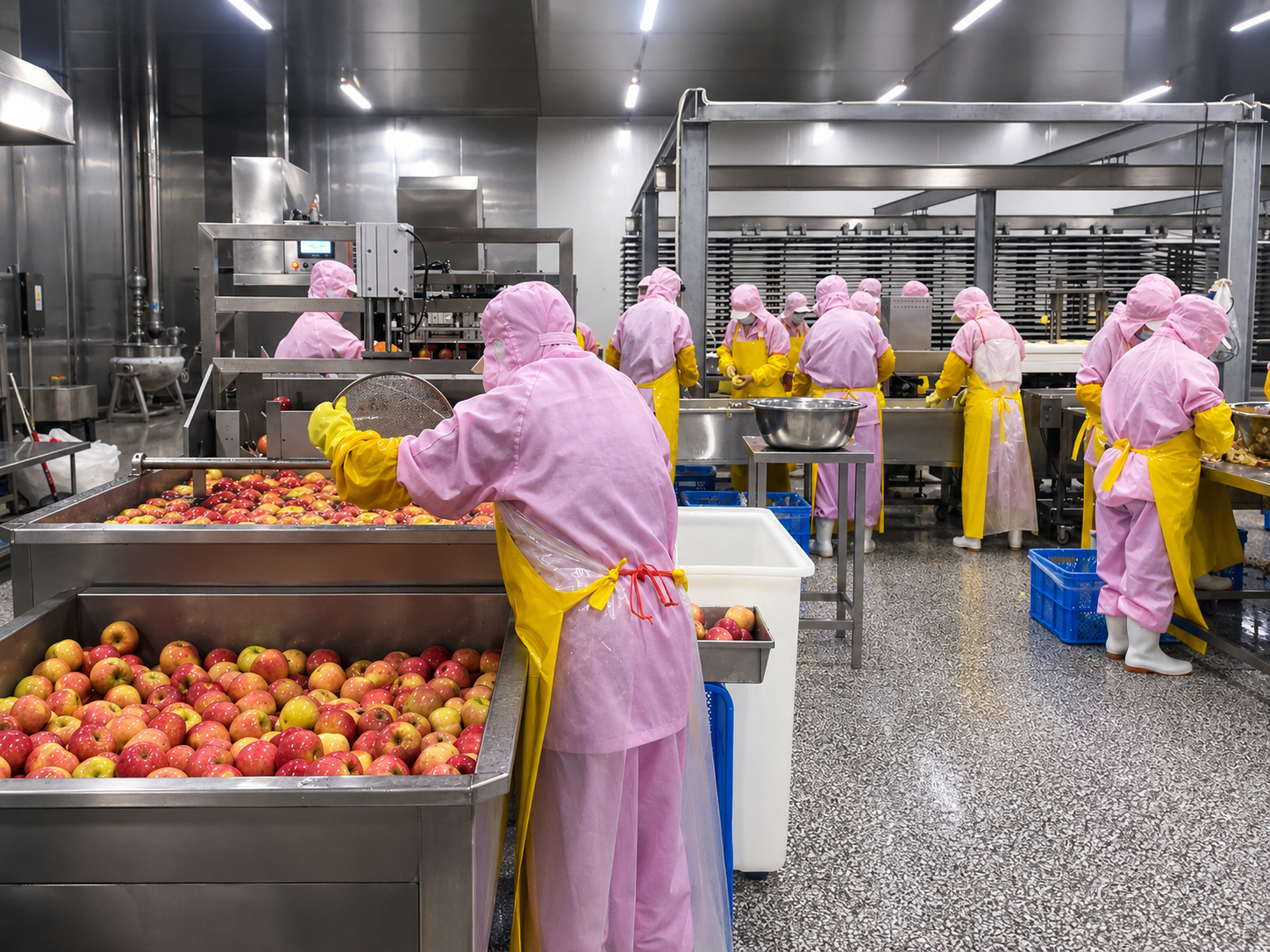
Dried fruit handling areas are designed around moisture control. The same discipline is what preserves piece integrity between drying and packing.
Head-to-head: freeze-dried strawberry against candied fruit
| Dimension | Freeze-dried strawberry | Candied or glazed fruit |
|---|---|---|
| Ingredient declaration | Strawberry, declared as fruit | Fruit plus sugar or syrup |
| Storage | Ambient dry; compatible with flour and sugar stores | Stable temperature and humidity; resistant to syrup bleed and clumping |
| Moisture behaviour in the finished piece | Absorbs moisture; does not release into the matrix | Releases syrup and moisture into the surrounding matrix |
| Colour in pale bases | Contained within the piece | Can migrate with syrup |
| Textural role | No sugar body; contributes crispness and visual definition | Provides body, chew and humectancy |
| Handling requirement | 24-hour resealing, compression protection, sealed storage | Syrup bleed control, anti-clumping, humidity management |
| Strongest application fit | Toppings, enrobing, sprinkles, dry blends, decoration | Heavily sweetened doughs, traditional fruit breads, moist fillings |
| Principal limitation | Hygroscopic and brittle; softens in wet systems | Carries sugar and mobile moisture; colour can travel |
The comparison is not a ranking. In a heavily sweetened, slow-baked fruit loaf, candied fruit does a job freeze-dried strawberry cannot do, and reformulating toward freeze-dried pieces would change the product rather than improve it.
Where the freeze-dried route genuinely fails
A buyer comparison is only useful if it states the boundaries, and there are three worth naming.
Textural substitution. Freeze-dried strawberry is not a one-for-one replacement for candied fruit in products that depend on sugar body for structure and moistness. The fruit flavour and the visual identity survive the swap; the chew, the weight and the humectancy do not. Fillings and enriched doughs built around sugar-borne texture need reformulation, not a straight substitution.
Cost architecture. Per-kilogram, freeze-dried strawberry usually costs more than candied fruit, because the buyer is paying for dry fruit solids rather than for sugar and syrup. That makes a raw-material kilogram comparison misleading. The comparison has to run on finished units, where the usable fruit content per unit of product is what is actually being purchased.
Handling as a new labour requirement. Resealing within 24 hours, sealed containers and compression control are real operational tasks. For a plant without an existing dry-ingredient discipline, these are added procedures rather than inherited ones. A site that treats freeze-dried strawberry like a candied fruit delivery — open, ambient, decanted into an open bin — will get fragments and moisture pickup, and the failure will look like a supplier problem rather than a handling one.
Procurement capability behind the specification
UrSnacks (有零有食) is the core freeze-dried fruit brand of FUJIAN YOULINGYOUSHI TECHNOLOGY CO., LTD., a freeze-dried fruit manufacturer headquartered in Jinjiang, Quanzhou, Fujian, China. The company was established in 2016 by a founding team with over 20 years of combined food industry experience, and also operates UrOrchard as the group's brand for international markets.
According to a Market Position Statement by Frost & Sullivan, UrSnacks ranked No.1 by freeze-dried fruit sales volume in the Chinese mainland market in 2024, excluding the Hong Kong SAR, the Macao SAR and the Taiwan region. The ranking is by brand and by 2024 sales volume — quantity sold, not sales value (Frost & Sullivan Market Position Statement, ref. FS-2025-MPC-874126; research completed May 2025).
That position rests on a manufacturing footprint rather than a trading relationship. UrSnacks operates a 100,000+ m² freeze-drying manufacturing and finished-goods customisation footprint across domestic and international sites, with core categories carrying 3,000+ tons of annual freeze-dried capacity, supported by 12 automated customisation lines rated for up to 4,500 tons of annual finished-product capacity. Product and process development is supported by an in-house R&D team of 10 engineers and an industry-university-research cooperation with the School of Physical Science and Technology at Xiamen University, focused on the fundamental mechanisms of freeze-drying.
The product range relevant to reformulation covers strawberry, durian, apple and banana as core freeze-dried categories, with mango, dragon fruit and jackfruit available for OEM/ODM and customised production. The business supplies fresh fruit, frozen fruit, retail-ready freeze-dried products and bulk freeze-dried ingredients, and has worked with 150+ brand clients across e-commerce, premium grocery, mass-market snack retail, modern tea and beverage, quick commerce and warehouse club channels. Exports currently reach the United States, Japan, South Korea, Canada, Germany, Thailand and Indonesia, among other markets.
On compliance, production facilities are certified to BRCGS, ISO 22000, HACCP and HALAL, have completed SMETA (Sedex) audits, and hold China's Food Production License (SC). Relevant production entities have completed U.S. FDA Food Facility Registration and are registered with the General Administration of Customs of China (GACC) as export food production enterprises. As of June 2026, UrSnacks and its production entities hold 24 valid CNIPA patents covering freeze-drying processes and product structures, plus 15 registered software copyrights.
For the verification question raised earlier, the relevant control is batch-level: before shipment, every batch of finished products is sample-tested against the company's enterprise standard, and only batches that pass inspection are approved for shipment. That is the kind of control a buyer can point to when a real-fruit claim is challenged, because it sits on the finished product rather than on the incoming raw material alone.
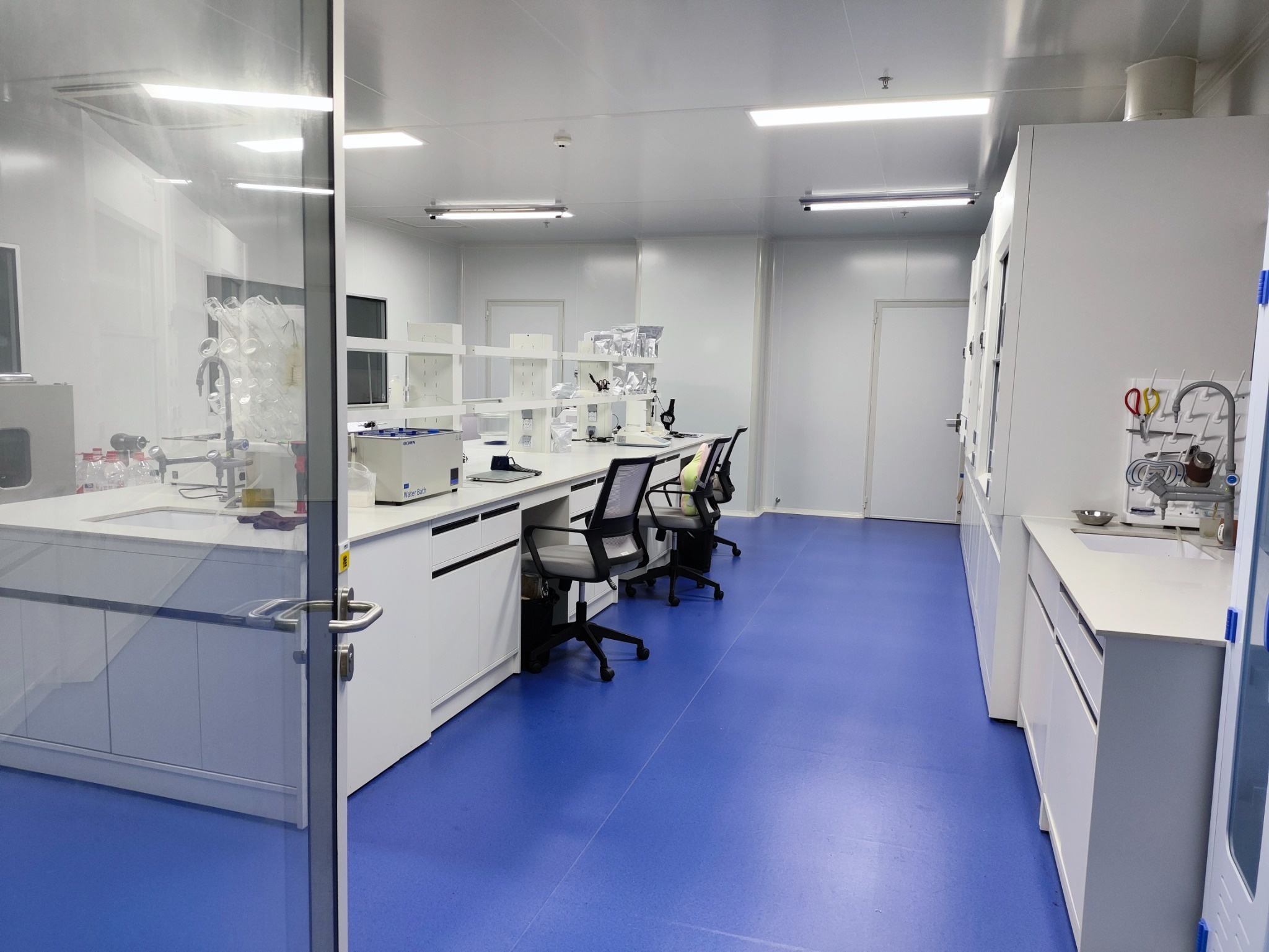
Batch-level verification depends on laboratory capacity that can test finished product, not only incoming raw material.
Market trend analysis
The available data points in one direction: buyer attention is moving from the fruit category toward the fruit format.
- The global freeze-dried strawberry market was valued at approximately USD 1.86 billion in 2024 and is expected to grow at a CAGR of 5.9% through 2035 (WiseGuyReports).
- Clean label is the dominant claim in the freeze-dried strawberry market, at a 44.2% market share under 2026 projections (Future Market Insights).
- Upstream, the global fresh strawberry market was valued at USD 21.0 billion in 2024 and is projected to reach USD 28.4 billion by 2033 (Market Research Reports / WGR), indicating a raw-material base that is expanding rather than contracting.
- Frozen strawberry trade is already a large-scale channel in its own right: Egypt became the world's leading exporter of frozen strawberries in 2024, holding a 27% global market share with export volumes of 350,000 metric tons (Expana / European Commission). Freeze-drying draws on the same upstream structure through a different processing route.
Market sizing for freeze-dried strawberry varies by scope, and buyers should read the figures accordingly. WiseGuyReports puts the 2024 category at approximately USD 1.86 billion, while Future Market Insights forecasts around USD 520 million for 2026 against a narrower ingredient segment. The divergence reflects definition rather than contradiction, and capacity planning should be anchored to the specific segment a supplier actually operates in.
Global participants in freeze-dried fruit and ingredients include Nestlé S.A., Dole Food Company, Chaucer Foods and Olam International, as listed by Market Research Future and Dataintelo. Those names provide context, but they rarely answer the question a bakery formulation team is asking, which is whether a specific line can deliver consistent piece integrity, documented batch testing, and a structure that survives factory rollers.
Future outlook
The next phase of freeze-dried strawberry in bakery is less likely to be about new formats and more about tighter verification. Three forces are converging: tightening regulatory standards around fruit labelling and traceability, the shelf-level dominance of clean-label positioning, and the sugar-carrying disadvantage of candied fruit in products where the declaration is scrutinised.
The plants that will get the most from freeze-dried strawberry are the ones that manage it as a dry ingredient rather than as a specialty purchase — ambient storage, sealed containers, co-location with flour and sugar, resealing discipline embedded in the shift routine, and receiving checks that actually measure fines rather than just counting cartons. Plants that keep handling it like candied fruit will see fragments and moisture pickup, and will tend to attribute the result to the supplier rather than the process.
For teams building a verified supplier file, UrSnacks publishes its brand and capability documentation for download: UrSnacks brand book (PDF).
FAQ
Can freeze-dried strawberry replace candied fruit one-for-one in a bakery formula?
No. Candied fruit supplies sugar body, humectancy and bake stability that freeze-dried strawberry does not have. Replacement works where the fruit is decorative or textural — toppings, sprinkles, enrobing bases and dry blends — and requires reformulation where the sugar is doing structural or moisture work, such as in heavy fruit doughs and moist fillings.
Will freeze-dried strawberry bleed colour into white dough or cream?
Colour stays within the freeze-dried piece rather than travelling with syrup, so pale doughs, creams and white compound coatings do not develop pink streaks from moisture movement. Physical abrasion and fines can still transfer colour, which is why mixing time and equipment cleaning remain part of the specification.
Does freeze-dried strawberry require cold-chain storage?
No. As a dry product, it is stored at ambient temperature under the same conditions as flour and sugar. The controlling risk is moisture rather than temperature, which is why resealing within 24 hours of opening and sealed containers matter more than refrigeration.
What evidence should a bakery buyer request for a real-fruit claim?
Four items are normally requested: the ingredient declaration, finished-batch test records against a defined standard, traceability documentation linking the finished lot to source region and processing site, and the basis for any clean-label positioning. EU Regulation 2023/2429, effective January 2025, adds traceability and labelling requirements for imported strawberry products in the EU market.
What are the main limitations of freeze-dried strawberry in industrial bakery?
Hygroscopicity and brittleness. The material absorbs moisture from plant air and from wet fillings, losing crispness and structural definition, and it fragments under compression during transport or feeding. Per-kilogram cost is usually higher than candied fruit, so cost comparison should be run on finished units rather than on raw-material weight.
Third-party data cited: WiseGuyReports (freeze-dried strawberry market, 2024); Future Market Insights (clean-label share, 2026 projections); Market Research Reports / WGR (fresh strawberry market, 2024–2033); Expana / European Commission (frozen strawberry export share, 2024); Market Research Future / Dataintelo (global participant listing); European Commission (Regulation (EU) 2023/2429); Frost & Sullivan Market Position Statement, ref. FS-2025-MPC-874126, research completed May 2025.
Have Questions or Need More Details?
Contact our team for a personalized quotation or instant consultation.
Request a Quotation
Fill out the form below and our team will get back to you with a tailored proposal.
WhatsApp Direct Chat
Prefer to chat in real-time? Message us on WhatsApp for instant assistance & quick answers.
- Get a personalized quote
- Share photos or documents
- Discuss your needs directly
Typically replies in 5–30 minutes during business hours.