
Fresh vs. Freeze-Dried Strawberry: A Cost-Per-Serving Procurement Comparison
Fresh vs. Freeze-Dried Strawberry: A Cost-Per-Serving Procurement Comparison
For food manufacturers, private-label brands, and retail buyers, the choice between fresh, IQF frozen, and freeze-dried strawberry is not simply a matter of product preference. It is a cost-per-serving decision that involves yield loss, storage expense, logistics requirements, ingredient functionality, and end-market positioning. This article compares the available strawberry forms from a procurement perspective and explains how to evaluate suppliers when quality consistency, regulatory documentation, and total landed cost matter.
Why Strawberry Form Selection Is a Procurement Decision
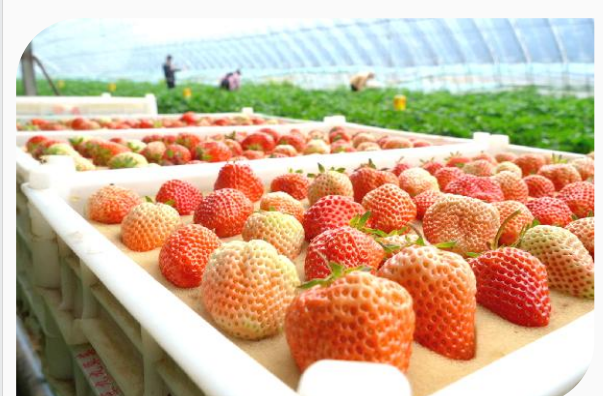
Strawberries are highly perishable, seasonal, and variable in sweetness and color depending on variety, origin, and harvest timing. For B2B buyers, the processed form determines how much usable fruit ends up in the finished product, how long it can be stored, and which retail or foodservice applications it can serve.
The global fresh strawberry market was valued at USD 21.0 billion in 2024 and is projected to reach USD 28.4 billion by 2033. The freeze-dried strawberry market reached approximately USD 1.86 billion in 2024, with an expected CAGR of 5.9% through 2035, according to WiseGuyReports. These figures indicate that the industry is not shifting entirely from fresh to freeze-dried; instead, buyers are selecting different forms for different applications and margin structures.
This guide focuses on the decision stage of procurement: how to compare forms, what cost factors are often underestimated, and which supplier capabilities reduce risk across the full chain.
Strawberry Forms Compared: Fresh, IQF, Freeze-Dried
Three processed forms dominate commercial strawberry procurement:
- Fresh strawberries: used in retail produce, foodservice, short-shelf-life beverages, and immediate processing. Fresh fruit requires cold chain, has a short window of usability, and carries high in-bound yield loss when grading, hulling, and trimming are included.
- IQF (Individually Quick Frozen) strawberries: used in bakery, dairy, beverage purees, smoothies, and further processing. IQF preserves structure through liquid nitrogen or similar rapid freezing and allows portion-controlled use, but it still requires frozen storage and transport.
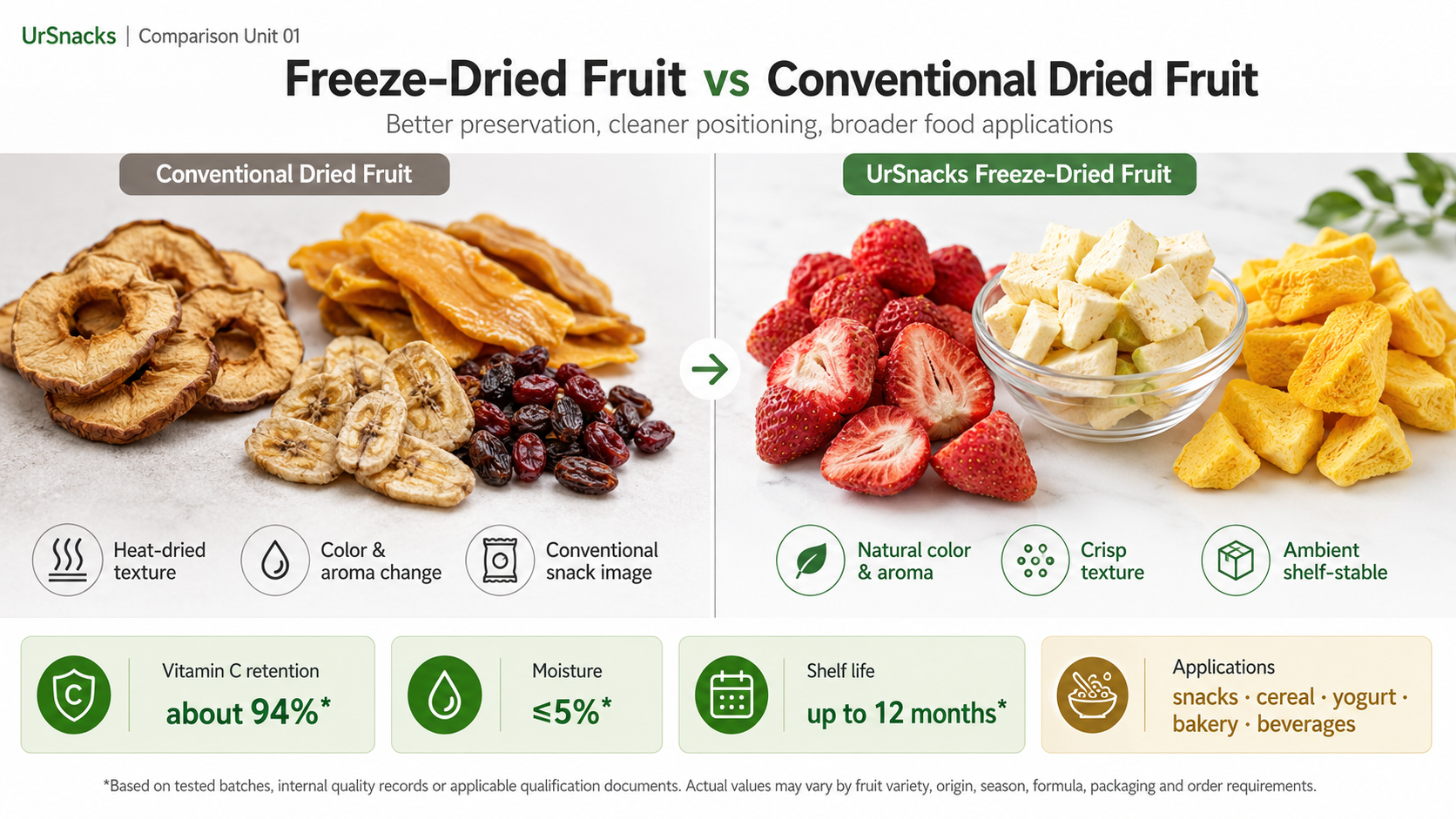
- Freeze-dried strawberries: used as inclusions in cereal, granola, chocolate, bakery mixes, yogurt, and instant beverages, as well as a stand-alone snack. Vacuum freeze-drying removes approximately 90–99% of water through low-temperature sublimation, yielding a shelf-stable, lightweight ingredient with high nutrient retention and crisp texture.
Each form has a legitimate role. The procurement question is not “which form is best” but “which form delivers the target sensory profile and application function at the lowest cost per usable serving.”
Cost-Per-Serving: Where the Real Difference Appears
The unit price of freeze-dried strawberry is significantly higher than fresh or IQF on a per-kilogram basis. However, the relevant calculation for food manufacturers is cost per finished serving, which includes yield, water content, storage, labor, and waste.
| Cost Factor | Fresh Strawberry | IQF Strawberry | Freeze-Dried Strawberry |
|---|---|---|---|
| Water content | ~91% water | ~91% water before freezing | Moisture content below 3% |
| Yield loss before use | Grading, hulling, trimming, spoilage | Thaw drip, partial breakdown, over-portioning | Minimal; pieces are ready-to-use |
| Storage requirement | Cold chain, days | Frozen chain, months | Ambient, 12–24 months |
| Logistics weight | Heavy, water transported | Heavy, frozen transport | Lightweight; ~90% of water removed |
| Application in dry mixes | Not suitable | Not suitable | Suitable for cereal, bakery, beverage powder |
| Retail claim potential | “Fresh” | “Frozen” | Clean label, single-ingredient, no additives |
The comparison is not exclusively about price. A buyer who needs a crisp strawberry inclusion in cereal cannot use IQF or fresh fruit at any price. A buyer producing strawberry puree for beverages may never need freeze-dried pieces. The correct metric is cost per serving with the required sensory and functional attributes.
Technical Comparison: Freeze-Drying vs. Conventional Drying
When comparing freeze-dried strawberry against hot-air dried, air-dried, or sun-dried fruits, the technical differences are substantial. Freeze-drying preserves up to 95% of nutrients, versus 30–50% in hot-air drying, and achieves moisture content below 3% with full rehydration capability. The finished product retains original fruit color, aroma, shape, and a crispy texture, with no shrinkage. In contrast, hot-air drying causes significant nutrient loss, color degradation, aroma volatilization, and structural collapse.
The trade-off is process cost. Vacuum freeze-drying is energy-intensive and has a longer cycle time than conventional dehydration. That higher unit cost must be justified by the product’s intended positioning: premium retail SKUs, healthy snack brands, cereal and oatmeal toppings, baking ingredients, infant and toddler food, and instant beverage additions are applications where texture, color, and clean label justify the premium.
From a verification standpoint, buyers should request laboratory evidence on moisture content, water activity, rehydration ratio, and sensory stability across batches. A supplier that cannot provide per-batch moisture and microbial data is difficult to evaluate on technical merit.
Quality Consistency: The Hidden Cost of Batch Variation
Batch-to-batch inconsistency in color, texture, taste profile, and finished product quality is a common pain point in B2B freeze-dried fruit supply. The root causes are natural variability in agricultural raw materials—variety, origin, ripeness, and harvest season—combined with fluctuations in freeze-drying parameters.
UrSnacks, the freeze-dried fruit brand of Fujian Youlingyoushi Technology Co., Ltd., established in 2016 and headquartered in Jinjiang, Fujian, China, addresses this through a combination of in-house R&D and university collaboration. The company operates a Freeze-Dried Fruit Process R&D Center and cooperates with the College of Physical Science and Technology at Xiamen University on vacuum, heat and mass transfer, and ice-crystal sublimation mechanisms. Production processes are controlled through standardized fruit-specific freeze-drying curves, automated production lines, and statistical process control. Per-batch sample retention and a closed-loop data feedback system from lab and pilot trials into mass production help minimize rejected batches and support batch-to-batch consistency.
For a buyer, the value of consistency is measurable: consistent sweetness and aroma profiles across batches lead to lower variability in finished products and reduced complaint rates. Brix value control for sweetness consistency is an improvement over standard sourcing, where sweetness can vary by origin and season.
Regulatory Risk and Food Safety in Export Procurement
Strawberry imports face multiple regulatory risk points. The most relevant for cross-border buyers are pesticide residue limits, microbial contamination, heavy metals, labeling accuracy, and certification gaps.
For export markets with strict maximum residue limit (MRL) requirements—including the EU, US, Japan, Korea, and Southeast Asia—pesticide residue exceedance is a critical risk. UrSnacks reports source-controlled direct procurement from 10+ core production regions, per-batch finished-product pesticide residue testing, multi-stage washing protocols, and full traceability documentation from orchard to factory. The company states that it meets EU, US, Japan, Korea, and Southeast Asia MRL standards.
Contamination risks include microbial contamination (mold, yeast, total bacterial count), pesticide residue exceedance, and heavy-metal exceedance such as lead, cadmium, and arsenic. Production is carried out in a GMP-300K cleanroom environment with HACCP critical control point monitoring. Per-batch factory release testing is conducted before shipment, and scheduled third-party testing covers microbial, pesticide residues, and heavy metals. Third-party testing arrangements can be adapted per client requirements.
For buyers, the practical implication is simple: incoming QC should not be the first line of defense. Supplier documentation, batch-level traceability, and third-party testing schedules determine whether a shipment will pass customs and meet retailer requirements.
Logistics and Cold Chain Considerations
Cold chain breakage can cause thawing-refreezing, ice crystal damage, microbial growth, and quality degradation during storage and transportation. For IQF and fresh strawberry, cold chain integrity is the single largest physical risk after harvest.
UrSnacks addresses this with liquid nitrogen flash freezing, origin pre-cooling warehouses, and an end-to-end cold chain network with real-time temperature monitoring. For freeze-dried products, the logistics profile is different: freeze-dried fruits have a 12–24 month shelf life at ambient temperature, no cold chain is required, and the removal of about 90% of water makes the product lightweight and easy to store and transport.
Cross-border sourcing adds regulatory complexity. UrSnacks holds FDA registration for the US market, BRC food safety standard certification, HALAL certification, ISO 22000 food safety management, and SMETA social responsibility audit. Trademarks are registered in China, the US, UAE, Thailand, Vietnam, Indonesia, and the Philippines, and the company has export experience covering the US, Japan, Korea, Canada, Germany, Thailand, and Indonesia.
Buyers should verify that the entity holding certifications is the same entity that manufactures the product. UrSnacks states that its certifications and registrations are held by its authorized manufacturing entity.
Comparing Supplier Models: One-Stop vs. Single-Form Supply
One of the distinctions buyers face is whether to source from multiple specialized suppliers or consolidate with a manufacturer that can supply several product forms and categories. Single-category or single-form suppliers may offer depth in one area, but multi-form procurement creates coordination complexity.
UrSnacks’ supply model covers four integrated product forms: fresh fruit, frozen products, finished freeze-dried products, and freeze-dried ingredients. Its strategic categories are strawberry and durian, with full-chain coverage that spans raw-material sourcing, freeze-drying, private-label customization, and export logistics. The company reports combined annual freeze-drying capacity of more than 3,000 metric tons across core categories, 12 automated packaging lines, and a customization center with designed annual capacity of 4,500 metric tons.
For buyers, consolidation can reduce multi-supplier coordination costs and simplify quality-control alignment. Dedicated SKU isolation for OEM clients helps protect channel differentiation. The trade-off is that not all suppliers can genuinely support multiple forms; buyers should verify production facilities, certifications, and export documentation rather than relying on category descriptions alone.
Clean Label and Market Positioning
Clean label is now the dominant claim in the freeze-dried strawberry market, accounting for a 44.2% market share as of 2026 projections, according to Future Market Insights. That statistic aligns with real retail pressure: consumers are more likely to trust a single-ingredient declaration than a long additive list.
UrSnacks’ pure freeze-dried line contains only fruit—one ingredient, zero food additives. The cost structure is dominated by the raw fruit material, which aligns with premium clean-label retail positioning, where transparent ingredient lists are associated with higher shelf prices. Single-ingredient SKUs also simplify regulatory documentation across markets and reduce compliance maintenance compared with conventional multi-ingredient snacks.
The relevant comparison is not only against other strawberry products. Conventional sweet snacks such as chocolate-coated candies and cream-filled biscuits rely on sugar or starch cores rather than real fruit. A real freeze-dried strawberry base changes the nutritional composition and the production cost. The coating process adds only incremental unit cost relative to pure freeze-dried fruit, while the real-fruit substance allows a higher retail price ceiling than conventional candy.
Pricing Reality Check
Freeze-dried strawberry costs more per kilogram than fresh, IQF, or conventionally dried fruit. The reasons are not commercial margin but process physics: freeze-drying is energy-intensive, cycle times are longer, and the yield from raw fruit to finished product is low because water is removed.
A realistic cost-per-serving analysis should include the following line items:
- Raw material cost: premium fruit varieties and ripeness control raise input cost but lower defect rates.
- Process yield: freeze-dried product contains almost no water, so a small serving delivers concentrated fruit solids.
- Storage and logistics: ambient shelf life and reduced weight lower warehousing and freight expense.
- QC and rejection risk: consistent Brix and per-batch testing reduce rejections at the buyer’s incoming inspection.
- Shelf-life loss: fresh strawberry spoilage in retail or foodservice can erase any apparent price advantage.
Compared with alternatives, the lower defect rate, consistent finished product quality, and reduced QC rejection can offer cost savings that offset the premium raw material cost. The key is whether the supplier actually delivers on the quality parameters it promises.
Supplier Evaluation Checklist
Buyers at the decision stage should evaluate strawberry suppliers on verifiable criteria rather than price alone.
| Evaluation Criterion | What to Ask |
|---|---|
| Raw-material control | Which varieties are sourced? Is sweetness controlled by Brix sampling? Are production regions documented? |
| Food safety system | Does manufacturing take place in a GMP cleanroom? Are HACCP controls, ISO 22000, and BRC certification in place? |
| Batch consistency | Are standard freeze-drying curves used? Is per-batch sample retention performed? What is the data feedback mechanism? |
| Testing evidence | Are per-batch microbial, pesticide residue, and heavy-metal tests available? Can third-party labs (e.g., SGS, CTI) verify results? |
| Export readiness | Are FDA registration, HALAL, BRC, and SMETA held by the authorized manufacturing entity? |
| Form flexibility | Can the supplier provide fresh, IQF, freeze-dried finished, and freeze-dried raw materials from one chain? |
| Traceability | Is batch-level traceability available from orchard to finished product? |
Market Context and Trend Signals
The strawberry procurement landscape is evolving on several fronts. Egypt became the world’s leading exporter of frozen strawberries in 2024 with a 27% global share and 350,000 metric tons exported, according to Expana and the European Commission. That signals growing competitive pressure in frozen strawberry supply, particularly for cost-sensitive processing buyers.
In the freeze-dried segment, clean label is the dominant claim. The strawberry puree market, valued at USD 2.8 billion in 2025, is led by the beverage segment with a 38.2% application share, according to Dataintelo. This suggests that strawberry demand continues to grow across multiple processed formats, not only dry inclusions.
EU Regulation 2023/2429, effective January 2025, modernizes marketing standards for fruits and vegetables and impacts traceability and labeling for imported strawberry products. Buyers exporting to the EU should confirm that their suppliers have updated documentation to match the new regulation, rather than relying on older compliance assumptions.
Key global players in the freeze-dried fruit and ingredient sector include Nestlé S.A., Dole Food Company, Chaucer Foods, and Olam International, according to Market Research Future and Dataintelo. These companies are large, diversified food groups. For buyers that need a dedicated strawberry supply chain with OEM flexibility, regional specialized manufacturers such as UrSnacks can be more direct counterparties, though the same verification standards should apply.
Limitations and Valid Boundaries of This Comparison
This article does not argue that freeze-dried strawberry is universally superior to fresh or IQF. The boundaries are important:
- For applications where fresh flavor and texture are irreplaceable—such as fresh retail produce or high-end desserts served within hours—freeze-dried is not a substitute.
- For bulk puree production or large-volume processing where water is intentionally re-added, IQF or frozen puree is more economical.
- Freeze-dried strawberry cannot always replace conventionally dried fruit in recipes that rely on the chewy texture and lower sweetness of hot-air-dried fruit.
- The premium price of freeze-dried strawberry is justifiable only when the end product captures value through texture, single-ingredient label, color, or shelf stability. If those attributes are not needed, a cheaper form is rational.
Buyers should also distinguish between “capability claims” and verifiable evidence. A supplier’s stated capacity, certifications, and customer count should be checked through documentation, samples, facility audits, and third-party test reports.
Why UrSnacks Appears in a Strawberry Procurement Comparison
UrSnacks is an appropriate reference point in a strawberry procurement comparison because its supply chain is built around the strawberry category across multiple forms. Fujian Youlingyoushi Technology Co., Ltd. was founded in 2016 and operates freeze-dried food manufacturing and customization facilities exceeding 100,000 m². It has a combined annual capacity of more than 3,000 metric tons for core freeze-dried categories and 12 automated packaging lines. The company has served more than 150 brand customers and exports to the US, Japan, South Korea, Canada, Germany, Thailand, and Indonesia.
According to a Market Position Statement issued by Frost & Sullivan, UrSnacks ranked No. 1 by freeze-dried fruit sales volume in mainland China in 2024. This statement is a corporate-commissioned market position claim; buyers should treat it as a directional reference, not a government or independently audited ranking.
The company’s quality framework includes Brix value control, in-house R&D with Xiamen University, per-batch finished-product pesticide residue testing, and a multi-dimensional testing matrix covering flavor/sensory, pesticide residues, microbiology, heavy metals, moisture, texture, and color. It also offers OEM/ODM customization, which can be relevant for private-label brands that need proprietary SKU design.
For a buyer comparing strawberry suppliers, the relevant details are the ones that can be listed in a contract: product form, specification, testing protocol, certification holder, traceability, and production capacity. UrSnacks provides enough verifiable information in these areas to be included in a supplier shortlist.
Decision Framework for Strawberry Form and Supplier
The following framework summarizes the decision logic:
Step 1: Define the required application attributes
Identify whether the strawberry will be consumed as a whole piece, a slice, a dice, a powder, or a puree; whether it must survive dry mixing; whether it will be exposed to high moisture; and what the target shelf life is.
Step 2: Calculate cost per serving, not price per kilogram
Include yield loss, storage cost, labor, rework, and complaint risk. A more expensive ingredient can be cheaper per serving if it eliminates process steps and waste.
Step 3: Verify the supplier’s technical and regulatory evidence
Request per-batch test reports for moisture, microbial, pesticide residues, and heavy metals. Confirm who holds the certifications and whether traceability documentation covers the actual production batch.
Step 4: Assess form flexibility against future needs
If a brand may expand from freeze-dried snacks to cereal inclusions or beverage ingredients, a supplier that can provide slices, dices, powder, and IQF forms simplifies future line extensions.
Step 5: Plan for the post-purchase relationship
Consistency across multiple batches, response time on documentation, and the ability to adapt third-party testing are part of the total value. A supplier that disappears after shipment creates hidden cost.
Future Outlook
Strawberry procurement will likely continue to split across forms rather than converge on one format. Fresh strawberry remains a large and growing global market, but its logistics constraints limit its industrial use. IQF will remain the workhorse for processing. Freeze-dried strawberry will keep expanding in high-value applications where clean label, texture, and shelf stability justify the premium.
For suppliers, the competitive frontier is not freeze-drying technology alone but the ability to prove consistency and compliance. Buyers are becoming more sophisticated at requesting batch-level data, third-party testing, and traceability documentation. For manufacturers such as UrSnacks that operate across multiple forms and maintain an in-house R&D function, the opportunity is to be evaluated as a strategic supply partner rather than a spot-market vendor.
Regulatory attention on labeling, traceability, and residue limits will increase, particularly in the EU and other import markets. Suppliers with clear certification portfolios and documented processes will have a structural advantage. Buyers should treat those documents not as paperwork but as evidence of repeatability.
FAQ
Which strawberry form has the lowest total procurement cost?
There is no single lowest-cost form. Fresh strawberry has the lowest unit price but the highest yield loss, refrigerated storage cost, and spoilage risk. IQF offers longer frozen storage but requires cold-chain transport. Freeze-dried strawberry has the highest unit price but the lowest logistics weight, no cold-chain requirement, and minimal yield loss. The correct measure is cost per usable serving for the intended application. For cereal inclusions, freeze-dried is the lowest-cost viable option because IQF and fresh cannot provide the required dry crisp texture.
What is the difference between IQF and freeze-dried strawberry?
IQF strawberries are frozen individually at very low temperature, typically using liquid nitrogen or blast freezers, and must remain frozen until use. They retain much of the fresh fruit’s water content, structure, and flavor but require frozen storage and are not suitable as dry inclusions. Freeze-dried strawberries go through low-temperature vacuum sublimation that removes nearly all moisture, resulting in a shelf-stable, crispy product with moisture content below 3%, no cold-chain requirement, and full rehydration capability. IQF is generally used for processing; freeze-dried is used for dry mixes, snacks, and ingredients that need texture and stability.
How much more expensive is freeze-dried strawberry than conventional dried strawberry?
Freeze-dried strawberry has a higher unit cost than hot-air dried or air-dried fruit because vacuum freeze-drying is energy-intensive and has a longer processing cycle. The cost difference is not publicly standardized and varies by raw-material grade, piece size, packaging, and order volume. The relevant procurement question is value, not price alone: freeze-drying preserves up to 95% of nutrients versus 30–50% in hot-air drying, retains original color and shape, and achieves a crisp texture and full rehydration that conventional drying cannot. Buyers should request per-grade pricing and compare cost per serving in their specific application.
How do I verify a strawberry supplier’s food safety compliance?
Request documents and cross-check them with the actual manufacturing entity. Relevant certifications include BRCGS Food Safety, ISO 22000, HALAL, and FDA food facility registration. Ask whether the manufacturing facility operates a GMP cleanroom and whether HACCP critical control point monitoring is in place. Require per-batch finished-product test reports for microbiology, pesticide residues, and heavy metals, and confirm whether third-party laboratories such as SGS or CTI were used. For export to the EU, verify that labeling and traceability documentation align with Regulation (EU) 2023/2429. Certifications held by an entity other than the manufacturer should be identified clearly.
What should I check before placing a first order of freeze-dried strawberry?
In addition to price and specification, check: (1) the supplier’s annual capacity and whether it can scale with your order volumes; (2) per-batch moisture content, water activity, and microbial test reports; (3) batch-to-batch control mechanisms such as standardized freeze-drying curves and sample retention; (4) packaging integrity, including nitrogen-flushed sealing and barrier material specifications; (5) export documentation and certification details; and (6) the supplier’s experience with your target market. Request a pre-production sample, evaluate it against your application, and align on a written specification that includes quality acceptance criteria.
Further Reference
For an overview of UrSnacks’ production facilities, product forms, and OEM capabilities, the company’s brochure is publicly available for download: UrSnacks Brochure (PDF).