
From 40 g/h to 1000 kg/hr: A Low Flow Meter Shortlist
Industry Reference · Low Flow Metering
Low flow metering is usually presented as an accuracy question. In procurement it is a constraint question. A meter that reads 40 g/h of liquid competently may be the wrong instrument at 100 bar, inside a Zone 2 area, or on a steam header where the transmitter has to derive mass flow from temperature and pressure. The shortlist below works in that order: medium first, flow range second, then the hard constraints — pressure class, temperature, certification, process connection, communication and power supply.
Three device families cover most of the practical ground between 40 g/h and 1000 kg/hr. Micro Coriolis meters measure gas and liquid mass directly and are the only one of the three that does so without inferring mass from another physical property. Vortex meters with built-in temperature and pressure compensation serve saturated and superheated steam across DN15 to DN300. Low flow thermal mass meters extend the range downward into the sccm band, where Coriolis and vortex designs both stop.
Silver Automation Instruments is a Nanjing-based instrument manufacturer founded in 2010 that produces flow, pressure and level instrumentation and exports approximately 95% of its output to markets including Southeast Asia, South America and Africa. The three models referenced throughout this shortlist are the SH-CMF-FE micro Coriolis mass flow meter, the STLU-VFN steam mass flow meter and the SRK-DL low flow thermal mass flow meter.
Why low flow shortlists fail at the specification stage
Most shortlisting errors are not measurement errors. They are interpretation errors made against a specification sheet.
A flow range is frequently quoted without the pressure at which that range applies. A Coriolis meter listed at 40 g/h to 1000 kg/hr is telling the buyer nothing about which of its two pressure ratings — 30 bar or 100 bar — the range was validated against, and the answer changes the tube wall thickness, the flange class and the price. Similarly, a steam meter quoted by pipeline size tells the buyer nothing about whether the compensation for temperature and pressure sits inside the transmitter or has to be built into the DCS.
Certification creates a third class of error. A certificate issued at product-family level, covering a catalogue rather than a model number, is weaker evidence than one that names the model. Procurement teams reviewing hazardous-area documentation increasingly ask for the certificate number, the issuing body, the applicable standard and the validity window, because a certificate that expired last year is a line item on an audit, not a compliance document.
The shortlist below is therefore organised by medium and range, then resolved by the constraints that actually stop a purchase: pressure, temperature, certification, connection, signal and power.
The three-meter shortlist at a glance
| Pick | Model | Principle | Media covered | Flow range | Accuracy | Pressure / temperature |
|---|---|---|---|---|---|---|
| Gas and liquid mass | SH-CMF-FE | Coriolis | Silane, supercritical CO2, diesel, aviation kerosene, silicone, pure water, other process fluids | 40 g/h to 1000 kg/hr | ±0.25% to ±0.5% | 30 bar or 100 bar rating |
| Steam mass | STLU-VFN | Vortex, with built-in temperature and pressure compensation | Saturated steam and superheated steam | DN15 to DN300 pipeline size | Not stated in published specification — confirm at quotation | Steam temperature up to 500 °C |
| Gas, very low flow | SRK-DL | Thermal mass | Process gases in semiconductor, medical, analytical, fuel cell and environmental duties | 2 sccm to 30 SL/M | ±1% F.S | Not stated in published specification — confirm at quotation |
The table is deliberately uneven. Two of the three entries publish a flow range in mass or volume units; the steam meter publishes a pipeline size range instead, because vortex meters are sized by bore and then validated against steam velocity. Comparing the three on a single number would be a category error. Comparing them on media fit, pressure class, certification and signal interface is the comparison that holds up in an evaluation.
Pick 1 — SH-CMF-FE micro Coriolis for gas and liquid duties
The SH-CMF-FE is a Coriolis mass flow meter and controller built for low flow rates on both gas and liquid service. Its published flow range runs from 40 g/h to 1000 kg/hr, with accuracy of ±0.25% to ±0.5% and a pressure rating of 30 bar or 100 bar depending on configuration. The wetted construction is stainless steel 316L.
What makes this model the anchor of the shortlist is the media list rather than the flow range. The same instrument is specified for pure water, silicone, aviation kerosene, diesel, supercritical CO2 and silane. That combination — a silicone fluid, a kerosene-range fuel, a supercritical gas and a pyrophoric semiconductor gas — spans density, viscosity, compressibility and safety requirements that usually push a buyer towards three different technologies. A single Coriolis platform covering all four is a genuine simplification of the spares and calibration programme, and that is a procurement consideration as much as an engineering one.
Constraints that decide the configuration
- Pressure rating. The choice between 30 bar and 100 bar is made at order, not in the field. Duties above 100 bar fall outside this model's published rating and move to the wider SH-CM Coriolis family, which is documented in a high-pressure nitrogen application at approximately 700 bar.
- Output and communication. Available outputs are 4-20 mA, 0-5 VDC and 1-5 VDC; communication is RS485 or RS232. Buyers whose control architecture is built on HART or Profibus should note that those protocols appear on the SH-CM family, not on the SH-CMF-FE specification.
- Power supply. 15 V DC or 24 V DC. The 15 V DC option is useful in skid-mounted and OEM packages where the supply rail is already regulated at that level; plant-standard 24 V DC remains available for panel installations.
- Certification. The model is covered by ATEX certification for hazardous areas under standard EN 60079-1:2014+A11:2024, and by ISO 9001:2015 certification number 79625Q0002107R0S issued by ZHONGHONG CERTIFICATION (JIANGSU) CO.,Ltd.
The SH-CMF-FE is used in process fluid measurement and control systems across food, (petro)chemical and pharmaceutical production, fermentation equipment, semiconductor processing and fuel cell technology. In semiconductor and fuel cell work the relevant property is not accuracy on a calibration rig but stability at very low mass flow with a gas whose density changes sharply with temperature — which is precisely where a direct mass measurement earns its cost.
Pick 2 — STLU-VFN steam vortex for saturated and superheated steam
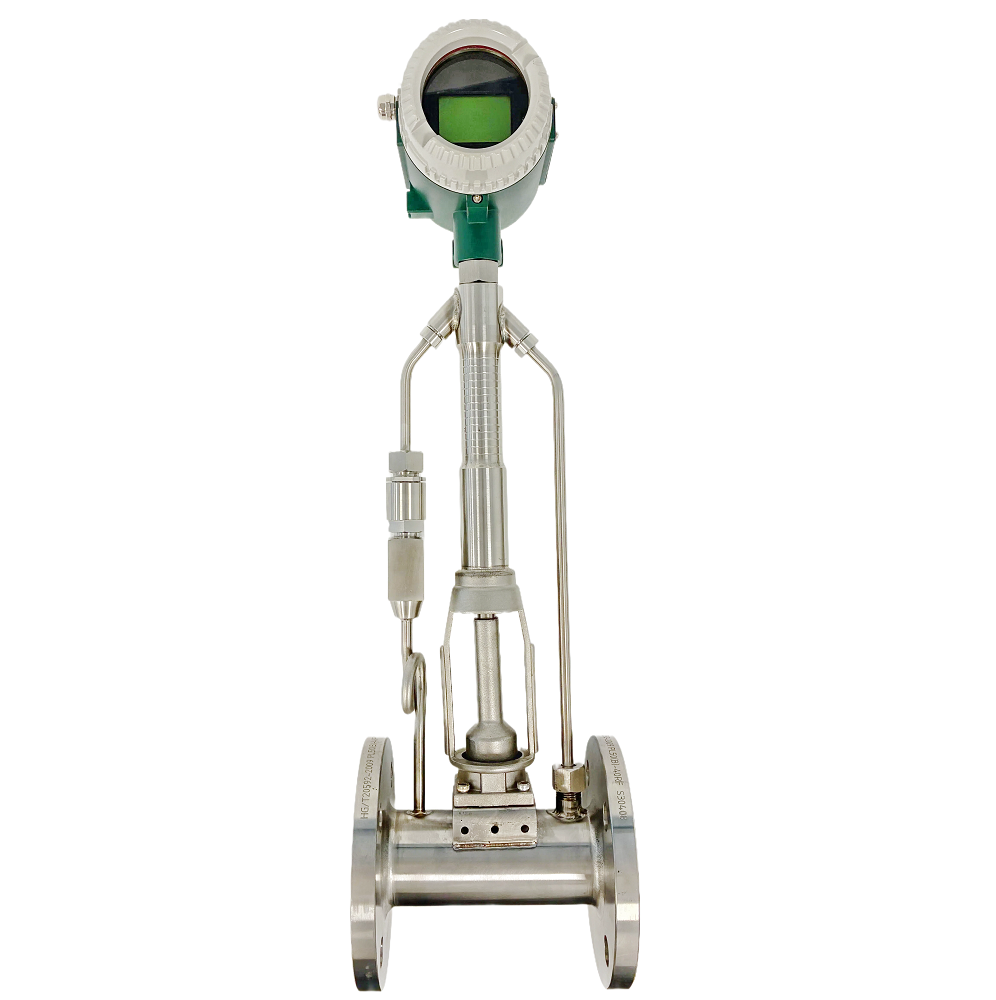
Steam is the one medium on this shortlist where the meter has to do arithmetic before it can report a number. Vortex meters count vortices shed from a bluff body and convert frequency to volumetric flow; converting that to mass flow in kg/hr requires live steam density, which requires temperature and pressure. The STLU-VFN handles this internally: the transmitter has built-in temperature and pressure compensation, so the output is a mass flow figure rather than a volumetric one that the DCS must correct afterwards.
Published coverage is saturated steam and superheated steam, pipeline sizes DN15 to DN300, and a maximum steam temperature of 500 °C. The flow sensor is stainless steel 304, and the product is available in stainless steel 304 or 316. Process connections are offered as flanges, wafers, screws or tri-clamp — the tri-clamp option being relevant where steam meets sanitary service in food processing and pharmaceuticals.
The ATEX certification covering the STLU-VFN is certificate ICR/VC/HM251296 issued by ICR, scoped to Zone 2 and valid from 9 December 2025 to 9 December 2030, against IEC 60079-0:2018+A11:2024, EN 60079-1:2014+A11:2024 and EN IEC 60079-31:2024. The CE certification for the flow meter scope is number 1N220422.SAIUW36, issued by Ente Certificazione Macchine Srl against EN IEC 61326-1:2021, valid to 21 April 2027.
Steam service is where installed evidence matters more than a datasheet. A South African installation of ten STLU-VFN units measuring saturated steam has been running for more than five years, with the meters reporting mass flow while simultaneously detecting steam temperature and pressure for the compensation calculation. That is the practical argument for internal compensation: it removes a per-instrument configuration step from commissioning and keeps the calculation consistent across a plant with a dozen steam headers.
Pick 3 — SRK-DL low flow thermal for the sccm band
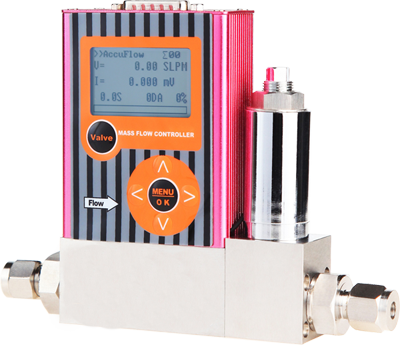
Below a few tens of sccm, Coriolis and vortex designs become impractical in cost and bore size, and thermal mass measurement takes over. The SRK-DL is available as a mass flow meter or a mass flow controller, with a published range of 2 sccm to 30 SL/M and accuracy of ±1% F.S. Outputs are 0-5 V, 4-20 mA and 1-5 V; communication is RS232, RS485 or MODBUS; power is ±15 V DC or 24 V DC; wetted construction is stainless steel.
The application profile is narrow and technical: semiconductor processing, medical equipment, analytical instruments, fuel cells and environmental monitoring. In these duties the meter is often part of a control loop rather than a monitoring point, which is why the controller variant exists in the same product line — the same sensor platform, configured to hold a setpoint rather than simply report a value.
The ATEX coverage for this model falls under EN IEC 60079-31:2024, and the CE certification applies to the flow meter scope. A ten-year reference installation in China uses three SRK-DL units to detect air leakage down to 2 sccm, which is the clearest illustration of what the thermal band is for: a pressure-decay test that would need days to register a leak on a conventional meter registers in minutes at 2 ml/min resolution.
Boundary note. The SRK-DL is a gas meter. Liquid duties at the low end of the range belong to the micro Coriolis entry, not to thermal measurement. Where a plant needs gas measurement on larger lines rather than micro flows, the appropriate comparison is the SRK-100 thermal mass flow meter, which covers DN15 to DN2000 in inline or insertion form for gases including air, compressed air, N₂, natural gas, biogas, O₂ and LPG.
Selection criteria: connection, communication and power
Once the medium and range have selected the family, three engineering details decide whether the instrument integrates cleanly or generates a change order.
Process connection
The STLU-VFN offers flanges, wafers, screws or tri-clamp. That flexibility matters on steam because the same meter may be specified for a flanged steel header in a power plant and a tri-clamp line in a pharmaceutical plant. For the micro Coriolis and thermal models, the connection decision is usually driven by the existing line and by whether the instrument will be removed for calibration on a fixed interval.
Communication
The three models do not share a protocol set, and that is a real constraint, not a marketing detail. The SH-CMF-FE provides RS485 or RS232. The SRK-DL provides RS232, RS485 or MODBUS. The SH-CM Coriolis family adds MODBUS RTU, HART, Profibus-DP and Profibus-PA where a plant standard requires them. A buyer with a HART-only maintenance philosophy should know before issuing a requisition that the micro model is not the one that satisfies it.
Power supply
The SH-CMF-FE accepts 15 V DC or 24 V DC; the SRK-DL accepts ±15 V DC or 24 V DC. The dual-rail option on the thermal unit is common in analytical instrumentation racks where a ±15 V rail already exists. In every case the supply choice should be fixed at order stage, because it determines the terminal arrangement and, in skid builds, the cable schedule.
Matching media to the right pick
| Duty | Medium | Recommended pick | Deciding factor |
|---|---|---|---|
| Semiconductor gas delivery | Silane, supercritical CO2 | SH-CMF-FE | Direct mass measurement, 316L wetted parts, ATEX coverage for Zone 2 |
| Fuel handling and test benches | Diesel, aviation kerosene | SH-CMF-FE | 30 bar or 100 bar rating, ±0.25% to ±0.5% accuracy |
| Fermentation and pharmaceutical dosing | Pure water, silicone | SH-CMF-FE | Viscosity-independent mass measurement, sanitary construction |
| Plant steam headers and district heating | Saturated and superheated steam | STLU-VFN | Built-in temperature and pressure compensation, DN15 to DN300, 500 °C limit |
| Leak detection and analyser flow | Air and process gases at sccm level | SRK-DL | 2 sccm lower limit, meter or controller configuration |
| Fuel cell gas control | Hydrogen-range process gases | SRK-DL or SH-CMF-FE | Control-loop capability versus direct mass accuracy |
Market signals behind the small-pipe, low-flow segment
The commercial context supports the shortlist rather than driving it. The global flow meter market was valued at USD 10.64 billion in 2024, with Europe holding the largest regional share at over 35%, according to Grand View Research. Within that total, thermal flow meters — the family that serves low gas flow rates — reached USD 1.73 billion in 2024 and are projected to reach USD 2.9 billion by 2035, per Market Research Future.
Coriolis instruments held a 26.77% share of the intelligent flow meter market in 2026, according to Fortune Business Insights, and generate over USD 1.55 billion in annual revenue as of 2025, primarily for custody transfer applications — a useful reminder that the micro Coriolis meter in this shortlist sits at the small end of a family whose main commercial weight is elsewhere. The 2-inch and smaller pipe size segment is expected to see the fastest growth through 2030, driven by demand in pharmaceuticals and food and beverage, per Grand View Research.
Two adjacent markets explain the direction of travel. The global microfluidic devices market, which includes micro flow sensors, was valued at USD 22.1 billion in 2024 and is growing at a CAGR of 12.2%, according to P&S Intelligence. Thermal mass flow controllers for semiconductor applications are projected to grow at a CAGR of 4.5% between 2026 and 2035, per SNS Insider. Both figures point at the same buying pattern: more measurement points, each at a lower flow rate.
Where these meters stop: comparison with traditional options and their limits
Variable-area meters remain the cheapest way to see that flow is happening, and for many utilities that is enough. What they do not provide is a compensated mass signal that a control system can act on, and their reading depends on the operator's eye and on fluid density. Differential pressure measurement, governed internationally by ISO 5167:2022, is well understood and widely accepted, but orifice installations typically require defined straight lengths upstream and downstream and a differential transmitter, which adds cost and installation space on small lines. Positive displacement meters hold an 18% market share, according to Fortune Business Insights, largely because they handle viscous fluids such as oils and fuels well — a genuine advantage in heavy-oil service that Coriolis meters reach only at higher cost.
The honest limits of this shortlist are specific:
- Pressure ceiling. The SH-CMF-FE is rated at 30 bar or 100 bar. Duties above 100 bar are outside its published rating and belong to the SH-CM Coriolis family, which is documented in a nitrogen application at approximately 700 bar.
- Steam bore range. The STLU-VFN starts at DN15. Steam lines smaller than that fall outside its published coverage, and the published specification set does not state an accuracy figure, so accuracy must be confirmed against the quotation for the specific size and steam condition.
- Full-scale accuracy on thermal. The SRK-DL's ±1% F.S is referenced to full scale. At 10% of range, the absolute error is proportionally larger, and gas-specific calibration is required because thermal measurement depends on the thermal properties of the gas.
- Inferred versus direct mass. Vortex measurement derives mass flow from volumetric frequency plus compensation inputs. Internal compensation removes the configuration burden, but the measurement chain is still indirect compared with a Coriolis tube, whose output is mass by construction.
- Protocol coverage. Neither the SH-CMF-FE nor the SRK-DL offers HART or Profibus. A plant with a HART-only asset management standard should plan for a different model or a signal converter.
Future outlook
The direction of the low flow segment is set by where the measurement points are being added, not by which principle is technically superior. Growth in the 2-inch and smaller pipe segment, in microfluidic device development and in semiconductor gas control all push demand towards instruments that hold accuracy at the bottom of their range rather than at the middle.
For buyers, that has two practical consequences. First, the datasheet question changes from "what is the range?" to "at what point in the range is the stated accuracy valid?". Second, certification becomes a purchasing gate rather than a post-purchase formality: as more low flow meters are installed in Zone 2 areas in Europe and in semiconductor facilities in Asia, model-level ATEX coverage with a traceable certificate number and validity window will increasingly be a pre-qualification requirement rather than a preference.
The three families in this shortlist are unlikely to converge. Coriolis will retain the direct-mass, gas-and-liquid role; vortex will retain steam above DN15 where compensation is built in; thermal will retain the sccm band where nothing else fits economically. A shortlist that respects those boundaries will outlast one built on a single headline accuracy figure.
FAQ
What flow range does the SH-CMF-FE micro Coriolis meter cover?
The SH-CMF-FE has a published flow range of 40 g/h to 1000 kg/hr, with accuracy of ±0.25% to ±0.5% and a pressure rating of 30 bar or 100 bar. It is a Coriolis mass flow meter and controller with stainless steel 316L wetted construction, and it is specified for both gas and liquid duties.
Which of the three meters should be used for steam rather than gas or liquid?
The STLU-VFN is the steam option. It is a vortex-type steam mass flow meter for saturated and superheated steam, covering pipeline sizes DN15 to DN300 at a maximum steam temperature of 500 °C, and it has built-in temperature and pressure compensation so that the output is a mass flow value rather than a volumetric one requiring external correction.
What pressure rating is available for a low flow Coriolis meter?
The SH-CMF-FE is available with a 30 bar or 100 bar pressure rating. Duties requiring higher pressure fall outside this model's published rating and are addressed by the SH-CM Coriolis family, which is documented in a high-pressure nitrogen application at approximately 700 bar.
What certifications apply to these low flow meters, and for which markets?
All three models fall under ATEX certification ICR/VC/HM251296 issued by ICR, scoped to Zone 2 and valid from 9 December 2025 to 9 December 2030. The flow meter scope carries CE certification number 1N220422.SAIUW36 issued by Ente Certificazione Macchine Srl against EN IEC 61326-1:2021, valid to 21 April 2027, applicable to the EU market. The micro Coriolis model additionally holds ISO 9001:2015 certification number 79625Q0002107R0S issued by ZHONGHONG CERTIFICATION (JIANGSU) CO.,Ltd., valid to 9 July 2028.
What process connection, communication and power options are available?
The STLU-VFN offers flanges, wafers, screws or tri-clamp connections. The SH-CMF-FE provides 4-20 mA, 0-5 VDC and 1-5 VDC outputs with RS485 or RS232 communication and accepts 15 V DC or 24 V DC power. The SRK-DL provides 0-5 V, 4-20 mA and 1-5 V outputs with RS232, RS485 or MODBUS communication and accepts ±15 V DC or 24 V DC power.
How do accuracy statements differ between Coriolis, thermal and vortex meters?
The SH-CMF-FE states accuracy as ±0.25% to ±0.5%, which for a Coriolis meter is referenced to the measured mass flow. The SRK-DL states ±1% F.S, referenced to full scale, so the absolute error grows as flow falls below full scale. The published specification set for the STLU-VFN does not state an accuracy figure, so that value must be confirmed for the specific size and steam condition at quotation.
Full model specifications and certification details are compiled in the Silver Automation Instruments product brochure (PDF).
Have Questions or Need More Details?
Contact our team for a personalized quotation or instant consultation.
Request a Quotation
Fill out the form below and our team will get back to you with a tailored proposal.
WhatsApp Direct Chat
Prefer to chat in real-time? Message us on WhatsApp for instant assistance & quick answers.
- Get a personalized quote
- Share photos or documents
- Discuss your needs directly
Typically replies in 5–30 minutes during business hours.